What was advertised in a revolutionary American newspaper 250 years ago today?
Providence Gazette (September 9, 1775).
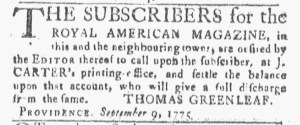
“SUBSCRIBERS for the ROYAL AMERICAN MAGAZINE … are desired by the EDITOR thereof to … settle the balance upon that account.”
Joseph Greenleaf acquired the Royal American Magazine in the summer of 1774 and less than a year later suspended publication following the battles at Lexington and Concord. Some subscribers apparently had not paid for issues already delivered to them, prompting Greenleaf to insert a notice in the June 9, 1775, edition of the Essex Journal. It called on “Subscribers for the American Magazine at Newbury, Newbury-Port, and the vicinity … to pay their respective ballances to the month of March.” That corresponded with the final issue of the magazine.
Three months later, Greenleaf’s son, Thomas, ran a similar advertisement in the Providence Gazette. “THE SUBSCRIBERS for the ROYAL AMERICAN MAGAZINE, in this and the neighbouring towns,” the notice stated, “are desired by the EDITOR thereof,” Joseph, “to call upon the subscriber,” Thomas, “at J. CARTER’S printing-office, and settle the balance upon that account.” In turn, Thomas “will give a full discharge.” The younger Greenleaf “learned printing” from Isaiah Thomas, the printer of the Massachusetts Spy and the founder of the Royal American Magazine, and “managed his father’s printing house” in Boston until it closed in 1775.[1] He left the city and migrated to Rhode Island, where he worked as a journeyman printer for John Carter, the printer of the Providence Gazette, from September 6, 1775, to April 10, 1776.[2] The advertisement calling on local subscribers to the Royal American Magazine to settle accounts appeared in the first issue of the Providence Gazette published after Greenleaf began working in that printing office. Even as he set about his new responsibilities, the journeyman renewed the efforts to collect payment from delinquent subscribers who had not paid for the magazines they received. His advertisement was not as lively as the one placed by his father. He did not lament “being driven from his house and business by the perfidious [General Thomas] Gage,” the governor and king’s representative in Massachusetts. Instead, he left it to subscribers to realize why he no longer resided in Boston. Some may have hoped that they could avoid settling accounts with the Greenleafs while they remained in Massachusetts, but the advertisement in the Providence Gazette reminded them of their obligation.
**********
[1] Isaiah Thomas, The History of Printing in America: With a Biography of Printers and an Account of Newspapers (1810; New York: Weathervane Books, 1970), 175.
[2] Marcus A. McCorison, “The Wages of John Carter’s Journeyman Printers, 1771-1779,” Proceedings of the American Antiquarian Society, 2nd ser., 81 (1971): 273-303.
What was advertised in a revolutionary American newspaper 250 years ago today?
Essex Journal (June 9, 1775).
“The Editor being driven from his house and business by the perfidious [Thomas] Gage.”
Like so many other Bostonians, Joseph Greenleaf, the publisher of the Royal American Magazine, became a refugee who fled from the city during the siege that followed the battles at Lexington and Concord. When the governor, General Thomas Gage, and the Massachusetts Provincial Congress agreed that Loyalists could enter the city and Patriots and others could depart, each with any of their effects they could transport (except for firearms and ammunition), Greenleaf removed to Watertown. He crafted his own narrative of what happened in an advertisement that ran in the June 9, 1775, edition of the Essex Journal: “The Editor [was] driven from his house and business by the perfidious –– Gage in public violation of his most sacred engagements, leaving ALL (except Beds and some Clothing) behind.” Apparently, Greenleaf had not managed to take his press or any of his supplies and other equipment with him.
He found himself in desperate need of money, deprived of his livelihood in Boston. In his advertisement in the Essex Journal, published in Newburyport, Greenleaf called on “Subscribers for the American Magazine at Newbury, Newbury-Port, and the vicinity … to pay their respective ballances to the month of March, being fifteen months, to Bulkeley Emerson of Newbury-Port,” his local agent in that town. In a single sentence, Greenleaf gave an abbreviated history of the Royal American Magazine. The publication, first proposed by Isaiah Thomas in May 1773, had commenced publication with the January 1774 issue. Thomas published several issues, fell behind, and then suspended the magazine due to the “Distresses” that he and everyone else in Boston experienced due to the Boston Port Act closing the harbor until colonizers made restitution for the tea destroyed there in December 1773. Almost as soon as he announced that he suspended the Royal American Magazine, Thomas informed subscribers and the public that Greenleaf became the new proprietor. From August 1774 through April 1775, Greenleaf worked diligently to publish the delinquent issues and get the magazine back on schedule. He succeeded … until the beginning of the Revolutionary War became too disruptive to continue.
When Greenleaf became the proprietor of the magazine, Thomas transferred all the accounts to him. Some subscribers thus owed for the entire fifteen months of the magazine’s run from January 1774 through March 1775. Under the circumstances, the publisher could no longer afford to extend credit to them. He prorated the subscription fees, but expected that “being driven from his house and business … will no doubt excite the Subscribers to be kindly Punctual, as it is at present the only dependence for support of the Person and Family of their Humble Servant.” The war meant that Greenleaf could no longer do business as usual. After leaving Boston, he needed subscribers to pay what they owed.
**********
The Adverts 250 Project has tracked the entire marketing campaign for the Royal American Magazine from Thomas’s first mention of distributing subscription proposals to Greenleaf’s last advertisements for the final issue.
What was advertised in a revolutionary American newspaper 250 years ago this month?
Massachusetts Gazette and Boston Weekly News-Letter (April 13, 1775).
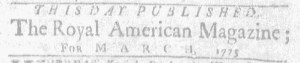
“THIS DAY PUBLISHED, The Royal American Magazine; FOR MARCH, 1775.”
On April 28, 1775, Daniel Fowle, printer of the New-Hampshire Gazette, reported that the “Boston News Papers … are all stopt, and no more will be printed for the present” following the outbreak of hostilities at Lexington and Concord. He could have also mentioned that the Royal American Magazine, published by Joseph Greenleaf in Boston, had been suspended as well. Although some of the newspapers eventually resumed, the Royal American Magazine did not. The March 1775 issue, distributed in the second week of April, was the last one for that ambitious project that had repeatedly met with mishaps. Isaiah Thomas, the original publisher, delayed the first issue when the ship carrying new types ran aground in January 1774 and then fell several issues behind because of the “Distresses” that Boston experienced when the Boston Port Act closed the harbor in June 1774 in retaliation for the destruction of tea the previous December. Shortly after Thomas advised the public that he had suspended the magazine, he announced that he transferred it to Greenleaf. The new publisher worked diligently to compile, print, and circulate the overdue issues and get back on schedule.
Massachusetts Gazette and Boston Weekly News-Letter (April 20, 1775).
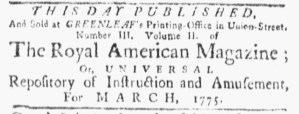
Despite the challenges, he managed to do so, especially considering that eighteenth-century subscribers expected the issue for a month either at the very end of that month or early in the following month. Accordingly, when Greenleaf first announced publication of the February 1775 issue on March 13 the new issue was on time, especially given the circumstances. A month later, he ran a brief notice in the April 13 edition of the Massachusetts Gazette and Boston Weekly News-Letter: “THIS DAY PUBLISHED, The Royal American Magazine; FOR MARCH, 1775.” A week later, he placed a more extensive advertisement in the same newspaper. That one promoted the “elegant Engraving” that “Embellished” the magazine, though he did not reveal that it was a political cartoon depicting “America in Distress” engraved by Paul Revere. (See the American Antiquarian Society’s illustrated inventory of “Royal American Magazine Plates” for images and descriptions of Revere’s engravings that accompanied the magazine.) As he sometimes did in advertisements in previous months, Greenleaf stated that “Subscriptions continue to be taken in.” That advertisement appeared on April 20, the day after the battles at Lexington and Concord. Almost certainly Greenleaf composed the advertisement before such momentous events; very likely the type had already been set when word arrived in Boston. The Massachusetts Gazette and Boston Weekly News-Letter covered the “unhappy Affair” in a single paragraph that ran on the same page as the advertisement for the Royal American Magazine. It would be the last issue of that newspaper until May 19. On April 24, the final issue of the Boston Evening-Postcarried only three advertisements, one of them announcing publication of the March issue of the Royal American Magazine.
Boston Evening-Post (April 24, 1775).
That brought to conclusion an advertising campaign that lasted nearly two years when Thomas first declared that he would distribute subscription proposals. For several months, he advertised widely in newspapers in New England, New York, Pennsylvania, and Maryland, seeking subscribers in distant cities for what was the only magazine published in the colonies at the time. (Robert Aitken eventually launched the Pennsylvania Magazine in January 1775, a year after the Royal American Magazine commenced.) Thomas scaled back the advertising once he took the first issue of the magazine to press. In turn, Greenleaf also confined his advertising to Boston’s newspapers. The ambitious project ended up a casualty of the imperial crisis when resistance became revolution.
What was advertised in a colonial American newspaper 250 years ago this month?
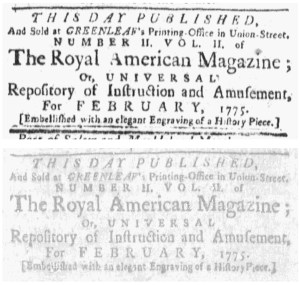
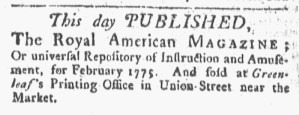
“The Royal American MAGAZINE … for February 1775.”
In March 1775, three of Boston’s newspapers carried advertisements that the February issue of the Royal American Magazine was now available “at Greenleaf’s Printing Office in Union-Street near the Market” in Boston. The advertisements first appeared in the Boston Evening-Post and the Boston-Gazette on March 13. Based on publication dates for magazines today, the February issue seems quite overdue, but in the eighteenth century published distributed magazines at the end of the month or early in the following month. Considering that Greenleaf had not advertised the January edition until February 20, it appears that he managed to take the next issue to press in just three weeks.
Above: Boston Evening-Post (March 13, 1775); Below: Massachusetts Gazette and Boston Weekly News-Letter (March 17, 1775).
The advertisement in the Boston-Gazette ran for two consecutive weeks. The more elaborate version in the Boston Evening-Post reported that the February issue was “Embellished with an elegant Engraving of a History Piece.” That copperplate engraving, executed by Paul Revere, depicted a scene from the “History of Lauretta,” a moral tale included among the contents of the magazine. The advertisement ran only once in the Boston Evening-Post, but appeared in the Massachusetts Gazette and Boston Weekly News-Letter on March 17 and 30. Once again, those printing offices seem to have shared type set in one printing office and transferred to the other. It is not clear what role Greenleaf played in that arrangement since some of the city’s printers engaged in that practice on other occasions.
What is clear is that Greenleaf’s marketing campaign was not nearly as extensive as the one devised by Isaiah Thomas when he first proposed publishing the Royal American Magazine and announced distribution of the first several issues. Yet the number of advertisements and the array of newspapers that carried them diminished even during Thomas’s tenure as publisher of the magazine, likely due to the evolving political situation in Boston and throughout the colonies. He had promoted the magazine widely in the months before colonizers dumped tea into Boston Harbor, but only began publishing it as they contended with the aftermath, including the closure of the port and other punitive measures passed by Parliament in the Coercive Acts. Even as Thomas filled the magazine with patriot propaganda, he and other residents of Boston experienced “Distresses” that apparently made marketing the Royal American Magazineless of a priority. For his part, Greenleaf advised the public about new issues, but he did not attempt to replicate the initial marketing strategy devised by Thomas.
What was advertised in a colonial American newspaper 250 years ago today?
Massachusetts Gazette and Boston Weekly News-Letter (February 26, 1775).
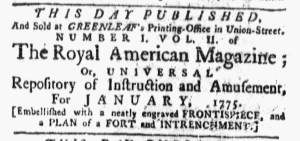
“The Royal American Magazine … For JANUARY, 1775.”
When Joseph Greenleaf acquired the Royal American Magazine from Isaiah Thomas, the original printer, near the end of the summer of 1774, the magazine had fallen two months behind, largely due to the hardships caused by the Boston Port Act. Over the next several months, Greenleaf worked diligently to return the magazine to its publication schedule, achieving that goal with publication of the December 1774 issue during the first week of January 1775. While that may seem late by twenty-first century standards, magazines bore the date of the previous month, not the upcoming month, in the eighteenth century. Subscribers anticipated receiving that month’s issue at the very end of the month or the beginning of the next month.
Although Greenleaf managed to get the magazine back on schedule at the beginning of the new year, that did not last long. The January issue, anticipated around the first of February, was not available until nearly the end of the month. On February 20, a notice in the Boston Evening-Post announced, “THIS DAY PUBLISHED … The Royal American Magazine … For JANUARY, 1775.” It was the first advertisement that mentioned the magazine in February, except for the final appearance of Henry Christian Geyer’s notice that critiqued the Royal American Magazine because it “was not printed with his Ink” that he “manufactured” in Boston. Greenleaf’s progress may have been stalled, in part, by producing a supplement to the first volume of the magazine during January. That supplement included a title page for the entire volume to insert if subscribers had all the issue bound together, an address to subscribers, and an index. It also delivered an installment of Thomas Hutchinson’s History of Massachusetts-Bay, a premium offered to subscribers when Thomas circulated subscription proposals.
Boston Evening-Post (February 20, 1775).
Greenleaf published only two advertisements for the Royal American Magazine in February 1775. His notice that first appeared in the Boston Evening-Post on February 20 ran three days later in the Massachusetts Gazette and Boston Weekly News-Letter. As had been the case in January, it seems that the printing offices shared type that had been set in one location and transferred to the other.
The January 1775 issue turned out to be one of the last issues of the Royal American Magazine, despite the plans for improvement that Greenleaf sketched in the address to subscribers in the supplement. The printer could not contend with the circumstances in Boston as the political situation worsened. Although Greenleaf and the subscribers did not know it at the time, the first battles of the Revolutionary War would take place within a couple of months. In their wake, some newspapers printed in Boston suspended publication and others ceased publication. The Royal American Magazine was not the only periodical that became a casualty of the imperial crisis.
What was advertised in a colonial American newspaper 250 years ago today?
Massachusetts Gazette and Boston Post-Boy (January 30, 1775).
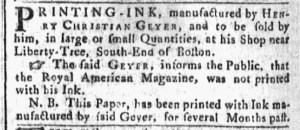
“The Royal American Magazine, was not printed with his Ink.”
The final mention of the Royal American Magazine in newspaper advertisements published in January 1775 may not have been the kind of coverage that Joseph Greenleaf, the printer, desired. Henry Christian Geyer once again inserted his notice for printing ink that he made and sold “at his Shop near Liberty-Tree” in Boston in the January 30 edition of the Massachusetts Gazette and Boston Post-Boy. In it, he noted to the public that “the Royal American Magazine, was not printed with his Ink.”
Beyond that squabble, Greenleaf did advertise the Royal American Magazine on eight occasions in three of the five newspapers printed in Boston that January. On January 5, he ran notices in both the Massachusetts Gazette and Boston Weekly News-Letter and the Massachusetts Spy. In the former, he announced that he “JUST PUBLISHED … NUMBER XII. of The Royal American Magazine … For DECEMBER, 1774.” To entice curiosity, he noted that issue was “Embellished with elegant Engravings.” He also stated that he continued to accept subscriptions at his printing office. That advertisement ran in three consecutive issues. As was his custom, he ran a shorter advertisement in the Massachusetts Spy. Extending only three lines, it advised, “This day was published, by J. GREENLEAF, THE Royal American Magazine, or Universal Repository, No. XII. for DECEMBER, 1774.” That advertisement in the Massachusetts Spy ran only twice. Another version appeared in the January 16 edition of the Boston Evening-Post, much closer in format to the one in the Massachusetts Gazette and Boston Weekly News-Letter except but without the call for new subscriptions.
That Greenleaf disseminated the December edition of the magazine in early January was a feat. In the eighteenth century, monthly magazines came out at the end of the month that bore their date or early in the next month, unlike modern magazines released in advance of the dates on their covers. When Greenleaf acquired the Royal American Magazine from Isaiah Thomas in August 1774, publication had fallen behind by two months because of the “Distresses of the Town of Boston, by the shutting up of our Port.” Over the next several months, Greenleaf steadily caught up on the overdue issues, delivering the December issue to subscribers right on time at the beginning of January.
On January 23, Greenleaf inserted a new advertisement in the Boston Evening-Post, this time alerting readers that he published “A SUPPLEMENT to The Royal American Magazine … With the Title-Page and Index to Vol. I. for 1774.” That supplement consisted of a two-page address to the subscribers, a seven-page index, and the next twenty-four pages of Thomas Hutchinson’s History of the Province of Massachusetts-Bay, a monthly feature and premium for subscribers. In the address, Greenleaf explained that since the magazine had been “suspended near two months by the original undertaker, I have been obliged to publish one oftner than once in three weeks.” Furthermore, he considered it “necessary to apologize for the poor appearance of the work the last six months.” He did not have type “so good as I could wish” and could not acquire more because of the “non-importation agreement, which it was MY DUTY to comply with.” Fortunately, a friend assisted him in obtaining “almost new” type for continuing to publish the magazine. He also acknowledged that the ink “has been poor, but as it was of AMERICAN MANUFACTURE my customers were not only willing but desirous I should use it.” When Geyer published advertisements that mentioned Greenleaf did not use his ink in printing the Royal American Magazine, it may have been just as much an attempt to distance his product from the “poor” appearance of the magazine as it was an effort to shame Greenleaf into purchasing from him in the future. The index concluded with “DIRECTIONS to the BOOK-BINDER for placing the PLATES, &c. in the ROYAL AMERICAN MAGAZINE, for 1774.” Bookbinders usually incorporated the copperplate engravings that accompanied eighteenth-century magazines yet removed the advertising wrappers that enclosed them.
Curiously, when an advertisement about the supplement ran in the January 26 edition of the Massachusetts Gazette and Boston Weekly News-Letter, it looked identical to the one in the Boston Evening-Post. If that was indeed the case, it was not the first time that those printing offices seemed to share type that had already been set, a matter for further investigation.
What was advertised in a colonial American newspaper 250 years ago this month?
Boston Evening-Post (December 26, 1774).
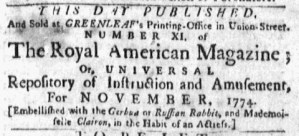
“THIS DAY PUBLISHED … The Royal American Magazine … For NOVEMBER, 1774.”
Joseph Greenleaf published a new issue of the Royal American Magazine and advertised sporadically in December 1774. Perhaps the troubles that Boston experienced in the wake of the Boston Port Act, the Massachusetts Government Act, and the other Coercive Acts played a role in placing advertisements without the same attention to developing a marketing strategy that Isaiah Thomas had sometimes shown when he first launched the magazine, though the original publisher had also advertised somewhat haphazardly in his final months as proprietor before transferring the publication to Greenleaf. In general, Thomas had been much more intentional about advertising in the early stages when he sought subscribers than he had been once the magazine began circulating to readers.
As previously noted, Greenleaf advertised on November 17 that he would publish the October edition of the Royal American Magazine the following day, but no subsequent advertisements appeared in any of Boston’s newspapers until December 5. On that day, the Boston-Evening Post ran a notice that declared, “THIS DAY PUBLISHED … The Royal American Magazine … For OCTOBER, 1774.” To entice readers, Greenleaf noted that the issue was “Embellished with an elegant Engraving of the Dancing Bishops.” Eighteenth-century readers knew that “THIS DAY PUBLISHED” meant that a book, pamphlet, almanac, magazine, or other item was available for sale, not necessarily that it had been published on that day. As a result, Greenleaf could have published and circulated the October edition any time between November, if he had not met any delays after his previous advertisement, and December 5.
Three days later, Greenleaf placed advertisements in both the Massachusetts Gazette and Boston Weekly News-Letterand the Massachusetts Spy. In the former, he hawked the October edition of the magazine, “Embellished with an elegant Engraving.” That notice did not describe the engraving, but it did indicate that Greenleaf continued to take in subscribers. A much shorter advertisement in the Massachusetts Spy announced, “To-morrow will be published, by J. GREENLEAF, THE Royal American Magazine, No. XI. For NOVEMBER, 1774.” Subsequent advertisements suggest that Greenleaf did indeed publish the new edition in the next few days. That meant that whatever difficulties he experienced in the past month, he was nearly on time in delivering the November issue of the Royal American Magazine. In the eighteenth-century, magazines usually came out at the end of the month or the first week of the next month rather than in advance of the date on the cover.
During the following week, Greenleaf inserted advertisements for the November edition of the Royal American Magazine in four of the five newspapers published in Boston at the time. Rather than submit identical copy to the printing offices, he devised four variations, starting with one that ran in the Boston Evening-Post on December 12. In that one, he stated that the November issue was “THIS DAY PUBLISHED” and promoted two engravings, “the Gerubaor Russian Rabbit, and Mademoiselle Clarion, in the Habit of an Actress.” (Paul Revere produced all the engravings for the Royal American Magazine, though neither Thomas nor Greenleaf ever identified him in their advertisements.) On December 16, the Massachusetts Gazette and Boston Weekly News-Letter and the Massachusetts Spy, each published a day later than usual, both ran advertisements about the Royal American Magazine, though this time about the same edition. The advertisement in the Massachusetts Gazette and Boston Weekly News-Letter merely updated the month and issue number, presumably using type already set for the previous advertisement. The compositor for the Massachusetts Spy seemingly did something similar, updating the first line to read “This day was published, by J. GREENLEAF” instead of ““To-morrow will be published, by J. GREENLEAF.” The “T” in “THE Royal American Magazine,” slightly out of alignment in both advertisements suggests that was the case. Finally, the Boston-Gazettecarried a brief advertisement on December 19: “Just Published (No. XI) The Royal American Magazine, For November 1774, at Greenleaf’s Printing-Office, near the Market, Boston.”
Greenleaf inserted advertisements in the Boston Evening-Post and the Massachusetts Gazette and Boston Weekly News-Letter a second time, but not the Boston-Gazette and the Massachusetts Spy. For some reason, two weeks passed between the first and second appearance of those notices that did run twice. Still, Greenleaf pursued a more extensive advertising campaign for the Royal American Magazine in December than November, increasing to nine advertisements compared to only four. Although not as robust as some months, these marketing efforts gave the magazine’s November edition greater visibility in the public prints.
**********
“THIS DAY PUBLISHED … Royal American Magazine … For OCTOBER, 1774”
December 5 – Boston Evening-Post (first appearance)
“JUST PUBLISHED … Royal American Magazine … For OCTOBER, 1774”
December 8 – Massachusetts Gazette and Boston Weekly News-Letter (first appearance)
“To-Morrow will be published … Royal American Magazine … NOVEMBER, 1774”
December 8 – Massachusetts Spy (first appearance)
“THIS DAY PUBLISHED … Royal American Magazine … For NOVEMBER, 1774”
December 12 – Boston Evening-Post (first appearance)
December 26 – Boston Evening-Post (second appearance)
“JUST PUBLISHED … Royal American Magazine … For NOVEMBER, 1774”
December 16 – Massachusetts Gazette and Boston Weekly News-Letter (first appearance)
December 29 – Massachusetts Gazette and Boston Weekly News-Letter (second appearance)
“This day was published … Royal American Magazine … NOVEMBER, 1774”
December 16 – Massachusetts Spy (first appearance)
“Just Published (No. XI) The Royal American Magazine, For November 1774”
In the first week of November 1774, Joseph Greenleaf took to the pages of two of the newspapers printed in Boston to announce that he had published a new issue of the Royal American Magazine. His advertisement for the September issue that already appeared in the October 31 edition of the Boston Evening-Post ran in that newspaper once again on November 7. It actually appeared twice, once on the third page and once on the fourth. The compositor likely made an error. In addition, a similar advertisement appeared in the Massachusetts Gazette and Boston Weekly News-Letter on November 3, following up on a notice from October 27 that stated the magazine would be published the following day.
Greenleaf had been busy trying to catch up on overdue editions since he acquired the magazine from Isaiah Thomas in August. Thomas had fallen behind due to the “Distresses of the Town of Boston” following the Boston Port Act and other Coercive Acts that went into effect in the summer of 1774. He originally planned to suspend publication of the magazine, but then decided to transfer ownership to Greenleaf. In the eighteenth century, monthly magazines usually appeared at the end of the month, so subscribers expected the October edition near the end of October or in the first week of November. The September edition that Greenleaf advertised at the end of October and the beginning of November was a month overdue, yet the new publisher had made progress in getting back on schedule.
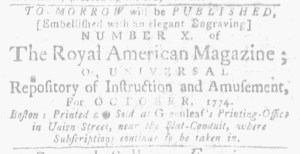
However, he may not have been able to improve on that progress. The advertisements make it difficult to determine. On November 17, Greenleaf placed advertisements in the Massachusetts Gazette and Boston Weekly News-Letter and the Massachusetts Spy. In both, he stated that he would publish the October edition of the Royal American Magazine “TO-MORROW.” In the Massachusetts Gazette and Boston Weekly News-Letter, he noted that “an elegant Engraving” accompanied the magazine, though he did not reveal its subject, and stated that “Subscriptions continue to be taken in.” If Greenleaf did indeed publish the October edition of the magazine on November 18, then he made gains on the delinquent issue, disseminating it less than three weeks behind schedule.
Yet no advertisements for the Royal American Magazine ran in any of Boston’s five newspapers throughout the remainder of the month. For Greenleaf to publish a new issue and not advertise it deviated from the practice he had established during his time as proprietor. No advertisement for the October edition of the Royal American Magazineappeared until a notice declared it “THIS DAY PUBLISHED” in the Boston Evening-Post on December 5. Eighteenth-century readers knew that headline meant a book, almanac, pamphlet, magazine, or other publication was available for purchase, not necessarily that it was released for the first time on that date. That means that the October edition could have been published any time between November 18 and December 5. The date on the cover did not reveal the complicated publication history of that issue of the Royal American Magazine.
**********
“JUST PUBLISHED … Royal American Magazine … For SEPTEMBER, 1774”
November 3 – Massachusetts Gazette and Boston Weekly News-Letter (first appearance)
“THIS DAY PUBLISHED … NUMBER IX … Embellished with an elegant Engraving”
November 7 – Boston Evening-Post (second appearance and third appearance)
“TO-MORROW will be PUBLISHED … Royal American Magazine … For OCTOBER, 1774”
November 17 – Massachusetts Gazette and Boston Weekly News-Letter (first appearance)
“To-Morrow will be published, THE Royal American MAGAZINE, for OCTOBER, 1774”
November 17 – Massachusetts Spy (first appearance)
What was advertised in a colonial American newspaper 250 years ago this month?
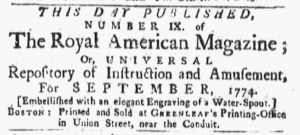
“THIS DAY PUBLISHED … The Royal American Magazine … For SEPTEMBER, 1774.”
Boston Evening-Post (October 31, 1774).
Upon becoming the proprietor of the Royal American Magazine, Joseph Greenleaf set about publishing new issues to catch up with how many should have been distributed. Isaiah Thomas, the original proprietor, had fallen behind because of the “Distresses of the Town of Boston” when the Boston Port Act went into effect in the summer of 1774. Initially, Thomas intended to suspend the magazine until “the Affairs of this Country are a little better settled,” but then he decided to transfer it to Greenleaf. By that time, the magazine was several months behind schedule. Greenleaf took the July issue to press in September 1774. In October, he published two issues, the August issue near the beginning of the month and the September issue at the end of the month. Since magazine typically came out at the end of the month rather than the beginning, that meant that the Royal American Magazine was now only a month behind schedule. In keeping subscribers and the public apprised of the new issues, Greenleaf resorted to a greater number of advertisements in a greater number of newspapers in October than in September.
The Adverts 250 Project has examined advertisements for the Royal American Magazine that began with Thomas’s first mention of circulating subscription proposals in May 1773 and subsequent newspaper advertisements in June, July, August, September, October, November, and December 1773 and January, February, March, April, May, and June 1774. The “Distresses” meant no newspaper advertisements for the magazine in July 1774, but they resumed with the notices from Thomas and Greenleaf in August, September, and October.
A brief advertisement in the October 6 edition of the Massachusetts Spy announced, “To-morrow will be published, THE Royal American Magazine, No. 8. For AUGUST, 1774.” A more elaborate notice in the Massachusetts Gazette and Boston Weekly News-Letter on the same day proclaimed, “THIS DAY PUBLISHED … NUMBER VIII. of The Royal American Magazine.” That one noted that the issue was “Embellished with an elegant Engraving” to supplement the articles. It also encouraged new subscribers to submit their names to Greenleaf at his printing office on Hanover Street. Apparently, there had been a miscommunication with one of the printing offices concerning when the September issue would be ready for subscribers. That did not matter by the time the Boston Post-Boy ran the same “THIS DAY PUBLISHED” advertisement on October 10. Readers knew that “THIS DAY PUBLISHED” did not necessarily refer to a specific day but instead meant that a book, pamphlet, or other item was now available. The Boston-Gazette carried yet another version of Greenleaf’s advertisement, also on October 10. That one stated that he “JUST PUBLISHED” the magazine and promoted the engraving. Advertisements for the August issue of the Royal American Magazine appeared in four newspapers published in Boston, compared to advertisements for the July issue running in only two.
Those four newspapers each carried advertisements about the September issue of the magazine by the end of October. On October 20, Greenleaf inserted a notice in the Massachusetts Spy to inform the public that he moved his printing office to Union Street. In a nota bene, he stated, “The Magazine for September, will be out next week.” He ran the same notice in the Boston Evening-Post on October 24. A few days later, both the Massachusetts Gazette and Boston Weekly News-Letter and the Massachusetts Spy featured variant advertisements that declared, “To-Morrow will be published, THE Royal American Magazine, for September 1774.” On October 31, the Boston-Evening Post and the Boston-Gazette also ran similar, but not identical, advertisements that stated, “THIS DAY PUBLISHED … The Royal American Magazine … For SEPTEMBER 1774.” The version in the Boston Evening-Post promoted an “elegant Engraving of a Water-Spout” and directed readers to Greenleaf’s printing office. The one in the Boston-Gazette did not. Greenleaf got the word out about the latest issue of the magazine, produced incredibly quickly compared to previous issues, but did not resort to standard copy that he sent to the various newspapers in Boston.
**********
“THIS DAY PUBLISHED … NUMBER VIII”
October 6 – Massachusetts Gazette and Boston Weekly News-Letter (first appearance)
October 10 – Boston Evening-Post (first appearance)
October 13 – Massachusetts Gazette and Boston Weekly News-Letter (second appearance)
October 17 – Boston Evening-Post (second appearance)
“To-morrow will be published … No. 8”
October 6 – Massachusetts Spy (first appearance)
October 13 – Massachusetts Spy (second appearance)
“JUST PUBLISHED … NUMBER VIII”
October 10 – Boston-Gazette (first appearance)
“The Magazine for September, will be out next week”
October 20 – Massachusetts Spy (first appearance)
October 24 – Boston Evening-Post (first appearance)
October 27 – Massachusetts Spy (second appearance)
“TO-MORROW will be Published … Magazine … For SEPTEMBER”
October 27 – Massachusetts Gazette and Boston Weekly News-Letter (first appearance)
“To-Morrow, will be published … Magazine … for September … by J. GREENLEAF”
October 27 – Massachusetts Spy (first appearance)
“THIS DAY PUBLISHED … NUMBER IX … Embellished with an elegant Engraving”
October 31 – Boston Evening-Post (first appearance)
What was advertised in a colonial American magazine 250 years ago this month?
Detail from advertising wrapper: Royal American Magazine (August 1774).
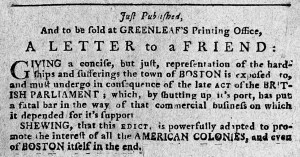
“A concise, but just, representation of the hardships and sufferings of the town of BOSTON.”
For eighteen months, the Adverts 250 Project has been tracing the efforts of, first, Isaiah Thomas and, eventually, Joseph Greenleaf in advertising and publishing the Royal American Magazine. Newspaper advertisements have definitively demonstrated that the dates associated with most issues did not match when they were published and distributed to subscribers and other readers. On October 13, 1774, for instance Greenleaf placed advertisements in both the Massachusetts Gazette and Boston Weekly News-Letter and the Massachusetts Spy to announce “This day was published, THE Royal American Magazine, No. 8. For AUGUST, 1774. In the eighteenth century, magazines usually came out at the end of the month, so readers would have expected to see the September issue advertised in October. Greenleaf continued to work on catching up on delinquent issues after acquiring the magazine from Thomas.
Greenleaf packaged the August issue in wrappers intended to be removed when the subscriber had the monthly issues bound into a single volume. The pages numbers continued from one issue to the next. The wrapper supplemented a title page that included a list of contents within the issue; printers intended for the title page to remain after discarding the wrapper. Unlike modern magazines, advertisements did not appear within the issue. Instead, they ran only on the wrappers. The front of the wrapper for the August 1774 issue of the Royal American Magazine featured the same items as the one for July: the coat of arms of Great Britain above the title of the magazine (along with an updated date and issue number), an address to subscribers from Thomas, and an advertisement for “A LETTER to a FRIEND: GIVING a concise, but just, representation of the hardships and sufferings the town of BOSTON is exposed to” available at Greenleaf’s printing office.
What about the back of the wrapper? That presented a bit of a mystery that cannot be solved solely by examining the digital surrogates. A list of books and blanks that Greenleaf sold filled the back of the wrapper that accompanied the July issue. That was also the case for the September issue. The digitized version of the August issue, however, does not include any trace of the back of the wrapper, not even images of blank pages. It does include an image of the blank page that was the interior of the front of the wrapper with the impression of the title and date from the other side clearly visible. The same database includes images of blank pages for the interiors of front and back wrappers for the July and September issues, demonstrating that production of the digital surrogates incorporated careful attention to capturing more than just the contents printed on the numbered pages of those issues. It stands to reason, then, that if the back of the wrapper had been present with the August issue that it would have been digitized. Perhaps it had been damaged and removed at some point. Yet sometimes mistakes happen. The only way to know for certain is to examine the original document.
Unfortunately, my teaching schedule will not allow me to visit the reading room at the American Antiquarian Society before publishing this entry. On the other hand, I am fortunate to live and work in the same city as the research library that houses the original magazine that was digitized to make the Royal American Magazine more widely accessible. That means that I have more ready access to the original and tracking down answers to these sorts of questions than most others who consult the images in the database. I will update this entry when time allow, but leave this discussion intact since it demonstrates that even though digital surrogates expand access, they cannot replace original sources.



 “The Royal American MAGAZINE … for February 1775.”