September 26

What was advertised in a colonial American newspaper 250 years ago today?

Boston Evening-Post (September 26, 1774).

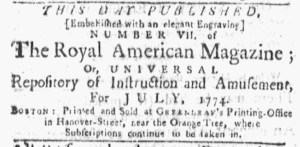
“NUMBER VII. of The Royal American Magazine.”

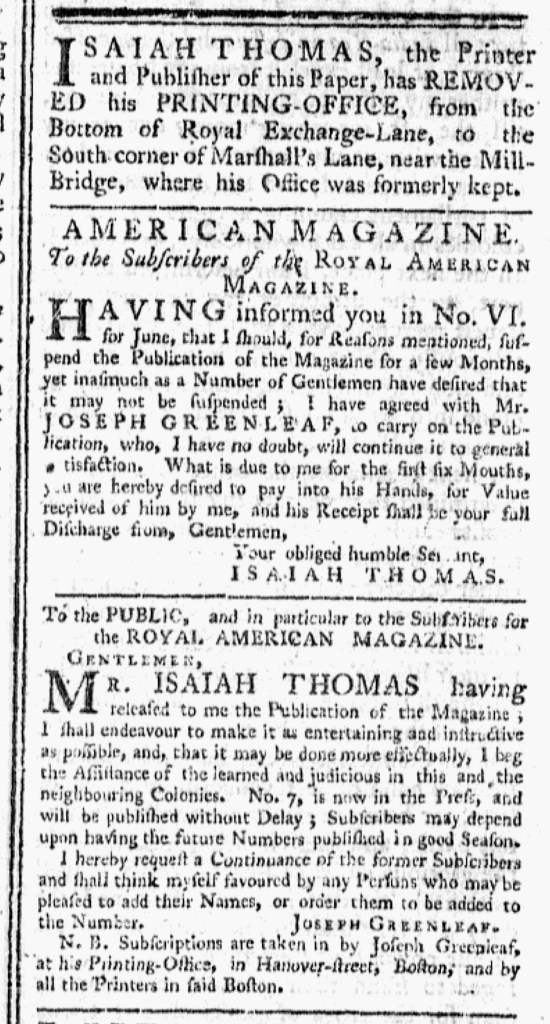
The Royal American Magazine experienced a disruption in publication during the summer of 1774.  In a notice in the June issue, Isaiah Thomas, the founder of the magazine, reported that the “Distresses of the Town of Boston” that resulted from the Boston Port Act forced him to suspend publication for a few months.  He hoped to resume once “the Affairs of this Country are a little better settled.”  Not long after making that announcement, however, he took to the pages of his own newspaper, the Massachusetts Spy, to inform subscribers and the public that he transferred the magazine to Joseph Greenleaf.  An address from Greenleaf appeared immediately below Thomas’s advertisement.  They were the latest entries in a marketing campaign that commenced when Thomas first revealed his intention to circulate subscription proposals in May 1773 and subsequent newspaper advertisements in June, July, August, September, October, November, and December 1773 and January, February, March, April, May, and June 1774.  The “Distresses” meant no newspaper advertisements for the magazine in July 1774, but they resumed with the notices from Thomas and Greenleaf in August.

Those notices each made four more appearances in September.  Not surprisingly, the Massachusetts Spy accounted for three of them.  For four weeks, Thomas used his own newspaper to advise subscribers and others of the change in publisher for the magazine.  The companion notices also ran once in the Boston Evening-Post on September 5.  Greenleaf’s address indicated that the July issue of the magazine “is now in the Press, and will be published without Delay.”  On September 15, the last day that they ran in the Massachusetts Spy, that newspaper also carried a new advertisement from Greenleaf, one that declared, “THIS DAY PUBLISHED … NUMBER VII. of The Royal American Magazine.”  The July issue finally became available in September!  Greenleaf’s advertisement was brief and restrained compared to many that Thomas had inserted.  It stated that the issue was “Embellished with an elegant Engraving,” but did not give a description or even a name for Paul Revere’s engraving of “Spanish Treatment at Carthagena,” nor did the advertisement incorporate an extensive list of the contents to entice readers.  Instead, it succinctly noted that the magazine was “Printed and Sold at GREENLEAF’S Printing-Office … where Subscriptions continue to be taken in.” The new publisher hoped to expand the magazine’s circulation despite a less ambitious advertising strategy than Thomas sometimes deployed.  The announcement about the July issue ran only once in the Massachusetts Spy.  It appeared in the Boston Evening-Post for the first time in its next edition four days later and again the following week.  Amid the “Distresses of the Town of Boston,” Greenleaf’s first issue of the Royal American Magazine had less fanfare than many of the issues that Thomas published.

**********

To the Subscribers of the ROYAL AMERICAN MAGAZINE”

  • September 1 – Massachusetts Spy (second appearance)
  • September 5 – Boston Evening-Post (first appearance)
  • September 8 – Massachusetts Spy (third appearance)
  • September 15 – Massachusetts Spy (fourth appearance)

“To the PUBLIC, and in particular to the Subscribers”

  • September 1 – Massachusetts Spy (second appearance)
  • September 5 – Boston Evening-Post (first appearance)
  • September 8 – Massachusetts Spy (third appearance)
  • September 15 – Massachusetts Spy (fourth appearance)

“THIS DAY PUBLISHED … NUMBER VII”

  • September 15 – Massachusetts Spy (first appearance)
  • September 19 – Boston Evening-Post (first appearance)
  • September 26 – Boston Evening-Post (second appearance)

September 18

What was advertised in a colonial American magazine 250 years ago this month?
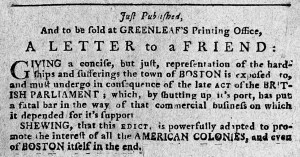
Advertising wrapper enclosing Royal American Magazine, July 1774 (published September 15, 1774).

“A concise, but just, representation of the hardships and sufferings of the town of BOSTON.”

An advertisement in the September 15, 1774, edition of the Massachusetts Spy informed readers that “NUMBER VII of the ROYAL AMERICAN MAGAZINE” was “This day published” and “will be ready to be delivered, to-morrow, to the subscribers.”  The notice referred to the July edition.  Isaiah Thomas, the original publisher, had always been behind in circulating new issues of the magazine, putting Joseph Greenleaf, the new proprietor, in a position to catch up.  The July issue was his first, published just three weeks after the first announcement that he now oversaw the magazine.

Like other eighteenth-century magazines, the Royal American Magazine did not feature advertisements interspersed among its contents, yet that did not mean that it lacked advertising altogether.  First Thomas and then Greenleaf distributed each issue enclosed in blue paper wrappers that featured advertisements.  In the last quarter of the century, other magazine publishers did the same.  The wrappers protected each issue until subscribers had six of them bound into a volume, though bookbinders usually removed the wrappers and other advertising ephemera, such as trade cards, subscription proposals, and book catalogs, within them.  Bound volumes preserved in research libraries give the impression that advertising was not part of eighteenth-century magazines, yet intact individual issues demonstrate that was not the case at all.

Advertising wrapper enclosing Royal American Magazine, July 1774 (published September 15, 1774).

Over time, the kinds of advertisements on the wrappers evolved to include an array of goods and services, but in the 1770s they almost exclusively came from the book trades and, especially, the publisher of the magazine.  Such was the case with the Royal American Magazine.  The wrappers for the July 1774 issue had a message to the subscribers from Thomas, the same one that announced the change of publisher in the Massachusetts Spy, an advertisement for “A LETTER to a FRIEND: GIVING a concise, but just, representation of the hardships of the town of BOSTON” sold at Greenleaf’s printing office, and a list of books and printed blanks also available from the publisher of the magazine.  The wrappers for the June 1774 edition had included advertisers not affiliated with the magazine, yet still members of the book trades.  Benjamin Edes and John Gill, printers of the Boston-Gazette, advertised “OBSERVATIONS on the ACT of PARLIAMENT, commonly called the BOSTON PORT BILL,” the legislation that resulted in the “hardships of the town” outlined in the pamphlet Greenleaf promoted.  Nathaniel Mills and John Hicks, printers of the Massachusetts Gazette and Boston Post-Boy, advertised an array of books they stocked, while Bernard Romans outlined his “PROPOSALS For printing by Subscription, A CONCISE Natural HISTORY of EAST and WEST FLORIDA.”

The Adverts 250 Project has tracked newspaper advertisements concerning the Royal American Gazette from Thomas’s first mention of his intention to circulate subscription proposals through the publication of the first six issues and transferring the magazine to a new publisher.  That story, however, has not examined the Royal American Magazine as a delivery mechanism for advertising.  Subsequent entries will take a closer look at the advertisements that appeared on the magazine’s wrappers throughout its run.

August 28

What was advertised in a colonial American newspaper 250 years ago this month?

Massachusetts Spy (August 25, 1774).

“Suspend the Publication of the Magazine for a few Months.”

For more than a year, the Adverts 250 Project has traced Isaiah Thomas’s advertising campaign for the Royal American Magazine, from his first announcement that he intended to circulate subscription proposals in May 1773 through the notices that ran in newspapers in June, July, August, September, October, November, and December 1773 and January, February, March, April, May, and June 1774.  Last month, I noted that Thomas did not advertise the magazine in July 1774, that the sole marketing effort in the public prints was a poem “From the ROYAL AMERICAN MAGAZINE” that appeared in the “POETS CORNER” in the July 21, 1774, edition of the Massachusetts Spy, the newspaper that Thomas printed.  I also commented that newspaper advertisements do not reveal when the June 1774 issue of the magazine became available to readers.

Further investigation, however, reveals that newspaper advertisements do indeed provide that information.  The June 1774 issue of the Royal American Magazine was not published until August 1774.  Eighteenth-century magazines commonly came out at the end of the month, unlike modern magazines issued in advance of the dates on their covers.  Subscribers would have expected the June issue in late June or early July, but Thomas was more than a month late in distributing it.  He had perpetually been behind the anticipated publication schedule since the first issue.

On Thursday, August 4, the Massachusetts Spy carried a notice that “Saturday next will be published … NUMBER VI. of THE ROYAL American Magazine.”  To promote that issue, Thomas proclaimed that it would be “Embellished with elegant Engravings, I. The able Doctor, or America swallowing the bitter Draught.  II. The Hooded Serpent.”  Paul Revere produced both engravings.  The “Able Doctor,” depicting America personified as an Indigenous woman being held down by members of Parliament and forced to drink tea, protested the Boston Port Act.  It is now considered one of the most important examples of visual propaganda supporting the patriot cause produced during the imperial crisis.

By Monday, Thomas took the overdue issue to press.  The August 8 edition carried a nearly identical advertisement with the headline updated to “THIS DAY PUBLISHED.”  On August 11, an announcement received a prominent place in the Massachusetts Spy, running as the first item in the first column on the first page.  Although delinquent in publishing the June issue, Thomas privileged promoting it when he could finally declare, “This day was published … NUMBER VI. of THE ROYAL American Magazine.”  As he had done with previous issues, Thomas highlighted the engravings and provided a list of the contents to entice readers who were not already subscribers to purchase copies.  The articles included a “Description of the Hooded Serpent” to accompany the second engraving.

The June issue included an address “To the PUBLIC” in which Thomas informed “all those Gentlemen and Ladies, in this and the other Provinces, who have favoured him with their Subscriptions” that current events forced him to suspend publication of the magazine.  “The Distresses of the Town of Boston, by the shutting up of our Port,” Parliament’s response to the Boston Tea Party, had “throw[n] all Ranks of Men into Confusion,” including “those good Gentlemen … who kindly promised to assist the Editor with their various Lucrubrations.”  Thomas had regularly published advertisements seeking original content for the magazine, but now those who had volunteered to contribute had found themselves overcome by other priorities.  As a result, Thomas received “but few original Pieces.”  He could not provide readers with “that Entertainment and Instruction, which they have a Right to expect.”  Accordingly, he planned to suspend publication for a few months “until the Affairs of this Country are a little better settled” and his correspondents could once again turn their attention to supplying the magazine with content.

Not long after subscribers saw that notice in the June issue of the American Royal Magazine, Thomas took to the Massachusetts Spy with a new update on August 25.  He reported that “a Number of Gentlemen have desired that it may not be suspended.”  Not in a position to continue with the magazine at that time, Thomas “agreed with Mr. JOSEPH GREENLEAF, to carry on the Publication.”  He assured subscribers that the new publisher “will continue it to general satisfaction.”  He also instructed them to submit subscription fees for the first six issues to Greenleaf.  A notice from Greenleaf “To the PUBLIC, and in particular to the Subscribers for the ROYAL AMERICAN MAGAZINE” immediately followed.  He pledged to make the magazine “as entertaining and instructive as possible,” yet, like Thomas, needed the “Assistance of the learned and judicious in this and the neighbouring colonies.”  He was on track to make good on his promise to subscribers, declaring that the next issue “is now in the Press, and will be published without Delay.”  In addition, subscribers “may depend upon having the future Numbers published in good Season,” implicitly acknowledging that publication of previous issues had often been deferred longer than anticipated.  The new publisher concluded with a request that current subscriber continue and new subscribers “add their Names,” either at his printing office or with any other printers in Boston.

The suspension could have been the end of the Royal American Magazine, but Greenleaf managed to publish new issues through February 1775.  The Adverts 250 Project will continue to document advertisements for the magazine to compare Greenleaf’s marketing efforts to those of Thomas.

**********

“Saturday next will be published … NUMBER VI.”

  • August 4 – Massachusetts Spy (first appearance)

“THIS DAY PUBLISHED … NUMBER VI.”

  • August 8 – Boston Evening-Post (first appearance)
  • August 15 – Boston Evening-Post (second appearance)

“This day was published … NUMBER VI.” [with list of contents]

  • August 11 – Massachusetts Spy (first appearance)

To the Subscribers of the ROYAL AMERICAN MAGAZINE”

  • August 25 – Massachusetts Spy (first appearance)

“To the PUBLIC, and in particular to the Subscribers”

  • August 25 – Massachusetts Spy (first appearance)