January 9

What was advertised in a revolutionary American newspaper 250 years ago today?
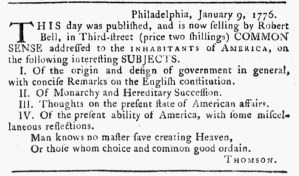
Pennsylvania Evening Post (January 9, 1776).

“THIS day was published … COMMON SENSE addressed to the INHABITANTS of AMERICA.”

On January 9, 1776, the first advertisement for Thomas Paine’s Common Sense appeared in an American newspaper.  The notice did not include Paine’s name.  Instead, it stated that Robert Bell, the prominent printer and bookseller, “published, and is now selling … COMMON SENSE addressed to the INHABITANTS of AMERICA, on the following subjects.”  The advertisement then listed the headings for the several sections in the first edition: “I. Of the origin and design of government in general, with concise Remarks on the English constitution.  II. Of Monarchy and Hereditary Succession.  III. Thoughts on the present state of American affairs.  IV. Of the present ability of America, with some miscellaneous reflections.”

Over the next several months, printers in many towns would publish and advertise local editions of Common Sense, making it the most widely disseminated political pamphlet during the era of the American Revolution (though, as Trish Loughran convincingly demonstrates, the number of copies has been wildly exaggerated).[1]  Historians also consider Common Sense the most persuasive pamphlet that advocated for the American cause.  Even though hostilities commenced at Lexington and Concord in April 1775, many Americans still hoped that the king would intervene to address their grievances.  The plain language of Common Sense (along with unflattering depictions of monarchy) played a significant role in convincing many colonizers to support independence over a redress of grievances.  Paine made a strong case for “the present ability of America” to establish a new government and trading relationships beyond the British Empire.

There seems to be some confusion about the publication date for Common Sense.  Some sources claim that it was published on January 10, 1776.  I suspect that is because advertisements for the pamphlet first appeared in the January 10 editions of the Pennsylvania Gazette, the newspaper Benjamin Franklin formerly operated, and the Pennsylvania Journal, published by Patriot printers William Bradford and Thomas Bradford.  Those advertisements featured almost identical copy (but different choices for the format made by the compositors), including the phrase “THIS DAY IS PUBLISHED” in the Pennsylvania Gazette and “This Day was Published” in the Pennsylvania Journal.  I have previously examined other instances of similar phrases, demonstrating that they did not literally refer to the publication date but instead meant that a book or pamphlet was now available for purchase.  When the advertisement ran in the Pennsylvania Ledger on January 13 and in the Wochentliche Pennsylvanische Staatsbote on January 16, both versions stated, “This Day was Published.”  Eighteenth-century readers knew how to interpret the phrase.  I wonder if some scholars consulted the more famous and the more venerable Pennsylvania Gazette (founded 1728) and Pennsylvania Journal (founded 1742), saw a phrase that suggested the date of the newspaper was indeed the publication date for Common Sense, and overlooked a newspaper that had been in production for a little less than a year when it carried its first advertisement for Common Sense.  (Benjamin Towne distributed the first issue of the Pennsylvania Evening Post on January 24, 1775.)  Bell may have been selling copies of Common Sense before January 9.  The advertisement in the Pennsylvania Evening Post does not definitively demonstrate that the pamphlet was published on January 9, but it does show when marketing for the pamphlet began and that Bell published it no later than January 9, 1776.

**********

[1] Trish Loughran, “Disseminating Common Sense: Thomas Paine and the Problem of the Early National Bestseller,” American Literature 78., no. 1 (March 2006), 1-28.

December 10

What was advertised in a revolutionary American newspaper 250 years ago this week?

Pennsylvania Evening Post (December 9, 1775).

“JUST published, and may be had of the printer hereof, JOURNAL of the PROCEEDINGS of the CONGRESS.”

Like other printers, Benjamin Towne sold books to supplement the revenue he generated from newspaper subscriptions, advertisements, and job printing.  In a brief advertisement in the December 9, 1775, edition of the Pennsylvania Evening Post he announced, “JUST published, and may be had of the printer hereof, JOURNAL of the PROCEEDINGS of the CONGRESS, held at Philadelphia May 10, 1775.  Also that new and interesting work, of great merit and integrity, BURGH’s POLITICAL DISQUISITIONS.”

Three days earlier, on a Wednesday, William Bradford and Thomas Bradford, the printers of the Pennsylvania Journal, advertised that they would publish and sell the journal of the proceedings of the Second Continental Congress from May through August starting “On FRIDAY Next.”  On Saturday, Towne became the first bookseller other than the Bradfords to announce that he had copies for sale.  In this instance, as in so many other advertisements for books and pamphlets that appeared in early American newspapers, the phrases “JUST published” and “may be had of the printer hereof” did not both apply to the printer who placed the notice.  Instead, “JUST published” merely informed readers that a work was now available.  Such was the case for the journal of the proceedings of the Second Continental Congress as well as for the American edition of James Burgh’s Political Disquisitions, published by Robert Bell.  Towne did not take up Bell’s invitation to “All the Printers on the continent to insert “the whole” of a lengthy advertisement with an address from “The American Editor to his Countrymen” in his newspaper even though Bell promised to pay for such consideration with cash or books.  Towne may have expected that prospective customers were already familiar with Bell’s marketing efforts from other newspapers printed in Philadelphia.  Towne likely sold other books at his printing office, yet he did not choose to include any others in his advertisement.  Instead, the printer opted to promote books that resonated with current events, believing that they would draw customers to his shop.  He could hawk other books once readers arrived to examine the volumes that he advertised.

September 6

What was advertised in a revolutionary American newspaper 250 years ago today?

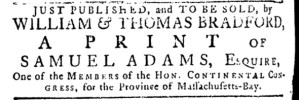
Pennsylvania Journal (September 6, 1775).

“A PRINT OF SAMUEL ADAMS, ESQUIRE, One of the MEMBERS of the HON. CONTINENTAL CONGRESS.”

The Second Continental Congress convened in Philadelphia after the battles of Lexington and Concord.  It met through most of the summer of 1775, took a recess during August, and started meeting again in September.  The delegates had just resumed their deliberations when William Bradford and Thomas Bradford, the printers of the Pennsylvania Journal, ran an advertisement promoting “A PRINT OF SAMUEL ADAMS, ESQUIRE, One of the MEMBERS of the HON. CONTINENTAL CONGRESS, for the Province of Massachusetts-Bay.”

Even though their advertisement stated, “JUST PUBLISHED, and TO BE SOLD, by WILLIAM & THOMAS BRADFORD,” this seems to have been another instance of printers treating those two phrases separately.  “TO BE SOLD” did indeed refer to the Bradfords stocking and selling the print at their printing office, but “JUST PUBLISHED” did not indicate that they had published the published the print, only that someone had recently published it and made it available for sale.  The Bradfords did not previously attempt to incite demand or gauge interest in a print of Adams among residents of Philadelphia with a subscription notice or other advertisement.

They most likely acquired and sold copies of the print that Charles Reak and Samuel Okey advertised in the Newport Mercury, the Massachusetts Spy, and the Boston-Gazette several months earlier.  In February, Reak and Okey took to the pages of the Newport Mercury to announce their intention to print a “striking likeness of that truly staunch Patriot, the Hon, SAMUEL ADAMS, of Boston.”  Near the end of March, a truncated advertisement in the Massachusetts Spy and the Boston-Gazette advised that “[i]n a few days will be published … A FINE mezzotinto print of that truly worthy Patriot S. A. … executed and published by and for Charles Reak and Samuel Okey, in Newport, Rhode-Island.”  The version in the Massachusetts Spy indicated that more information would appear in the next issue, but the printer, Isaiah Thomas, did not supply additional details in the last few issues printed in Boston before he suspended the newspaper for several weeks and relocated to Worcester just before hostilities commenced at Lexington and Concord.  Those events gave Reak and Okey an expanded market for a print of a Patriot leader already famous in New England.  Their advertisements in Boston’s newspapers listed local agents who would sell their print there.  The Bradfords likely became local agents in Philadelphia rather than publishers of another print of Adams.

July 23

What was advertised in a revolutionary American newspaper 250 years ago this week?

South-Carolina and American General Gazette (July 21, 1775).

“A SERMON on the present Situation of American Affairs.”

Robert Wells, the printer of the South-Carolina and American General Gazette, often inserted advertisements that promoted the merchandise available at his “GREAT STATIONARY & BOOK STORE” in Charleston.  On July 21, 1775, he devoted a notice to “A SERMON on the present Situation of American Affairs.  Preached in Christ Church, Philadelphia, June 23, 1775, at the Request of the Officers of the Third Battalion of the City of Philadelphia and District of Southwark.  By WILLIAM SMITH, D.D. Provost of the College in that City.”  Like many other advertisements for books, the copy replicated the title page.  Wells added the verse from the Book of Joshua that Smith cited as inspiration for the sermon.

The headline for the advertisement declared, “Just published, and to be sold BY ROBERT WELLS.”  Did “Just published” and “to be sold” both describe Wells’s role in disseminating Smith’s sermon?  When printers and booksellers linked those phrases together, they often meant that a work had been “Just published” by someone else and made available “to be sold” by other printers and booksellers.  Wells may have acquired copies of the sermon printed by James Humphreys, Jr., in Philadelphia and retailed them at his own shop.  Another advertisement in the same issue used the headline, “This Day are Published, BY ROBERT WELLS,” to introduce two books, “OBSERVATIONS on the RAISING and TRAINING of RECRUITS. By CAMPBELL DALRYMPLE, Esq; Lieutenant Colonel to the King’s Own Regiment of Dragoons,” and “THE MANUAL EXERCISE, with EXPLANATIONS, as now practised by The CHARLESTOWN ARTILLERY COMPANY.”  In contrast to “This Day are Published,” other items certainly not printed by Wells appeared beneath a header that stated, “At the same STORE may be had.”  On the other hand, Wells could have published a local edition of Smith’s sermon.  James Adams printed and sold a local edition in Wilmington, Delaware.

Christopher Gould includes Smith’s Sermon on the Present Situation of American Affairs (entry 103) in his roster of imprints from Wells’s printing office, along with The Manual Exercise (entry 92) and Observations on the Raising and Training of Recruits (entry 93).  For each of them, he indicates that he did not examine an extant copy but instead drew the information from newspaper advertisements.  Gould explains that “many of the entries for 1774 and 1775 must be regarded as suspect.  Wells advertises them as his publications, but in the absence of extant copies bearing his imprint, the likelihood is strong that they are in fact London editions of popular works bound in Charleston by Wells.”[1]  As I have noted, Wells used a headline to introduce Smith’s Sermon that both contemporary printers and readers understood did not necessarily attribute publication to the advertiser.  Even if he sold copies of the sermon printed elsewhere, they did not come from London.  Smith delivered the sermon on June 23 and Wells advertised it just four weeks later, not nearly enough time for London printers to be involved.  Wells advertised an American edition, even if he did not publish it.

Whatever the case, the sermon supplemented the news.  Readers of the South-Carolina and American General Gazettefollowed all sorts of “AMERICAN INTELLIGENCE” from New England to Georgia, but the pages of any newspaper could present only so much content.  Wells presented readers an opportunity to learn more about the discussions about current events taking place in Philadelphia by experiencing Smith’s sermon themselves.  As consumers, they could become better informed and join with others who heard or read the sermon.

**********

[1] Chrisopher Gould, “Robert Wells, Colonial Charleston Printer,” South Carolina Historical Magazine 79, no. 1 (January 1978): 42.