Who was the subject of an advertisement in a colonial newspaper 250 years ago this week?
New-York Gazette (February 10, 1766).
“TO BE SOLD, For Want of Employ.”
This advertisement was put forth by a master looking to sell a slave due to the fact that they no longer could use their work. Advertisements for slaves were common since slaves were commodities during the Colonial period. In the eyes of many at the time, selling slaves was not much different than selling oxen or horses.
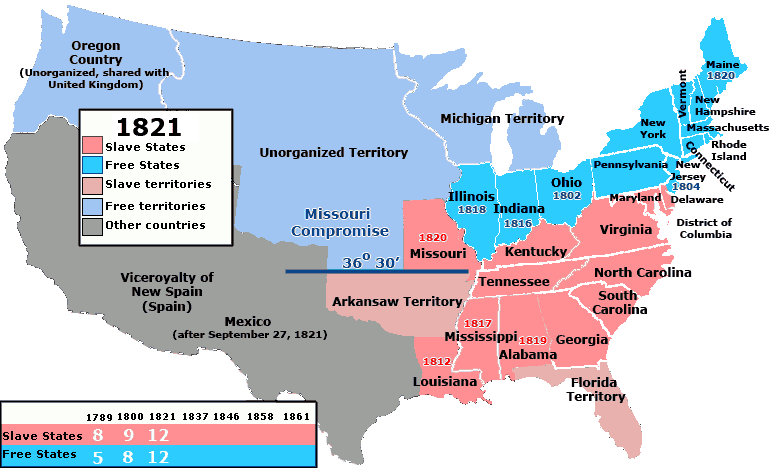
Map of Slave States and Free States in 1800.
The slave featured within this particular advertisement seems to be nineteen years old. At twenty myself, I took a look at this advertisement and, for a second, imagine my own life.
I imagine that many members of the public would be interested to know that a newspaper in what came to be known as the North, advertised slavery in the 1760s. These types of advertisements also continued in New England’s newspapers for at least 10 years until Vermont, inspired by the Declaration of Independence, was the first to ban slavery in its 1777 state constitution. Other New England states followed suit. By 1800 all the states within New England’s borders abolished slavery.
**********
ADDITIONAL COMMENTARY: Carl Robert Keyes
Today Kathryn has selected a type of advertisement that surprises many students who enroll in my courses on early America, whether the introductory survey or advanced electives on colonial and Revolutionary America or the capstone research seminar on slavery in America. As Kathryn points out, many are shocked when looking through the pages of eighteenth-century newspapers to discover just how often enslaved men, women, and children were advertised, either to be bought and sold or because they ran away from their masters.
Many students (and I would venture to guess many New Englanders as well as other Americans) imagine a strict North-South divide. Slavery as an institution was something that existed in the South, they assume, but not in the North. Such assumptions conflate nineteenth-century America and earlier periods by grafting the antebellum era over the realities of seventeenth- and eighteenth-century America.
Map of Slave States and Free State in 1821. Note that New Jersey and New York merit additional explanation and clarification due to gradual emancipation.
Even the history of abolition is messier than simply stating that after a certain year slavery had been abolished in Northern states. Not every state adopted immediate abolition. New York (1799) and New Jersey (1804) each enacted gradual emancipation intended to phase out slavery over time. As a result, slaves resided in New York as late as 1824 and in New Jersey until the Civil War ended in 1865.
This advertisement reminds us of a history of slavery that is all too often hidden: its widespread practice throughout all the colonies in the seventeenth and eighteenth centuries and its continuation in some Northern states well into the nineteenth century.
What was advertised in a colonial newspaper 250 years ago this week?
Boston Evening-Post (February 10, 1766).
“WANTED to purchase, A burthensome SLOOP of about 55 Tons.”
The average colonial consumer would not be seeking to purchase an entire ship, such as the individual in this advertisement.
One thing especially interesting about historical newspapers in general is their usage of language or terminology that is sometimes extremely unfamiliar to the average modern reader. I particularly enjoy looking up the terminology and discovering what it means. In the case of this advertisement, the term “burthensome” was entirely unfamiliar to me before I took some time to research it. I found that it is the original version of the modern term “burdensome.” In this advertisement, the word indicated the durability of a ship.
The item being sought out is a sloop. This is a type of ship that came to have multiple meanings that vary, depending upon the historical period being discussed.
**********
ADDITIONAL COMMENTARY: Carl Robert Keyes
Once again, I appreciate Kathryn’s attention to language. “Porringers” and “salvers” yesterday and now “burthensome” and “sloop.” Certainly “sloop” has not fallen out of usage to the same extent as the other three, but it is a term most familiar to those with specialized knowledge of maritime history and culture. I’ll admit that while I could identify a sloop as a sailing vessel, I did not know which aspects distinguished a sloop from other vessels prior to Kathryn selecting this advertisement and writing about it. Even having conducted a bit more research, I still find the varieties of sloops perplexing. I imagine that this advertisement provides enough information (a sloop, 55 tons, constructed in the 1760s, sailing in and out of colonial American ports) to figure out much more detail after an afternoon in a library or archive.
Yet here again eighteenth-century advertisements help to demonstrate how common knowledge has changed over the centuries. A great many residents in a seafaring town like Boston would not have thought twice about a “SLOOP of about 55 tons.” They would have been able to instantly envision such a vessel and its size and configuration relative to other ships in the harbor. (Other advertisements in the same issue mention brigantines and snows.) Many would have had family, friends, or acquaintances who earned their livings sailing on such ships. Most would have connected many of the goods offered for sale in other advertisements with the sloops and other vessels that transported raw materials and finished items via networks of commerce and exchange that crisscrossed the Atlantic.
Model of the sloop Mediator.
Update: Liz Loveland alerted us to a model of the Chaleur, a sloop converted into a two-masted schooner in 1768. The On the Water exhibit at the Smithsonian Institution’s National Museum of American History also includes this model of the eighteenth-century sloop Mediator.
What was advertised in a colonial newspaper 250 years ago today?
“Will be Sold by PUBLIC VENDUE … A variety of genteel House Furniture, belonging to a Gentleman going out of the Province, viz. Mohogony Desk and Book-Case.”
This advertisement features a series of household goods for sale, listing both the type of items and how many of the items are available. This particular advertisement was placed by an individual who was leaving the ‘province,’ which, for all intents and purposes, meant the same thing as the colony. Today, we might look at this ad as an eighteenth-century version of an advertisement for a yard sale of a homeowner who was leaving the state. It is always interesting to look at something from history and see it through a modern lens. When a person moves, they sometimes sell their possessions to make some funds for the move and get rid of possessions that will not be needed or wanted for their journey elsewhere.
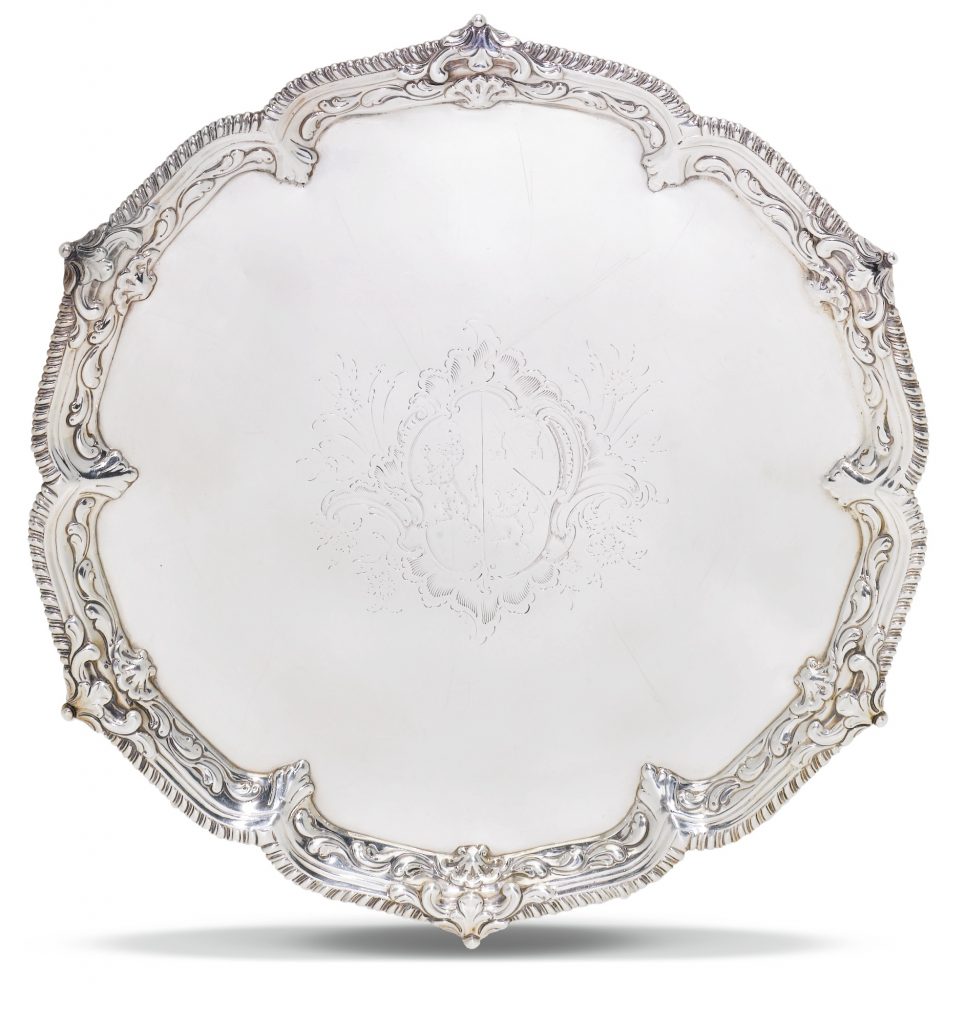
Silver Salver (Ebenezer Coker, London, 1766).
One item featured in the advertisement that I find intriguing is the mahogany desk. Desks of the Colonial period were sometimes ornate, featuring far more details and far more lavish woods than what is utilized in today’s desks. To a large extent, furniture helped to designate a family or individual’s social class. Wealthier families would have the most ornate woods and intricately-carved pieces in their homes, while middling individuals would have pieces that were far more basic.
Other items also caught my attention: the “porringers” and “salver.” A porringer was a special type of bowl that featured one or two decorated handles and were often made out of silver or pewter. They were often used for serving soup or porridge. (Check out this modern recipe for perfect porridge from BBC Good Food magazine.) Once again, the more ornate the dishes were, the more wealth that a family had. Silver was a sign of elite status, while pewter was a sign of the middling and lower sorts. A salver, on the other hand, was an eighteenth-century tray. These also could be made of silver or pewter, with the same connotations for their worth. Check out this silver salver crafted by Ebenezer Coker of London.
**********
ADDITIONAL COMMENTARY: Carl Robert Keyes
One of the reasons I founded the Adverts 250 Project was to use advertisements to open up the daily lives of colonists. I anticipated that some advertisements would be featured because they were simply mundane, what colonists expected to see, rather than exceptional or extraordinary in some way.
Kathryn has chosen an advertisement and offered commentary that illuminates the daily lives of colonists in several ways, some of them demonstrating a continuity with our modern lives and others demonstrating how much has changed. I confess that I never thought of this kind of “Public Vendue” notice as an eighteenth-century “garage sale” advertisement, but Kathryn makes a valid comparison that I will incorporate into my own classroom explanations in the future.
I also appreciate the way she worked through some of the language in the advertisement. Porringers? Salvers? Those would have been housewares encountered by many early Americans on a daily basis. The words they used to describe them would have been part of their everyday lexicon. Yet the words sound strange to most of us today. The uses, to some extent, seem archaic. Who needs a porringer to serve soup or porridge when there’s a bowl in the cupboard?!
The household goods this gentleman sought to sell included one more item much less common today. His “Case containing 12 Knives and Forks, [and] 12 Spoons” also included a spoon “for Marrow.” That’s not a standard piece of many silverware sets sold today, reflecting a change in dining habits since the colonial era.
What was advertised in a colonial newspaper 250 years ago this week?
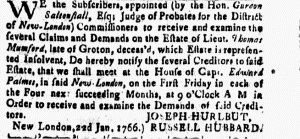
New-London Gazette (February 7, 1766)
“We the subscribers, appointed … Commissioners to receive and examine the several Claims and Demands on the Estate of Lieut. Thomas Mumford, late of Groton, deceased.”
This advertisement is of a different nature than many others featured within the Adverts 250 Project. This is due to the fact that it is not advertising goods or services. Instead, this advertisement is a probate notice, a type of memorandum about managing the estate of the deceased. In this particular case, the deceased individual was Thomas Mumford. Joseph Hurlbut and Russell Hubbard were appointed by a judge as executors of his estate.
From this example, we can conclude that probate notices were constructed very differently than advertisements for goods and services were. The text within the notice seems as if it is printed in small type, unlike many of the advertisements for goods that I came across in my time examining Colonial newspaper advertisements for this project. This may be because the text is lengthier and formed in complete sentences, rather than in list format, as some of the advertisements for goods were.
**********
ADDITIONAL COMMENTARY: Carl Robert Keyes
This advertisement reminds us of one of the many different purposes that colonists turned to the public prints to publish notices of various sorts. As I explained when I inaugurated the Adverts 250 Project, I am primarily interested in advertisements for goods and services, their methods of marketing wares to potential customers, and their role in the consumer revolution of the eighteenth century. This eliminates a fair number of advertisements from consideration for inclusion here. However, I have instructed my students that during their time as guest curators they are permitted to choose one of these other kinds of advertisements per week. If it caught their attention and helped them to learn more about early American society and print culture, then it was fair game.
Kathryn makes some important observations about this probate notice. Even though it includes some italics and capitals (exclusively for people and place names), it does not vary the font size or experiment with white space at all. It appears very dense, even more dense than many of the advertisements for goods and services. As Kathryn points out, advertisements listing assorted goods also included a lot of text, but often the format provided more variation. Probate notices, on the other hand, followed a rather standard formula (both for the wording of the text and its format). The responsibility for drawing readers to advertisements promoting goods and services fell on the advertisers. On the other hand, the “Commissioners” appointed “to receive and examine the several Claims and Demands on [an] Estate” may very well have felt that it was the responsibility of the “several Creditors” to stay informed of any legal notices appearing in the local newspaper. In publishing a probate notice the commissioners had fulfilled their responsibility. They were not required to devise flashy advertisements.
What was advertised in a colonial newspaper 250 years ago this week?
Final Page of Pennsylvania Gazette (February 6, 1766).
“This is to inform the PUBLIC …”
In first taking a look at this particular set of advertisements from the Pennsylvania Gazette, I believed that it was a single advertisement, but came to learn that instead it was multiple advertisements that were not separated from one another as was customarily done. It is believable that an advertisement might take up an entire page during the twenty first century in America, as many magazines feature full-page advertisements for different products, but this was not done in Colonial times. Instead, the fact that this was featured without separations between each advertisement was an indicator of some sort of issue or malfunction with technologies. The fact that the advertisement was not properly sectioned into different advertisements posed tremendous difficulty for me in trying to discern what the advertisement was for and what it focused upon. Analysis of this is best done while zoomed in closely upon the featured text, as the quality of the modern photography of the Pennsylvania Gazette is not high and this poses a difficulty in providing a historical understanding of its structure and content.
The Pennsylvania Gazette, a newspaper printed by Benjamin Franklin for many decades, was esteemed and often did not feature advertisements on its front page, as some others did, but instead, seems to have kept these advertisements, for the most part, separate from the rest of the newspaper, putting them within the last few pages all together beside one another.
Pennsylvania Gazette (February 6, 1766).
This particular advertisement is unique in its construct, as the majority of eighteenth-century advertising did not feature visuals of any kind.
**********
ADDITIONAL COMMENTARY: Carl Robert Keyes
As Kathryn indicates, this issue of the Pennsylvania Gazette illustrates some of the difficulties working with digitized sources, especially for those who have not had opportunities previously to work with the sources in their original format.
Kathryn notes that at first she thought the entire page might be one extensive advertisement. To better understand her initial confusion, it would be helpful to describe how the Early American Newspapers database visualizes the pages of eighteenth-century newspapers. In most instances they have been indexed in such a manner that each item has a separate index entry on a menu at the left of the screen. Upon selecting the index entry or clicking on the text itself, that item appears separately, enlarged for easier viewing. In some cases, however, the multiple items on the page have not been disambiguated by the software and/or the people who prepared the index. This can lead to frustration for researchers and confusion for novice users. It suggests some of the limits of using digitized sources: sometimes flawed metadata affects how users interpret the sources. In the case, Early American Newspapers classified the entire page as one “Advertisement.”
Note in this screen shot from Early American Newspapers that the index at the left classifies this entire page of the February 6, 1766, issue of the Pennsylvania Gazette as a single advertisement.
**********
Note in this screen shot from Early American Newspapers that the index at the left includes a separate entry for each advertisement from this page of the February 10, 1766, issue of the Boston-Gazette. Individual advertisements are also disambiguated by highlighting each in yellow when positioning the cursor over them.
Kathryn also notes that many of the advertisements for this issue have been grouped together at the end of the newspaper. She is correct in making this observation, but it also opens the door for a bit of printing history. As we saw with yesterday’s featured advertisement and issue of the New-Hampshire Gazette, most eighteenth-century newspapers were broadsheets folded in half to create a four-page issue. The extremely successful Pennsylvania Gazette, printed in the largest urban center in the colonies, often had more advertising than it could include in just four pages. As a result, it often issued an additional half sheet with advertisements printed on both sides. That explains the fifth and sixth pages of this particular issue of the Pennsylvania Gazette. The extra half sheet would have been tucked in the fold, between the traditional second and third pages. Other newspapers sometimes issued half sheet “supplements” (with news and/or advertising) and “extras” (usually just news).
What was advertised in a colonial newspaper 250 years ago today?
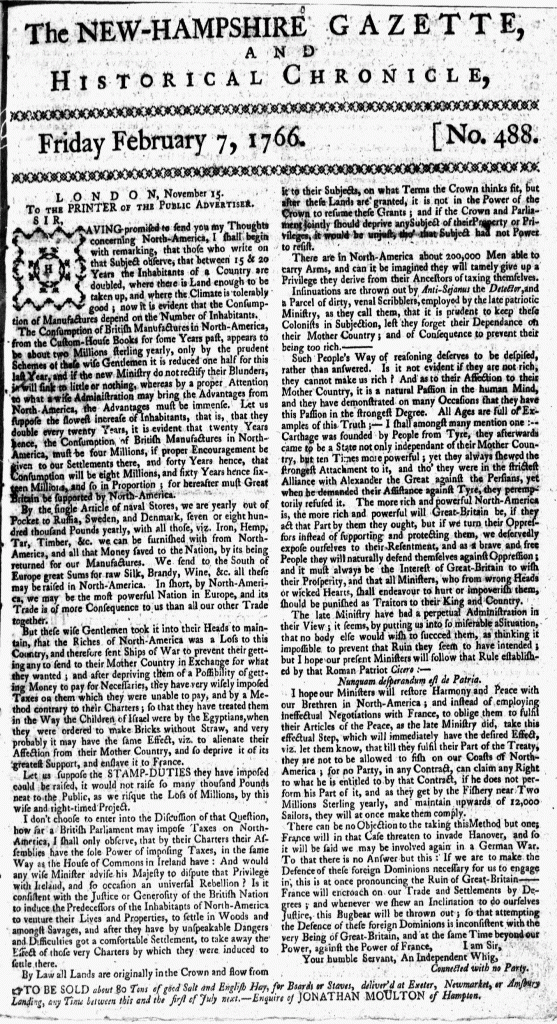
New-Hampshire Gazette (February 7, 1766).
“To be sold about 80 tons of good salt and English hay, for boards or staves.”
During Colonial times, items were often bartered, rather than sold. In this case, salt and hay are being offered in exchange for boards or staves, which were materials that might be used for carpentry projects, such as putting up buildings. In modern times, we would call a ‘stave’ a post, or a piece of wood used to make a wooden barrel and most individuals in the lumber industry today would not know what you meant if you asked them for a stave.
In this advertisement, it seems that the project that a person is trying to collect materials for might be one that will take place over a period of time, as it says that the individual seeking these materials has between now (which, remember, is February 1766) and ‘next’ July 1 for people to respond.
A final thing that catches my eye with this advertisement, is the mentioning of Jonathon Moulton of Hampton. Each time I see a name in an old newspaper, I have to see if there’s a trail that will lead me to understand what the mentioned individual was after and what information is available about their life and death. This will be a recurring theme within my posts this week. I often find individuals to be an intriguing area of history. I feel that in some cases, some historians favor learning about events, while others favor learning about individuals.
In researching Moulton, I was delighted to find a plethora of information available about him from a Hampton library website page. Johnathon Moulton was born on July 21, 1726, and is the descendant of some of the first settlers of Hampton, a group that came to the Colonies from Norfolk, England. Moulton died on September 18, 1787. To learn more about Moulton of Hampton, check out this link.
**********
ADDITIONAL COMMENTARY: Carl Robert Keyes
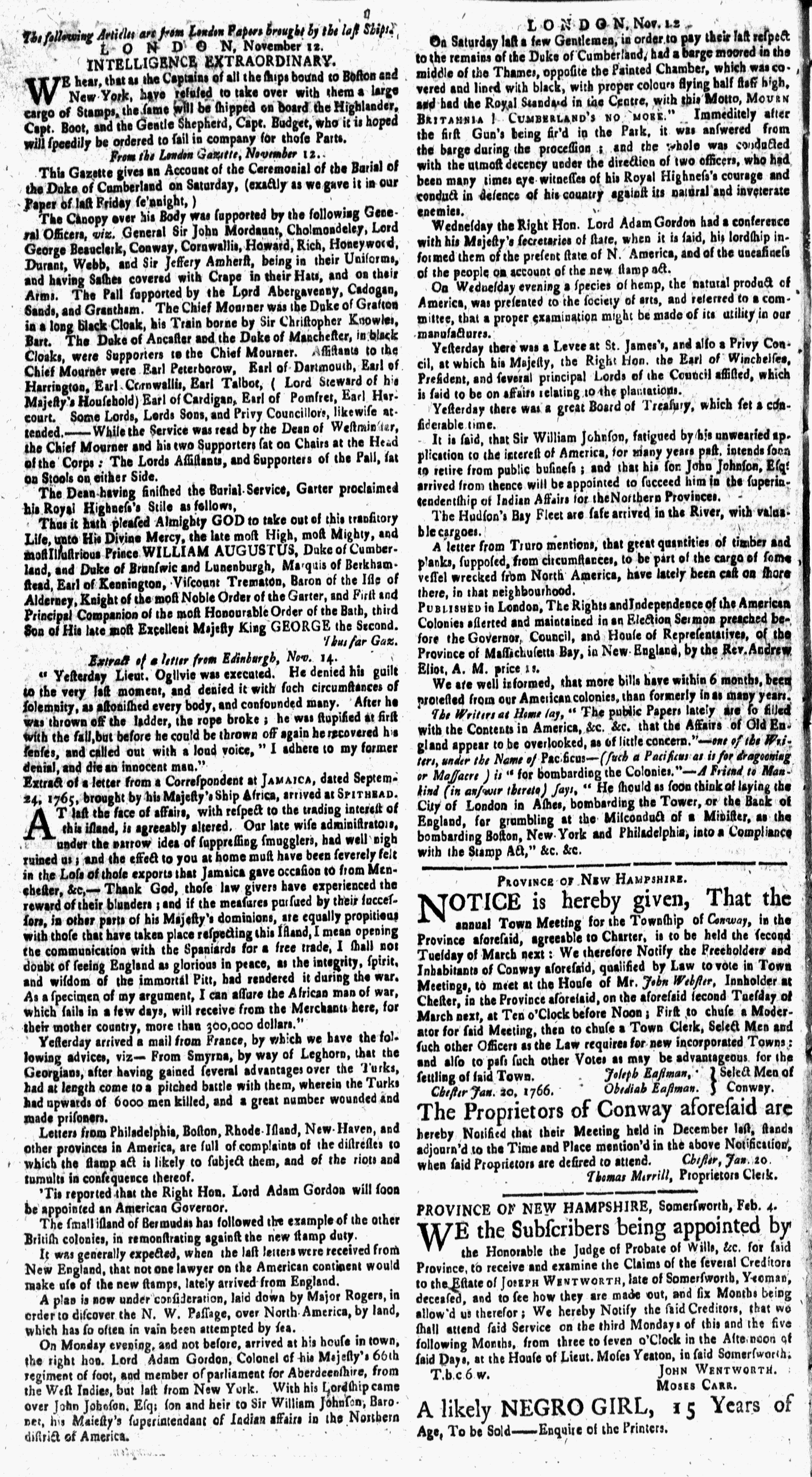
First Page of New-Hampshire Gazette (February 7, 1766).
While Kathryn focuses on evidence of bartering in colonial advertisements and a more extensive biography of this particular advertiser, I am interested in the format of this advertisement and the layout of the rest of the issue. I sometimes insert an entire page of a newspaper to provide both visual and textual context, but today I think it would be helpful to see the entire issue of the New-Hampshire Gazette that included this advertisement.
The advertisement that Kathryn selected appeared at the bottom of the first page. It extends across both columns. This is unusual, but not completely uncommon. Printers sometimes used this method to fill space or perhaps to insert advertisements received just before going to press. Compare this advertisement to yesterday’s featured advertisement for a lottery, which appeared at the end of the final column of the final page. The page – and the issue – were set perfectly thanks to its inclusion.
In contrast, this issue includes several advertisements laid out in unusual ways. Short advertisements from Jonathan Moulton run across both columns at the bottom of both the first and final pages. These two pages would have been printed on the same side of the broadsheet before it was folded in half to make a four-page newspaper. It is likely that both were added after the remainder of the issue had been set. In making each page the same length, the advertisements provided balance on the first and last pages (which others would have seen next to each other when looking at a subscriber reading the second and third pages). This suggests conscientiousness about the appearance of the newspaper on the part of the printer.
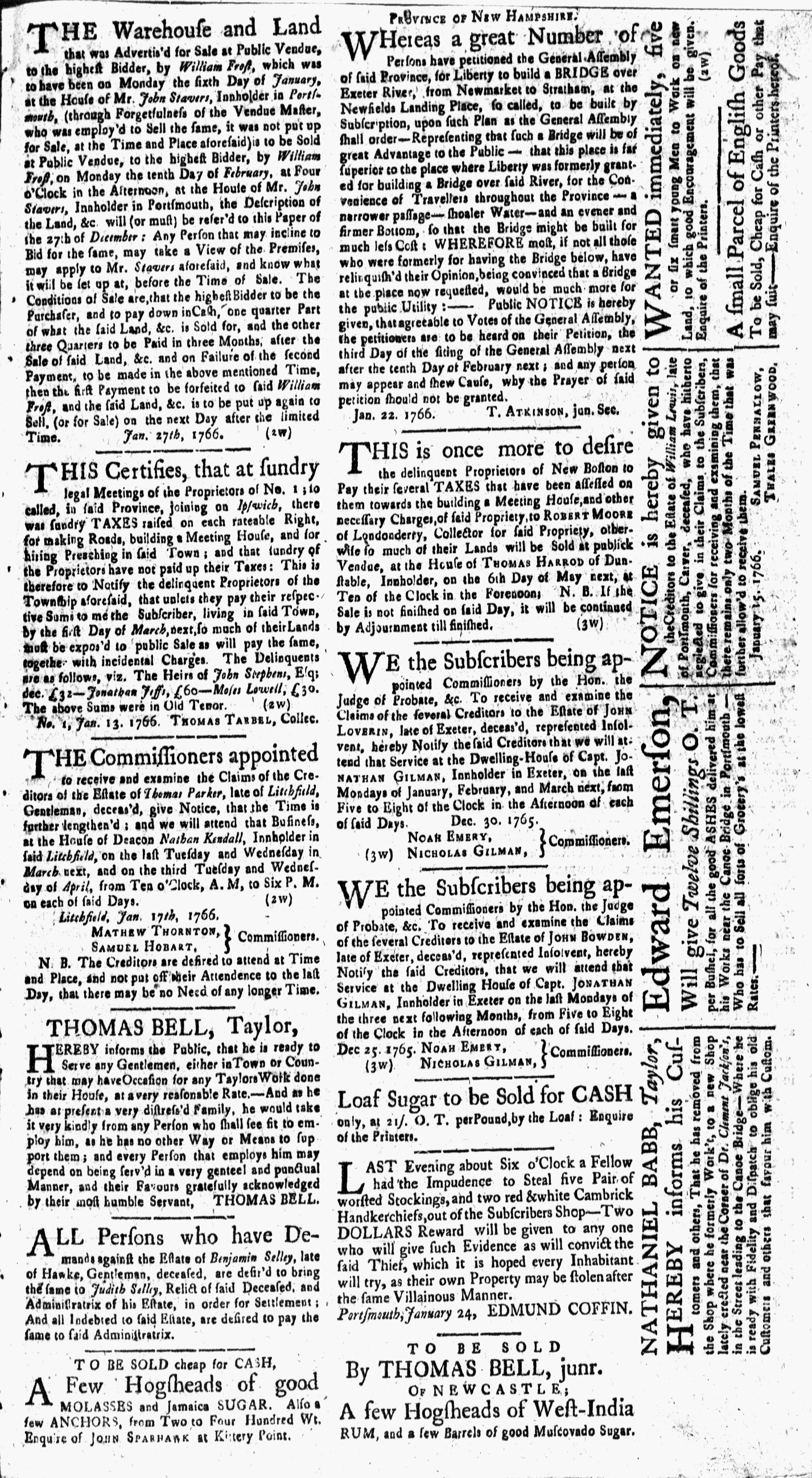
Second Page of New-Hampshire Gazette (February 7, 1766).
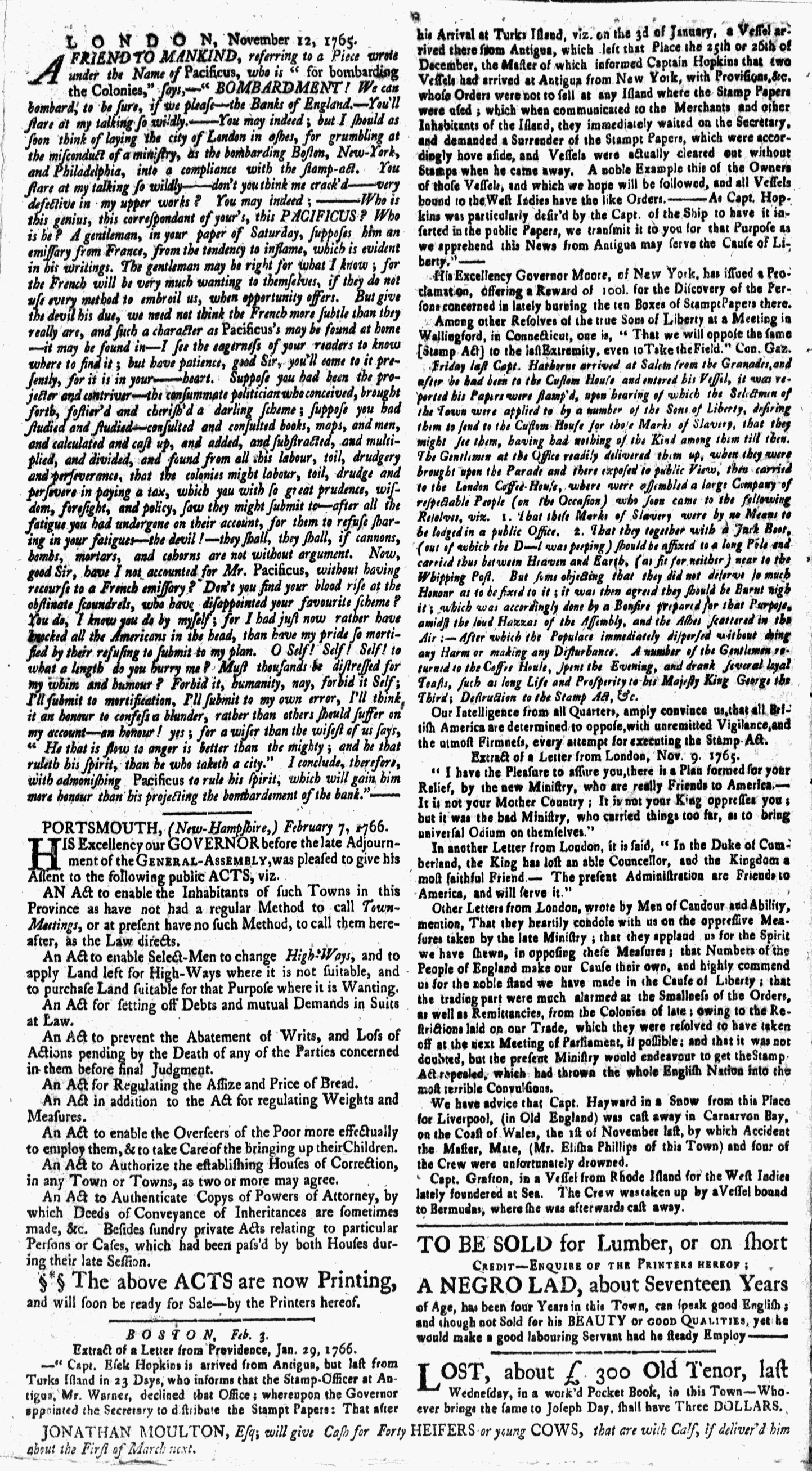
The advertisements on the third page, however, were laid out in an extremely unusual manner. That page features two columns of advertisements, as expected, along with four additional advertisements rotated ninety degrees clockwise to form a third column. This would be very visually striking. It might draw attention to the advertisements. Perhaps this was the printer’s intention, but I hesitate to make this claim without evidence that other similar experiments appeared in the New-Hampshire Gazette over the next several weeks or months. Something else may have explained this decision, such as advertisers clamoring to have commercial notices for which they had already paid appear in print. After all, the New-Hampshire Gazette had recently printed relatively few advertisements in favor of covering the Stamp Act crisis throughout the colonies. The printer may have been attempting to insert advertisements usually any layout necessary to do so.
This is an instance in which digitized sources reveal some questions that cannot be answered without consulting the original sources in an archive. I’d like to know about the amount of space covered in print on the second and third pages relative to each other, but both appear exactly the same size on my computer screen, making it impossible to make such an assessment. Indeed, I assumed above that Jonathan Moulton’s advertisements mirroring each other on the first and fourth pages caused the text on both to cover the same amount of space. This seems like a reasonable conclusion, but it must be tested by consulting an original (rather than photographed, microfilmed, or digitized) issue of the February 7, 1766, New-Hampshire Gazette.
Third Page of New-Hampshire Gazette (February 7, 1766).
**********
Fourth Page of New-Hampshire Gazette (February 7, 1766).