April 10

What was advertised in a colonial American newspaper 250 years ago this week?

Rivington’s New-York Gazetteer (April 7, 1774).

“ETHAN SICKELS, Leather-Dresser and Breeches-Maker.”

Even if imitation is the sincerest form of flattery, Cornelius Ryan, “LEATHER DRESSER and BREECHES MAKER,” probably did not feel particularly flattered when Ethan Sickels, “Leather-Dresser and Breeches-Maker,” ran an advertisement that imitated Ryan’s advertisement a little too much.  Compare the copy from Ryan’s notice, which first appeared in the New-York Gazette and Weekly Mercury on March 21, 1774, and Sickels’s notice, which first appeared in Rivington’s New-York Gazetteer on March 31.

Ryan: “MAKES and sells best Buck and Doe Skin Breeches, find ground Lamb do, best Buck and Doe Skin Gloves, also the very best Kind of Caraboo Skin Breeches and Gloves.”

Sickels: “MAKES and sells the best buck and doe skin breeches, fine ground lamb best buck and doe skin gloves; Also the very best Caraboo skin breeches, and gloves.”

Ryan: “He likewise has a great Variety of Buck Skin Breeches for Traders or Country Stores … all which he will sell on as low Terms as they can be had from Philadelphia, or any Part of the Continent.”

Sickels: “he likewise has a great quantity of buckskin breeches for traders, or country stores … all which he will sell on as low terms as they can be had from Philadelphia, or any part of the continent.

This was not an instance of using standardized or formulaic language as was often the case in eighteenth-century advertisements for consumer goods and services.  Instead, Sickels quite clearly borrowed Ryan’s advertising copy … but that was not the only undeniable similarity between the two newspaper notices.  Each of them included a woodcut depicting a pair of breeches and the initials of the advertiser that accounted for approximately half of the space occupied by the advertisements.  Ryan’s image also included a sun, replicating his “Sign of the SUN and BREECHES,” while Sickels’s image had a border around it instead.

Sickels apparently admired Ryan’s advertisement or feared that it gave his competitor too much of an advantage or recognized a means of drawing more attention to his own business.  All those factors may have been at play when he saw Ryan’s notice in the New-York Gazette and Weekly Mercury and decided to cross the street from his workshop “Opposite Mr. RIVINGTON’S PRINTING-OFFICE” to arrange for such a similar advertisement to run in Rivington’s New-York Gazetteer.  This suggests that entrepreneurs did not place newspaper advertisements as mere announcements in the eighteenth century but instead some of them monitored the public prints to devise their own marketing efforts or at least keep up with their competitors.

March 28

What was advertised in a colonial American newspaper 250 years ago today?
Supplement to the New-York Gazette and Weekly Mercury (March 28, 1774).

“The Sign of the SUN and BREECHES.”

Cornelius Ryan, “LEATHER DRESSER and BREECHES MAKER,” pursued his trade at “the Sign of the SUN and BREECHES, IN THE BROADWAY” in New York.  Residents and visitors to the busy port likely glimpsed his sign as they traversed the streets of the city.  Readers of the New-York Gazette and Weekly Mercury almost certainly noticed the woodcut that adorned the advertisements he ran in that newspaper.  It included the same elements as the sign that marked his location, a sun above a pair of breeches.  The sun had a face that stared directly at readers as well as eight rays enclosed within a corona.  In addition, the initials “CR,” for Cornelius Ryan, appeared between the legs of the breeches.  The woodcut may or may not have replicated Ryan’s sign; at the very least, it strengthened the association that the leather dresser and breeches maker wanted consumers to have with his business and visual representations of it.

To achieve that, Ryan invested in commissioning a woodcut stylized for his exclusive use.  Most entrepreneurs did not go to such lengths when they advertised in colonial newspapers, though Smith Richards, who kept shop “At the Tea canister and two sugar loaves,” once again included a woodcut depicting those items in his notice in the same supplement that carried Ryan’s advertisement.  Nesbitt Deane advertised hats he “Manufactured,” but did not adorn his notice with the image of a tricorne hat and his name within a banner that he had included in other notices on several occasions over the years.  Since advertisers paid by the amount of space their notices occupied rather than the number of words, woodcuts amounted to significant additional expense beyond the costs of producing them.  For Ryan, the woodcut accounted for nearly half of his advertisement, doubling the cost of running it in the New-York Gazette and Weekly Mercury.  He may very well have considered it worth the investment if the striking image prompted prospective customers to read the copy more closely.  The visual image served as a gateway for the appeals to skill, quality, price, consumer choice, and customer satisfaction that followed.

October 30

What was advertised in a colonial American newspaper 250 years ago today?

New-Hampshire Gazette (October 30, 1772).

“Leather-Dressers, & Breeches-Makers, in Kingstreet, Portsmouth.”

James Haslett and Mathew Haslett placed an advertisement in the October 30, 1772, edition of the New-Hampshire Gazette to inform prospective customers that they made “Leather Breeches of all sorts” at their shop on King Street in Portsmouth.  They declared that they made breeches “as neat as cheap & as good as any in New-England,” incorporating appeals to fashion, price, and quality into their short advertisement.

The Hasletts occasionally ran newspaper advertisements in the late 1760s and early 1770s.  Sometimes they included other marketing strategies to generate interest in their business.  For instance, in previous advertisements they stated that “the Sign of the BUCK and GLOVE” marked the location of their shop.  They also listed items for sale other than breeches, such as “all sorts of Wash Leather, Deer, Sheep and Moose Skins for Breeches and Jackets, Sheep Skins for Aprons, [and] Buck and Sheepskin Gloves.”  They made bolder claims about the quality of their wares, proclaiming that “the above Articles is Warranted as good as any in Europe or America” rather than narrowing the comparison to their competitors in New England.

The woodcuts that adorned some of the Hasletts’ advertisements were the most distinctive aspect of their marketing efforts.  The leather dressers commissioned several variations, but each depicted the Sign of the Buck and Glove along with an image of leather breeches.  Some of them included their name within the sign.  All of them included “1766,” the year the Hasletts relocated from Boston and established their shop in Portsmouth.

Why did the Hasletts discontinue using woodcuts to draw attention to their advertisements?  Why did they run shorter advertisements that gave fewer details about their business?  Perhaps they considered advertising a necessity as they sought to build their reputation in a new town, but over time determined that they achieved sufficient name recognition that they did not need more elaborate advertising to earn their livelihood their local market.  As consumers became more familiar with the Hasletts and their wares, the “LEATHER DRESSERS from BOSTON” became “Leather-Dressers, & Breeches-Makers, in Kingstreet, Portsmouth,” who may have believed that relatively stark advertisements served their purpose now that they were no longer newcomers in their community.

October 15

What was advertised in a colonial American newspaper 250 years ago today?

Oct 15 - 10:15:1768 Providence Gazette
Providence Gazette (October 15, 1768).

“Leather and Breeches may also be had at said Nash’s Store, the Sign of the Buck and Glove.”

When Joseph Nash advertised a “large Parcel of Deers Leather” and “Buckskin Breeches” in the Providence Gazette in the fall of 1768, he informed readers that they could purchase these items at two locations in Providence. Prospective customers could deal directly with Nash “At the North End of the Town of Providence.” Alternately, they could also visit “Nash’s Store, the Sign of the Buck and Glove, just below the Mill-Bridge, in Providence.” Nash reported that Levi Hall and N. Metcalf, “Leather-Dressers,” had set up shop at that location. It appears that Hall and Metcalf may have been tenants rather than employees of Nash, but their relationship extended to assisting each other with their business endeavors. Nash’s advertisement concluded with a note that Hall and Metcalf wished to procure sheepskins, “for which they will give Cash or Leather.”

Whatever their relationship, Nash was the focal point of the advertisement, in terms of both the typography and the appeals made to prospective customers. “Joseph Nash” served as the headline for the advertisement, appearing on a line of its own and in much larger font than the rest of the copy in the advertisement. In that regard “Joseph Nash” matched the treatment given to the names of other advertisers in their notices, including “Joseph Olney,” “John White,” and “Charles Stevens.” The compositor also applied this design to advertisements placed by partners, giving each partner his own line: “JOSEPH / AND / Wm. RUSSELL” and “THURBER / AND / CAHOON.” With the exception of the masthead, the only other text of similar size in that issue came from the headline of an advertisement in which the printers promoted the “New-England / TOWN and COUNTRY / Almanack.” Both “New-England” and “Almanack” appeared in the same significantly larger font as “Joseph Nash.” Even though “LEVI HALL, and N. METCALF” appeared in capitals in the middle of the advertisement, “Joseph Nash” was the name readers would notice at a glance. It dominated the advertisement and the rest of the page on which it appeared.

Nash’s appeals to customers also overshadowed any independent work undertaken by Hall and Metcalf. Before he even mentioned that they occupied his store at the Sign of the Buck and Glove, Nash addressed the quality and range of choices among his “large Parcel of Deers Leather,” stating that the pieces were “dressed in the neatest Manner, and well so sorted, from the thickest Buckskin to the finest Doe; so that any Gentleman may have his Choice.” Furthermore, his “ready made Buckskin Breeches” were also “done in the neatest Manner, by a Workman from London.” Unlike Hall and Metcalf, Nash certainly supervised the work done by an employee at his location at the north end of Providence. The remainder of the advertisement mentioned that prospective customers could purchase the same items from Hall and Metcalf, but did not promote the quality, prices, or choices of their inventory, which also included “Sheep and Lambskins … and Sheeps Wool.”

Nash’s advertisement certainly promoted his own products. It also granted increased visibility to Hall and Metcalf even though the focus remained primarily on their collaboration with Nash. That likely served Nash’s purposes, especially if he wished to retain as much of his share of the local market as possible while also making Hall and Metcalf’s business a viable enough enterprise that they could continue as tenants or otherwise operating his second location at the Sign of the Buck and Glove.

July 17

What was advertised in a colonial American newspaper 250 years ago today?

Jul 17 - 7:17:1767 New-Hampshire Gazette
New-Hampshire Gazette (July 27, 1767).

“For sale at their Shop at the Sign of the BUCK and GLOVE.”

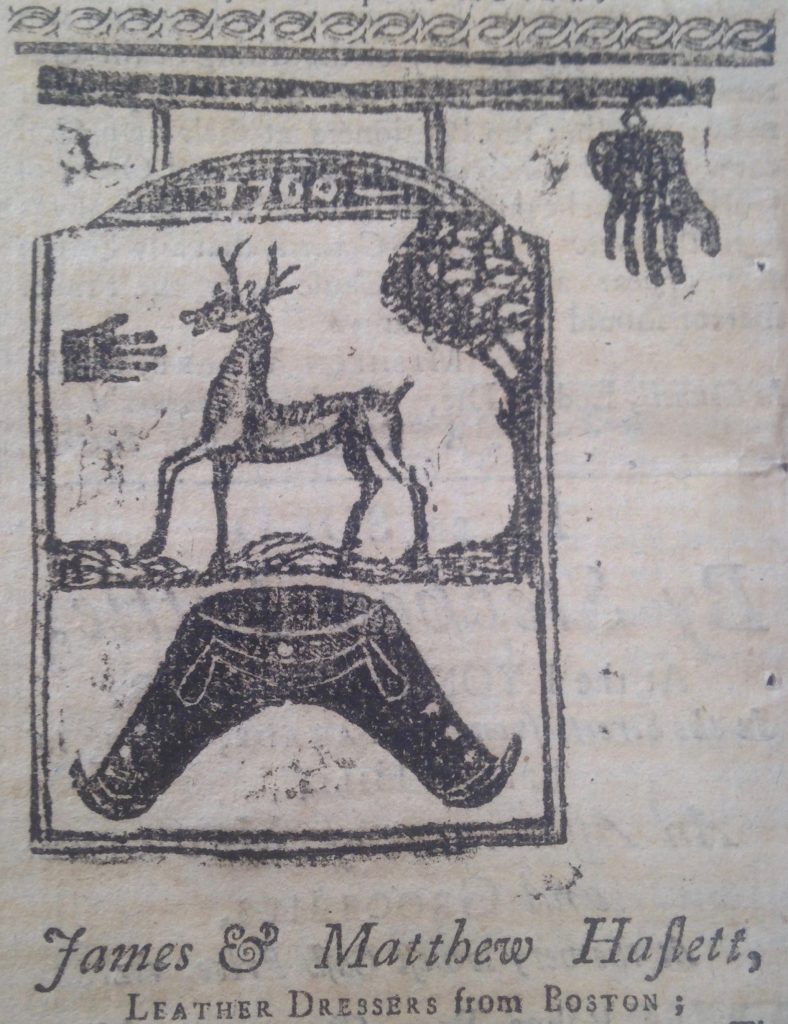
It would have been difficult not to notice the woodcut that accompanied James and Matthew Haslett’s advertisement in the July 17, 1767, edition of the New-Hampshire Gazette. Except for the insignia of the lion and unicorn within the masthead at the top of the first page, it was the only visual image in the entire issue, immediately drawing the eye away from the text that surrounded it.

The Hasletts reminded potential customers that “they still carry on the Leather Dressing Business … at their Shop at the Sign of the BUCK and GLOVE in King Street” in Portsmouth. The woodcut indeed depicted a sign that featured a buck and glove, as well as a pair of breeches. The text of the advertisement also promoted “all sorts of Breeches ready made.”

This was not the first time that the leather dressers inserted a woodcut alongside their advertisement, but it had been ten months since they last did so. In the interim, their commercial notices had been unadorned, relying on the copy alone to convince potential customers to avail themselves of the Hasletts’ services.

When they decided to once again include a woodcut, they did not return to either of the two that previously appeared in the pages of the New-Hampshire Gazette. This woodcut was new, though it included the same elements incorporated into at least one of the previous iterations. All three depicted a signboard with a buck, a glove, and a pair of breeches hanging alongside a separate glove on the same pole. The first version included the date they founded their business and the Hasletts’ names in the same locations as the newest woodcut, but the second one eliminated their names and moved the date to the top of the sign. This version included decorative finials at the top and bottom of the sign that had not been present in either previous woodcut.

With this woodcut, the Hasletts further developed their brand. Their advertisement helps to create a better sense of the visual aspects of eighteenth-century signs that marked all kinds of businesses. However, the variations among the various woodcuts used by the Hasletts suggests that any woodcut should be considered a general or stylistic representation of how a sign might have looked rather than an attempt to closely or exactly replicate its appearance.

September 12

What was advertised in a colonial American newspaper 250 years ago today?

Sep 12 - 9:12:1766 New-Hampshire Gazette
New-Hampshire Gazette (September 12, 1766).

James & Mathew Haslett … have set up their Factory at the Sign of the Buck and Glove.”

Relatively few artisans or shopkeepers included images in their newspaper advertisement during the eighteenth century. Although printers already possessed the type, advertisers were responsible for providing any woodcuts beyond the stock printers ornaments. As a result, most advertisements placed by artisans and shopkeepers lacked images. In contrast, advertisements for runaway slaves, real estate, and vessels clearing port often sported woodcuts of slaves, houses, or ships, respectively. Each type of those stock ornaments could be used interchangeably for advertisements from the associated genre.

On the other hand, when advertisements placed by artisans and shopkeepers included woodcuts, those images were specific to a particular advertiser. In most cases, the text of the advertisement suggested that the image illustrated the shop sign that marked the advertiser’s establishment. The woodcut in James and Matthew Haslett’s advertisement even depicted a shop sign!

Sep 12 - Haslett 8:29
Detail of James and Matthew Haslett’s advertisement in the New-Hampshire Gazette (August 29, 1766). American Antiquarian Society.

The visual culture of the newspaper corresponded to the scenes readers saw on the street. But how closely did these woodcuts replicate the shop signs they were intended to portray? It’s tempting to assume that they were designed to reproduce the original as much as possible, yet the woodcut in the Hasletts’ advertisement throws that supposition to question. The image that appeared in the September 12 issue was the second one used by the Hasletts. Just two weeks earlier they published the same advertisement with a different (but similar) woodcut, before replacing it in the September 4 and September 12 issues. (The woodcut did not appear in the New-Hampshire Gazette again after that throughout the rest of 1766.)

Sep 12 - Haslett 9:4
Detail of James and Matthew Haslett’s advertisement in the New-Hampshire Gazette (September 4, 1766). American Antiquarian Society.

Why did the Hasletts switch from one woodcut to another? What kind of expenses were involved in that decision? Was including a woodcut in their advertisement worth the investment? Did the Hasletts distribute any handbills or billheads that incorporated the same woodcut? Did the new woodcut more closely replicate their actual shop sign?

Today’s advertisement offers some refreshing visual culture among eighteenth-century advertisements usually comprised exclusively of text. However, it also raises questions about the decisions made by advertisers and how closely the crude proto-logos that appeared in newspaper advertisement portrayed the shop signs they were supposed to reference.

Sept 12 - Haslett 9:12
Detail of James and Matthew Haslett’s advertisement in the New-Hampshire Gazette (September 12, 1766). American Antiquarian Society.

While researching this entry, I consulted the original newspapers in the collections of the American Antiquarian Society in addition to the digital surrogates in Readex’s Early American Newspapers.

April 11

GUEST CURATOR:  Kathryn J. Severance

What was advertised in a colonial newspaper 250 years ago today?

Apr 11 - 4:11:1766 New-Hampshire Gazette
New-Hampshire Gazette (April 11, 1766).

“Jam. & Mat. Haslet, Leather Dressers from Boston.”

This advertisement showcases the opening of a leatherwork “Factory” in Portsmouth that would sell leather products (wholesale to shop owners or retail to consumers) by James and Mathew Haslet, who were “Leather Dressers.” In colonial America, a leather dresser was a tradesman who spent the workday obtaining and then tanning various animal hides (this advertisement mentions deer and moose). These hides would be used to craft various items, including gloves and breeches, as the advertisement mentions. Other items that were crafted from leather mainly consisted of shoes, saddlebags, and belts. It should be noted that shoes were actually put together by tradesmen known as cobblers.

Many tradesmen who were leather dressers actually left England and migrated to the thirteen colonies to provide leather goods and leather dressing services to the inhabitants of the colonies. Unlike in colonial days, in today’s society, products made to imitate leather are actually more commonly found in American homes than are authentic leather products. Of course, imitation leather was not available to the inhabitants of the thirteen colonies, which meant that the toiling process and expertise associated with leather dressing made tradesmen with these skills a necessary part of society.

For more information on leather workers, especially in colonial Virginia, check out this research report from the Colonial Williamsburg Digital Library.

**********

ADDITIONAL COMMENTARY:  Carl Robert Keyes

The Haslets mentioned gloves twice in their advertisement: “Buckskin and Sheepskin Gloves” and “The neatest Mode Gloves for Funerals.” In so doing, they suggest that the former were intended for everyday use but the latter were reserved for the rituals of mourning the dead.

What may not be apparent to modern readers was that “Gloves for Funerals” were intended for the living, not for the deceased. Although the practice declined after the Revolution, in colonial New England families distributed gloves to mourners who attended the funerals of their loved ones. For families from more humble backgrounds this usually meant giving away a handful (pun intended!) of gloves, but wealthier families sometimes distributed hundreds of pairs of gloves. This ritual occurred only occasionally at the beginning of the eighteenth century, but it became a common and expected part of funerals by the 1760s. Elite families distributed funeral gloves to acknowledge their relationships with each other, but also to demonstrate their commitment to the communities of which they were part.

Distributing funeral gloves became a status symbol by the end of the colonial period. It also became a competition and a form of conspicuous consumption that sometimes garnered criticism as an inappropriate expression of luxury. After the Revolution, large-scale glove-giving declined as elites and others forged new relationships as new rhetoric of egalitarianism emerged. Today, the practice of giving away funeral gloves to mourners is little more than a distant memory of our colonial past, not a standard part of our funeral rituals.

For a more extensive examination of funeral gloves, I recommend: Steven C. Bullock and Sheila McIntyre, “The Handsome Tokens of a Funeral: Glove-Giving and the Large Funeral in Eighteenth-Century New England,” William and Mary Quarterly, 3rd ser., 69, no. 2 (April 2012): 305-346.