In Which Addresses in Adverts Reveal Changing Conceptions of Urban Landscapes in Early America

I have devoted several years to studying advertising in early America. As the project has unfolded, I have discovered that some people are drawn to certain advertisements because the addresses they include seem quaint or charming compared to modern systems of dividing up space and denoting locations. I’m content that old-fashioned addresses, those that lack a street number but instead rely on landmarks or familiarity with the surrounding area, encourage others to learn more about what the other elements of advertisements reveal about early American life and culture. However, I also try to make the case that the addresses themselves consist of more than just obligatory or introductory material to commercial notices. The addresses, in whatever form they happened to take, also reveal quite a bit about the world inhabited by eighteenth-century Americans.

Whenever possible, I have noted the location or directions provided in eighteenth-century advertisements (including “At the Sign of the Black Boy” in yesterday’s advertisement from tobacconist Augustus Deley), exploring what they tell us about early American life and culture. Some advertisements featured earlier this week also suggested the connections early Americans made among politics, commerce, and their conceptions of the spaces and places around them, including Barnabas Clarke’s shop “Near Liberty-Bridge” in Portsmouth, New Hampshire, and Adam Collson selling wool “Under the TREE of LIBERTY” in Boston. In both instances, the advertisements referenced recent protests against the Stamp Act.

In many cases the addresses included in advertisements help to demonstrate change over time, how much our understanding of commerce and the urban landscape has changed in last quarter of a millennium. In other instances, however, the locations – especially shop signs – testify to continuity as much as change. Consumers may not look for the “Golden Key” or the “Sign of Admiral Vernon” any longer, but they do easily recognize a sign with a stylized red target or a pair of golden arches.

For the most part, modern businesses identify their location with a standardized address, even if their advertising offers additional information and directions to help potential customers find them. (Some advertising explicitly notes which standardized street address should be entered in a GPS device in order for customers to successfully navigate to their place of business.) Yet numbered street addresses do not appear in advertisements from 1766. When did this become a common practice? Once again, we have to look to the eighteenth century, though in this case the last decades of that century, to witness this innovation. Advertisements, along with other sources from the period, help us to understand how consumers reimagined urban spaces.

Under the pressure of increasing population growth, economic development, and urban expansion, residents of Philadelphia, Boston, New York, and other urban ports devised new ways of positioning themselves within the urban landscape, creating a new spatial geography that helped orient residents in these more complex commercial cities. As David M. Henkin stresses in his examination of antebellum New York, “urban texts,” including advertisements, street signs, and building numbers, became “indispensable guides” that helped residents and visitors maneuver through the city and its increasing commercial abundance. They were also “apt symbols for a new kind of public life,” marking “the streets as belonging to an inclusive and undifferentiated public of potential readers.”[1]

The prosaic directions listed in advertisements both registered and promoted these changes in mapping the cityscape. Let’s use Philadelphia as an example. During the first half of the eighteenth century, the city was small and easy to navigate. Colonists in 1735, for example, would have been able to purchase pickled sturgeon by following directions in a newspaper advertisement that was no more specific than “Caleb Elfreth in Third-Street.” Elfreth’s advertisement was typical of others that also appeared in the June 19, 1735, issue of the Pennsylvania Gazette. Others directed potential customers to “Mrs. Mankin” or “Miles Strickland … in Market-Street.” Some also included landmarks, including an advertisement for soap available at the “New Printing Office” and Theophilus Grew’s school “Over-against the Post-Office in Second-Street.” One advertiser made reference to a shop sign, “the Crooked Billet in Front-Street.” The city was compact enough and its population small enough that potential customers could find commercial places and people with minimal and unstandardized directions, using qualitative visual markers.

Time ran out on these older ways of marking the urban landscape during the second half of the century. Philadelphians were still likely to know the retailers who lived and worked in their neighborhoods and sometimes the locations of businesses elsewhere, especially when they had operated in the same spot for a number of years. But potential customers could no longer be counted on to know the whereabouts of most businesses, both because there were many more new commercial places and because a higher proportion of the city’s residents were newcomers. Accordingly, directions in advertisements became more specific and uniform. By the 1780s and 1790s, advertisers began to list locations that included “on the corner of Market and Third Streets,” “Front, between Arch and Race Streets,” and “Chesnut, the third door above Front street.” These were the locations or directions provided by W. Coulthard, Rundle and Murgatroyd, and Robert Smock, respectively, all in the July 5, 1790, issue of the Pennsylvania Packet. By this time other advertisers used numbered street addresses, both in newspapers and on other advertising media. For instance, James and Henry Reynolds listed their address as “56 Market Street” on their furniture label.[2] Apothecary Townsend Speakman’s billhead included “4 Second Street” as his address.[3]

Although some advertisers continued to rely on older ways of signaling location, including references to landmarks and the like, these began to look decidedly old-fashioned by the 1780s and, especially, the 1790s in the wake of city directories that listed a numbered street address for all residences and businesses. Some advertisers did incorporate traditional means of giving directions with newer forms, as did Thomas Dobson, a bookseller and stationer at “the New STONE HOUSE in Second street below Market street the seventh door above Chesnut Street” on his billhead in 1789.[4] Some advertisers also continued to refer to their shop signs, but this became less a way to signal location than one among several ways of branding their wares and their businesses. All in all, the newer directions that appeared in advertisements (in newspapers and other media) helped to disseminate a more standardized way of imagining the city spatially in the last decades of the century.

**********

[1] David M. Henkin, City Reading: Written Word and Public Spaces in Antebellum New York (New York: Columbia University Press, 1998), x, 40.

[2] James and Henry Reynolds’ furniture label, Decorative Arts Photograph Collection, Winterthur Library.

[3] Townsend Speakman’s billhead, “Bot. of Townsend Speakman” (Philadelphia: 1789), Stauffer Collection, Historical Society of Pennsylvania.

[4] Thomas Dobson’s billhead, “Bot. of Thomas Dobson,” (Philadelphia: 1789), Levi Hollingsworth Receipted Bills, Society Small Collection, Historical Society of Pennsylvania.

March 28

GUEST CURATOR:  Mary Aldrich

What was advertised in a colonial newspaper 250 years ago today?

Mar 28 - 3:28:1766 New-Hampshire Gazette.gif
New-Hampshire Gazette (March 28, 1766).

“TO BE SOLD By Barnabas Clarke, Near Liberty-Bridge.”

This advertisement caught my eye because it mentioned Liberty Bridge in Portsmouth, New Hampshire. Almost yearly, I have visited Portsmouth, but have never heard of a Liberty Bridge. It turns out that the Liberty Bridge got its name in the year 1766 in connection with the Liberty Pole. On March 22, 1765, King George III signed the Stamp Act, which did not go into effect until November of that same year. It was later repealed on March 18, 1766, because of the strong opposition it met.

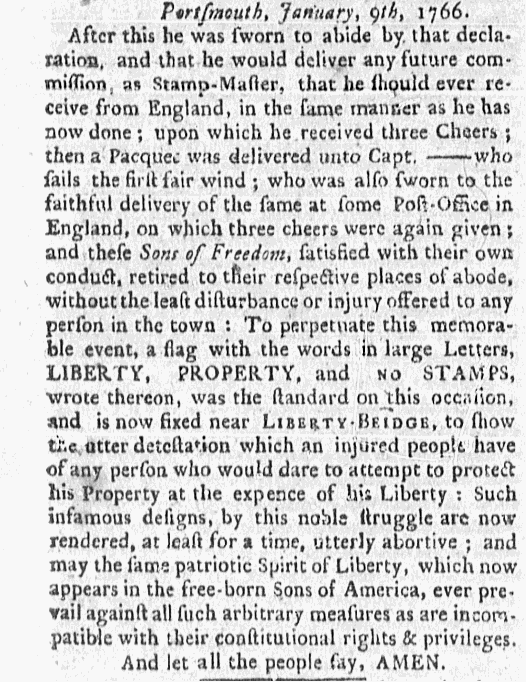
On January 6, 1766, a group of men who called themselves the Sons of Liberty made an effigy of George Grenville, the author of the Stamp Act, paraded it around, and burned it. To commemorate this event they erected a Liberty Pole bearing a flag with “LIBERTY, PROPERTY, and NO STAMPS.” On January 20, the Boston Evening-Post wrote up a story a few weeks after the event.

The Liberty Bridge was the bridge that crossed what used to be Puddle Dock, which has since been filled in. The Liberty Pole did not get its official marker or a permanent pole until 1824. But the Liberty Bridge was notable enough and recent enough to be prominently displayed in this advertisement. People of the region would also have known exactly where this landmark was and would have been able to find the shop.

Mar 28 - 1:20:1766 Boston Evening-Post
Boston Evening-Post (January 20, 1766).

**********

ADDITIONAL COMMENTARY:  Carl Robert Keyes

Even as Barnabas Clarke sold goods imported from England, the location he listed in his advertisement testified to the place he believed he and his fellow colonists inhabited in the British Empire. This place was not exclusively a geographic location but rather a sense of identity. “Near Liberty-Bridge” told potential customers where to find Clarke’s shop, but it also indicated the customary rights and privileges that Clarke and other colonists asserted they possessed. Mary selected an advertisement that, once again, demonstrates that advertising and consumption took on a political valence and encouraged colonists to think about the meanings of goods – social, cultural, and political – in the era of the American Revolution.

Nov 24 - 11:22:1765 New-Hampshire Gazette
New-Hampshire Gazette (November 22, 1765).

The Stamp Act had been repealed on March 18, 1766, ten days before this advertisement appeared, although it would take several weeks for word to arrive in the colonies. When that happened, colonists would also learn that the repeal of the Stamp Act had been accompanied by passage of the Declaratory Act, which asserted that Parliament had the authority to oversee and regulate the colonies. Liberty Poles and Liberty Bridges would continue to serve as potent symbols to colonists.

Dec 28 - 12:27:1765 New-Hampshire Gazette
New-Hampshire Gazette (December 27, 1765).

This advertisement also suggests how quickly colonists reconceived their surroundings. I have previously featured two advertisements Barnabas Clark(e) published in the New-Hampshire Gazette, one on November 1765 and the other in December 1765.* Both predated the activities of the Sons of Liberty on January 6, 1766, that Mary described. Protests by the Sons of Liberty were significant in their own right, but perhaps became increasingly effective as colonists remembered, commemorated, and incorporated them into their daily lives, including listing the location of their shops as “Near Liberty-Bridge.”

**********

*These two advertisements appeared via #Adverts250 on Twitter, prior to this blog launching on January 1, 2016.

March 25

GUEST CURATOR:  Elizabeth Curley

What was advertised in a colonial newspaper 250 years ago this week?

Mar 25 - 3:24:1766 Newport Mercury
Newport Mercury (March 24, 1766).

“Just imported in the Cornelia, Capt. Harvey, (via New-York) …”

This advertisement by merchant John Dockray caught my attention because of the fact that the goods came to the colonies via New York City before being sold in Newport, Rhode Island. The Cornelia, commanded by Capt. Harvey, was the ship that brought Dockray’s merchandise to New York. At this time Newport, itself a bustling port, was still smaller in size and population compared to New York or Boston.

The advertisement lists many different everyday goods for everyday people. Dockray clearly characterized these goods as “WINTER GOODS,” the uppercase letters and the placement made that the prominent and eye-catching feature. Due to the fact that it was March, colonists’ winter stores would be getting low as the season came to an end. With spring arriving soon, people would be getting ready for planting, farming, and other occupations.

Dockray also said that the store was attached to his house, which allowed for easy management and control.

**********

ADDITIONAL COMMENTARY:  Carl Robert Keyes

Elizabeth’s final observation, that Dockray operated his business in “his Store adjoining to his House,” allows us to further consider some of the ramifications of the work that she did yesterday when she located the general area where several colonists sold their wares using addresses from newspaper advertisements and trade cards in combination with maps of Boston from the period.

John Dockray’s situation was not unique. In yesterday’s featured advertisement Elizabeth Clark announced that she sold seeds “At her Shop near the Mill Bridge, BOSTON.” Clark most likely resided at the same location. In the featured advertisement from two days ago, William Symonds indicated that he sold his wares “at his house, the corner of Market and Second streets, opposite the Quaker Meeting-house” in Philadelphia. In the portion of the advertisement devoted to Mary Symonds’s millinery business, she reiterated that her merchandise was “in the corner shop in said house.”

Colonial Americans who lived in urban ports – like Newport, Boston, and Philadelphia – often tended to work at the same location where they lived, whether shopkeepers or artisans, unlike today’s practice of residing at one location and working elsewhere. An artisan’s workshop, for instance, might be on the first floor of the domicile, with the family residing upstairs. Or portions of a house could have been set aside for running a shop, as was the case with Mary Symonds.

As a result, the addresses included in colonial advertisements help us to reconstruct more than just the commercial landscape of early American cities and towns. In many instances they also tell us where a variety of people lived, helping us to better understand who lived in which neighborhoods and what kinds of relationships – social as well as economic – developed there.

March 24

GUEST CURATOR:  Elizabeth Curley

What was advertised in a colonial newspaper 250 years ago today?

Mar 24 - 3:24:1766 Boston-Gazette
Boston-Gazette (March 24, 1766).

Elizabeth Clark placed this advertisement to sell an assortment of seeds. She got her supplies “per Capt. Freeman” from London. The timing makes perfect sense, because April showers bring May, June, July, and August crops. With it being late March the planting season was right upon colonists in Boston and the rest of Massachusetts.

Anyone who frequently visits the Adverts 250 Project might notice that this advertisement seems repetitive. To be honest I had to review my work from my first week as guest curator in February. The historical impact that woman of the past have on women of the present and future interests me greatly so I try to pick advertisements that feature primarily woman if I am able. On February 17, I featured an advertisement from Lydia Dyar, who also sold garden seeds and had gotten them from Captain Freeman. In his additional commentary Prof. Keyes also pointed out an advertisement from yet another woman, Susanna Renken, who both sold seeds and bought them from Captain Freeman. All three of these woman posted similar advertisements, for mostly the same product, and bought their goods from the same man.

Two of them seem to have had shops in the same vicinity: Mill Creek. Susanna Renken states that her shop is “near the Draw Bridge” and Elizabeth Clark advertised that she was located “near the Mill Bridge,” which was located on Mill Creek. This trade card helped further convince me that these two woman shops were near each other because William Breck had a shop “at the Golden Key near the draw-Bridge Boston.”

Mar 25 - William Breck Trade Card
William Breck’s trade card (Paul Revere, engraver, ca. 1768).  This trade card is part of the American Antiquarian Society’s Paul Revere Collection.
Mar 24 - Nathaniel Abraham - 2:20:1766 Massachusetts Gazette
Massachusetts Gazette (February 20, 1766).

Nathaniel Abraham, who also regularly advertised in the Boston newspapers, listed “Sign of the Golden Key, in Ann-street” as his location too.

This map shows that Ann Street intersected Mill Creek.  The drawbridge crossed Mill Creek.  Elizabeth Clark, Susanna Renken, William Breck, and Nathaniel Abraham had shops located near each other.

Mar 24 - Detail of Map
Detail of A Plan of the Town of Boston.

**********

Mar 24 - Map of Boston.jpg
A Plan of the Town of Boston with the Intrenchments &ca. of His Majesty’s Forces in 1775, from the Observations of Lieut. Page of His Majesty’s Corps of Engineers, and from Those of Other Gentlemen (1777?).  Library of Congress.

**********

ADDITIONAL COMMENTARY:  Carl Robert Keyes

I am impressed with the way that Elizabeth mobilizes several different primary sources –newspaper advertisements, trade cards, maps – in a preliminary attempt to reconstruct neighborhoods and marketplaces in Boston in the 1760s. This is work that historians and scholars in related fields have undertaken on a grander scale.

I appreciate that Elizabeth draws attention to an aspect of eighteenth-century advertisements that has not yet received much attention here: when examined systematically the locations listed in the advertisements help us to understand not only the geography of early American towns and cities but also relationships of various sorts.

More than two decades would pass before publication of the Boston Directory, the city’s first directory that listed the occupations and residences of its inhabitants, in 1789. That and subsequent city directories from Boston and other urban centers in early America have been invaluable to historians, but such sources do not exist for earlier periods.

Elizabeth has discovered on her own – and helps to demonstrate – that newspaper advertisements provide more information than just lists of goods or attempts to convince potential customers to make purchases. They include valuable information about where people worked and where they lived, details that fill in some of the blanks for an era before city directories.

January 29

What was advertised in a colonial newspaper 250 years ago this week?

Jan 29 - 1:28:1766 Newport Mercury
Newport Mercury (January 28, 1766)

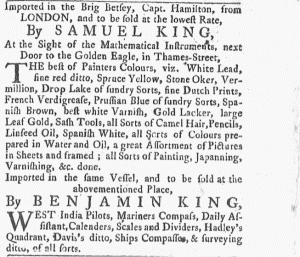
“At the Sight of the Mathematical Instruments, next Door to the Golden Eagle, in Thames-Street.”

Sometimes the directions for locating a business are just as interesting as the merchandise offered for sale, at least to someone observing from a distance of 250 years.  I’ve commented fairly regularly about various modes of identifying where a business happened to be located, especially when such directions crowded out appeals that could have marketed goods and services to potential customers.  (On the other hand, advertisers couldn’t sell anything if customers couldn’t find them.)  Last week I even made sport of an attorney who provided unnecessarily convoluted and legalistic directions to his office.  Providing adequate directions was a part of doing business in the days before standardized street numbers (an innovation that appeared in many American cities around the final decade of the century).

This advertisement does not make reference to cross streets or counting the number of doors after arriving at an intersection.  It simply states that this shop is located “At the Sight of the Mathematical Instruments, next Door to the Golden Eagle, in Thames-Street.”  Contemporary visual images of streetscapes in colonial American cities are relatively rare, but advertisements like this one help to envision what colonists would have seen as they went about their daily business.

Contemplating “the Sight of the Mathematical Instruments” or “the Golden Eagle” evokes days gone by.  It might even seem quaint, but I’m not certain that the American consumer landscape has changed as significantly as we might like to imagine.  After all, how many people actually know the street address of the fast food restaurant where they grab a quick lunch or the store where they buy everything from bread to toys to clothes?  I’m guessing that most people look for golden arches or a big red target rather than a street number.

Also, note what kinds of merchandise Benjamin King sells and the sign that announces the location of his shop to potential customers.  Clever.

January 11

What was advertised in a colonial newspaper 250 years ago this week?

Jan 11 - 1:10:1766 New-Hampshire Gazette
New-Hampshire Gazette (January 10, 1766)

“NATHANIEL BABB, Taylor, … informs his Customers and others, That he has removed from the Shop where he formerly Work’t to a new Shop.”

Who hasn’t heard a particular hackneyed phrase — “Location!  Location!  Location! — when contemplating buying a home or, especially, opening a business.  Nathaniel Babb understood that location was important:  he could not remain in business if former and potential customers did not know where to find him.  His advertisement offers few appeals to consumers (though he does indicate he was “ready with Fidelity and Dispatch”) in favor of instead making sure that they knew where to find him after his move to a new location.

Many shopkeepers and artisans used elaborate shop signs, such as the one seen below, to identify their places of business in eighteenth-century America (and England as well), but not everyone did so.  In an era before standardized street numbers, Babb offers convoluted directions:  his shop was “lately erected near the Corner of Clement Jackson’s, in the Street leading to the Canoe Bridge.”  Even if Babb had a sign to hang at his new shop, he still needed to direct customers to the general vicinity.

Philip Godfrid Kast Trade Card
Philip Godfrid Kast’s trade card engraved by Nathaniel Hurd in Boston in 1774 (American Antiquarian Society).

The druggist who issued this trade card included an image of his shop sign, an early form of branding that helped customers remember and locate his business.