September 29

What was advertised in a revolutionary American newspaper 250 years ago today?
Story and Humphreys’s Pennsylvania Mercury (September 29, 1775).

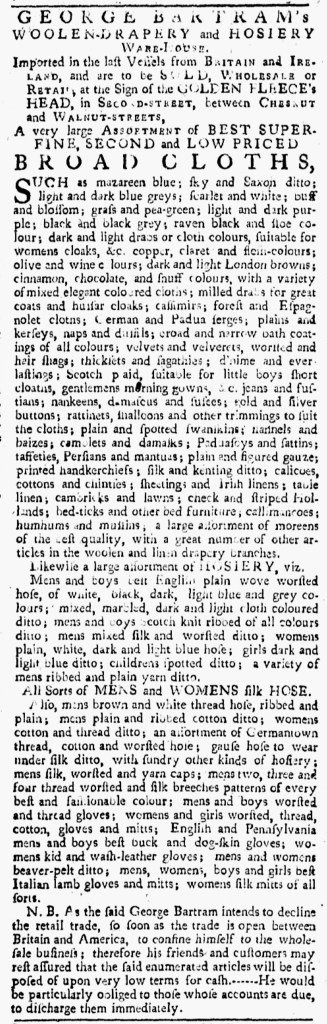
“George Bartram intends to decline the retail trade, so soon as the trade is open between Britain and America.”

As September 1775 came to a close, George Bartram advertised a “very large ASSORTMENT of BEST SUPERFINE, SECOND and LOW PRICED BROADCLOTHS” and “a large assort of HOSIERY” available at his “WOOLEN-DRAPERY and HOSIERY WARE-HOUSE … at the Sign of the GOLDEN FLEECE’s HEAD” in Philadelphia.  He listed dozens of different kinds of textiles and hose for men, women, and children as well as an array of gloves and mittens.  Bartram stated that he imported that merchandise “in the last Vessels from BRITAIN and IRELAND,” but he may have meant the last ships to arrive before the Continental Association went into effect nearly ten months earlier.  After all, he acknowledged in a nota bene that the colonies were not trading with Britain at the time he placed his advertisement.

That nota bene also included a clarification about Bartram’s plans for his business.  In March, he had advertised that he was “resolved to decline his Retail Trade” and would “sell his Stock of Goods on Hand at the very lowest Rates.”  A headline proclaimed, “Now SELLING OFF.”  That gave the impression that Bartram was holding a going out of business, yet his subsequent advertisement suggests that was not his intention at all.  Instead, he planned to shift his emphasis.  “[S]o soon as the trade is open between Britain and America,” he would “decline the retail trade … to confine himself to the wholesale business.”  His “WOOLEN-DRAPERY and HOSIERY WARE-HOUSE” would not close after all, but that did not mean that customers could not find bargains when they visited the familiar Sign of the Golden Fleece’s Head.  For the moment, Bartram continued to serve retail customers, assuring them that “the said enumerated articles will be disposed of upon very low terms.”

Bartram did not know when trade with Britain would resume.  He placed his previous advertisement before hostilities broke out at Lexington and Concord.  He attempted to earn his livelihood as he navigated current events, not knowing when the conflict would end, hoping that good deals would convince customers to continue shopping at his “WOOLEN-DRAPERY and HOSIERY WARE-HOUSE” even as they kept their eyes on news arriving from Boston.
February 12

What was advertised in a colonial American newspaper 250 years ago today?

Providence Gazette (February 12, 1774).

“As low Rates as can be purchased at any Shop or Store in Boston or elsewhere.”

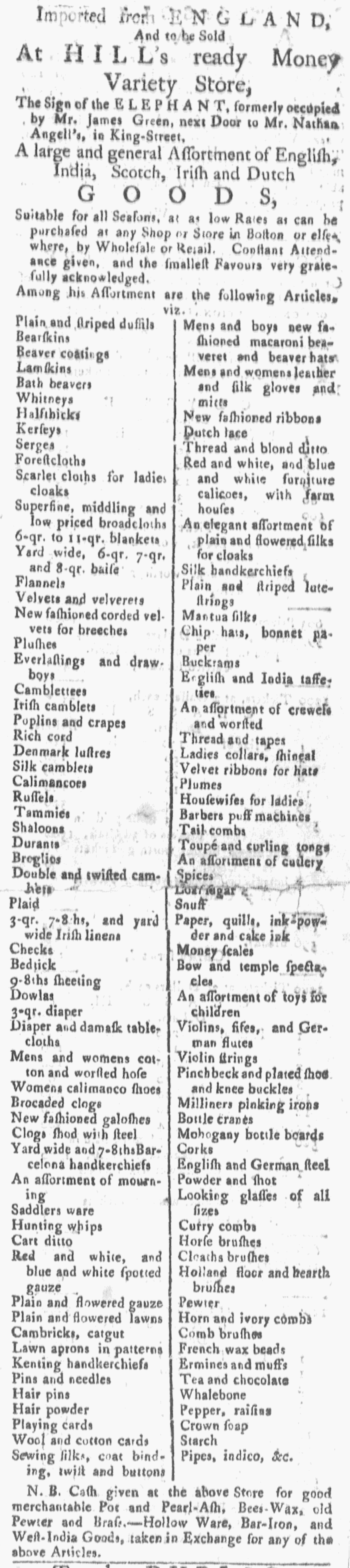
When the proprietor of “HILL’s Variety Store” took to the pages of the Providence Gazette near the end of January 1774, his advertisement promoted a “compleat Assortment of English, Scotch and India Goods,” listed about a dozen items, and promised “every other Article usually imported, too many to be enumerated in this Week’s Paper.”  That final note suggested that either the printer had truncated the advertisement due to space constraints or the advertiser had not yet compiled a more complete inventory to insert in the public prints.  It may very well have been the latter, considering that three weeks passed before a more extensive advertisement appeared in the Providence Gazette.

And more extensive it certainly was!  That advertisement filled nearly an entire column in the February 12 edition.  The merchant devoted most of that space to a catalog of “English, India, Scotch, Irish and Dutch GOODS,” demonstrating the range of choices available to consumers.  Divided into two columns with only one item per line, making it easier for readers to navigate than the dense paragraphs of text in some advertisements, this notice included many kinds of textiles and accessories, “Womens calamanco shoes,” “Mens and boys new fashioned macaroni beaveret and beaver hats,” “Mens and womens leather and silk gloves and mitts,” “Pinchbeck and plated shoe and knee buckles,” “Violins, fifes, and German flutes,” and even an “assortment of toys for children.”  Prospective customers could expect to discover much more at “HILL’s ready Money and Variety Store.”  (The variation on the name suggested that they would need to pay at the time of sale rather than purchase on credit, but a note at the end of the advertisements indicated “Hollow Ware, Bar-Iron, and West-India Goods, taken in Exchange for any of the above Articles.”)  The list of goods began with a clarification that “Among his Assortment are the following Articles,” while the catalog concluded with “&c.” (an abbreviation for et cetera) to signal that even more was available at the store.

Yet such appeals to consumer choice were not the only marketing strategies deployed by the merchant.  A preamble to his inventory reported that he sold his goods both wholesale and retail “at as low Rates as can be purchased at any Shop or Store in Boston or elsewhere.”  He realized that he did not compete solely with local merchants and shopkeepers but also with their counterparts in Boston, Newport, New York, and other towns.  He did not want shopkeepers in the countryside turning to importers in other ports to supply their inventory.  Such wholesale purchases could amount to significant revenue.  At the same time, he did not ignore consumers interested in retail purchases.  The merchant stated that “the smallest Favours” or purchases would be “gratefully acknowledged.”  Between the selection and the prices, he hoped prospective customers would come to the “Sign of the ELEPHANT” in King Street to acquire goods they needed to supplement inventories at their own shops or that they wanted for their own use.

October 22

What was advertised in a colonial American newspaper 250 years ago today?

New-Hampshire Gazette (October 22, 1773).

“A neat and elegant Assortment of MERCERY, HABERDASHERY, and WOOLEN GOODS.”

Daniel Fowle, the printer of the New-Hampshire Gazette, apparently experienced some sort of disruption in his paper supply in the fall of 1773.  For several weeks, he issued a broadsheet newspaper with four columns on each side rather than the usual standard edition that consisted of three columns on each of four pages.  That meant that he delivered eight columns of news, advertising, and other contents rather than twelve.  It was not the first time in recent years that Fowle made some sort of substitution when he did not have access to sheets of the usual size.

In this instance, that meant Thomas Achincloss’s lengthy advertisement in the October 22 edition accounted for an even greater proportion of the space on the broadsheet than if it had appeared in a standard issue at some other time.  It filled half a column.  Achincloss advised readers that he recently imported and offered for sale a “neat and elegant Assortment of MERCERY, HABERDASHERY, and WOOLEN GOODS,” though most of the advertisement consisted of an extensive list of his wares.  He stocked “Calicoes, newest Patterns,” a “Genteel Assortment of Chintzes,” and “Laces, Knee Straps, [and] Necklaces, different qualities, newest and most fashionable,” along with a variety of other textiles and accessories enumerated in his notice.  Achincloss supplemented that merchandise with a “neat Assortment of Hardware,” an “assortment of Bibles and Testaments, also of various Books and Stationary Ware,” and “Men’s Saddles” and “Riding Whips.”  He presented a multitude of choices to consumers in Portsmouth and nearby towns.

Achincloss realized that promoting this selection may not have been enough to draw prospective customers to his shop.  To incite demand, he made appeals to price before and after describing his inventory.  He initially stated that he sold his goods “at a very low advance” (or only a small markup), but went into more detail in a nota bene at the end of the advertisement.  “The Public may depend, and be assured,” Achincloss declared, “that the Goods being from first Hands and Manufacturers, will be afforded upon as low terms, as any in the place can.”  In other words, Achincloss claimed that he acquired these goods directly from the producers rather than middlemen merchants.  That kept his costs low, allowing him to pass along the savings to his customers.  In turn, he set competitive prices that matched the best deals available in Portsmouth.

The amount of space that Achincloss’s advertisement occupied may have attracted attention.  Once readers perused it, they encountered an array of choices, especially among the dozens of textiles that the shopkeeper listed, as well as assurances of low prices.  In crafting this notice, Achincloss deployed some of the most common marketing strategies in use throughout the colonies.

October 16

What was advertised in a colonial American newspaper 250 years ago today?

Maryland Journal (October 16, 1773).

“As they are but new beginners, country merchants may depend on being served with any of the above articles at the lowest rates.”

When Daniel McHenry and Son advertised their “Wholesale and Retail store, on the east side of Calvert-street” in Baltimore in the October 16, 1773, edition of the Maryland Journal, they described themselves as “new beginners.”  Though they had little experience as merchants and shopkeepers, their advertisement followed a format familiar to readers and consumers.  Advertisements for goods and services were so ubiquitous by the 1770s that “new beginners” could craft their own newspaper notices by selecting from among many standard elements that regularly appeared in advertisements throughout the colonies.

McHenry and Son, for instance, emphasized consumer choice.  They described their inventory as “a large and various assortment of merchandize.”  To demonstrate, they listed more than two dozen items from among their “DRY GOODS,” mostly textiles but also “playing cards, rose and Indian blankets, [and] women’s made up cloaks.”  They promised that they stocked “HARD-WARE,” but did not enumerate any of those items.  McHenry and Son devoted a separate list to “GROCERIES.”  Both lists concluded with “&c.” (an abbreviation for et cetera) to indicate that customers would discover so much more on the shelves when they visited the store.  Additional elements of the advertisement replicated other newspaper notices.  McHenry and Son sold goods “suitable to the season.”  They also assured prospective customers that they carried new goods rather than hawking leftovers; they acquired their merchandise via “the last vessels from London, Liverpool, Ireland,” and other ports.  McHenry and Son also promoted “the quality of their goods” and low prices or “the lowest rates” for their customers, especially “country merchants” looking to stock their own shops.

McHenry and Son sought to take advantage of common advertising strategies to entice customers.  At the same time, they attempted to leverage their status as “new beginners,” asking prospective customers to take into account their willingness to set lower prices (for goods of the same quality) compared to merchants with more experience.  To establish their reputations and secure their position in the marketplace, McHenry and Son offered the best bargains in hopes that doing so “will induce the public to give them a trial” and then continue purchasing from them in the future.  They made their status as “new beginners” a selling point, even as they crafted an advertisement that otherwise testified to their understanding of what mattered most to colonial consumers.

October 6

What was advertised in a colonial American newspaper 250 years ago today?

Pennsylvania Gazette (October 6, 1773).

“He flatters himself, it is in his power to sell as low as any shop or store in the city.”

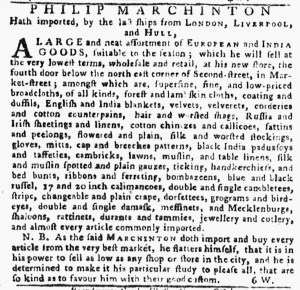
Philip Marchinton commenced a new advertising campaign at the beginning of October 1773.  His advertisements in the October 6 issues of the Pennsylvania Gazette and the Pennsylvania Journal both included a notation, “6 W,” that advised the compositors to run them for six weeks and then remove them from those newspapers.  Marchinton did not anticipate that anyone outside the printing offices would pay much attention to those notations.  Instead, he wanted prospective customers to focus on the “LARGE and neat assortment of EUROPEAN and INDIA GOODS” that he recently imported “by the last ships from LONDON, LIVERPOOL, and HULL.”

Marchinton’s advertisements followed a familiar format.  They commenced with a brief description of where and when he acquired his merchandise, suggesting to consumers that he did not merely peddle leftovers that he had not been able to sell.  The merchant declared that his new inventory was “suitable to the season” and made an appeal to price, offering “the very lowest terms.”  He devoted most of the advertisement to demonstrating the choices available his “assortment” of goods, listing a variety of textiles as well as “silk and worsted stockings” and “jewellery and cutlery.”  In addition, he claimed to stock “almost every article commonly imported,” putting him in competition with Andrew Bunner, William Price, and other merchants and shopkeepers who ran advertisements in the several newspapers published in Philadelphia.

Marchinton deviated from that familiar format in the final lines of his advertisement.  He appended a nota bene in which he provided a short explanation about how he could “sell at the very lowest terms,” circling back to the appeal that he made before listing his wares.  The merchant explained that he “doth import and buy every article from the very best market.”  In the process, he avoided unnecessary markups.  As a result, “it is in his power to sell as low as any shop or store in the city.”  He did not go into greater detail, content with reminding prospective customers of his low prices before making a final pledge “to make it particular study to please all, that are so kind as to favour him with their good custom.”  Low prices and good customer service went hand in hand at Marchington’s store.  Like many other merchants and shopkeepers, Marchinton mostly adhered to a familiar format while choosing a small variation to distinguish his advertisement from others.

September 30

What was advertised in a colonial American newspaper 250 years ago today?

Supplement to the Massachusetts Gazette and Boston Weekly News-Letter (September 30, 1773).

“At such Rates as may encourage all Retailers in Town and Country … to complete their Assortments.”

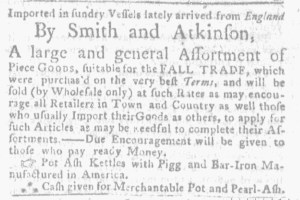
Smith and Atkinson encouraged shopkeepers in and near Boston to augment their inventories for the fall season.  In an advertisement that appeared in several newspapers in September 1773, the merchants announced that they carried a “large and general Assortment of Piece GOODS, suitable for the FALL TRADE” that they “Imported in sundry Vessels lately arrived from England.”  These were not leftovers from last year, Smith and Atkinson suggested, but instead new merchandise to enhance the offerings of “all Retailers in Town and Country.”  Those prospective customers needed such items “to complete their Assortments” and attract the attention of consumers.  They knew that shopkeepers emphasized providing choices for consumers in their own advertisements.

For their part, Smith and Atkinson did not deal with shoppers directly.  The merchants confined their business to wholesale purchases only, supplying shopkeepers with goods at advantageous prices.  Smith and Atkinson proclaimed that they acquired their shipments “on the very best Terms” and planned to pass along the bargains “at such Rates as may encourage” shopkeepers to do business with them rather than their competitors.  As further inducement, the merchants declared that they gave “Due Encouragement … to those who pay ready Money.”  In other words, cash purchases qualified for additional discounts.

Smith and Atkinson competed with other merchants who made similar appeals while also attempting to distinguish themselves in the marketplace.  In the September 30, 1773, edition of the Massachusetts Gazette and Boston Weekly News-Letter, James and Patrick McMasters and Company similarly advertised a “large and general Assortment of English, India, and Scotch GOODS, suitable for the Season” that they “imported in the last Ships from LONDON.”  While they did not specify that they sold “by Wholesale only” like Smith and Atkinson, McMasters and Company did assert that “Town and Country Merchants and others who are pleased to favour them with their Custom, may depend on the best Usage, and handsome Allowance to those who buy by the Quantity.”  They offered discounts for purchasing in volume rather than discounts for cash.  Some retailers may have found that marketing strategy more appealing.

In another advertisement, Amorys, Taylor, and Rogers declared that they sold a “general Assortment of GOODS Suited to the Season … at the lowest Rates, by Wholesale or Retail.”  Other merchants inserted advertisements with their own variations in their efforts to move their merchandise.  They did not expect that they could merely announce that they had goods for sale and then expect retailers to purchase them.  Instead, merchants devised marketing strategies to entice shopkeepers to acquire merchandise from them.  In turn, shopkeepers crafted strategies for inciting demand among consumers rather than relying on incipient demand.

May 9

What was advertised in a colonial American newspaper 250 years ago this week?

Massachusetts Gazette and Boston Weekly News-Letter (May 6, 1773).

“His Store is the cheapest after all is said and done, &c. &c. &c. &c.”

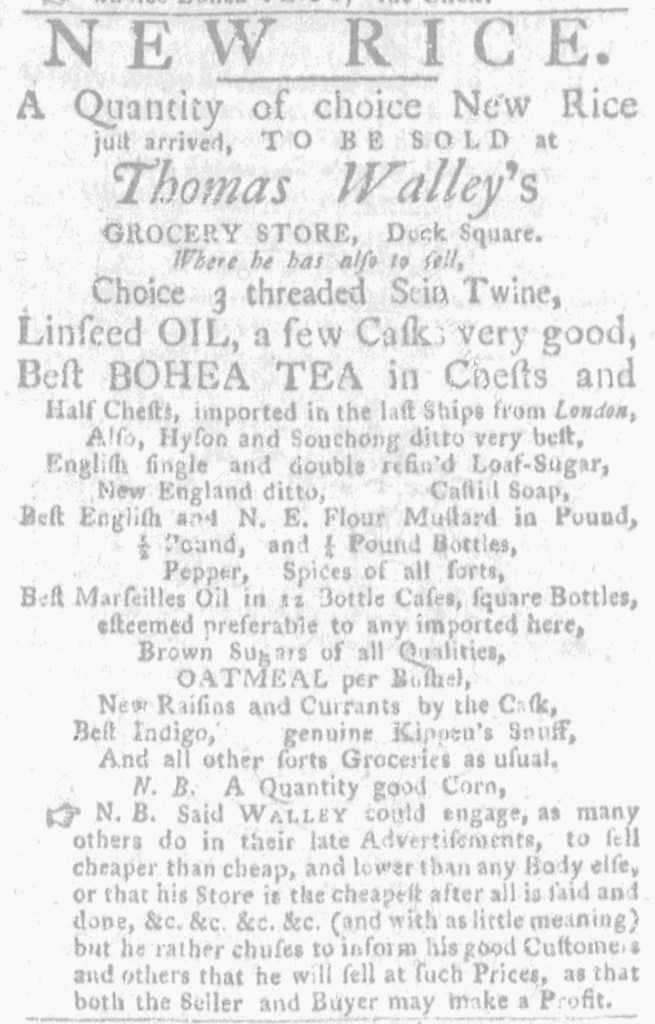
Thomas Walley stocked a variety of items at his “GROCERY STORE” on Dock Square in Boston in the spring of 1773.  In an advertisement in the May 6 edition of the Massachusetts Gazette and Boston Weekly News-Letter, he listed many of those items, from “New Rice” to “BOHEA TEA” to “Flour Mustard” to “Brown Sugars of all Qualities.”

Walley concluded his advertisement with a lively nota bene that commented on the marketing strategies deployed in the city’s newspapers by various purveyors of goods.  He stated that he “could engage, as others do in their late Advertisements, to sell cheaper than cheap, and lower than any Body else, or that his Store is the cheapest after all is said and done, &c. &c. &c. &c.”  The string of “&c.” (which modern readers would recognize as “etc. etc. etc. etc.”) communicated his exasperation with advertisers who went on and on about the bargains that they made available to their customers.  More bluntly, he declared that if he did the same that it would have “as little meaning,” something that he suspected both advertisers and savvy consumers realized.  Instead of making bold claims about his prices to dazzle prospective customers, Walley considered simplicity and honesty the better means of cultivating relationships of trust.  He “rather chuses to inform his good Customers and others that he will sell at such Prices, as that both the Seller and the Buyer may make a Profit.”  In other words, both parties got a good deal.

Walley’s approach echoed the one taken by Samuel Flagg when he advertised imported goods available at his store in Salem several months earlier.  Flagg proclaimed that he did not “mean to make such a Parade, not furnish the Publick with so many pompous Promises (as have lately been exhibited) of Goods being so amazingly cheap, but would rather convince them of the Cheapness of his Goods and of his Integrity in dealing, whenever they may please to call and favour him with their Custom.”  When it came to engaging prospective customers with his advertisements, he did not wish to “tell them a Story” like in “so many flashy Advertisements as weekly present themselves.”  Flagg asserted that such stories had no “true Meaning” … and readers knew that as well as he did.

Both Walley and Flagg saw critiquing advertising as the most effect means of marketing their wares.  They flattered readers by suggesting that they all knew that other advertisers inflated their claim yet Walley and Flagg would not insult the intelligence of their prospective customers.  Instead, they opted for honesty and integrity in presenting prices that worked to the advantage of both the shopkeepers and consumers.

May 1

What was advertised in a colonial American newspaper 250 years ago today?

Providence Gazette (May 1, 1773).

“He proposes to sell for Cash, cheaper than he has ever yet done.”

Several merchants and shopkeepers advertised “English and India GOODS” in the May 1, 1773, edition of the Providence Gazette, noting that they recently received new inventory via ships from London and other English ports.  In addition to that headline, John Brown provided an extensive list of his merchandise.  Most others, however, inserted much shorter advertisements that emphasized consumer choice without cataloging their wares.  Caleb Greene and Welcome Arnold, for instance, promoted a “new and compleat ASSORTMENT of English and India GOODS.”  Similarly, Jabez Bowen hawked a “very neat Assortment of Summer GOODS,” while Ebenezer Thompson advertised a “fresh ASSORTMENT of all Kinds of English and India GOODS.”  If prospective customers wanted to know more about the particulars, they needed to visit those shops and stores.

That was also the case for the “fine ASSORTMENT of Spring and Summer GOODS” that Samuel Young “has just received by the last Vessels from England.”  In his efforts to convince prospective customers to browse his merchandise and make purchases from him rather than his competitors, Young declared that he set prices “cheaper than he has ever yet done.”  He had been in business at the same location “opposite the Baptist Meeting-House” for several years, so many local consumers presumably had some sense of his prices relative to those of Brown, Greene and Arnold, Bowen, Thompson, and other merchants and shopkeepers in the city.  Even if some considered Young’s prices higher than those of his competitors, he gave an incentive to consider shopping in his store when he asserted that he offered his best bargains ever.  He challenged the curious to discover the extent that he slashed prices for themselves.

Although Young lowered his prices, another aspect of his business remained the same.  He advised readers of the Providence Gazette that the “Sign of the Black Boy” marked the location of his shop.  Young received his “fine ASSORTMENT of Spring and Summer GOODS” from England, but consumers knew that route was only one part of transatlantic networks of trade and exchange that connected Europe, Africa, and the Americas.  Other routes, some of them plied by vessels owned by wealthy merchants in Providence, carried involuntary migrants, enslaved men, women, and children, from Africa to the Americas.  Some of those who survived the Middle Passage labored on plantations in the Caribbean, where they harvested sugar and other “West-India Goods” that Young also advertised.  The “Sign of the Black Boy” testified to the extent that consumer culture in Providence relied on slavery and the slave trade throughout the early modern Atlantic World.  Young offered bargain prices to his customers, but enslaved men, women, and children paid much higher costs in making available the imported goods sold at shops and stores in Providence and other colonial towns and cities.

April 19

What was advertised in a colonial American newspaper 250 years ago today?

Boston Evening-Post (April 19, 1773).

Those who are acquainted with his Prices, will not need to be told that he sells at low Rates.”

Samuel Eliot made consumer choice and low prices the centerpieces of the advertisement he inserted in the April 19, 1773, edition of the Boston Evening-Post.  He first established that he stocked a “very fine Assortment of English and India Piece GOODS.”  He also stated that his inventory included a “Variety of Genteel Looking-Glasses” as well as “Stationary, Cutlery, and Hard Ware.”  He did not provide as extensive a list of individual items as Caleb Blanchard did for his “large and general Assortment of English and India GOODS” or Daniel Waldo did for his “compleat Assortment of London, Bristol, Birmingham, and Sheffield Hard Ware Goods,” but he did conclude with “&c. &c.” (an abbreviation for et cetera) to indicate that he sold goods beyond those that appeared in his advertisement.

Rather than listing dozens of items like some of his competitors, Eliot devoted more attention to promoting his prices.  In a paragraph that appeared in italics, he declared, “Those who are acquainted with his Prices, will not need to be told that he sells at low Rates.”  Even though they did not need to be told, Eliot offered a reminder that simultaneously presented an opening for elaborating on his prices for “those who are not” already aware of the bargains he offered.  He invited them “to call on him,” confidently asserting that once they visited his shop near Dock Square or his store on Wilson’s Lane they “shall be satisfied he makes no idle Profession, when he engages to sell his Goods on the most reasonable Terms.”  Eliot suggested that he set such low prices that many consumers already associated good deals with his merchandise.  For those not already aware, he issued a challenge to confirm his “low Rates” for themselves.  Getting prospective customers into one of his locations, Eliot likely surmised, increased the chances of making sales, especially if his prices were indeed as low as he suggested.  Other merchants and shopkeepers, like Ebenezer Storer, made passing references to “the lowest Rates” for their goods.  Eliot, in contrast, encouraged engagement with readers of the Boston Evening-Post by creating a narrative around his prices.

December 11

What was advertised in a colonial American newspaper 250 years ago today?

New-London Gazette (December 11, 1772).

“All the above articles will be sold lower than can be bought either in [New] York or Boston.”

In the fall of 1772, Ebenezer Backus, Jr., ran multiple advertisements for goods available at his store in Norwich, Connecticut, in the New-London GazetteOne of those advertisements may very well have circulated separately as a broadside or handbill.  It occupied almost an entire page in the November 20 edition.  An advertisement of that size would have been expensive.  In subsequent issues, Backus published another advertisement, one more in line with the length of advertisements published by other purveyors of goods and services.

Like the longer advertisement, the shorter version included a list of goods.  To help prospective customers navigate that list, Backus divided his notice into two columns with only one or two items per line rather than including everything in a paragraph of dense text.  He stocked a variety of textiles, including checks, ginghams, damasks, “Pelong Sattins,” and “Plain Sattins” as well as accessories like buttons, “Barcelona Handkerchiefs of different colours,” and a “Compleat assortment of Ribbons.”  Beyond merchandise intended for making garments, Backus also sold “Cream coloured Ware of all Kinds.”

Although Backus included fewer goods in this advertisement than his previous one, he did add a new marketing appeal with the intention of capturing the attention of prospective customers.  In a nota bene that concluded the notice, Backus asserted that “All the above articles will be sold lower than can be bought either in [New] York or Boston.”  Consumers in and around Norwich may have expected to pay more to acquire goods in the small town of Norwich than in the region’s major urban ports, but Backus assured them that was not the case.  He hoped to entice them with bargains as good or even better than they would encounter elsewhere.  In so doing, he demonstrated that the consumer revolution reached even small towns where colonizers had access to the same goods at the same prices as their counterparts in the largest cities in the colonies.