September 3

What was advertised in a revolutionary American newspaper 250 years ago this week?
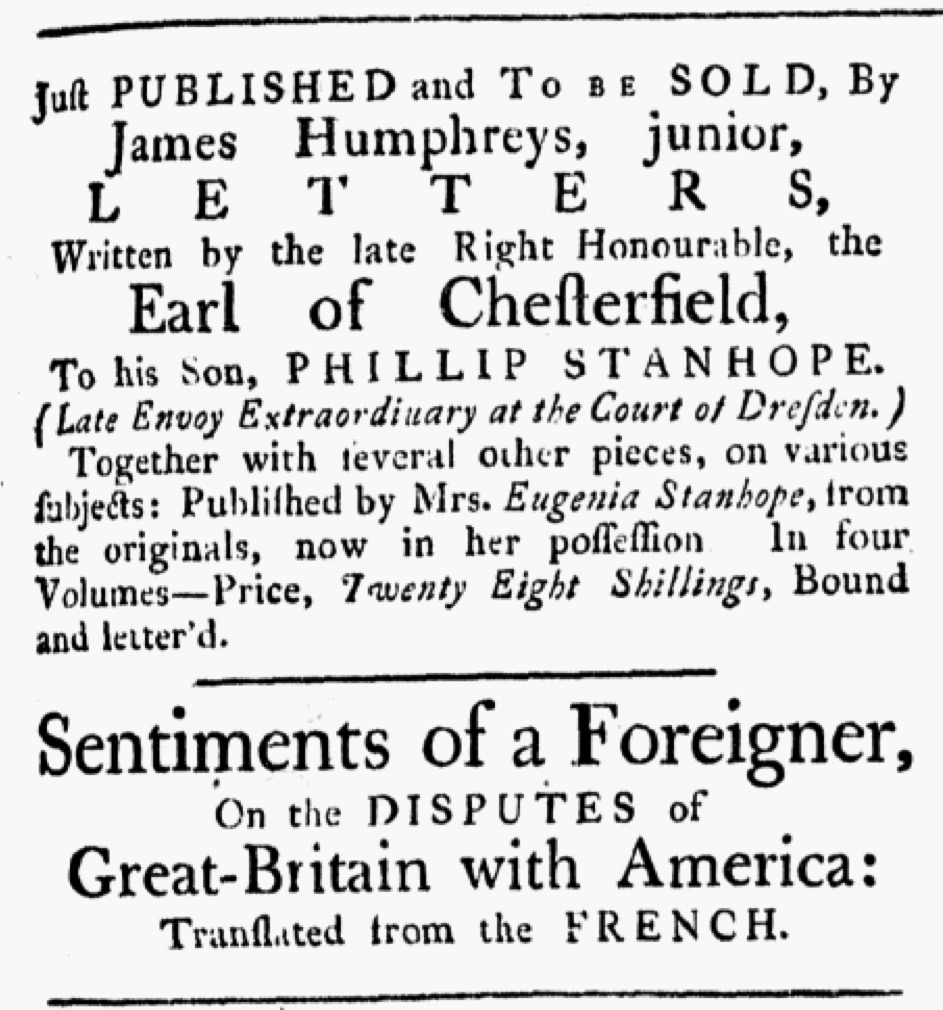
Pennsylvania Ledger (September 2, 1775).

“LETTERS, Written by the late Right Honourable, the Earl of Chesterfield, To his Son.”

James Humphreys, Jr., led the September 2, 1775, edition of the Pennsylvania Ledger with an advertisement for Letters by the Late Right Honourable, the Earl of Chesterfield, to His Son, Phillip Stanhope.  Although the header proclaimed, “Just PUBLISHED and TO BE SOLD, By James Humphreys, junior,” the printer of the Pennsylvania Ledger merely sold copies of a book printed by others.  As was often the case, the phrase “Just PUBLISHED” meant that a book, pamphlet, print, or other items was now available for purchase, but advertisers expected readers to separate “Just PUBLISHED” and “TO BE SOLD.”  Only the latter applied to the advertiser.  In this case, Humphreys likely stocked copies of an American edition printed by Hugh Gaine and James Rivington in New York.

Prospective customers did not care nearly as much about who printed the book as they did about the contents.  The advertisement (drawn from the extended title of the work) indicated that it consisted of four volumes that contained the Earl of Chesterfield’s letters “Together with several other pieces, on various subjects: Published by Mrs. Eugenia Stanhope, from the original, now in her possession.”  The earl had written 448 letters to his son between 1737, when the boy was five, and his death in 1768.  At that time, the early learned that his son had been secretly wed for a decade and had two sons of his own.  The earl provided for his grandsons but did not support their mother.  In turn, she published the collection of letters.

The letters caused a stir in both Britain and America.  They presented a guide to manners for gentlemen to navigate aristocratic society, prompting colonizers concerned with demonstrating their own gentility to take note of the advice the earl offered to his son.  Yet readers did not universally celebrate the attitude and conduct the early advocated.  Some critiqued what they considered cynical and amoral values contained within the letters.  While Gaine and Rivington may have found eager audiences for the letters in New York and Humphreys in Philadelphia, readers from New England, the descendants of Puritans, were much more skeptical.  Gwen Fries notes that John Adams refused to send Abigail a copy in 1776, advising her that the letters were “stained with libertine Morals and base Principles.”  When she did read them a few years later, she agreed that they contained “the most immoral, pernicious and Libertine principals.”  In confining his advertising copy to the extended title of the work, Humphreys did not take a position.  He likely suspected that even those who had heard that the letters included some unsavory advice would be curious to assess what Chesterfield wrote for themselves.  Many others in Philadelphia, the largest and most cosmopolitan city in the colonies, may not have cared much at all about the sorts of objections raised by readers in Boston.

April 28

GUEST CURATOR: Patrick Waters

What was advertised in a colonial American newspaper 250 years ago today?

New-Hampshire Gazette (April 28, 1769).

“A SCHOOL for teaching young MASTERS and MISSES, DANCING and GOOD MANNERS.”

Peter Curtis took out an advertisement in the April 28, 1769, edition of the New Hampshire Gazette to advertise his dance school. This advertisement is particularly interesting because it demonstrates one of the ways that people found entertainment in the eighteenth century. The lives of colonists during the revolutionary era were not focused only on work and survival. The services that Peter Curtis offered might have been a great way for people to take a break and learn how to dance. The profession of dance master could be quite rewarding because, according to an online exhibition from the American Antiquarian Society, these dances were difficult to master and would require many classes. However, having the time and money to attend a dance class would have been a luxury that mostly the middling sort and elites would have been able to take advantage of. In another part of this advertisement that is interesting Curtis states that he will also teach good manners. This would be a must for elites who wanted their children to learn the proper way to behave themselves when in the company of other affluent members of society. A common way that people asserted their affluence was through consumer culture, but being able to dance and have well-mannered children also accomplished the same goal.

**********

ADDITIONAL COMMENTARY: Carl Robert Keyes

In this advertisement Peter Curtis announced that he “has again opened a SCHOOL for teaching young MASTERS and MISSES, DANCING and GOOD MANNERS.” In declaring that he had “again opened a SCHOOL,” he assumed that readers and prospective clients were already aware of his previous endeavors as a dancing master. The brevity of his advertisement, especially compared to another he previously inserted in the New-Hampshire Gazette, suggests that was indeed the case. For instance, Curtis did not even state his location; he instead expected that others knew where to find his dancing school. In an advertisement that ran almost two years earlier, however, when Curtis launched that enterprise, he informed residents of Portsmouth that “he proposes to open a DANCING SCHOOL, at the House where the late Mr. David Horney kept a Tavern, and opposite Mr. John Stavers.” Over the course of a couple of years, his school became so familiar that Curtis no longer considered it necessary to give directions.

The dancing master himself had also become familiar in the community, so much so that he no longer underscored one of his most important credentials. When he first opened his school he introduced himself in the public prints as “Peter Curtis, From PARIS.” After outlining his services, he noted that he “has resided fifteen Years in France; he will teach them in the most polite and genteel Manner.” In so doing, he linked the experience he gained living and working in France with gentility and proper comportment. He encouraged prospective clients to desire the additional cachet of employing a dancing master with connections to Paris, at least when he first marketed his services in a community as yet unfamiliar with him. Over time, however, he apparently decided that he had established such a reputation in Portsmouth that he no longer needed to explicitly attach himself to the cosmopolitan French center of fashion and manners.

That Curtis once again advertised in the New-Hampshire Gazette suggests that he experiences some success in Portsmouth and its environs. Dancing masters were notorious for being itinerant in eighteenth-century America. Curtis apparently attracted enough clients and cultivated sufficient demand that he planned to remain in the relatively small port for another season rather than seek his fortune in New York or Philadelphia or any of the larger cities in the colonies. Even beyond urban centers, genteel colonists (and those who aspired to gentility) considered dancing and the manners associated with the pastime an important signifier of their status.