August 2

What was advertised in a revolutionary American newspaper 250 years ago today?
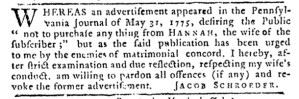
Pennsylvania Journal (August 2, 1775).

“I hereby … am willing to pardon all offences (if any) and revoke the former advertisement.”

It was a rare retraction.  Jacob Schroeder asked the public to disregard the advertisement he placed regarding his wife, Hannah, a few months earlier.  Some sort of marital discord occurred within the Schroeder household, prompting Jacob to run an advertisement with these instructions: “ALL persons are forewarned trusting, or purchasing any thing from HANNAH SCHROEDER the wife of the Subscriber, as he will pay no debts of her contracting from the date hereof.” Similar advertisements regularly appeared in newspapers throughout the colonies, sometimes more than one in a single issue.  Usually, they indicated that a wife had “eloped” or run away from her husband.  In turn, the husband instructed merchants, shopkeepers, artisans, and others not to allow his wife access to his credit.  Such advertisements often alleged various kinds of bad behavior perpetrated by the wife.  However, husbands set the narrative.  In many instances, the wife likely removed herself from an unhappy or even abusive marriage.  Deprived of credit, most did not have an opportunity to publish their side of the story, though occasionally a wife did find the means to respond in an advertisement.

Retractions made by the husbands were also few and far between in early American newspapers, making Jacob’s advertisement even more noteworthy.  “WHEREAS an advertisement appeared in the Pennsylvania Journal of May 31, 1775, desiring the Public ‘not to purchase any thing from HANNAH, the wife of the subscriber,’” he wrote, “but as the said publication has been urged to me by the enemies of matrimonial concord, I hereby, after strict reflection, respecting my wife’s conduct, an willing to pardon all offences (if any) and revoked the former advertisement.”  He did not offer additional details.  A shorter advertisement cost less, but a desire to avoid as much public scrutiny as possible may have been the deciding factor in not elaborating on the “offences (if any)” or the insinuations made to Jabob by “the enemies of matrimonial concord.”  After all, it would have been embarrassing enough to resort to an advertisement in the first place, an admission that Jacob had been unable to exercise proper authority within his own household.  That the details of Jacob and Hannah’s did not appear in print did not mean that they did not circulate in their neighborhood and beyond.  Those “enemies of matrimonial concord,” whether relatives, friend, or acquaintances, likely gossiped about the couple, as did others.  The appearance of both Jacob’s original advertisement and his retraction may have sparked more conversations and speculation about what occurred in the Schroeder household.  The newspaper notices captured only part of the story.
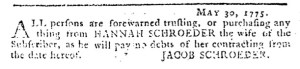
Pennsylvania Journal (May 31, 1775).

September 13

What was advertised in a colonial American newspaper 250 years ago today?

Massachusetts Gazette and Boston Post-Boy (September 13, 1773).

“After reading the above I leave the World to judge of my unhappy State.”

Most newspaper advertisements concerning runaway wives went unanswered, at least in the public prints.  Friends, neighbors, and acquaintances almost certainly discussed the circumstances of the marital discord that prompted wives to depart from the households of their husbands, sharing what they knew or heard from others and checking for new developments when they engaged in the rituals of gossip.  On occasion, however, some of those wives published their own advertisements in response.  Such was the case with Judith Walker.

Her husband, Simeon, inserted an advertisement in the March 29, 1773, edition of the Massachusetts Gazette and Boston Post-Boy.  It ran for three weeks.  Simeon did not provide much detail, instead resorting to formulaic language that readers would have associated with any notice from the genre.  “WHEREAS Judith, my Wife,” Simeon announced, “has Eloped from me, and refuses to Bed and Board with me:— I now forbid all Persons trusting her on my Account, as I will not pay any Debt of her contracting after this Date.”  Curiously, Simeon dated the advertisement January 18, though it did not run until ten weeks later.

Judith’s response was anything but formulaic.  She spilled a lot more ink than her estranged husband, first citing his advertisement and then offering her reasons for “absenting myself from him.”  Judith asserted that Simeon did not provide “the common Necessaries of Life,” but instead perpetrated “abusive Treatment … for a Number of Years.”  She contended that Simeon “oblig[ed] me to take the Care of Cattle thro’ several Winters, and many unreasonable Tasks he used to compel me to, which I, nor scarce any other Woman, could perform.”  Rather than asking readers to take her word for it, Judith presented a note “from [Simeon’s] own Handwriting, and attested by two credible Persons,” Stephen Felton and Ruth Wheeler, in which he acknowledged that his wife “hath been a faithful, just Attorney in my Business … and she has just Occasion to harden her Heart against me.”  Furthermore, this passage concluded with Simeon expressing his desire for “Church and State to have Charity for my Wife, for she has been obedient to me in Sickness and in Health.”  That note bore the date “February 20th, 1773,” after the date on Simeon’s advertisement but before his advertisement appeared in the newspaper.

Their relationship apparently did not improve over the next several months.  Nearly half a year after Simeon first placed his notice in the Massachusetts Gazette and Boston Post-Boy, Judith took to the pages of the same newspaper.  Those relatively few women who did respond to “runaway wife” advertisements usually did so within weeks.  Why did Judith wait months?  Given the sentiments in Simeon’s handwritten note, had the couple perhaps reconciled temporarily and then found themselves at odds once again?  Whatever had occurred, Judith presented her perspective to the public.  “After reading the above,” she declared, “I leave the World to judge of my unhappy State.”  Husbands usually controlled the narrative in the public prints, but in this instance Judith Walker managed to gain access to the power of the press to offer a competing account.

March 24

Who was the subject of an advertisement in a colonial American newspaper 250 years ago today?

Pennsylvania Journal (March 24, 1773).

“I had not just cause to attack her reputation in the manner I have published.”

It was a rare retraction.  James Harding instructed William Bradford and Thomas Bradford, printers of the Pennsylvania Journal, to discontinue an advertisement in which he advised the community against extending credit to his wife, Margaret.

James did not reveal the circumstances the prompted him to place his first advertisement in the March 3, 1773, edition of the Pennsylvania Journal.  In that notice, he succinctly declared, “LET no Person credit my Wife, MARGARET HARDING, on my account, for I will pay none of her debts, after this date.”  Throughout the colonies, aggrieved husbands regularly placed similar notices concerning recalcitrant wives.  In many instances, they provided much more detail about how the women misbehaved or even “eloped” or abandoned their husbands.  Without access to the family’s financial resources, controlled by each household’s patriarch, most wives could not publish rebuttals.  Those who did offered very different accounts of marital discord and who was really at fault.  For many women, running away was the most effective means of protecting themselves from abusive husbands.

Less than a week after placing the advertisement, James had a change of heart and sent instructions for the printers to remove the notice from subsequent issues.  “HAVING published an advertisement in your last Paper, prohibiting persons from crediting my Wife, MARGARET HARDING, on my account,” James stated, “I do hereby, in justice to my Wife’s character, declare, that I had not just cause to attack her in the manner I have published.”  Having reached that realization, he “therefore do forbid the continuance of said advertisement.”  Once again, James did not go into details, though friends, neighbors, and acquaintance – women and men alike – probably shared what they knew and what they surmised as they gossiped among themselves.

Pennsylvania Journal (March 24, 1773).

James intended for his initial advertisement to run for a month, according to the “1 m,” a notation for the compositor, that followed his signature.  In the end, that notice appeared just one before the Bradfords published his retraction in the March 10, 17, and 24 editions of the Pennsylvania Journal.  Someone in the printing office may have felt some sympathy for Margaret.  The retraction ran immediately below the “PRICES-CURRENT in PHILADELPHIA” on March 10, making it the first advertisement readers encountered as they transitioned from news items to paid notices.  That likelihood increased the chances of readers noticing the retraction, even if they only skimmed the rest of the advertisement.  Margaret did not share her side of the story in the newspaper, but it may have been some consolation that James’s acknowledgement that he erred in “attack[ing] her reputation” appeared repeatedly and the initial notice only once.  That was more satisfaction than most women targeted by similar advertisements received from their husbands in the public prints.

July 3

What was advertised in a colonial American newspaper 250 years ago this week?

Pennsylvania Chronicle (July 1, 1771).

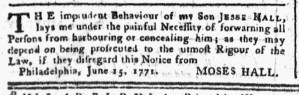
“THE imprudent Behaviour of my Son JESSE HALL, lays me under the painful Necessity of forwarning all Persons from harbouring or concealing him.”

Conradt Wolff lamented that his wife, Jenny, “hath behaved herself in such a manner as lays me under a necessity of forbidding any persons from trusting her on my account.”  In an advertisement in the July 1, 1771, edition of the New-York Gazette and Weekly Mercury, he warned the public that he “will pay no debts of her contracting.”  Throughout the colonies, similar notices frequently ran in eighteenth-century newspapers.  Aggrieved husbands deployed “runaway wife” advertisements to discipline disobedient women, though their notices told only one side of a story of marital discord. Relatively few wives possessed the resources to respond in print.  Those that did usually provided much different narratives, often accusing their husbands of abuse and neglect.  From their perspective, running away was an act of self-preservation and principled resistance rather than willful disobedience.

On occasion, colonists resorted to the public prints in the wake of other sorts of tumult within their households.  On the same day that Wolff placed an advertisement in the New-York Gazette, Moses Hall placed his own notice in the Pennsylvania Chronicle.  Hall, however, deplored the misbehavior of his son, Jesse.  “THE imprudent Behaviour of my Son,” Hall declared, “lays me under the painful Necessity of forwarning all Persons from harbouring or concealing him.” Furthermore, “they may depend on being prosecuted to the utmost Rigour of the Law, if they disregard this Notice.”  Hall did not elaborate on his son’s “imprudent Behaviour,” though gossip and rumors likely circulated beyond the newspaper.  That was almost certainly the case for the Camps and the Brents in Elizabethtown, New Jersey.  John D. Camp, Jr., informed readers of the New-York Gazette that he had been “compel’d by David Brent, to marry Catherine, his daughter.”  Camp vowed to “allow her a separate Maintenance, in all Respects suitable to her Degree,” but he would not pay “any Debts of her Contracting.”  Camp carefully avoided the details about events that resulted in his unwelcome wedding.  If friends and acquaintances had not been discussing whatever transpired between John and Catherine and her father before the advertisement ran in the New-York Gazette, its appearance probably prompted them to share what they knew for certain and speculate on what they did not.

Wolff, Hall, and Camp all attempted to focus attention on the subjects of their advertisements:  an absent wife, a troublesome son, or an imperious father-in-law.  In even publishing their notices, however, they called attention to themselves and their shortcomings in maintaining order within their households.  They sought to regain authority through the power of the press, but in the process they made their private altercations all the more visible to the public.  They framed the narratives and obscured the details, yet they still alerted others to scenes of difficulty and embarrassment that did not reflect well on them despite their efforts to shift responsibility to the actions of others.

April 20

What was advertised in a colonial American newspaper 250 years ago today?

Providence Gazette (April 20, 1771).

“His Design is … to exclude his Wife from all Interest in, or Advantage from said Farm.”

On occasion, advertisements published in colonial newspapers generated responses disseminated in subsequent advertisements.  Such was a case when Moses Lyon advertised a farm in South Brimfield, Massachusetts, in the Providence Gazette in the spring of 1771.  Nathaniel Child placed an advertisement in response, apparently on behalf of Lyon’s wife.  Child asserted that potential buyers needed to know more about the conditions of the sale before they purchased the property.

“Justice requires,” Child proclaimed, “the Public should be informed, that [Lyon’s] Design is, if possible, to exclude his Wife from all Interest in, or Advantage from said Farm.”  In an effort to prevent such an injustice, Child published his advertisement.  He explained that Lyon’s “now lawful Wife … sustains a reputable Character” and had not “done any thing that might justly forfeit an Interest in his Affections, any more than in his Estate.”  Child did not provide all the details about the discord in the Lyon household, but he did accuse Moses of “repeated Declarations,” a “Series of public Conduct,” and “certain notorious Facts, more loudly speaking than Words” that all indicated he sought to “prevent [his wife] having the least Advantage from any of his Estate.”

Child did not specify his relationship to the Lyon family.  Perhaps he was father, brother, or cousin to the aggrieved wife.  Whatever the relationship, he framed his intervention as a matter of “Justice” so “no Person should be misled, or act in the Dark” when purchasing the farm.  Why did this warning come from him?  By law and by custom, Lyon’s wife did not possess as much power as her husband.  As a result, enlisting a male ally to act as her advocate in the public prints may have been one of the best strategies at her disposal for protecting her interests.  A third party, even a male relation, who testified to Lyon’s “Conduct towards her” likely stood to garner more trust in the veracity of that account than if she relayed a similar story on her own.  Publishing an advertisement in response to Lyon’s real estate notice gave his “now lawful Wife” and her defender greater leverage than had she pursued the matter in private.