August 13

What was advertised in a colonial American newspaper 250 years ago today?

Providence Gazette (August 13, 1774).

“No. 6. The Imperial Lip-Salve (never made by any one before).”

When Philip Russel arrived in Rhode Island “from England,” he placed an advertisement in the Providence Gazette to advise the public that he “makes and sells” a variety of medicines to treat an array of ailments and potions for other purposes.  He enumerated and named each of them, along with giving a short description and price.  His medicines included “No. 4. His surprising excellent Tooth-Drops, which will immediately cure the Tooth-Ach the first Time of using; it will also cure the Scurvy in the Gums, and will preserve the Teeth from rotting. Price Half a Dollar a Bottle,” “No. 5. The Venetian Tooth-Powder, which in a few Times using makes them white and beautiful (although very foul and black before) and preserves those that are rotten and decayed from growing worse. Price Two Shillings a Bottle,” and “No 7. A most curious Eye Water, for cold Humours or Inflammations, which will be an effectual Cure in a few Days. Price Two Shillings a Bottle.”

Rather than addressing health and hygiene, three of Sabine’s products aided with cleaning and laundering: “No. 1 HIS famous Iron-Mould Drops, for taking Iron-Moulds and Ink-Spots out of Linen, Lawn, Muslin and Lace. Price One Shilling and Sixpence a Bottle,” “No. 2. A curious Composition for taking all Sorts of Stains, Pitch, Tar, &c. out of Cloth, Silk, Stuff or Worsted. Price One Shilling and Sixpence,” and “No. 3. A Tincture for taking any Stains out of Ma[h]agony, or any other Wood. Price One Shilling and Sixpence a Bottle.”

Including the prices helped prospective customers with comparison shopping when they considered purchasing similar products from other vendors.  Low or reasonable prices likely aided in stimulating interest in Russel’s wares among consumers unfamiliar with them, despite his assertion that some of his mixtures were “famous.”  Others were unique, such as “No. 6. The Imperial Lip-Salve (never made by any one before) which effectually takes away all Spots in the Face, makes the Skin beautiful, and cures the Lips when sore, in three or four Times rubbing.”  Knowing that this item cost “Half a Dollar a Box” might have convinced the curious to give it a try if they considered it a bargain.

In a nota bene, Sabine made three marketing appeals in quick succession: “Any Ladies or Gentlemen may, if they please, see Experiments of the above. – No Cure, no Pay. – Good Allowance to Shop Keepers who buy to sell again.”  The first two encouraged prospective customers that they had nothing to lose by visiting Sabine to learn more about his products.  He gave demonstrations so they could judge for themselves the effectiveness and value of his medicines and cleaning agents.  He also offered a moneyback guarantee, promising that customers did not have to pay if his medicines did not cure their maladies.  The final appeal presented a discount for purchasing by volume, a plan to pass along his products to retailers who then had an interest in marketing them on his behalf.  From start to finish, every word of Russel’s advertisement was calculated to persuade consumers rather than merely announce goods for sale.

August 2

What was advertised in a colonial American newspaper 250 years ago today?

Connecticut Courant (August 2, 1774).

Opportunity to express the grateful Sense he retains, of the Favors of his Customers in Time past.”

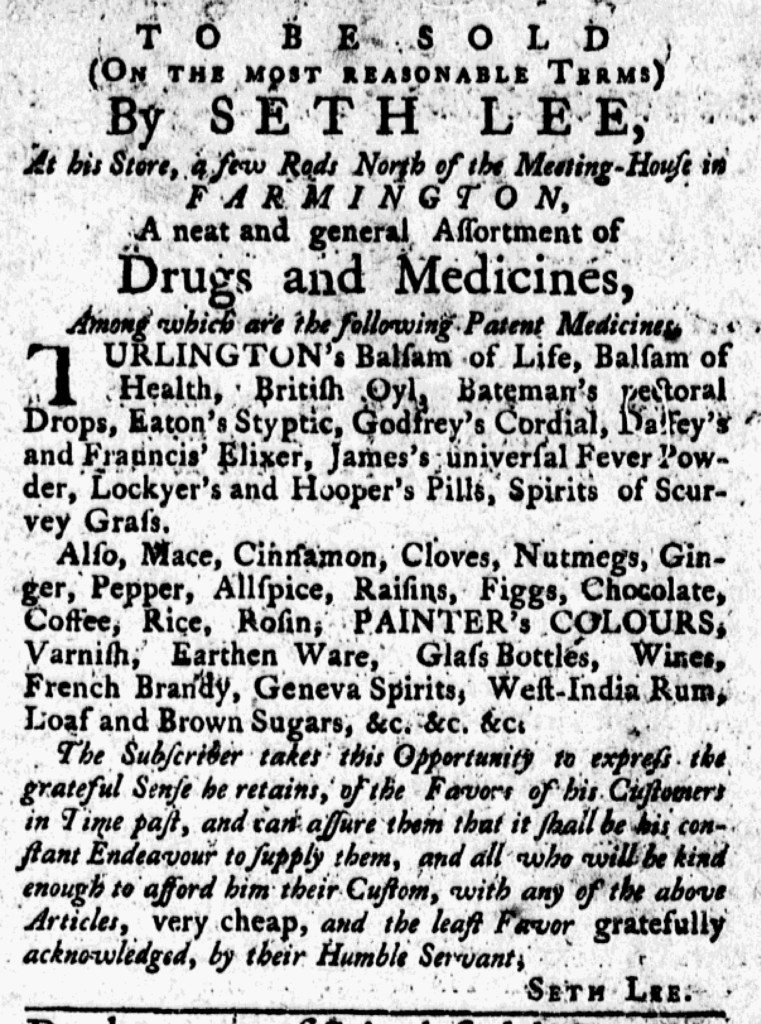
In the summer of 1774, Seth Lee of Farmington ran an advertisement for a “neat and general Assortment of Drugs and Medicines” in the Connecticut Courant.  He advised prospective customers that he sold his wares “ON THE MOST REASONABLE TERMS,” hoping that the promise of bargains would entice them to shop at his store.  His merchandise included a variety of patent medicines, each of them so familiar that Lee merely listed a dozen of them without indicating which symptoms they alleviated or maladies they supposedly cured.  He also called attention to alcohol, groceries, paint, and other items that supplemented his inventory.  Lee peddled two popular beverages, coffee and chocolate, but did not mention tea, an increasingly problematic commodity following the Boston Tea Party the previous December and the Coercive Acts passed by Parliament in response.  Elsewhere in the August 2 edition, Amos Wadsworth and Fenn Wadsworth continued hawking “BOHEA TEA, (not infected with a duty),” while Samuel Wescote advertised “good TEA” without further explanation.

Rather than wade into consumer politics, Lee appended a note to his former customers and prospective new customers.  He declared that he wished “to express the grateful Sense he retains, of the Favors of his Customers in Time past.”  In addition to demonstrating his appreciation for their business, such sentiments also testified to his experience providing satisfactory service, an implicit appeal to new customers as Lee attempted to buttress his reputation.  As he continued, Lee included prospective customers in the invitation he extended to readers to shop at his store.  He addressed “all who will be kind enough to afford him their Custom,” pledging that “it shall be his constant Endeavour to supply them … with any of the above Articles, very cheap.”  Furthermore, they would receive exemplary customer service, with “the least Favorgratefully acknowledged.”  Lee highlighted prices at the beginning and end of his advertisement, but he did not make those “REASONABLE TERMS” the focus of his notice.  Instead, he emphasized the relationships he cultivated with customers in the past and would endeavor to continue providing as “their Humble Servant.”  Lee listed goods to attract attention, then sought to hold it by wooing readers with his devotion to customer service.

April 10

What was advertised in a colonial American newspaper 250 years ago today?

Providence Gazette (April 10, 1773).

“An Assortment of choice Medicines.”

Nearly four months had passed since Thomas Truman first placed a notice in the Providence Gazette to request that “all Persons who have Accounts unsettled with Doctor SAMUEL CAREW, late of Providence, deceased,” visit Truman at the “House and Shop lately occupied by Doctor CAREW” to make or receive payment.  He also informed the public that he “proposes to tarry in Providence, and continue the Practice of Physic and Surgery,” reminding “all those Gentlemen and Ladies who have kindly favoured him in the Way of his Business” that he served an apprenticeship under Carew’s supervision.  Truman positioned himself as Carew’s successor, hoping to inherit the physician’s patients.

On April 10, Truman inserted a new notice in which he “once more” directed “those who have hitherto neglected to bring in their Accounts against the Estate of Doctor SAMUEL CAREW” to so do “directly, that they may be settled.”  Similarly, he asked that those “indebted to said Estate … make Payment immediately … that the Books may be closed, and the Debts paid off with Honour.”  In a nota bene, Truman stated that he no longer occupied Carew’s former house and shop.  He had “removed … two Doors further down Street,” where he sold “an Assortment of choice Medicines.”  He offered the lowest prices for the quality of the medicines he peddled.

The timing of Truman’s new advertisement may have been a coincidence, but it happened to appear a week after Ebenezer Richmond placed his own notice that he “proposes to attend to the Practice of Physic and Surgery in this Town” and boasted of his extraordinary record of success caring for patients over several years.  Truman no doubt wished to close the books on Carew’s estate, but he may have also noticed the presence of a rival in the public prints.  Given that advertisements usually ran for three weeks or more, Truman may not have wanted Richmond to enjoy the benefits of being the sole physician to advertise in the city’s only newspaper.  That competition may have played as much of a role in convincing Truman to place a new notice as his desire to bring a conclusion to Carew’s estate.

December 8

What was advertised in a colonial American newspaper 250 years ago today?

Providence Gazette (December 8, 1770).

Fresh from one of the best Druggists in London.”

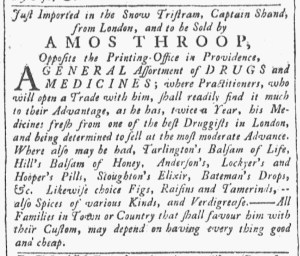
Like many other apothecaries in colonial America, Amos Throop of Providence resorted to newspaper advertising to promote his wares and attract clients.  In an advertisement in the December 8, 1770, edition of the Providence Gazette, he informed the public that he carried “A GENERAL Assortment of DRUGS and MEDICINES” recently imported from London.  Those included popular patent medicines, such as “Tarlington’s Balsam of Life, Hill’s Balsam of Honey, Anderson’s Lockyer’s and Hopper’s Pills, Stoughton’s Elixir, [and] Bateman’s Drops.”  Throop expected that these remedies were so familiar to prospective clients that he did not to describe the symptoms each eliminated.

Throop sought clients of various sorts, both “Families in Town or Country” and “Practitioners” like Ephraim Otis, whose own advertisement stated that he “offers himself in the Capacity of Physician and Surgeon, in every Branch (particularly Osteology and Bone setting).”  The apothecary also found himself in competition with William Bowen.  In his advertisement, Bowen declared that he “continues to practice Physic, Surgery and Midwifry” as well as sell “a neat Assortment of Drugs and Medicines, at as cheap a Rate as can be bought in this Town.”  Throop also pledged that his customers “may depend on having everything good and cheap,” but he further enhanced his appeal to distinguish it from Bowen’s promise of low prices.  He explained that he acquired his medicines “twice a year … fresh from one of the best Druggists in London.”  His clients did not have to worry that nostrums they purchased at his shop had been sitting on the shelves or in the storeroom so long as to diminish their effectiveness.  Furthermore, Throop explained that he had received a shipment “in the Snow Tristam, Captain Shand, from London.”  Readers familiar with vessels that arrived and departed could judge for themselves how recently Throop had updated his inventory.

Bowen and Throop both advertised “DRUGS and MEDICINES” in the Providence Gazette.  While Bowen relied primarily on low prices to market his merchandise, Throop offered more extensive appeals to prospective clients.  He underscored quality by asserting connections to a respected colleague in London, outlined his schedule for replenishing his inventory, noted which vessel recently delivered new items, provided credit to practitioners “who will open a Trade with him,” sold ancillary products, and made his wares available at bargain prices.

November 23

What was advertised in a colonial American newspaper 250 years ago today?

New-Hampshire Gazette (November 23, 1770).

“Any Gentleman Practitioner may be served … by Letter as well as if present.”

Joseph Tilton advertised a “compleat and general Assortment of the best Drugs and Medicines” in the November 23, 1770, edition of the New-Hampshire Gazette.  Now available at his shop in Exeter, these nostrums had recently been imported from London.  Tilton listed a variety of popular patent medicines, including Stoughton’s Elixir, Lockyer’s Pills, and Walker’s Jesuit Drops, as well as grocery items often incorporated into homemade remedies.  For instance, he stocked cloves, mace, nutmeg, and ginger.  He supplemented these wares with medical equipment, including lancets and “Surgeons Needles,” and other merchandise, not unlike modern retail pharmacies that carry over-the-counter medications, home health care supplies, and food and convenience items.  For some of his merchandise, Tilton offered bargains, stating that he sold them “cheaper than can be bought in this Government.”  In other words, consumers would not find better deals anywhere in the colony.

To expand his clientele, Tilton did not require customers to visit his shop in Exeter.  In a nota bene, he advised that “Any Gentleman Practitioner, may be served with Dispatch, and their Medicines well secured, by Letter as well as if present.”  Tilton provided mail order service to physicians who desired it, an accommodation apparently worth the effort if it enticed them to choose him to supply their medicines and equipment.  He promised that such orders would not languish in his shop; instead, he would fill them and send them as quickly as possible.  Visiting Tilton’s shop in person would not achieve faster service, nor would it result in better packaging for transporting medicines.  Prospective customers did not need to worry that they would not be able to oversee how the bottles, boxes, and packets were bundled.  Tilton pledged they would be “well secured” and arrive intact.

Tilton incorporated convenience into his business model.  He advertised an array of merchandise, from patent medicines to medical supplies to groceries, for consumers to acquire at one location.  He also provided mail order service as an alternative to shopping in person.  Eighteenth-century advertisements have sometimes been depicted as mere lists of goods, little more than announcements.  Many, however, contained marketing efforts intended to convince consumers to make purchases and choose the advertiser over competitors.

October 8

What was advertised in a colonial American newspaper 250 years ago today?

Boston-Gazette (October 8, 1770).

“All the Patenteed Medicines, too many to be enumerated in an Advertisement.”

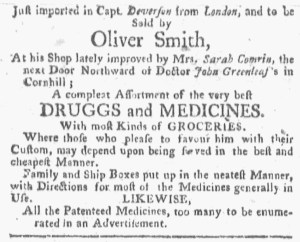
Oliver Smith advertised a “compleat Assortment of the very best DRUGGS and MEDICINES” in the October 8, 1770, edition of the Boston-Gazette.  He sold his remedies individually, but also offered “Family and Ship Boxes” that packaged together “most of the Medicines generally in Use” along with directions for administering them.  These eighteenth-century versions of first aid kits allowed apothecaries to increase their sales by asking consumers to anticipate possible future needs for a variety of medicines rather than wait until they had a specific need for any particular medicine.  Smith and others marketed “Family and Ship Boxes” as a convenience for their customers, but they also amounted to additional revenue for the sellers.

Smith also informed readers that he carried “All the Patenteed Medicines, too many to be enumerated in an Advertisement.”  Not listing those items saved Smith both space and money.  He expected that consumers were so familiar with the array of patent medicines on the market that he did not need to name them.  This strategy also indicated confidence that he had on hand a complete inventory.  They could depend on him carrying Turlington’s Original Balsam of Life, Godfrey’s General Cordial, Walker’s Jesuit Drops, Dr. Stoughton’s Elixir, Hooper’s Pills, Greenough’s Tincture for the Teeth and Gums, Bateman’s Pectoral Drops, and a variety of other patent medicines that apothecaries, shopkeepers, and even printers frequently listed in their advertisements.  One column over from Smith’s advertisement, William Jones did indeed name all of those nostrums and others.

Much of Smith’s advertisement focused on convenience.  In addition to selling “Family and Ship Boxes” and stocking a complete inventory of patent medicines, he operated his shop at a convenient location, “the next Door Northward of Doctor John Greenleaf’s in Cornhill.”  Prospective customers who had occasion to consult with Dr. Greenleaf could then visit Smith’s apothecary shop next door to select any medicines that the doctor recommended.  Smith also noted that the shop had been “lately improved” to make it more appealing to customers.  With the various conveniences he provided, Smith sought to make it as simple as possible for prospective customers to care for their health.

August 20

What was advertised in a colonial American newspaper 250 years ago today?

Aug 20 - 8:20:1770 Boston-Gazette
Boston-Gazette (August 20, 1770).

“Doctor’s Boxes … are carefully prepared.”

Peter Roberts advertised “An Assortment of the best DRUGS and MEDICINES” as well as other medical supplies, including “Surgeons Instruments,” “Iron and Marble Mortars and Pestles,” and “a great Variety of Smelling Bottles” in the August 20, 1770, edition of the Boston-Gazette.  In addition to listing his wares, he adopted two other marketing strategies commonly deployed by apothecaries and others who sold medicines.  In both, he emphasized convenience as an important part of the customer service he provided.

Roberts informed prospective customers that “Doctor’s Boxes of various Prices, with proper Directions, are carefully prepared and put up for Ships or private Families.”  He produced an eighteenth-century version of a first aid kit, packaging together several useful items that buyers did not need at the moment but would likely find useful when need did arise.  Even if the purchasers never used some of those items but merely had them on hand out of caution, Roberts still generated revenue for each item included in those “Doctor’s Boxes.”  At the same time, he sold a sense of security to those who felt better prepared for illnesses, injuries, and emergencies because they had a variety of medical supplies on hand.  To enhance that sense of security, Roberts included “proper Directions” in each box he prepared.  Buyers benefited from the convenience of having medicines, medical supplies, and directions easily accessible in those “Doctor’s Boxes.”

Roberts also offered medical professionals the convenience of placing their orders through the post or messenger rather than visiting his shop “opposite the West Door of the Town-House, BOSTON.”  He advised that “Practitioners in Town and Country may depend on being as well used by Letter as if present themselves.”  Roberts likely hoped to increase his share of the market by assuring prospective customers who could not come to his shop because they were too busy or because they resided too far away that he would not provide second-rate service.  He underscored that their business was important to him.

Roberts made clear in his advertisement that he did more than merely dispense drugs and sell medical equipment.  He aimed to provide a level of service and convenience that added value to the merchandise he offered for sale.  He intended that such marketing strategies would attract customers choosing among the many purveyors of patent medicines and other medical supplies in colonial Boston.

October 21

What was advertised in a colonial American newspaper 250 years ago today?

Oct 21 - 10:21:1769 Providence Gazette
Providence Gazette (October 21, 1769).

“He will sell as cheap as are sold in Boston, or any Part of New-England.”

In the fall of 1769, Amos Throop sold medicines at a shop “on the West Side of the Great Bridge, in Providence.” His inventory included “a fresh Assortment of Medicines, Chymical and Galenical” as well as sago and “all Sorts of Spices.” He also stocked a variety of familiar patent medicines, such as “Turlington’s Balsam of Life, Hooper’s Female Pills, Anderson’s Pills, Stoughton’s Elixir, and Hill’s Balsam of Honey.” Throughout the colonies, consumers recognized these brands. Apothecaries and shopkeepers from New England to Georgia advertised these popular patent medicines.

When they did so, they competed with each other. Their advertisements often made clear that they served not only local customers who visited their shops but also those who lived at a distance and submitted orders via letters or messengers. Throop addressed “Families in Town or Country” in his advertisement, acknowledging that he sought the patronage of customers beyond Providence. For all of his prospective customers, Throop pledged that he parted with his medicines “as cheap as are sold in Boston, or any Part of New-England.” Appeals to price were also familiar in eighteenth-century advertisements for medicines, but such comparisons were much less common. Throop did not even bother with assuring readers that he offered the best prices in town. He was so wary of competition from Boston that he framed his prices in relation to prices charged by druggists and shopkeepers there. Lest that raise questions about bargains that might be found elsewhere within the regional marketplace, he provided blanket assurances that he offered the best prices in all of New England. Perhaps claiming that he had the best prices in all of the colonies would have strained credulity!

Incorporating any sort of price comparison into an advertisement was relatively innovative in the late 1760s. It suggested that both the advertiser and consumers possessed a level of familiarity with the local and regional marketplace that allowed them to make or to assess such claims.

July 12

What was advertised in a colonial American newspaper 250 years ago today?

Jul 12 - 7:12:1769 Georgia Gazette
Georgia Gazette (July 12, 1769).

“Boxes of medicines prepared for the use of plantations and shipping.”

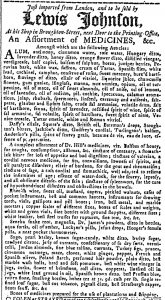
Lewis Johnson peddled an “Assortment of MEDICINES” at his shop in Savannah. He carried familiar patent medicines, such as Daffy’s elixir, Bateman’s drops, Stoughton’s bitters, Godfrey’s cordial, Turlington’s balsam, Anderson’s pills, and a “compleat assortment of Dr. Hill’s medicines.” His inventory of patent medicines rivaled what customers could expect to find in apothecary shops in larger cities on both sides of the Atlantic. In addition to those remedies, Johnson carried a variety of supplies for compounding other remedies according to the wishes of the customer or the instructions of a doctor or healer. He also stocked medical equipment, such as lancets, vials, mortars, and weights and scales.

To facilitate sales, Johnson concluded his advertisement with a service available to patrons: “Boxes of medicines prepared for the use of plantations and shipping.” In other words, Johnson produced the eighteenth-century equivalent of the modern first aid kit. He identified prospective customers likely to have particular need of a several medicines for treating a variety of ailments packaged in advance. Johnson’s boxes saved plantation owners and overseers located some distance from Savannah the trouble of sending for remedies every time they had need. For vessels at sea, having a supply of medicines on hand was imperative since they could be weeks from port and unable to acquire new supplies in the meantime. This method also allowed Johnson to boost his sales by bundling together items based on possible need at some future moment rather than certain need at the time of purchase.

For some customers, these “Boxes of medicines” were practically a necessity; for others they were a convenience. In both cases, Johnson did more than merely sell goods to consumers. He offered a service that enhanced the value of his wares. That service required him to contribute his own knowledge of medicines and their effects in selecting or recommending items to include in the boxes. Beyond the medicines and other supplies, Johnson’s expertise was an important component of the boxes he prepared for customers.

April 10

GUEST CURATOR: Bryant Halpin

What was advertised in a colonial American newspaper 250 years ago today?

Pennsylvania Chronicle (April 10, 1769).

“A FRESH supply of choice drugs and medicines.”

When I looked at this advertisement I wondered what kinds of “drugs and medicines” colonists had in 1769? How did colonists deal with diseases? According to Robin Kipps, who manages the Pasteur & Galt Apothecary at Colonial Williamsburg, “The sciences of biology and chemistry had not made significant impacts on the theories of disease. The big health issues of the day were not heart disease, cancer, obesity, or diabetes; they were smallpox, malaria, and childhood illnesses.” In the colonial and revolutionary periods, Americans did not have to worry about the same kind of disease that we do today. Instead, they had all kinds of other deadly diseases they had to worry about that people nowadays do not need to worry about due to advances in science and medicine. Colonists did not have the vaccines at this point in time to prevent many deadly diseases from happening and spreading to others, though they had experimented with smallpox inoculation.

**********

ADDITIONAL COMMENTARY: Carl Robert Keyes

John Sparhawk had competition. He was not the only purveyor of “choice drugs and medicines” in Philadelphia who advertised in the April 10, 1769, edition of the Pennsylvania Chronicle. Robert Bass, an apothecary who regularly inserted advertisements in several local newspapers, also ran a notice, one that may have more effectively captured the attention of prospective clients.

Sparhawk, a bookseller, published a comparatively sparse advertisement. Like many other printers and booksellers in eighteenth-century America, he supplemented his income by selling other items, including patent medicines, on the side. Such was the case with the “FRESH supply” that he had “just received from London” and sold at his bookstore. He made appeals to price and quality, pledging that he sold them “as low as can be bough[t] in America of equal quality,” but otherwise did not elaborate on these patent medicines.

Pennsylvania Chronicle (April 10, 1769).

Robert Bass, on the other hand, underscored his expertise in his advertisement, using his superior knowledge to leverage readers to visit his shop to seek consultations and make purchases. In addition to using his own name as a headline, he listed his occupation, “APOTHECARY,” all in capitals as a secondary headline. He did not merely peddle patent medicines that he had imported from suppliers in London. He also “strictly prepared” medicines in his shop, filling all sorts of prescriptions or, as he called them, “Family and Practitioners Receipts.” For those who desired over-the-counter remedies, he also stocked “a Variety of Patent Medicines.” His experience and reputation as an apothecary suggested that he could more effectively recommend those nostrums to clients based on their symptoms than Sparhawk the bookseller could. Bass also carried medical equipment, further underscoring his specialization in the field.

Not every customer needed the level of expertise Bass provided. Many would have been familiar with several patent medicines. For those customers who desired to make their own selections from among the products available on the shelves, Sparhawk (and Bass as well) simply made appeals to price and quality. That model differed little from patrons choosing over-the-counter medications at retail pharmacies or other kinds of stores today. For prospective customers who required greater skill and expertise from the person dispensing medications, Bass made it clear in his advertisement that he was qualified to address their needs.