GUEST CURATOR: Madison Sandusky
What was advertised in a revolutionary American newspaper 250 years ago today?
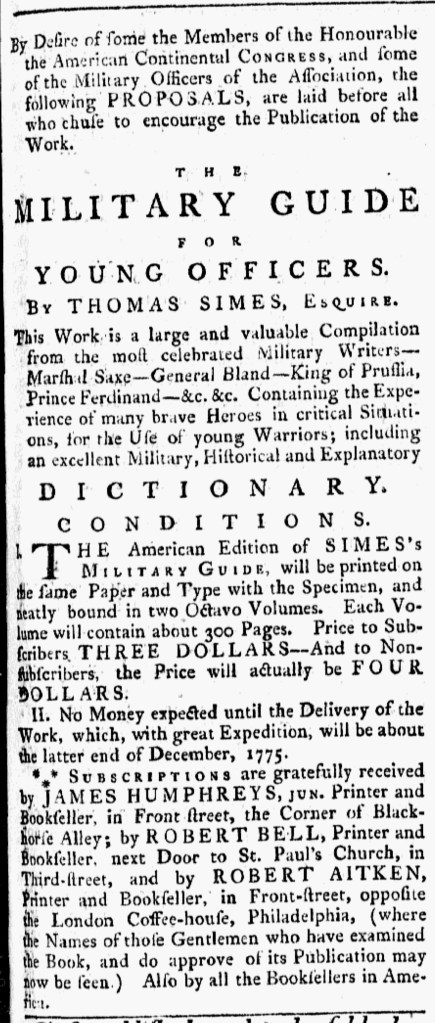
“THE MILITARY GUIDE for YOUNG OFFICERS. By THOMAS SIMES, Esq.”
Several printers in Philadelphia advertised “THE MILITARY GUIDE for YOUNG OFFICERS” by Thomas Simes in February 1776. The manual was published in 1776 and contained a compilation of “works of several military authors, including Humphrey Bland and the comte de Saxe.” When the American Revolution began in 1775, military manuals, such as the one Simes wrote, became popular among young men preparing to join the war and those who had already joined. According to the American Revolution Institute of the Society of the Cincinnati, “to meet the demand for military texts, a flood of printings began to appear from the American presses.” Additionally, the advertisement above, published in the Pennsylvania Evening Post, which was a newspaper located in Philadelphia, displays how that flood of printing was “centered in Philadelphia, where more than thirty works on military subjects were published in the years 1775 and 1776 alone.” The advertisement briefly summarizes the book, stating that it included “the experience of many brave heroes in critical situations, for the use of young warriors” to entice the target audience of young men who would serve as officers to purchase the book as a helpful guide. The advertisement even noted that the guide came with its own “explanatory DICTIONARY,” a bonus section. One signer of the Declaration of Independence, William Floyd, owned a copy of Simes’s guide, which can be taken as an indicator of both the quality and popularity of its contents.
**********
ADDITIONAL COMMENTARY: Carl Robert Keyes
Robert Bell, the publisher of the first edition of Thomas Paine’s Common Sense, continued his feud with William Bradford and Thomas Bradford, the printers of the Pennsylvania Journal, with a new advertisement in the February 22, 1776, edition of the Pennsylvania Evening Post. Dissatisfied with Bell’s bookkeeping, Paine collaborated with the Bradfords on an expanded edition of his popular political pamphlet, yet Bell took an unauthorized second edition to press and simultaneously published diatribes about Paine and the Bradfords. His latest advertisement would be the last in the series that attacked the author and his fellow printers. It filled more than a column, starting on the third page of the February 22 issue of the Pennsylvania Evening Post and overflowing onto the fourth page. The advertisement for Thomas Simes’s Military Guide for Young Officers, jointly published by Bell, Robert Aitken, and James Humphreys, Jr., immediately followed Bell’s advertisement. In the column to the right, the Bradfords promoted their “NEW EDITION of COMMON SENSE, With ADDITIONS and IMPROVEMENTS,” and warned that the “Pamphlet advertised by Robert Bell intitled ADDITIONS to COMMON SENSE … consists of Pieces taken out of News Papers, and not written by the Author of COMMON SENSE.”
The advertisement for Simes’s Military Guide for Young Officers thus appeared in the middle of the controversy over the publication of new editions of Common Sense. Unlike Bell’s questionable decision to produce a second edition of the political pamphlet and then attempt to capitalize off it by publishing another pamphlet of “ADDITIONS” drawn from newspapers rather than written by Paine, he collaborated with Aitken and Humphreys in producing the military manual “at the desire of several Members of the Honorable the Continental Congress, and some of the Military Officers of the Association.” Bell (along with Aitken and Humphreys) had the right endorsements for an American edition of a manual previously published in London and the printers attempted to leverage that in marketing Simes’s Military Guide for Young Officers to prospective customers who, as Madison notes, could choose from among many similar works published in Philadelphia at the time. In the Pennsylvania Evening Post, the advertisement appeared in the middle of the various notices in the February 22 edition, but two days later it had a privileged place in the Pennsylvania Ledger. Humphreys, the printer of that newspaper, placed the advertisement on the first page, making it the first item in the first column. The printers of the Pennsylvania Gazette gave the advertisement the same treatment in the February 28 edition of their newspaper. The flamboyant Bell took a more measured approach to marketing the military manual compared to some of the other books and pamphlets he printed and, especially, his new editions of Common Sense. Perhaps his partners in the endeavor took the lead in marketing Simes’s Military Guide for Young Officers.