What was advertised in a colonial newspaper 250 years ago this week?
Newport Mercury (May 26, 1766).
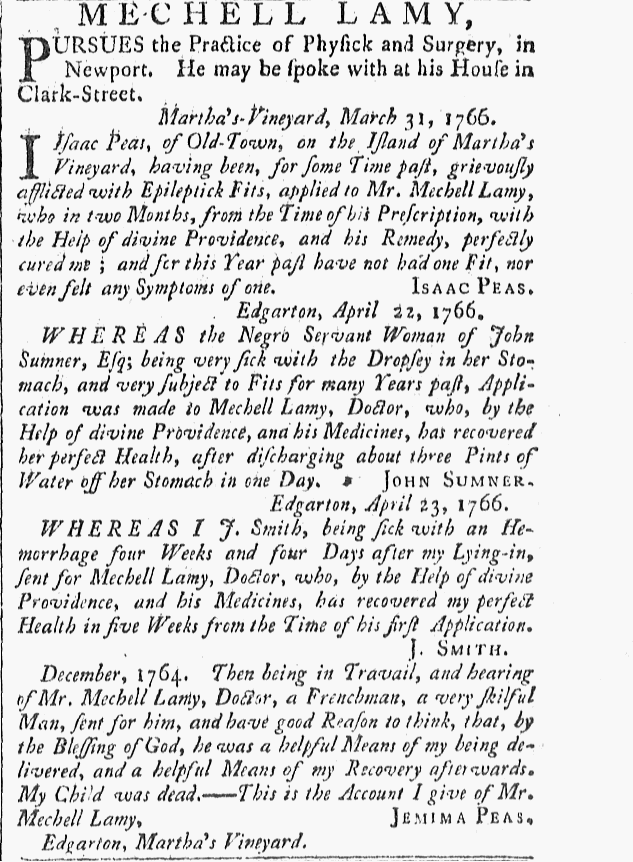
“With the Help of divine Providence, and his Remedy, perfectly cured me.”
Mechell Lamy, physician and surgeon, was new to the town of Newport. He needed to inform local residents about the services he provided, but he did not have much to say on his own behalf. Instead, he crafted an advertisement that consisted almost entirely of testimonials from former patients. Why try to convince the public of his skills and expertise when the endorsements of others might have much more influence? Each former patient lauded Lamy’s skill. Most of them underscored that his treatments worked quickly, that they were cured in a short amount of time. Lamy, they suggested, did not offer false promises or attempt to extend his care over ever increasing amounts of time in order to continue charging fees. In short, Lamy was not a quack or a charlatan, at least not according to his former patients.
All of the testimonials came from the island of Martha’s Vineyard, most of them from the village of Edgarton. With one exception, each was dated within the past two months, indicating that Lamy had actively pursued his occupation on Martha’s Vineyard fairly recently. At most, Lamy had resided on the mainland for a month when this advertisement appeared. He could not depend on his reputation being spread via word-of-mouth and extended acquaintance. Instead, he had to jumpstart local assessments of his services, skill, and expertise.
What was advertised in a colonial newspaper 250 years ago this week?
Newport Mercury (May 12, 1766).
It appears that James Morton’s primary purpose in placing this advertisement was to inform customers who had purchased goods on credit that they needed to visit his shop to make payment because he was preparing to leave town. The nota bene, however, tells an additional story of marketing innovation and maximizing the returns on what he spent to insert this announcement in the local newspaper.
Since he had purchased space in the newspaper to encourage customers in “settling their Accounts,” he diversified his message by using a small portion of it to “sell what few Goods he has on Hand,” but for cash rather than credit. This more or less amounted to an eighteenth-century “going out of business” sale. Morton looked to get rid of his remaining stock, figuring that some return on his investment was better than none. To draw customers to his sale he promised that they could purchase the remaining goods “at prime Cost.” In other words, they would get a deal.
What was advertised in a colonial newspaper 250 years ago this week?
Newport Mercury (April 28, 1766).
“Just published, and to be sold by the Printer hereof, CONSIDERATIONS upon the RIGHTS of the COLONISTS.”
When the Stamp Act was repealed a major political crisis came to a close (though the simultaneous passage of the Declaratory Act signaled that not all was resolved between Parliament and Britain’s colonies in North America). Colonial merchants imported goods from Britain. Advertisers encouraged consumers to purchase those goods.
Printers and booksellers continued to market other wares that had been for sale during the Stamp Act crisis: books and pamphlets about the “RIGHTS of the COLONISTS to the PRIVILEGES of British SUBJECTS.” Such items had been advertised frequently before the Stamp Act went into effect in 1765 and continuing through its repeal in the spring of 1766. The Stamp Act may have been repealed, but existing stock of these pamphlets did not disappear. Printers and booksellers needed to sell the leftovers in order to profit or at least break even on their investments. Surplus pamphlets did not suit their needs.
Newport Mercury (April 28, 1766).
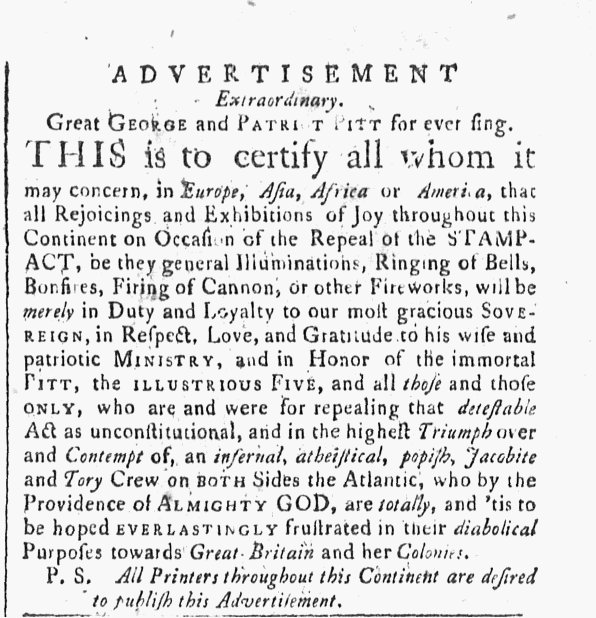
So they continued to advertise. Today’s featured advertisement was not the only one of its kind in the April 28, 1766, issue of the Newport Mercury. Other notices promoted books and pamphlets that advanced a similar political position. They appeared in the same issue that reprinted an “ADVERTISEMENT Extraordinary” from the Boston Gazette (which we saw also reprinted in the New-Hampshire Gazette earlier this week) celebrating the repeal of the Stamp Act.
In all fairness, decisions to continue selling and marketing pamphlets about the “RIGHTS of the COLONISTS” did not necessarily depend solely on financial considerations to the exclusion of sincere political anxieties. Although the immediate crisis was over, the Declaratory Act dampened the colonists’ victory. Astute printers and booksellers likely realized that Parliament and the colonies would continue to experience tensions. By selling pamphlets like the one from today’s advertisements, printers and booksellers performed a civic duty that kept their fellow colonists informed and helped to frame future debates and discourse.
What was advertised in a colonial newspaper 250 years ago this week?
Newport Mercury (April 7, 1766).
“A FARM in Bristol, containing about 140 Acres of good Land.”
I find interesting the way in which the American colonies and European countries sometimes diverged economically in the eighteenth century. In my Western Civilization course, we have discussed the beginnings of the Industrial Revolution. In Great Britain, where the revolution started, James Hargreaves invented the spinning jenny in 1764, revolutionizing the speed at which cotton could be spun. In that same decade Richard Arkwright introduced his water frame, which harnessed waterpower, resulting in water-powered factories that could produce mass amounts of textiles. People began to flock to the cities and abandon their farmlands. As farming became more technological and less profitable, jobs in the cities, especially in factories, opened up.
However, in America, such was not the case – yet. Farms and farmland were still highly valuable in the British colonies. Even when the Industrial Revolution reached America, the government would still encourage people to go west and start their own farms. The advertised farm has everything that a farmer could need to produce for the market and provide for his family.
**********
ADDITIONAL COMMENTARY: Carl Robert Keyes
Urban areas in America increasingly grew during the eighteenth century. Existing cities – Boston, New York, Philadelphia, and Charleston – expanded, while others – such as Baltimore – emerged as population centers and hubs of commerce in their own right. Still, as Maia explains, the Industrial Revolution did not arrive in North America as quickly as it did in Europe. Factories that employed new technologies discussed popped up in New England by the end of the century, but they were not part of the colonial landscape in the 1760s.
That does not mean that rural areas remained untouched. Note the many ways in which this advertisement demonstrates that colonists shaped the land on which they lived and worked. In addition to the town of Bristol, an “East Road” cut through the landscape. The farm for sale included a “House, Barn, and Cribb, &c.” These buildings certainly modified the landscape. The property had been “Fenced with about 1200 Rods of Stone Wall,” a significant change to the landscape. How much of the land devoted to “Meadow, Pasture, and Tillage” existed in such a state before colonists arrived? How much of it had been cleared by colonists?
Sometimes we assume that major changes to the environment occurred only in recent times, only after the United States fully engaged in the Industrial Revolution. This real estate advertisement, however, lists a variety of ways in which colonists reshaped the landscape to suit their own needs. Those who lived in rural areas did not reside in an undisturbed natural world. Instead, they engaged in a process of simultaneously adapting to the land and adapting the land as they desired.
What was advertised in a colonial newspaper 250 years ago this week?
Newport Mercury (March 31, 1766).
“A Large and good Assortment of loose STONES.”
I found a few things interesting about this advertisement: first, that Welsh’s goods were imported from London; second, the goods he sold; and, third, that his shop was located next to an insurance office.
Compared to other advertisements I chose for this week, Welsh explicitly stated that his goods were imported from London. While the Revolution had not officially started, there was a lot of unrest in the colonies and tension with Britain. On the other hand, from the goods he sold, Welsh would have wanted to let his potential customers know that they were getting a good product.
From the products he advertised, Welsh’s clients were likely elites or merchants with disposable income. I cannot imagine a farmer or shopkeeper with enough money to spend on garnets, topazes, or rubies. This is the first time I have seen an advertisement for such luxury items.
This leads me to the third thing that interested me about this advertisement: the location. Other than using the shop next door as a point of reference, I believe that John Welsh might have been trying to establish subconsciously a sense of security for his customers. By stating that his shop was located next to an insurance office he projected an air of reliability. He likely also has insurance with the office and he was well protected so his customers should have felt the same.
**********
ADDITIONAL COMMENTARY: Carl Robert Keyes
Like Mary, I am interested in where “JOHN WELSH, Jeweller,” kept shop, but from a different angle. He indicated that he sold “Jeweller’s and Goldsmith’s Work” at “his Shop next to Mr. Pigeon’s Insurance-Office, at the North End of BOSTON.” The advertisement, however, appeared in the Newport Mercury! This caught me by surprise because in the 1760s most men and women who placed newspaper advertisements for consumer goods and services did so only in publications printed in the city or town where they operated their business. They targeted their marketing at relatively local consumers, those who resided in their city or the hinterland served by the city’s newspaper(s). An increasing standardization of goods in eighteenth-century American helps to explain this: shopkeepers in Newport by and large stocked the same merchandise as their counterparts in Boston, Philadelphia, and Charleston. Accordingly, advertisers focused on attracting local customers.
There were, however, some exceptions, including John Welsh. His specialized merchandise may help to explain why he advertised in a newspaper printed and distributed in a port city about seventy miles away. He needed to reach a critical mass of potential customers. Certainly wealthy merchants who could afford his wares resided in Newport. Note that he stated that “any Gentleman may be as well used by Letter as if present.” Welsh offered a form of mail order shopping for customers who could not visit his shop.
What was advertised in a colonial newspaper 250 years ago this week?
Newport Mercury (March 24, 1766).
“Just imported in the Cornelia, Capt. Harvey, (via New-York) …”
This advertisement by merchant John Dockray caught my attention because of the fact that the goods came to the colonies via New York City before being sold in Newport, Rhode Island. The Cornelia, commanded by Capt. Harvey, was the ship that brought Dockray’s merchandise to New York. At this time Newport, itself a bustling port, was still smaller in size and population compared to New York or Boston.
The advertisement lists many different everyday goods for everyday people. Dockray clearly characterized these goods as “WINTER GOODS,” the uppercase letters and the placement made that the prominent and eye-catching feature. Due to the fact that it was March, colonists’ winter stores would be getting low as the season came to an end. With spring arriving soon, people would be getting ready for planting, farming, and other occupations.
Dockray also said that the store was attached to his house, which allowed for easy management and control.
**********
ADDITIONAL COMMENTARY: Carl Robert Keyes
Elizabeth’s final observation, that Dockray operated his business in “his Store adjoining to his House,” allows us to further consider some of the ramifications of the work that she did yesterday when she located the general area where several colonists sold their wares using addresses from newspaper advertisements and trade cards in combination with maps of Boston from the period.
John Dockray’s situation was not unique. In yesterday’s featured advertisement Elizabeth Clark announced that she sold seeds “At her Shop near the Mill Bridge, BOSTON.” Clark most likely resided at the same location. In the featured advertisement from two days ago, William Symonds indicated that he sold his wares “at his house, the corner of Market and Second streets, opposite the Quaker Meeting-house” in Philadelphia. In the portion of the advertisement devoted to Mary Symonds’s millinery business, she reiterated that her merchandise was “in the corner shop in said house.”
Colonial Americans who lived in urban ports – like Newport, Boston, and Philadelphia – often tended to work at the same location where they lived, whether shopkeepers or artisans, unlike today’s practice of residing at one location and working elsewhere. An artisan’s workshop, for instance, might be on the first floor of the domicile, with the family residing upstairs. Or portions of a house could have been set aside for running a shop, as was the case with Mary Symonds.
As a result, the addresses included in colonial advertisements help us to reconstruct more than just the commercial landscape of early American cities and towns. In many instances they also tell us where a variety of people lived, helping us to better understand who lived in which neighborhoods and what kinds of relationships – social as well as economic – developed there.
What was advertised in a colonial newspaper 250 years ago this week?
Newport Mercury (February 3, 1766)
“A Large Assortment of Medicines, chymical and galenical.”
This advertisement brings a variety of goods to the table, but what caught my eye was the presence of medicine at the top of the list. Prior to this period in colonial America, the Scientific Revolution was set into motion after the medieval period, which on some levels lacked innovation. In medicine, there seemed to be a regressing, especially with the presence of the Black Plague. However, scientists in the 1600s and 1700s were ever experimenting to find new solutions to problems, including diseases. Not only were there artificial remedies created, but there were natural remedies used as well, distinguished in the advertisement as “chymical and galenical.” As the Europeans composed the bulk of innovators and inventors, their ideas and products were passed on to their colonies. Although the colonial era continued to have sicknesses, including the Yellow Fever, colonists had a knowledge of medicine that would continue to grow and eventually lessen the effects of epidemics.
The American Colonies were able to benefit from improved Western medicine and they continued to see medicine develop in their time.
**********
ADDITIONAL COMMENTARY: Carl Robert Keyes
I suspect that much of Maia’s analysis of this advertisement was inspired by the two-semester History of Western Civilization sequence taught by my colleagues, Lance Lazar in the fall and Winston Black this spring. I encourage students to look for connections among their courses, especially history courses, rather than treat different places and different eras as if they existed completely independently of each other. It’s certainly gratifying when students take content and ideas from one course and effectively apply them to the periods and places they are studying in other courses.
That being said, this advertisement offers another opportunity to challenge students to think about other perspectives, to continue to integrate new knowledge into their interpretation of the past. While Europeans were certainly influential in the development of Western medicine, this advertisement leaves out the possible contributions of indigenous peoples (just as the advertisement for Jamaican sugar earlier this week belied the labor of enslaved Africans). Consider, for instance, the work of Kathleen S. Murphy (History, California Polytechnic State University), including “Translating the Vernacular: Indigenous and African Knowledge in the Eighteenth-Century British Atlantic.”[1] Murphy demonstrates that Europeans were often assisted by non-Europeans in their quest for scientific and medical knowledge. In some cases, these so-called “others” acted as teachers to Europeans, instructing them in healing techniques and the qualities of previously unknown flora and fauna in the wake of the Columbian Exchange.
Medical knowledge did make significant advances in the eighteenth century, partly as a result of interactions and cooperation among Europeans, Africans, and indigenous Americans. In turn, colonists could purchase “A Large Assortment of Medicines, chymical and galenical.”
**********
[1] Kathleen S. Murphy, “Translating the Vernacular: Indigenous and African Knowledge in the Eighteenth-Century British Atlantic,” Atlantic Studies 8, no. 1 (2011): 29-48.
What was advertised in a colonial newspaper 250 years ago this week?
Newport Mercury (January 28, 1766)
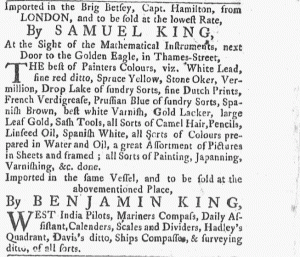
“At the Sight of the Mathematical Instruments, next Door to the Golden Eagle, in Thames-Street.”
Sometimes the directions for locating a business are just as interesting as the merchandise offered for sale, at least to someone observing from a distance of 250 years. I’ve commented fairly regularly about various modes of identifying where a business happened to be located, especially when such directions crowded out appeals that could have marketed goods and services to potential customers. (On the other hand, advertisers couldn’t sell anything if customers couldn’t find them.) Last week I even made sport of an attorney who provided unnecessarily convoluted and legalistic directions to his office. Providing adequate directions was a part of doing business in the days before standardized street numbers (an innovation that appeared in many American cities around the final decade of the century).
This advertisement does not make reference to cross streets or counting the number of doors after arriving at an intersection. It simply states that this shop is located “At the Sight of the Mathematical Instruments, next Door to the Golden Eagle, in Thames-Street.” Contemporary visual images of streetscapes in colonial American cities are relatively rare, but advertisements like this one help to envision what colonists would have seen as they went about their daily business.
Contemplating “the Sight of the Mathematical Instruments” or “the Golden Eagle” evokes days gone by. It might even seem quaint, but I’m not certain that the American consumer landscape has changed as significantly as we might like to imagine. After all, how many people actually know the street address of the fast food restaurant where they grab a quick lunch or the store where they buy everything from bread to toys to clothes? I’m guessing that most people look for golden arches or a big red target rather than a street number.
Also, note what kinds of merchandise Benjamin King sells and the sign that announces the location of his shop to potential customers. Clever.
What was advertised in a colonial newspaper 250 years ago today?
Newport Mercury (January 28, 1766)
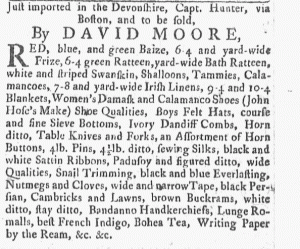
“To be sold, By DAVID MOORE … Women’s Damask and Calamanco Shoes … Boys Felt Hats … &c. &c.”
I recently featured an advertisement noteworthy in that it explicitly addressed female consumers. I pointed out that this was not a standard practice in colonial America, that most advertisers did not narrow the realm of possible customers by specifying that they expected to sell their wares to patrons of one sex or the other. I also noted some occasional exceptions, such as milliners who specialized in women’s hats or tailors who made men’s garments. Still, most shopkeepers, like David Moore, did not place advertisements that singled out one sex or the other.
That being said, many shopkeepers did indicate that they stocked goods, almost always clothing items, intended for men or women, boys or girls, such as the “Women’s Damask and Calamanco Shoes” and Boys Felt Hats” in this advertisement. They were not, however, parceled out in distinct sections of advertisements. Instead, they appeared mixed in with the multitude of other goods included in the list advertisements so common during the period. Rather than categorize their merchandise to make it easier for consumers to find men’s, women’s, and children’s garments, advertisers allowed them to discover these items in the midst of others that may or may not have been related.
What was advertised in a colonial newspaper 250 years ago this week?
Newport Mercury (January 20, 1766)
“Said FOX continues his Business in drawing Deeds of Conveyance, Leases, Mortgages, Charter-parties, Bills of Bottomry, Bills of Sale, Letters of Attorney, and all other Writings.”
Joseph Fox appears to have been an attorney. (Who other than an attorney would have devised such convoluted directions to his place of business?!) Many of the services he offered look quite familiar: leases, mortgages, bills of sale, and letters of attorney. One of the others grabbed my attention. What are bills of bottomry?!
West’s Encyclopedia of American Law (2008) offers this definition: “A contract, in maritime law, by which money is borrowed for a specified term by the owner of a ship for its use, equipment, or repair for which the ship is pledged as collateral. If the ship is lost in the specified voyage or during the limited time, the lender will lose his or her money according to the provisions of the contract. A contract by which a ship or its freight is pledged as security for a loan, which is to be repaid only in the event the ship survives a specific risk, voyage, or period.”
Given the risks associated with transporting goods throughout the network of commerce that crisscrossed the Atlantic in the eighteenth century, it’s easy to see why some owners of vessels might find this arrangement attractive.
Apparently bottomry declined significantly during the nineteenth century, to the point that it remains mainly of interest to maritime, economic, and legal historians today. In the eighteenth century in a busy port city like Newport, however, “Bills of Bottomry” would likely have been a relatively common mechanism well known to much of the seafaring populace, especially owners and masters of vessels.