January 22

What was advertised in a colonial newspaper 250 years ago this week?

Jan 22 - 1:20:1766 Newport Mercury
Newport Mercury (January 20, 1766)

“Said FOX continues his Business in drawing Deeds of Conveyance, Leases, Mortgages, Charter-parties, Bills of Bottomry, Bills of Sale, Letters of Attorney, and all other Writings.”

Joseph Fox appears to have been an attorney.  (Who other than an attorney would have devised such convoluted directions to his place of business?!)  Many of the services he offered look quite familiar:  leases, mortgages, bills of sale, and letters of attorney.  One of the others grabbed my attention.  What are bills of bottomry?!

West’s Encyclopedia of American Law (2008) offers this definition:  “A contract, in maritime law, by which money is borrowed for a specified term by the owner of a ship for its use, equipment, or repair for which the ship is pledged as collateral.  If the ship is lost in the specified voyage or during the limited time, the lender will lose his or her money according to the provisions of the contract.  A contract by which a ship or its freight is pledged as security for a loan, which is to be repaid only in the event the ship survives a specific risk, voyage, or period.”

Given the risks associated with transporting goods throughout the network of commerce that crisscrossed the Atlantic in the eighteenth century, it’s easy to see why some owners of vessels might find this arrangement attractive.

Apparently bottomry declined significantly during the nineteenth century, to the point that it remains mainly of interest to maritime, economic, and legal historians today.  In the eighteenth century in a busy port city like Newport, however, “Bills of Bottomry” would likely have been a relatively common mechanism well known to much of the seafaring populace, especially owners and masters of vessels.
January 8

What was advertised in a colonial newspaper 250 years ago this week?

Jan 8 - 1:6:1766 Newport Mercury
Newport Mercury (January 6, 1766)

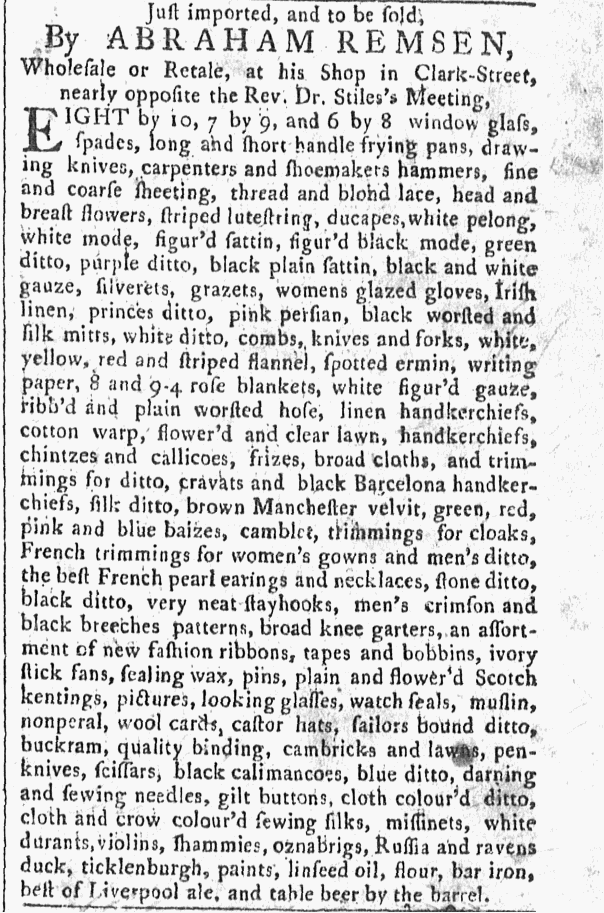
“Spades … black plain sattin … chintzes and callicoes … brown Manchester velvit … the best French pearl earings and necklaces … tapes and bobbins … pen-knives … darning and sewing needles … and table beer by the barrel.”

Abraham Remsen stocked a variety of merchandise to be sold “Wholesale or Retale, at his Shop in Clark-Street” in Newport.  Reading through his list advertisement, which certainly testifies to the assortment of goods so many shopkeepers promoted in eighteenth-century America, can be a bit disorienting.  In response to an advertisement featured a short while ago, one correspondent on Twitter remarked that colonial Americans must have had longer attention spans than their modern counterparts, considering the length, density, and lack of visual images common in many newspaper advertisements of the period.

This prompted me to think about reading habits in the eighteenth century.  Historians have long argued that early Americans read newspapers intensively, that they were read aloud in public spaces (like taverns and coffeehouses) and passed around until they became dog-eared.  Consider that American newspapers in the 1760s were published once a week.  Consider also that each issue was typically a single broadsheet, folded in half to create a four-page newspaper.  It makes sense that subscribers and others would read the news items carefully and perhaps multiple times.

But what about the advertisements?  Would they have been read as intensively as other items?  How would an early American reader have approached this advertisement?