July 29

What was advertised in a colonial American newspaper 250 years ago today?
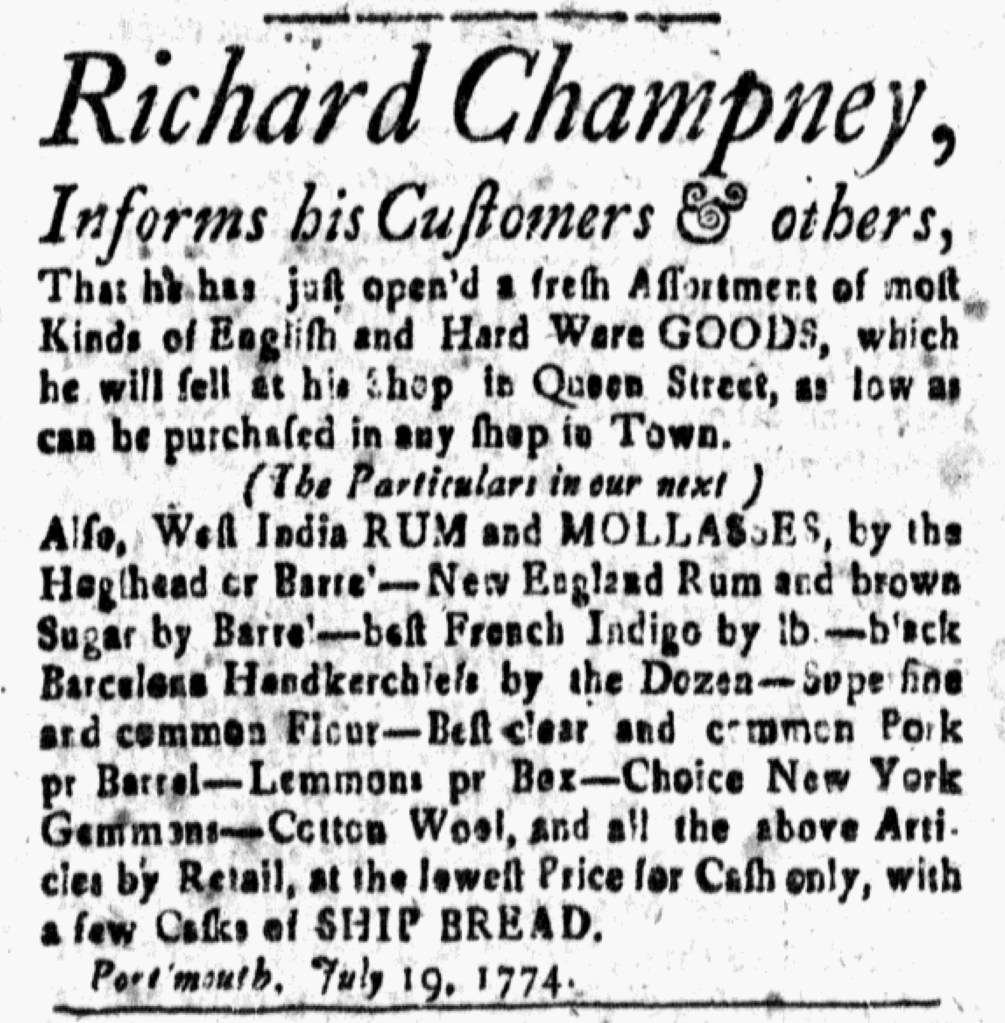
New-Hampshire Gazette (July 29, 1774).

(The Particulars in our next)

In the summer of 1774, Richard Champney took to the pages of the New-Hampshire Gazette to announce that he “has just open’d a fresh Assortment of most Kinds of English and Hard Ware GOODS” at his shop in Portsmouth.  He pledged that customers could acquire his merchandise “as low as can be purchased in any shop in Town.”  When his advertisement first ran on July 22, it did not list any of those items.  Instead, a note promised, “The Particulars in our next.”  Most likely the compositor devised that note due to lack of space in that issue; Champney’s advertisement appeared in the final column on the third page, the last of the content that would have been prepared for any edition.

The following week, however, his advertisement did not include the “Particulars.”  It ran exactly as it had, without any revision, though the compositor managed to find room for a new advertisement that featured an extensive catalog of goods that John Penhallow “Imported from LONDON” and sold at his store.  Had someone in the printing office overlooked the copy that should have appeared in Champney’s advertisement?  Did the shopkeeper raise an objection when his complete advertisement did not run as planned?  Was he frustrated that a competitor achieved greater visibility in the public prints even though he submitted his advertisement a week earlier?

Some exchange might have occurred between Champney and the printing office to rectify the situation.  The complete advertisement finally found its way into print in the August 5 edition of the New-Hampshire Gazette, two weeks after the shopkeeper first alerted readers that he had a “fresh Assortment” of goods.  It listed dozens of items to entice consumers, simultaneously demonstrating that the choices he offered to customers rivaled what Penhallow and other advertisers presented to the public.  Promising the “Particulars” in the next issue may have encouraged anticipation among prospective customers, especially in an issue that included only one other advertisement for imported wares, that one from a milliner who promoted a narrow range of goods, but not following through on it did not serve Champney well when his competitors published their own catalogs of merchandise.  Even though his complete notice eventually ran, any advantage from being the first in print had been squandered.
May 14

What was advertised in a colonial American newspaper 250 years ago today?

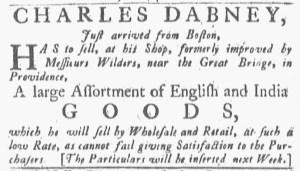
Providence Gazette (May 14, 1774).

“[The Particulars will be inserted next Week.]”

Charles Dabney took out an advertisement in the Providence Gazette to announce that he stocked a “large Assortment of English and India GOODS” at his shop near the Great Bridge.  He offered his wares “Wholesale and Retail, at such a low Rate, as cannot fail giving Satisfaction to the Purchasers.”  In other words, customers would be happy with the bargains they got when they visited Dabney’s shop.  He intended to provide a list of his merchandise to demonstrate the choices he made available to consumers, but his initial advertisement in the May 14, 1774, edition did not include “The Particulars.”  Instead, the notice stated that those details “will be inserted next Week.”  Who made that decision?  Perhaps Dabney did not have time to draw up a list of that “large Assortment” before the May 14 edition went to press.  Perhaps John Carter, the printer of the Providence Gazette, determined that he did not have space for all the content submitted that week.  Dabney’s advertisement may have been the item easiest to truncate.

Whatever the explanation, the complete advertisement did not appear the following week.  Politics and current events crowded out most advertisements, including even the short version of Dabney’s notice.  A note from the printer advised, “To make Room for the interesting Advices in this Day’s Gazette, we are obliged to omit several Advertisements.”  Those “interesting Advices” included the “Substance of the DEBATES on the BOSTON PORT-BILL” in the House of Commons in London.  Parliament closed the port of Boston in retribution for the destruction of the tea that occurred the previous December.  That news, which filled the entire front page and overflowed onto the second, arrived in Boston via several vessels from London.  Carter then reprinted it from Boston’s newspapers.  The second page also featured an editorial by “JUSTICE” that ran in the London’s Public Advertiser” and news from Philadelphia and Boston.  The updates from Boston continued on third page, followed by a resolution in support of “the Province of the Massachusetts Bay” adopted at a “Town-Meeting held at Providence, on the 17th Day of May.”  Advertising filled only two-thirds of the final column.  More coverage of the debate over the Boston Port Act filled almost the entire final page.  Two advertisements appeared at the bottom of the last column.

Dabney’s advertisement did finally appear in its entirety on May 28, but news about the imperial crisis, especially the repercussions of the Boston Tea Party, took priority.  That arrangement may have helped to draw more eyes to Dabney’s notice when it did run.  Colonizers looking for more news about the Boston Port Act and reactions to it in other colonies, including those who were not subscribers or regular readers, may have eagerly perused new issues of the Providence Gazette.  They certainly found more news on May 28, but they also encountered Dabney’s advertisement with its extensive list of merchandise.

June 13

What was advertised in a colonial American newspaper 250 years ago this week?

Massachusetts Spy (June 10, 1773).

“(The particulars in Monday’s papers.)”

After opening the “New Auction-Room” in Boston in 1773, auctioneer William Greenleaf sometimes deployed a two-step strategy for promoting upcoming sales in the public prints.  Consider the notice that he placed in the Massachusetts Spyon Thursday, June 10.  Greenleaf advised readers that a “great variety of English GOODS” “Will be sold by PUBLIC VENDUE” on the following Tuesday.  Rather than publish a roster of those items, he encouraged colonizers to look for subsequent advertisements with “The particulars in Monday’s papers.”  That meant that readers had to consult newspapers other than the Massachusetts Spy.  All five newspapers published in Boston in 1773 were weeklies, the Massachusetts Gazette and Boston Weekly News-Letter and the Massachusetts Spy appearing on Thursdays and the Boston Evening-Post, the Boston-Gazette, and the Massachusetts Gazette and Boston Post-Boy on Mondays.  The auction would be over by the time the printer published the next edition of the Massachusetts Spy.

Readers who turned to the Massachusetts Gazette and Boston Post-Boy for “The particulars” on the following Monday did not encounter any additional information, but those who perused the Boston Evening-Post and the Boston-Gazette did indeed discover a more complete preview of Greenleaf’s next auction.  In nearly identical advertisements, the auctioneer listed dozens of items, including “a fine Assortment of Chints, Callicoes and Printed Linens,” “a Number of Silver Watches,” and “a suit of Green Bed Curtains.”  The sale would begin “precisely at Ten o’clock” the next morning, so readers interested in bidding on any of the items needed to arrive in time that they did not miss that part of the sale.  Those advertisements likely contained information that had not yet been finalized the previous Thursday, yet given that Greenleaf competed with several other auctioneers in Boston he wished to generate some level of visibility for his next vendue, especially since those other auctioneers regularly advertised in multiple newspapers as well.  As advertisements placed by merchants and shopkeepers came and went in the public prints, notices from auctioneers, updated weekly, remained a constant feature in the city’s many newspapers.  In this instance, Greenleaf oversaw an advertising campaign that he updated more than once a week, coordinating with multiple printing offices.

May 21

What was advertised in a colonial American newspaper 250 years ago today?

Connecticut Journal (May 21, 1773).

(The Particulars will be in our next.)

Several shopkeepers advised readers of the Connecticut Journal and New-Haven Post-Boy that they recently acquired new merchandise. William Sherman advertised a “compleat Assortment of English & India Goods” and a “general Assortment of Hard-Ware.”  Thomas Gelstharp stocked a “Small Assortment of the neatest Silk, Thread, Cotton & Worsted HOSE” and other garments, while Daniel Lyman carried a “fresh Assortment of GOODS,” including nails, wines, shoes, and “sundry Articles, too tedious for Advertisement.”

Joseph Smith promoted his own “fresh and neat Assortment of GOODS, suitable for the Season,” but, unlike Lyman, he did wish to provide a more complete catalog of his wares to entice prospective customers to visit his shop.  His brief advertisement, however, ended with a note that “(The Particulars will be in our next.)”  A more extensive advertisement did indeed appear in the May 28, 1773, edition of the Connecticut Journal, filling more than half a column and listing dozens of items.

What explained the note appended to Smith’s initial advertisement?  Had his new merchandise “just come to Hand” so recently that he did not have an opportunity to compose a list of items in time to submit his advertisement to the printing office for the next edition of the Connecticut Journal?  Had that been the case, he may have believed that a short notice with few details was better than no advertisement at all.  When readers encountered the advertisements from Sherman, Gelstharp, and Lyman, they also saw Smith’s notice.

On the other hand, the printers, Thomas Green and Samuel Green, may have revised Smith’s advertisement and inserted the note about “The Particulars” appearing in the next issue because they did not have sufficient space to run all of the copy.  They could have strategically selected which advertisement to truncate when they set type for the May 28 edition. In that case, how did they handle the accounting and customer service?  Did the abbreviated version run gratis, the note about “The Particulars” intended for the advertiser rather than readers?  Did Smith pay a reduced rate for it?  Did the printers make any other effort to alert Smith that they would print his advertisement in its entirety but did not have enough space in the current issue?

Printers who published newspapers depended on revenue from advertising as much as revenue from subscriptions.  In addition, they likely had more contact with most advertisers than they had with most subscribers, especially considering that advertisements usually ran for only three or four weeks.  Renewing advertisements or placing new ones required contacting the printing office once again.  Both resulted in additional entries in the ledgers.  Printers likely had to exert more effort in managing their relationships with their advertisers than their relationships with their subscribers.  The note at the end of Smith’s advertisement may have been part of the Greens’ effort to manage their relationship with a local shopkeeper they hoped would continue to place notices in their newspaper.