March 19

What was advertised in a colonial American newspaper 250 years ago today?

Providence Gazette (March 19, 1774).

“… and many other Articles, as cheap as usual.”

Were advertisements in early American newspapers effective?  Did they work?  Did readers become consumers because advertisements incited demand?  Did consumers select where they would shop because of the advertisements they encountered in the public prints.  There are no easy answers to those questions.

What can be asserted with more certainty is that many merchants, shopkeepers, artisans, and others who provided goods and services considered advertising worth the investment, so much so that they placed advertisements for years.  Consider Nicholas Tillinghast and William Holroyd of Providence.  As spring approached in 1774, they once again took to the pages of the Providence Gazette, this time promoting an assortment of “GARDEN SEEDS” as well as a “Variety of English and West India GOODS.”  Perhaps seeing James Green’s advertisement for similar merchandise in the March 5 edition prompted them to insert their own notice in the next edition for fear of losing former and prospective customers to a competitor.

By that time, Tillinghast and Holroyd had been advertising in the Providence Gazette for years.  The Adverts 250 Projecthas not featured every advertisement that they published, but it has examined several of them.  On November 24, 1770, the partners announced that they “newly opened the Shop … at the Sign of the Elephant … where they have to sell a Variety of Articles.”  A year later, they once again hawked “a Variety of well assorted GOODS,” noting that they stocked too many items “to be particularly mentioned in an Advertisement.”  On May 16, 1772, they asserted that they sold a “Variety [of] ARTICLES … at as cheap a Rate as any Goods, of the same Quality, can be purchased in this Town.”  They did not merely announce that they had merchandise for sale.  Instead, Tillinghast and Holroyd repeatedly underscored that they offered choices to consumers and sometimes used prices to encourage prospective customers to choose their store over others.  They did so once again in August 1773 when they directed “their old Customers and the Public” to a new shop “which they have built.”  Their inventory consisted of “English Piece Goods, and Hard Ware of various Sorts, West-India Goods, Groceries and Wines of several Sorts.”  The partners resorted to a familiar refrain: “the Particulars of which would be tedious to enumerate in an Advertisement.”  Instead, they “can be better recounted to any who shall be pleased to make personal Application.”  Tillinghast and Holroyd promised attentive customer service.

Did advertising work?  Tillinghast and Holroyd thought that it worked well enough to justify placing yet another notice in the Providence Gazette in March 1774.  If they suspected that advertising did not yield a return on their investment, would they have continued doing so?

August 14

What was advertised in a colonial American newspaper 250 years ago today?

Providence Gazette (August 14, 1773)

“Can be better recounted to any who shall be pleased to make personal Application.”

When Nicholas Tillinghast and William Holroyd built a new shop in the summer of 1773, they placed an advertisement in the Providence Gazette to inform “their old Customers, and the Public,” about their new location.  They provided extensive directions, but did not mention if the Sign of the Elephant continued to adorn their business.

The partners gave a brief overview of their “Assortment” or inventory, stating that it “consists of English Piece Goods, and Hard Ware of various Sorts, West-India Goods, Groceries and Wines of several Sorts.”  Some merchants and shopkeepers demonstrated the choices they made available to consumers with lists of merchandise.  Joseph Russell and William Russell, two of the most prominent merchants in Providence, did so in the advertisement immediately above Tillinghast and Holroyd’s notice.  In addition to declaring that they stocked a “general Assortment of ENGLISH and HARD-WARE GOODS,” they named dozens of items and arranged them into two columns.  Tillinghast and Holroyd took a different approach, exclaiming that “the Particulars” of their inventory “would be tedious to enumerate in an Advertisement.”  They had deployed that strategy in the past, asserting that “The Articles are too many to be particularly mentioned in an Advertisement.”

Instead, Tillinghast and Holroyd advised that their merchandise “can be better recounted to any who shall be pleased to make personal Application.”  They invited “old Customers, and the Public” to visit their shop, examine the merchandise, compare items, ask questions, get recommendations, and chat about the “Assortment.”  That gave Tillinghast and Holroyd opportunities to cultivate relationships with consumers and, in the process, encourage them to make purchases rather than merely browse.  They might even convince shoppers to buy items that they had not even previously considered before making “personal Application” at Tillinghast and Holroyd’s new shop.  In their advertisement, the partners emphasized interacting with “their good Customers” rather than treating sales as nothing more than transactions.  They apparently believed that many consumers responded better to that personal touch compared to lengthy lists of goods.

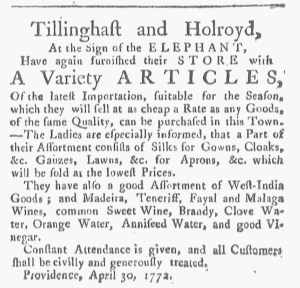
May 16

What was advertised in a colonial American newspaper 250 years ago today?

Providence Gazette (May 16, 1772).

“They will sell at as cheap a Raste as any Goods … can be purchased in this Town.”

Nathaniel Jacobs advised prospective customers that he stocked a “compleat Assortment of European and East-India GOODS” that he “sold at the lowest Prices” at his shop on the west side of the Great Bridge in Providence.  Other merchants and shopkeepers who also placed notices in the May 16, 1772, edition of the Providence Gazette placed even greater emphasis on the bargains they offered.

At their shop at the Sign of the Elephant, for instance, Tillinghast and Holroyd stocked a “Variety [of] ARTICLES … which they will sell at as cheap a Rate as any Goods, of the same Quality, can be purchased in this Town.”  In other words, their competitors did not have lower prices.  To underscore the point, they made an additional appeal to female consumers.  “The Ladies are especially informed,” Tillinghast and Holroyd declared, “that a Part of their Assortment consists of Silks for Gowns, Cloaks, &c. Gauzes, Lawns, &c. for Aprons, &c. which will be sold at the lowest Prices.”  According to the advertisement, women could acquire these goods without paying extravagant prices.

Jones and Allen also emphasized low prices in their lengthy notice that listed scores of “ENGLISH and INDIA GOODS” recently imported.  The headline for their advertisement proclaimed, “The greatest Pennyworths,” alerting prospective customers to bargain prices.  Not considering that sufficient to entice customers into their shop at the Sign of the Golden Ball, they concluded with a note that they “think it needless to say any thing more to the public, than that they deal for ready money, and are determined to be undersold by no retailer in Providence.”  Jones and Allen encouraged comparison shopping, confident that customers would ultimately buy their goods.

Thurber and Cahoon made similar promises concerning their “compleat Assortment of English and India GOODS” at the Sign of the Bunch of Grapes.  They suggested that they already had a reputation for good deals at their store, stating that they were “determined to sell at their usual low Prices.”  In addition, they challenged consumers to make their own assessments, confiding that they “doubt not but all, who will call and examine for themselves, will be convinced [their prices] are as low, if not lower, than are sold by any Person, or Persons, whatever.”  Their advertisement advanced yet another claim to setting the best prices in town.

Tillinghast and Holroyd, Jones and Allen, and Thurber and Cahoon did not merely tell prospective customers that they offered low prices.  They did not make offhand appeals to price.  Instead, they crafted short narratives about the bargains at their shops, pledging consumers would not find better deals elsewhere.  They believed that such narratives would entice customers to visit their shops even if they encountered low prices in other stores.

November 16

What was advertised in a colonial American newspaper 250 years ago today?

Providence Gazette (November 16, 1771).

“The Articles are too many to be particularly mentioned in an Advertisement.”

Nicholas Tillinghast and William Holroyd stocked their store on King Street in Providence with “a Variety of well assorted GOODS … just imported in the last Ships from London.”  Their inventory included “a fine Assortment of Queen’s Ware,” but the partners declined to list other items, stating that the “Articles are too many to be particularly mentioned in an Advertisement.”  They made an appeal to consumer choice by suggesting that the choices were too extensive to do justice to them in a newspaper notice.  Prospective customers would have to visit their store to see for themselves what might strike their fancy.

Tillinghast and Holroyd were not the only advertisers who adopted that strategy in the November 16, 1771, edition of the Providence Gazette.  Nicholas Brown and Company informed readers that “[t]o enumerate the particular Articles” among their “compleat Assortment of English, India and Hard Ware GOODS” would “require much more room than can well be afforded in a News-Paper.”  They sweetened the deal by asserting that their inventory included “a great Number [of goods] not usually imported into this Town,” another means of leveraging curiosity to draw prospective customers into their store.  Stewart and Taylor selected a couple of dozen items from their “Variety of ENGLISH and INDIA GOODS” to list in their advertisement, but insisted that they carried “a variety of other articles, too tedious to mention.”  Jabez Brown cataloged an even greater number of items from his “neat Assortment of Fall and Winter GOODS,” bit concluded with “&c. &c. &c.”  He repeated the eighteenth-century abbreviation for et cetera three times to underscore the range of choices available.

Such advertisements gave the Providence Gazette a different appearance than many of the newspapers published in Boston, New York, and Philadelphia that same week.  Publications in those cities included many advertisements that incorporated extensive lists of merchandise, many of them extending half a column or more.  Similar advertisements sometimes ran in the Providence Gazette, but, at least for the moment, the merchants and shopkeepers in town opted for an economy of prose.  In general, advertising practices were not regionally distinctive in eighteenth-century America, but the number of merchants and shopkeepers who declared they sold “too many [items] to be particularly mentioned in an Advertisement” represents a trend toward a particularly strategy in Providence in the fall of 1771.  It suggests that advertisers did take note of the methods deployed by their competitors and adjusted their own notices accordingly.

November 24

What was advertised in a colonial American newspaper 250 years ago today?

Providence Gazette (November 24, 1770).

“Many other articles not enumerated.”

Consumer choice was a key element of Nicholas Tillinghast and William Holroyd’s advertisement in the November 24, 1770, edition of the Providence Gazette.  The partners informed the public that they stocked “a Variety of Articles, both of wet and dry Goods,” at their new shop at the Sign of the Elephant.  To help prospective buyers imagine the choices available to them, Tillinghast and Holroyd provided a list of some of their many wares, naming everything from “WOOLLEN and linen cloths” to “best French brandy.”  They placed special emphasis on “an assortment of stationary ware,” cataloging “writing paper by the ream, account books of different sizes, ink cake, red and black ink powder, wafer, quills and pens ready made, ink stands, sand boxes, pounce boxes, [and] pencils.”  In addition to all of those accessories, Tillinghast and Holroyd carried “many other articles not enumerated.”  While the list helped prospective customers imagine some of the wares available at the Sign of the Elephant, promising even more items than would fit in the advertisement challenged them to consider what else they might encounter when visiting the shop.

Purveyors of goods often deployed these marketing strategies in newspaper advertisements in the second half of the eighteenth century.  Elsewhere in the same issue of the Providence Gazette, Clark and Nightingale promoted a “COMPLEAT Assortment of ENGLISH and INDIA GOODS” at their store at the Sign of the Fish and Frying Pan.  Other advertisers provided lists of merchandise, though all of them were short in comparison to what appeared in newspapers published in Boston, New York, and Philadelphia.  Still, merchants and shopkeepers in Providence attempted to entice prospective customers by presenting them many choices intended to incite demand.  Many advertisers throughout the colonies concluded their lists with one or more “&c.” (the abbreviation for et cetera commonly used in the eighteenth century) to indicate that consumers would discover many other goods when visiting their shops.  Tillinghast and Holroyd deployed a variation, “many other articles not enumerated,” that delivered the same message.  Along with price and quality, consumer choice was among the most common marketing strategies in eighteenth-century newspaper advertisements.  Merchants and shopkeepers invited consumers to be make a pastime of shopping by considering the many choices available and contemplating the power they possessed in making selections for themselves.