June 1

What was advertised in a colonial American newspaper 250 years ago today?
Pennsylvania Journal (June 1, 1774).

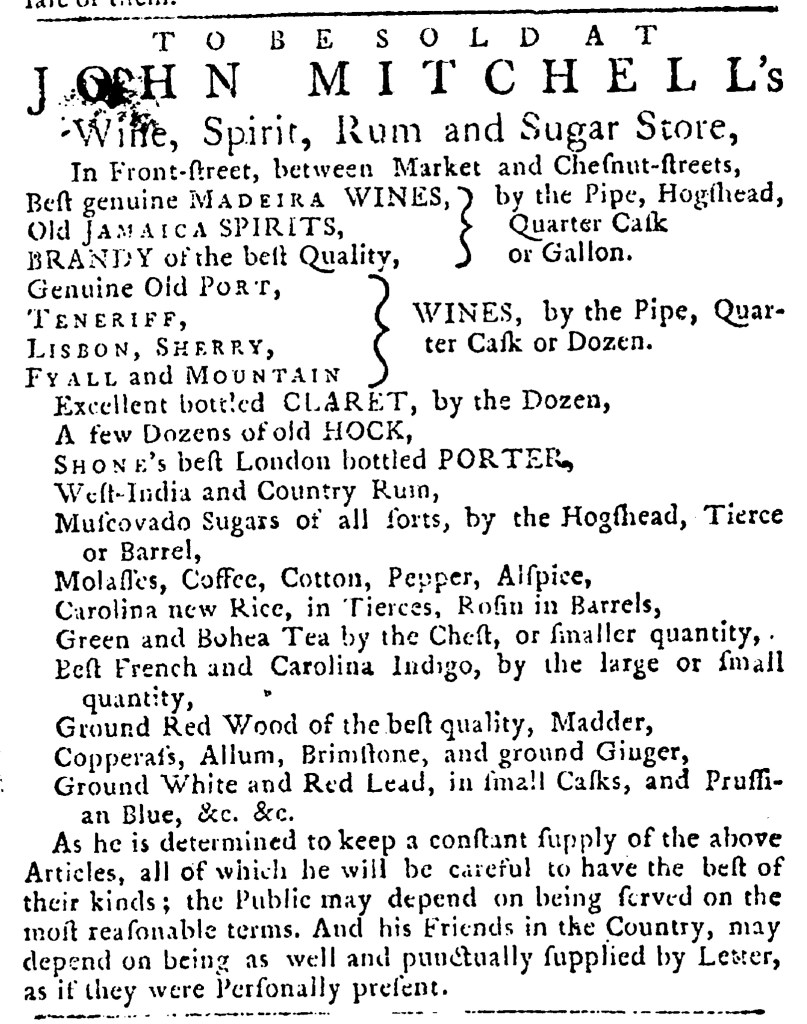
“Wine, Spirit, Rum and Sugar Store.”

John Mitchell ran the “Wine, Spirit, Rum and Sugar Store” on Front Street in Philadelphia in the 1770s.  Thomas Batt’s “WINE and SPIRIT STORE” was among his competitors for customers in the bustling urban port and its hinterlands.  To attract the attention of prospective customers, Mitchell provided an extensive list of his inventory in his advertisement in the June 1, 1774, edition of the Pennsylvania Journal.  He sold “Best genuine MADEIRA WINES, Old JAMAICA SPIRITS, [and] BRANDY of the best Quality, by the Pipe, Hogshead, Quarte Cask or Gallon.”  Similarly, his patrons could purchase several kinds of wine, including “Genuine OLD PORT, [and] TENRIFF, LISBON, SHERRY, FYALL and MOUNTAIN” wines, “by the Pipe, Quarter Cask or Dozen.  Like Batt, he offered a choice among quantities.  “Excellent bottled CLARET,” “SHONE’S best London PORTER,” and “West-India and Country Rum” rounded out his selection of alcohol.  Mitchell also stocked groceries, including sugar, molasses, coffee, rice, and the increasingly problematic “Green and Bohea Tea.”

Beyond such a selection, Mitchell also aimed to convince readers that he made shopping at his store convenient.  He advised “Friends in the Country” that they “may depend on being as well and punctually supplied by Letter, as if they were Personally present.”  In other words, Mitchell did not give preference or better treatment to customers who visited his store; instead, he cultivated relationships with customers in towns and villages outside of Philadelphia by providing the same level of service, including filling orders as quickly as possible, so they felt comfortable continuing to buy from him rather than turn to his competitors.  That also meant maintaining “a constant supply” of the merchandise listed in his advertisement so customers did not have to wait on his supply chain after placing their orders.  Mitchell combined these appeals with promises of superior quality and fair prices, declaring that he “will be careful to have the best of their kinds” and that “the Public may depend on being served on the most reasonable terms.”  Although the list of his wares accounted for most of the space in his advertisement, Mitchell deployed a variety of other marketing strategies to entice customers to shop at the “Wine, Spirit, Rum and Sugar Store.”

September 22

What was advertised in a colonial American newspaper 250 years ago today?

Pennsylvania Journal (September 22, 1773).

“They have lately erected a commodious Elaboratory for the preparing Chemical and Galenical Medicines.”

In the fall of 1773, Speakman and Carter, “CHEMISTS and DRUGGISTS” in Philadelphia, advertised widely in their efforts to capture their share of the market for the “freshest DRUGS and genuine Patent MEDICINES, Surgeons INSTRUMENTS[,] Shop Furniture,” and other merchandise sold by apothecaries in the city.  They competed with other apothecaries, including several who ran their own notices in newspapers published in the city.  Robert Bass advertised in the Pennsylvania Chronicle.  William Smith inserted notices in both the Pennsylvania Journal and the Pennsylvania Packet.  John Watson, “DOCTOR, SURGEON, and APOTHECARY, at NEWCASTLE on Delaware,” competed for customers outside Philadelphia with an advertisement in the Pennsylvania Chronicle.

Speakman and Carter sought customers in the Philadelphia as well as “Orders from the country,” including New Castle and the surrounding area, and welcomed both wholesale and retail sales.  On September 22, they ran advertisements with identical copy (but variations in format) in the Pennsylvania Gazette and the Pennsylvania Journal.  In addition to hawking the drugs and patent medicines they recently imported from London, Speakman and Carter advised “Wholesale Dealers and Practitioners in Medicine” that they “erected a commodious Elaboratory for the preparing Chemical and Galenical Medicines in large quantities.”  The apothecaries asserted that they could compound medicines “in large quantities” of the same quality “on as low terms [or prices] as they can be imported from England.”

Pennsylvania Chronicle (September 20, 1773).

The industrious apothecaries simultaneously ran a more elaborate advertisement in the September 20 edition of the Pennsylvania Chronicle.  It included all of the material that appeared in the advertisements in the other two newspapers as well as a list of some of their inventory.  Divided into two columns with one item per line, that list included “Jesuits bark,” “Purging salts,” “Lancets single or in cases,” “Neat mahogany medicine chests for gentlemen’s families,” and “Keyser’s pills, warranted genuine from the only importer in London.”  In addition, Speakman and Carter inserted an abbreviated version of the advertisement in the Pennsylvania Packet on the same day.  It featured just a small portion of the notices that appeared in the other newspapers, promoting “A LARGE assortment of the freshest Drugs and Patent Medicines, the most saleable articles in large quantities, which will be sold on reasonable terms.”  Though relatively brief compared to the others, publishing that advertisement meant that Speakman and Carter placed notices in all four English-language newspapers published in Philadelphia at the time.  (They did not pursue Henry Miller’s standing offer to translate any and all advertisements for the Wöchentliche Pennsylvanische Staatsbote.)  The apothecaries apparently considered it worth the investment to achieve market saturation with advertisements in so many newspapers.

February 5

What was advertised in a colonial American newspaper 250 years ago today?

Feb 5 - 2:5:1768 New-Hampshire Gazette
New-Hampshire Gazette (February 6, 1768).

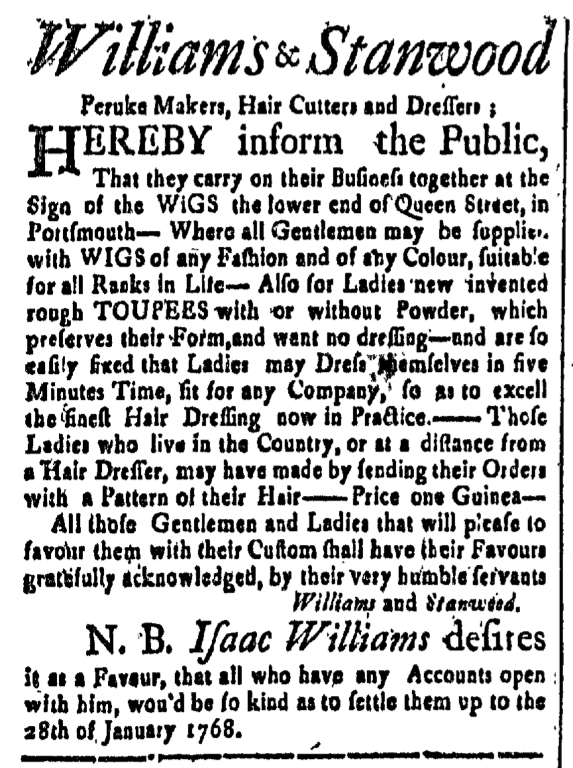
Williams & Stanwood Peruke Makers, Hair Cutters and Dressers.”

In eighteenth-century America wigmakers and hairdressers like Williams and Stanwood did not restrict their attempts to incite demand for their services to the better sorts who resided in the largest port cities. Their advertisement in the February 5, 1768, edition of the New-Hampshire Gazette informed prospective clients in Portsmouth and its hinterland that “they carry on their Business together at the lower end of Queen Street.” Rather than cultivating a clientele of the local elite, they sold gentlemen’s wigs “suitable for all Ranks in Life.” In addition, they served “Ladies who live in the Country, or at a distance from a Hair Dresser,” accepting orders for wigs submitted by post or messenger. Whether potential customers lived in a busy port city or a quiet village did not matter: wigmakers and hairdressers insisted that they must keep up with current fashions by enlisting their services.

Williams and Stanwood also used their advertisement to instruct the ladies about products that might not have been familiar to them previously, including “new invented rough TOUPEES.” Such merchandise needed some explanation to help prospective clients understand their value and convenience. Sold “with or without Powder,” such wigs “preserves their Form, and want no dressing.” They made it that much easier for women to prepare themselves to receive guests in their homes or to appear in public since these wigs were “so easily fixed that Ladies may Dress themselves in five Minutes Time, fit for any Company.” Customers did not, however, benefit from this ease and simplicity by sacrificing the quality or style derived from sitting with the hairdressers at their shop. Williams and Stanwood proclaimed that their toupees “excel the finest Hair Dressing now in Practice.” Ladies did not necessarily need the advantage of leisure time to appear smartly coiffed, especially if they acquired “new invented rough TOUPEES” from Williams and Stanwood.

Urban ports like Charleston, New York, and Philadelphia may have been the cosmopolitan centers of colonial life, but wigmakers and hairdressers did not allow the gentry to dictate that they be the only beneficiaries of their services. Instead, wigmakers and hairdressers encouraged much broad swaths of the colonial population to engage their products and services, portraying them as simultaneously stylish and convenient. Williams and Stanwood sold their wigs to customers of “all Ranks in Life” from city and countryside alike. To that end, they explained new products to prospective clients, training them to desire the most recent creations available in the marketplace.