January 19

What was advertised in a revolutionary American newspaper 250 years ago today?
Essex Journal (January 19, 1776).

“He is determined to be regularly supplyed with all the news-papers on the Continent.”

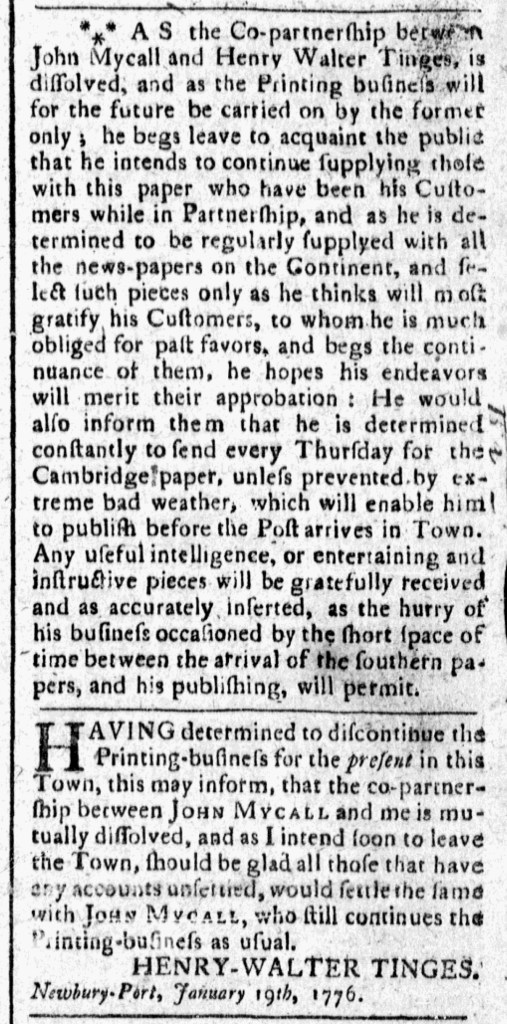
On January 19, 1776, John Mycall and Henry-Walter Tinges, the printers of the Essex Journal, announced the end of their partnership.  Tinges had been a founding partner, commencing publication of the newspaper in Newburyport, Massachusetts, in collaboration with Isaiah Thomas, the printer of the Massachusetts Spy, in December 1773.  As the junior partner, Tinges oversaw the printing office, including publication of the Essex Journal, in Newburyport, while Thomas tended to his printing office in Boston.  That initial partnership lasted only eight months before Thomas withdrew and Tinges began a new partnership with Ezra Lunt in August 1774.  That partnership also lasted less than a year.  In July 1775, Lunt exited and Mycall joined as Tinges’s new partner.  Seven months later, Tinges announced that he “determined to discontinue the Printing-business for the present in this Town” and the “co-partnership between JOHN MYCALL and me is mutually dissolved,” though Mycall “still continues the Printing-business as usual.”  Mycall published the Essex Journal on his own for just over a year.  It folded in February 1777, one of several newspapers that ceased publication during the Revolutionary War.

For his part, Mycall inserted his own advertisement stating that the partnership ended and that he “intends to continue supplying those with this paper who have been his Customers while in partnership.”  He outlined his plan for supplying subscribers with news, declaring that he “is determined to be regularly supplyed with all the news-papers on the Continent, and select such pieces only as he thinks will most gratify his Customers.”  That was the common practice for generating content in printing offices throughout the colonies.  Printers participated in extensive exchange networks, liberally reprinting, word for word, items that appeared in the newspapers they received.  Thus an item originally published in a newspaper in Charleston, for instance, could be reprinted from newspaper to newspaper in Williamsburg, Baltimore, Philadelphia, New York, Hartford, and Boston before appearing in the Essex Journal in Newburyport.  Mycall made a point that he would “send every Thursday for the Cambridge paper, unless prevented by extreme bad weather, which will enable him to publish before the Post arrives in Town.”  He referred to the New-England Chronicle, published Samuel Hall and Ebenezer Hall in Cambridge, Massachusetts.  During the siege of Boston, most of the newspapers previously printed in that city ceased or suspended publication or moved to other towns.  The Halls relocated the Essex Gazette, published in Salem, to Cambridge and renamed it the New-England Chronicle when it became the new paper of record for the latest news about the Massachusetts government and the Continental Army under the command of George Washington.  Mycall underscored that he quickly received the latest edition of the New-England Chronicle, printed on Thursdays, and incorporated “useful intelligence” into the Essex Journal, published on Fridays, ahead of the schedule for post riders to arrive in Newburyport.  In the eighteenth century, Mycall delivered breaking news to readers of the Essex Journal.
July 22

What was advertised in a revolutionary American newspaper 250 years ago today?

Essex Journal (July 22, 1775).

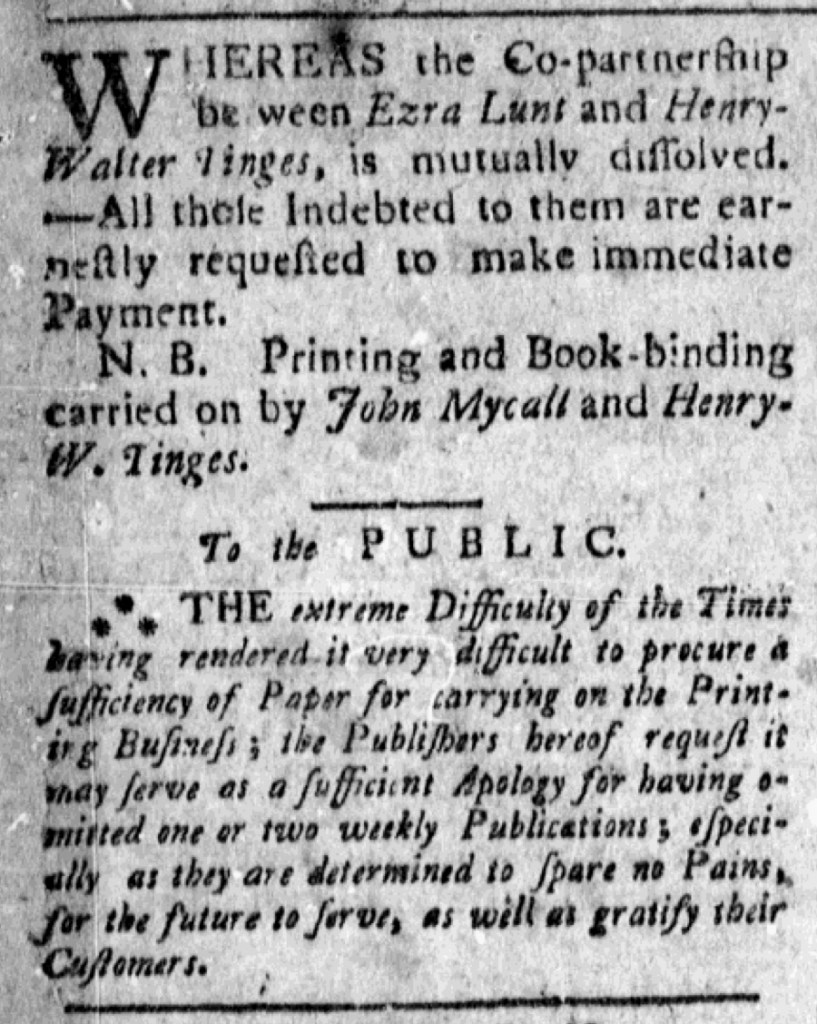
THE extreme Difficulty of the Times having rendered it very difficult to procure a sufficiency of Paper.”

A notice on the first page of the July 22, 1775, edition of the Essex Journal, Or, the Massachusetts and New-Hampshire General Advertiser informed readers that the “Co-partnership between Ezra Lunt and Henry-Walter Tinges,” the publishers of the newspaper, “is mutually dissolved” and called on “those Indebted to them” to settle accounts.  Yet the printing office in Newburyport was not being shuttered.  Instead, a nota bene declared, “Printing and Book-binding carried on by John Mycall and Henry-W. Tinges.”  Mycall became Tinges’s third partner in less than three years.  The young printer first went into business with Isaiah Thomas, the printer of the Massachusetts Spy in the late fall of 1773.  The more experienced printer remained in Boston while his junior partner oversaw the printing office and their new newspaper.  The partnership lasted less than a year.  On August 17, 1774, they notified the public that they “mutually dissolved” their partnership, but the “Printing Business is carried on as usual, by Ezra Lunt and Henry W. Tinges.”

Nearly a year later, Lunt departed and Mycall took his place.  As their first order of business, the new partners addressed some of the challenges the newspaper faced since the battles at Lexington and Concord three months earlier.  “THE extreme Difficulty of the Times having rendered it very difficult to procure a sufficiency of Paper for carrying on the Printing Business,” they lamented, “the Publishers hereof request it may serve as a sufficient Apology for having immitted one or two weekly Publications.”  Indeed, publication had been sporadic during May, immediately after the outbreak of hostilities, returned to a regular schedule in June, and then missed a week in July before announcing the departure of Lunt and arrival of Mycall.  The Essex Journal had missed only two issues, but the publishers did not consistently distribute the newspapers on the same day each week.  That likely added to the impression that they had not supplied all the newspapers that their customers expected.  In addition, the two most recent issues, June 30 and July, and the one that carried the notice about the new partnership consisted of only two pages rather than the usual four.  Mycall and Tinges vowed that “they are determined to spare no Pains, for the future to serve, as well as gratify their Customers.”  Mycall and Tinges kept that promise.  Publication returned to a regular schedule with only minor disruptions.

May 26

What was advertised in a revolutionary American newspaper 250 years ago today?

New-Hampshire Gazette (May 26, 1775).

“HAIR-DRESSERS … The Business is still carried on in the same Shop.”

William Knight, a “PERUKE MAKER and HAIR DRESSER,” placed advertisements for the wigs he made and the services he provided on several occasions.  In the January 22, 1773, edition of the New-Hampshire Gazette, for instance, he announced that he “open’d SHOP near LIBERTY BRIDGE” in Portsmouth, where he will be ready to serve any Persons on reasonable Terms.”  Six months later, he established a partnership with Peter Man.  On July 30, they published an advertisement to advise prospective clients that they “carry on their Business in all its Branches, at their Shop on the Parade in Portsmouth.”  They continued together for nearly two years, but as the Revolutionary War began Man and Knight decided to part ways.

That prompted another newspaper advertisement, one that deployed standard language for such circumstances.  Upon “having agreed to dissolve the Partnership which was between them,” they called on “all Persons with whom they have Accounts open to close them as soon as possible.”  They did not indicate why they ended their partnership, though perhaps Knight retired or moved to another town.  He did not place any more advertisements in the New-Hampshire Gazette.  Man, on the other hand, used the notice about the partnership ending for a second purpose.  With a manicule to draw attention, he proclaimed, “The Business is still carried on in the same Shop, on the Parade and constant Attendance given.”  Even as one iteration of the business closed, Man hoped to maintain the clientele that he and Knight had established over the past two years as well as attract new customers for wigs and styling.

He was not the only one to advertise such services.  In an advertisement for the inn that he operated in nearby Greenland, John Williams added a nota bene to inform “Amy Gentlemen Travellers inclining to have their Hair or Wigs dressed before they go to Town, may have it done by said WILLIAMS in the genteelest and most fashionable Manner.”  Even as the New-Hampshire Gazette carried the “Freshest ADVICES FOREIGN AND DOMESTIC” about the imperial crisis, advertisers catered to ladies and gentlemen who wanted their hair or wigs presentable for appearing in public.

December 1

What was advertised in a colonial American newspaper 250 years ago today?

Virginia Gazette [Purdie and Dixon] (December 1, 1774).

“I have sent Subscription Papers into all publick Places of the Country.”

Two advertisements that led the front page of the December 1, 1774, edition of Alexander Purdie and John Dixon’s Virginia Gazette provided important updates from the printers.  In the first, Purdie reported that he planned to “resign the Conduct of this Gazette” and wished to express his “sincere and most grateful Acknowledgments to all our Customers, and to the Publick in general,” for years of support.  In addition, he announced that he “shall begin doing Business for myself, and intend to print a GAZETTE as soon as I am furnished with a moderate Number of Customers.”  To entice them, he unveiled the proposed newspaper’s motto: “ALWAYS FOR LIBERTY AND THE PUBLICK GOOD.”  To acquire content, Purdie asked “the Favour of my BROTHER PRINTERS to the Northward to furnish me with their Newspapers, and they shall be sure to have mine, as soon as I begin to print.”  No doubt he and Dixon already participated in such exchanges.

Purdie planned to launch that enterprise “Immediately after Christmas,” but there was no guarantee that he would attract enough subscribers and advertisers to make a go of it.  After all, his newspaper would compete with the Virginia Gazettethat Dixon continued to publish and another Virginia Gazette printed by John Pinkney.  Was Williamsburg and the rest of the colony ready to support three newspapers?  To get a better sense of the market, Purdie “sent Subscription Papers into all publick Places of the Country” and instructed prospective customers that they could also contact him by letter or visit his printing office.  He eventually gained the “moderate Number of Customers” that he needed, though it took a couple of months before he distributed the first issue of his Virginia Gazette on February 3, 1775.  In that time, he also operated a shop where he sold books, sheet music, and stationery, pledging to circulate “a Catalogue of all my Books, &c. as soon as I possibly can.”  Purdie resorted to a variety of marketing media: newspaper advertisements, subscription papers, book catalogs.

In the second advertisement, Dixon revealed William Hunter, “Son of the late Mr. WM. HUNTER of this City, Printer,” would become his new partner in printing the Virginia Gazette and running a book and stationery shop.  He suggested that customers would experience a seamless transition, expressing his “most grateful Thanks for their many Favours” in the past, reminding them that “my Conduct, while in Company with Mr. PURDIE, met with general Approbation,” and pledging that “my future Endeavours to serve the Publick … will render me an Object worthy of their Encouragement.”  Aas Purdie sought subscribers and advertisers for his proposed newspaper, Dixon hoped to maintain the clientele they had cultivated over nearly a decade of working together.

Before perusing news articles or essays in the December 1 edition of Purdie and Dixon’s Virginia Gazette, readers first encountered two advertisements that delivered important news about the future of that newspaper and the possibility that another newspaper might soon be published in Williamsburg.  As was so often the case, printers used advertising space in their own publication to promote their enterprises, framing their work as service to the public.

August 17

What was advertised in a colonial American newspaper 250 years ago today?

Essex Journal (August 17, 1774).

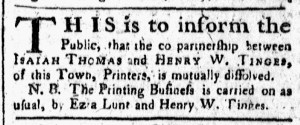
“The co partnership between ISAIAH THOMAS and HENRY W. TINGES, of this Town, Printers, is mutually dissolved.”

When the Essex Journal commenced publication on December 4, 1773, Henry-Walter Tinges printed it in partnership with Isaiah Thomas.  Tinges managed the printing office in Newburyport, while Thomas continued printing the Massachusetts Spy in Boston.  Less than a year passed before their partnership ended.  On August 17, 1774, “No. 35” of the Essex Journal carried a notice “to inform the Public, that the co partnership between ISAIAH THOMAS and HENRY W. TINGES, of this Town, Printers, is mutually dissolved.”  A nota bene further explained, “The Printing Business is carried on as usual, by Ezra Lunt and Henry W. Tinges.”  The young printer had a new partner.  He also updated the colophon on the final page to reflect this change.

Many decades later, Thomas provided a brief account of his partnership with Tinges in The History of Printing in America (1810).  Thomas recollected that he “opened a printing house” in Newburyport “[a]t the request of several gentlemen,” taking Tinges as a partner “who had the principal management of the concerns at Newburyport.”[1]  The young man had previously “served part of his apprenticeship with [John] Fleming,” one of the Tory printers of the Boston Chronicle, “and the residue with Thomas.”[2]  Although the newspaper’s colophon stated that the new printing office in Newburyport accepted job printing orders that would be completed “in a neat manner, on the most reasonable Terms, with the greatest Care and Dispatch,” Tinges devoted most of his time to printing the Essex Journal.  Thomas did not specify why the partnership was “mutually dissolved,” though he may have been frustrated that the printing office did not attract more business or distracted with the responsibilities of running his busy shop in Boston at the same time that the closure of the harbor mandated by the Boston Port Act introduced all sorts of challenges.  Whatever the reason, Thomas “sold the printing materials to Ezra Lunt, the proprietor of a stage, who was unacquainted with printing; but he took Tinges as a partner.”[3]  Tinges contributed his experience and knowledge of the printing trade, while Lunt provided the capital for the necessary equipment.  Even though Tinges performed the bulk of the labor in the printing office, his name appeared second in the colophon during his partnership with Thomas and again during his partnership with Lunt.  Although he may have taken direction from his partners on occasion, Tinges collated the news, engaged with subscribers, advertisers, and other customers, and disseminated additional information in response to “enquire of the printer” advertisements in the Essex Journal.

Essex Journal (August 17, 1774).

**********

[1] Isaiah Thomas, The History of Printing in America: With a Biography of Printers and an Account of Newspapers (1810; New York; Weathervane Books, 1970), 179.

[2] Thomas, History of Printing, 180.

[3] Thomas, History of Printing, 179.

February 9

What was advertised in a colonial American newspaper 250 years ago today?

Pennsylvania Journal (February 9, 1774).

“I will pay no debts of his contracting after the date hereof.”

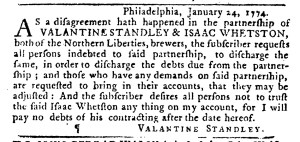
Valantine Standley and Isaac Whetston had a falling out at the beginning of 1774.  The brewers formed a partnership in the Northern Liberties on the outskirts of Philadelphia, but, as Standley explained in an advertisement in the February 9 edition of the Pennsylvania Journal, “a disagreement hath happened” that caused them to dissolve their partnership and go their separate ways.  Accordingly, Standley sought to separate his finances from Whetston, issuing a call for those who had done business with the brewers to settle accounts.  He requested “all persons indebted to said partnership, to discharge the same, in order to discharge the debts due from the partnership.”  At the same time, he asked that “those who have any demands on said partnership … bring in their accounts, that they may be adjusted.”

Standley could have left it there.  Merchants, shopkeepers, artisans, printers, and other entrepreneurs regularly placed advertisements asking their associates to settle accounts.  Similarly, executors often did so on behalf of the estates they administered.  Standley, however, inserted additional instructions to the partnership’s associates and to the general public, instructions that resembled those given by aggrieved husbands who ran what have become known as “runaway wife” advertisements to warn purveyors of goods and services not to extend credit to wives who had abandoned their husbands and households.  Standley advised “all persons not to trust the said Isaac Whetston any thing on my account, for I will pay no debts of his contracting.”  He replicated language that appeared in advertisements that resulted from marital discord but not usually in notices about business partnerships dissolving.  That Standley did so testified to the “disagreement” between the brewers.  He did not consider it sufficient that an announcement that they were no longer in business together would cause others to refrain from allowing Whetston to make charges on Standley’s account.  Instead, he explicitly forbade such transactions, suggesting that he did not trust his former partner to comport himself appropriately.  Rather than a dry and routine notification that the brewers were no longer in business together, Standley’s advertisement hinted at the acrimony between the two men, perhaps inciting curiosity among their neighbors and associates.  In this instance, an advertisement delivered both news and gossip.

April 9

What was advertised in a colonial American newspaper 250 years ago today?

New-Hampshire Gazette (April 9, 1773).

“The Partnership Of JAMES & MATHEW HASLETT is dissolv’d.”

The partnership of James Haslett and Mathew Haslett came to an end with little fanfare in the public prints.  The leather dressers inserted a short notice in the April 9, 1773, edition of the New-Hampshire Gazette, just two lines that announced, “The Partnership Of JAMES & MATHEW HASLETT is dissolv’d.”  They did not call on customers and other associates to settle accounts, nor did one or the other of them indicate that he intended to continue in the trade and would appreciate the continued patronage of former customers.

The quiet conclusion to this partnership differed from some of the flashy advertisements that the Hasletts previously placed in the New-Hampshire Gazette.  When they relocated to Portsmouth from Boston seven years earlier, they informed “Town and Country, That they have set up their Business at their Factory at the Sign of the BUCK and GLOVE … Where they carry on the [leather dressing] Business, in all its Branches, in the neatest and best Manner.”  The Hasletts deployed formulaic language, but doing so signaled that they were familiar with the advertising conventions of the era.  In the late 1760s and early 1770s, they placed advertisements of various lengths, though their longer advertisements coincided with the years that they were new to Portsmouth and still building their reputations in the region.

During that time, they commissioned woodcuts that depicted the “Sign of the BUCK and GLOVE” (and included breeches for good measure).  Those woodcuts all bore the date 1766, the year that the Hasletts established their workshop or “Factory” in Portsmouth.  Some, but not all, featured some variation of their names.  Although their shop sign no longer exists, the woodcuts in their newspaper advertisements testify to its likely appearance, like so many other woodcuts that depicted signs displayed by artisans and shopkeepers in eighteenth-century America.

For the Hasletts, their final notice in the New-Hampshire Gazette belied the visual feast and extensive copy that they previously presented to prospective customers.  On the other hand, they had been in business in Portsmouth long enough that merely glimpsing their names in the newspaper may have conjured images of the “Sign of the BUCK and GLOVE” for many readers.

December 25

What was advertised in a colonial American newspaper 250 years ago today?

New-Hampshire Gazette (December 25, 1772).

“Those who neglect, & are Indebted, must expect … the Accounts will be lodged with such Gentlemen as will create Trouble.”

As 1772 drew to a close, Daniel Fowle and Robert L. Fowle, printers of the New-Hampshire Gazette, announced their intention to dissolve their partnership.  Robert planned to leave the colony “in a short Time.”  Daniel founded the New-Hampshire Gazette in October 1756.  Nearly eight years later, according to Clarence S. Brigham, “Daniel admitted his nephew … to a share in the management” in September 1764.[1]  The Fowles worked together for more than eight years, distributing their last issue as partners in April 1773.  Daniel then became sole proprietor of the newspaper once again.

As Robert prepared to set out on his own, he inserted a notice in the December 25 edition, the final issue of the year, to alert readers that he “earnestly desires all Persons who have Accounts open, in which he has any Connections,” including accounts with the New-Hampshire Gazette, “to settle the same, as soon as possible.”  As the Fowles often did when they placed notices calling on subscribers and others to pay their bills, Robert threatened legal action against those who ignored this notice.  “Those who neglect, & are Indebted,” he warned, “must expect, that without respect to Persons, the Accounts will be lodged with such Gentlemen as will create Trouble and needless Charges.”  In other words, it did not matter if those who owed the Fowles happened to be the most influential colonial officials and the most affluent merchants; Robert intended to hold them accountable no matter their status.  To that end, he would hire attorneys, those “Gentlemen as will create Trouble and needless Charges.”  He hoped to avoid that “very disagreeable” action if “all Persons who have Accounts open” settled them, but he did not consider it “ungenerous” to sue them “after the repeated Solicitations for a Settlement” published in the newspaper and likely communicated to them in other ways.

As many colonial printers did, the Fowles gave this notice a privileged place in their newspaper.  It appeared at the top of the first column on the first page, immediately below the masthead.  That made it difficult for readers, including those indebted to the Fowles, to overlook the notice.  Perhaps as a means of reminding some of those readers of his other contributions to the community and their mutual obligations to each other, another notice signed by Robert L. Fowle appeared immediately below the one calling on colonizers to settle accounts.  In his capacity as “Pro. Sec.” of the New Hampshire lodge of the “Brethren of the Ancient and Honorable Society of Free and Accepted MASONS,” Robert extended an invitation on behalf of the master of that lodge to gather “to celebrate the Festival of St. JOHN the Evangelist” on December 28.  Robert may have intended for that notice to alleviate some of the sting of the blunt language in the other notice, having the one follow after the other.

**********

[1] Clarence S. Brigham, History and Bibliography of American Newspapers, 1690-1820 (Worcester, Massachusetts:  American Antiquarian Society, 1947), 471.

December 10

What was advertised in a colonial American newspaper 250 years ago today?

Massachusetts Gazette and Boston Post-Boy (December 10, 1770).

“The Co partnership of JOSEPH and DANIEL WALDO, is mutually dissolv’d.”

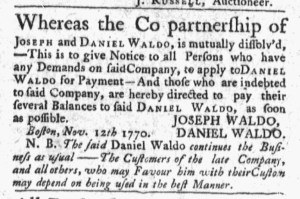
When their partnership came to an end in the fall of 1770, Joseph Waldo and Daniel Waldo placed newspaper advertisements “to give Notice to all Persons who have any Demands on said Company, to apply to DANIEL WALDO for Payment.”  They also called on “those who are indebted to said Company” to settle accounts “as soon as possible.”  That portion of the advertisement was fairly standard, replicating many others that appeared in newspapers throughout the colonies.

The nota bene at the end of the advertisement, however, incorporated a marketing strategy not nearly as common in these routine notices.  In this special note, Daniel proclaimed that he “continues the Business as usual.”  He pledged that the “Customers of the late Company, and all others, who may Favour him with their Custom may depend on being used in the best Manner.”  In the course of their partnership, the Waldos had established a clientele and a reputation among consumers in Boston and beyond.  Although the partnership had been “mutually dissolv’d,” Daniel sought to maintain both the clientele and the reputation, inviting existing customers to continue to deal with him and alerting others that the business continued to operate after Joseph’s departure.

That may explain why the advertisement did not include a certain element common to many such notices about partnerships dissolving.  The Waldos did not threaten legal action against those who owed debts, unlike others that made it clear that those who did not settle accounts would find themselves in court.  Doing so would have impaired Daniel’s attempts to continue friendly relationships with a customer base that he hoped to maintain.  After all, he promised continuing and prospective customers that they “may depend on being used in the best Manner.”  Daniel focused on customer service as a means of cultivating his business as it entered a new stage without Joseph as a partner.

May 16

What was advertised in a colonial American newspaper 250 years ago today?

May 16 - 5:16:1770 Georgia Gazette
Georgia Gazette (May 16, 1770).

“WILLIAMS and MACKAY’s Copartnership will expire in June next.”

It would have been nearly impossible for readers of the Georgia Gazette not to know that “WILLIAMS AND MACKAY’s Copartnership will expire” in June 1770.  The partners ran an advertisement to that effect in every issue for several months.  They commenced their efforts to notify “all indebted to that concern” to settle accounts in the January 3 edition of the Georgia Gazette.  That advertisement, the first item on the first page, bore a dateline at its conclusion: “Augusta, 1st January, 1770.”  The following week they published a slightly revised version, adding “Pack Horses, Indian Debts” to the list of items they continued to sell at “Their Trading House in Augusta.”  Doing so required resetting the type for the second half of the advertisement, but the compositor left the first half intact.

That advertisement ran for thirteen weeks before Williams and Mackay updated it again.  (I am assuming that it appeared in the March 14 edition.  The fourth page, usually reserved for advertisements in the Georgia Gazette, is missing from the digitized copy available via America’s Historical Newspapers).  Throughout that time, that advertisement advised that they sought to sell the trading house itself, “which may be entered upon the first of April next.”  Apparently, they did not find any purchasers by that time.  On April 11, they further revised the copy to state that the trading house “may be entered upon immediately.”  This required resetting type in the second half of the advertisement once again.  At that time, the dateline also disappeared from the advertisement.

For at least twenty consecutive weeks one iteration or another of Williams and Mackay’s advertisement ran in the Georgia Gazette.  It may have continued past the May 16 edition, but those issues have not survived.  America’s Historical Newspapers includes the first two pages of the May 23 edition, but by that time this advertisement had migrated to the last two.  That’s the end of both known copies of the Georgia Gazette and digitized editions that make them more accessible.  Inserting their advertisement that many times would have been a significant investment for Williams and Mackay.  For James Johnston, the printer, this advertising campaign yielded revenues that supported the dissemination of the news that appeared elsewhere in the Georgia Gazette.  Regular readers likely became accustomed to seeing the advertisement over the course of nearly half a year.  By inserting it so often, Williams and Mackay increased the chances that even those who read the Georgia Gazette only sporadically would see their notice.