October 11

What was advertised in a colonial American newspaper 250 years ago today?

Essex Gazette (October 11, 1774).

“LOST at the Fire on Wednesday Night last … the following Pieces of Merchandise.”

The October 11, 1774, edition of the Essex Gazette included coverage of a fire in Salem on October 6.  The conflagration destroyed the homes of several families as well as the shops and stores of more than a dozen merchants and shopkeepers.  In addition, the fire consumed a meeting house and the customs house.  Samuel Hall and Ebenezer Hall, the printers of the Essex Gazette, lost their printing office.  Just below the article about the fire, they inserted a notice alerting the public that they had relocated.  The Halls also reported that “Great Quantities of Goods, House Furniture and Papers of Value were lost, stole and destroyed in the Confusion and Destruction occasioned by the Fire; but it is impossible to obtain Accounts from the several Sufferers, sufficiently accurate to publish at this Time.”

That did not prevent others from publishing more information about the fire, either as letters to editors or by taking out advertisements that supplemented the coverage provided by the Halls.  One letter, for instance, noted that “the Sufferers in the late Fire in this Town, and others whose Goods were removed, still miss great Quantities of their Furniture and Goods.”  Such items clearly had not been misplaced and would soon be recovered as the confusion subsided and the town recovered; instead, the anonymous author asserted that goods and personal property “were stolen by the hardened Villains who ever stand ready to make their Harvest at such Times of Danger and Distress.”  Furthermore, those “Miscreants, in the Form of Pedlars, will doubtless be hawking these Goods about the Country,” capitalizing on the misfortune of others.  The letter concluded with a call for “well disposed People” to identify and imprison the thieves and encouraging justices of the peace to invoke existing laws to regulate peddlers to make sure they did not sell stolen goods when they “stroll[ed] about the Country.”

Nathaniel Sparhawk was among those with missing goods following the fire.  In an advertisement, he listed and described “Pieces of Merchandise” he “LOST at the Fire.”  He offered a reward to “Whoever will bring the above Articles or any of them” to him.  In a nota bene, he added, “No Questions will be asked.”  In other words, he only sought to recover goods apparently looted during the fire, choosing to give the benefit of the doubt that they had been removed to save them.  In exchange for that polite fiction, he would not prosecute anyone whose conscience (or the reward) prompted them to return the items.  He hoped that a reward given without questions or the possibility of prosecution would seem more attractive than whatever thieves might earn if they risked selling or fencing the stolen items.

Other advertisements also provided additional information about the fire.  One offered “300 Dollars Reward” to anyone who “will give Information” that the fire “was kindled with Design.”  Many residents believed the fire had been set intentionally.  Anyone who could prove that was the case would receive the reward “on Conviction of the Perpetrator or Perpetrators.”  Henry Putnam, who lost his shop in the fire, feared that he was a suspect.  In his own advertisement, he reported that “some ill-minded Person or Persons” spread “false Reports … intimating that there was reason to suspect that I had been guilty of the horrid Crime of being the Occasion of the late terrible Fire.”  Doing what he could to combat such gossip, he harnessed the power of the press to inform the public, especially “People at a Distance” who might hear such rumors, that “the People of this Place are fully convinced that the Reports are false and groundless.” Putnam defended his reputation in print, hoping to reach people who heard tales that spread by word of mouth.

Readers of the Essex Gazette pieced together a more complete account of the fire and its aftermath when they consulted the coverage written by the printers, the letter to the editors, and the advertisements.  As was often the case in colonial newspapers, advertisements delivered news that supplemented information that appeared elsewhere.  In this instance, the advertisements appeared in the next column, immediately to the right of the news, helping readers to make connections among the different kinds of reporting.

January 8

What was advertised in a colonial American newspaper 250 years ago this week?

New-York Gazette and Weekly Mercury (January 6, 1772).

“Will sell them cheaper than any in the city.”

Charles Oliver Bruff, a goldsmith and jeweler, operated a shop at “the Sign of the Tea-pot, Tankard, and Ear-ring” on Maiden Lane in New York in the early 1770s.  He regularly placed newspaper notices to advise prospective clients of his services.  In the January 6, 1772, edition of the New-York Gazette and Weekly Mercury, for instance, he declared that he “makes or mends any kind of diamond or enamel’d work in the jewellery way” and “makes all sorts of silversmiths work, and mends old work.”  In addition, he mended “ladies fans in the neatest manner and at the lowest price” and sold rings, lockets, “hair jewels,” and a variety of other jewelry.

Bruff sought to draw attention to two other aspects of his business.  He informed readers that he had “just finished some of the neatest dies for making sleeve buttons, with the neatest gold cuts to them to stamp all sorts of gold buttons, silver, pinchbeck, or brass.”  Colonizers who desired such distinctive buttons could acquire them from Bruff … and at bargain prices.  He pledged to “sell them cheaper than any in the city.”  In addition to buttons, Bruff also highlighted his interest in working with “gentlemen merchants that travel the country, or pedlars,” anticipating that they would purchase in quantity for resale.  The goldsmith asserted that peddlers “may depend on being used well.”  That included maintaining good relationships as well as offering low prices.  Bruff confided that for such customers he would “make any kind of work cheaper than they can get it in the city elsewhere.”

Whether hawking buttons, cultivating relationships with retailers, or mending fans for fashionable ladies, Bruff deployed superlatives to compare his prices to those of his competitors in the bustling port city.  He did not merely declare that he offered comparable low prices; instead, he claimed that he undersold other goldsmiths and jewelers in New York, hoping that this strategy would bring customers into his shop.

February 10

What was advertised in a colonial American newspaper 250 years ago this week?

New-York Journal (February 7, 1771).

“A great many other articles, suitable for traveling merchants.”

John Watson, a merchant, sold a variety of goods at his store on Cart and Horse Street in New York.  In an advertisement in the February 7, 1771, edition of the New-York Journal, he listed dozens of items ranging from textiles to “Mens and womens shoes” to “Men, women and boys, best silk gloves and mitts” to “Table spoons, and best Holland quills.”  This catalog of goods, arranged in two columns, presented consumers an array of choices that Watson hoped would entice them to visit his store and make selections according to their tastes.  He also promised that they would encounter an even greater assortment of merchandise, “a great many other articles … too tedious to enumerate.”  Many merchants and shopkeepers who emphasized consumer choice with their lengthy litanies of goods doubled down on that appeal by proclaiming that even with as much space as their advertisements occupied in colonial newspapers it still was not enough to do justice to everything in their inventories.

Watson did not address consumers exclusively.  He declared that he sold his wares “wholesale or retail,” supplying shopkeepers, peddlers, and others who purchased to sell again as well as working directly with consumers.  He noted that he stocked goods “suitable for traveling merchants” to carry to smaller towns and into the countryside.  Participating in the consumer revolution of the eighteenth century was not a privilege reserved for residents of the largest port cities.  Colonists did not need to live in New York and visit Watson’s store in order to purchase the fabrics, ribbons, buttons, snuff boxes, playing cards, and other items he imported and sold.  Instead, those who lived at a distance made purchases via the post or at local shops or from peddlers and “traveling merchants” who helped in distributing consumer goods beyond the major ports.  Bustling cities like New York, Boston, Charleston, and Philadelphia certainly had higher concentrations of shops, affording ready access to consumer goods to local residents, but those places did not have monopolies when it came to the rituals of consumption.  Watson, like many other merchants, used newspaper advertising for multiple purposes, seeking to incite demand among local customers while simultaneously distributing goods to retailers and peddlers who made them available to even greater numbers of customers.

August 19

What was advertised in a colonial American newspaper 250 years ago today?

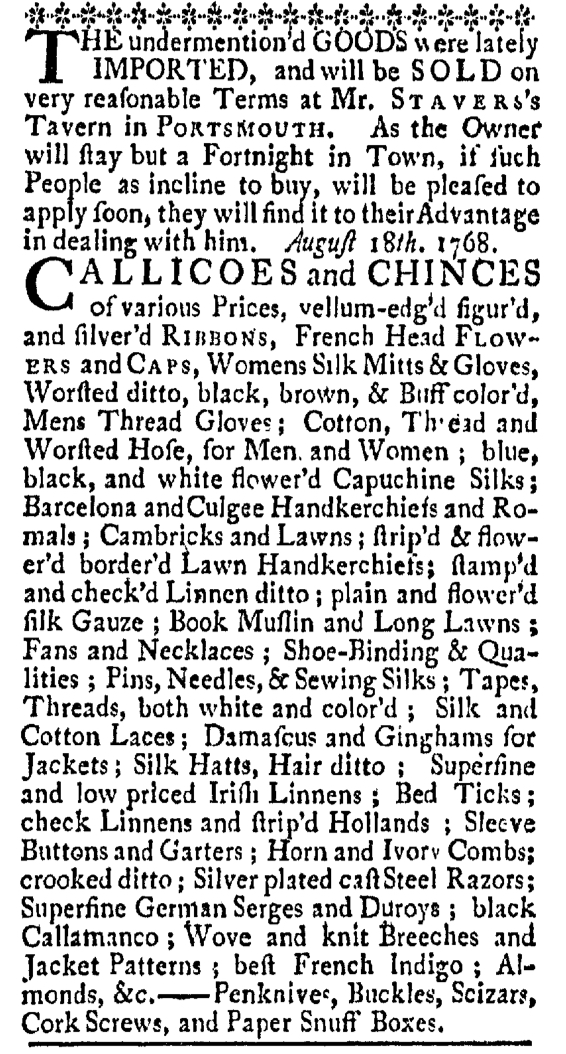
Aug 19 - 8:19:1768 New-Hampshire Gazette
New-Hampshire Gazette (August 19, 1768).

“The Owner will stay but a Fortnight in Town.”

Henry Appleton and Richard Champney placed advertisements in the New-Hampshire Gazette frequently. Members of their community likely knew where to find Appleton “At his shop in Portsmouth” and Champney “At his shop near Mr. John Beck’s, Hatter.” In the small port, both their faces and their shops would have been familiar. One of their competitors, however, was not nearly as familiar to the residents of Portsmouth and the surrounding area. An advertisement that appeared in the August 19, 17678, edition of the New-Hampshire Gazette listed many wares quite similar to those stocked by Appleton and Champney, but it did not specify the name of the seller.

Instead, it announced that “THE undermention’d GOODS were lately IMPORTED, and will be SOLD on very reasonable terms at Mr. STAVERS’s Tavern in PORTSMOUTH.” The unnamed advertiser stated that he “will stay but a Fortnight in Town.” From all appearances, Appleton and Champney found themselves in competition with a peddler. They likely did not appreciate his brief interlude in the local marketplace. Peddlers were disruptive. They diverted business away from the shops where customers usually acquired goods. In this case, the advertisement encouraged potential customers to head to a tavern to examine ribbons, gloves, fans, necklaces, and a variety of other “Baubles of Britain” (to borrow the evocative phrase from T.H. Breen’s examination of the consumer revolution in America in the eighteenth century). Those “incline[d] to buy … will find it to their Advantage in dealing with” the unnamed itinerant. Local shopkeepers like Appleton and Champney were probably none too pleased about this alternative means for their prospective customers to obtain many of the same trinkets they sold, especially not when the peddler implied that he offered lower prices than residents would otherwise encounter in Portsmouth.

Itinerant hawkers who traversed the roads from town to town in the late colonial period provided an alternate means of distributing many of the goods that were at the center of the consumer revolution. They complemented the shops and auctions that otherwise placed an array of merchandise in the hands and households of customers, usually to the chagrin of local entrepreneurs who did not appreciate the intrusion.