March 25

What was advertised in a revolutionary American newspaper 250 years ago today?
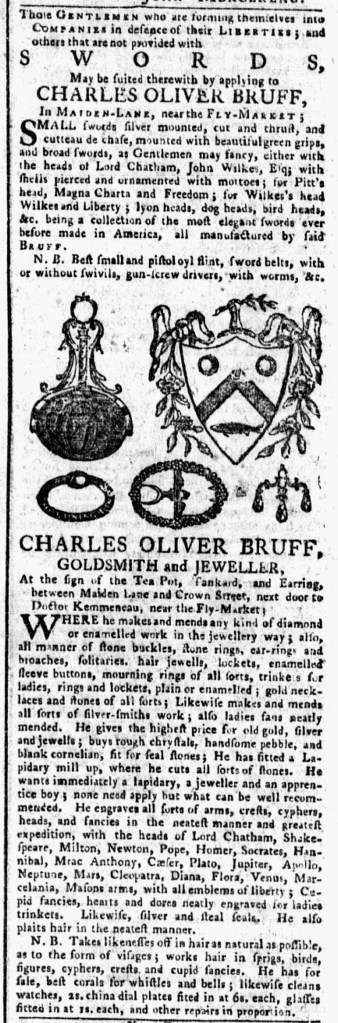
New-York Gazette and Weekly Mercury (March 25, 1776).

“Work in the jewellery way … all sorts of silver-smiths work.”

By the time that Charles Oliver Bruff, a goldsmith and jeweler, placed his advertisement in the March 25, 1776, edition of the New-York Gazette and Weekly Mercury he was a veteran advertiser with at least a decade of experience running notices in the public prints in New York.  While little direct evidence about the effectiveness of advertising in early America exists, the fact that Bruff repeatedly invested in marketing suggests that he believed that it worked and considered it worth the investment.  Indeed, his latest advertisement consisted of two advertisements.  The copy for the first one ran as its own notice in the Constitutional Gazette more than six months earlier.  As the first anniversary of the battles at Lexington and Concord approached, Bruff once again offered swords to “Those GENTLEMEN who are forming themselves into COMPANIES in defence of their LIBERTIES.”

Bruff may have considered advertising effective because he did more than merely announce that he had goods for sale.  Instead, he carefully crafted appeals to consumers, encouraging them to purchase his wares.  As he targeted prospective customers “forming themselves into COMPANIES,” for instance, he adorned them with likenesses of British politicians who advocated for the American colonies and corresponding mottoes, including “[William] Pitt’s head, Magna Charta and Freedom” and “[John]Wilkes’s head[,] Wilkes and Liberty.”  He also underscored that the words he stocked were “made in America, all manufactured by said BRUFF.”  When nonimportation agreements became one of the primary strategies for practicing politics, Bruff and other entrepreneurs marketed goods produced in the colonies.

The goldsmith and jeweler also deployed visual images to promote his business.  He advised readers that he kept shop “At the sign of the Tea Pot, Tankard, and Earring,” but they likely noticed the woodcut that adorned his advertisement before anything else.  It featured several of the items available at his shop, including a handheld looking glass with an ornate handle and frame, a ring, a buckle, and an earring.  The image also included an elaborate coat of arms.  A shield decorated with two silver balls, a chevron, and a fish was in the center.  A hand grasping a sheaf of wheat appeared above the shield.  Ribbons cascaded over the side, giving way to leaves and flowers.  The ornate woodcut corresponded to an appeal that Bruff made in the second of those advertisements combined into a single lengthy advertisement: “He engraves all sorts of arms, crests, cyphers, heads, and fancies in the neatest manner.”  For good measure, he reminded prospective customers that he also engraved “all emblems of liberty” on jewelry and other items.

In addition to his “work in the jewellery way” and “silver-smiths work,” Bruff provided other services to entice customers into his shop.  He cleaned watches, installed new glass, and made other repairs at reasonable prices and even “works hair in springs, birds, figures, cyphers, crests and cupid fancies” and “plaits hair in the neatest manner.”  Bruff made his advertisements worth the investment by developing a variety of appeals to consumers and promising an array of goods and services to encourage them to visit his shop.

May 29

What was advertised in a revolutionary American newspaper 250 years ago today?

New-York Gazette and Weekly Mercury (May 29, 1775).

“Small swords silver mounted … and broad swords as gentlemen may fancy.”

Charles Oliver Bruff, a goldsmith and jeweler who kept a shop at the “sign of the tea-pot, tankard, and ear-ring,” placed a familiar advertisement in the May 29, 1775, edition of the New-York Gazette and Weekly Mercury.  By then it had appeared several times, likely drawing the attention of readers because a woodcut depicting several items made by Bruff adorned the advertisement.  It showed a looking glass, a ring, a buckle, and an earring.  It also featured a coat of arms, a sample of the “arms, crests, cyphers, heads and fancies” that he engraved.  The goldsmith and jeweler also declared that he ornamented his wares with “emblems of liberty” for customers who wished to make political statements with their rings, brooches, and other accessories.

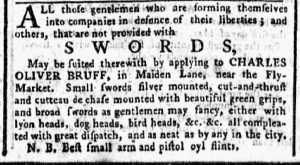
New-York Gazette and Weekly Mercury (May 29, 1775).

In the wake of current events, including the battles at Lexington and Concord and the ongoing siege of Boston, Bruff decided to insert a second advertisement in the New-York Gazette and Weekly Mercury.  He placed it for the purpose of promoting “SWORDS” to “ALL those gentlemen who are forming themselves into companies in defence of their liberties.”  He offered “[s]mall swords silver mounted, cut-and thrust and cutteau de chase mounted with beautiful green grips, and broad swords as gentlemen may fancy,” decorating them with “lyon heads, dogs heads, bird heads,” and other figures.  Bruff encouraged his genteel clients to contemplate how they could be fashionable as they mobilized in support of the American cause.  The latest news out of Massachusetts presented a marketing opportunity for the goldsmith and jeweler.  Kate Haulman has documented how military service during the Revolutionary War allowed men, especially officers, to embrace sartorial splendors.[1]  Yet those in uniform were not alone in embracing what Haulman terms “the military mode, where fashion and politics merged.”[2]  The purveyors of garments, textiles, and accoutrements, including tailors, shopkeepers, and jewelers, welcomed such business at a time that demonstrating patriotism otherwise called for abstaining from consumption so often considered luxurious and unnecessary.  Bruff saw a new avenue for attracting clients and adjusting his marketing efforts accordingly.

**********

[1] Kate Haulman, “Fashion and the Culture Wars of Revolutionary Philadelphia,” William and Mary Quarterly, 3rd ser., 62, no. 4 (October 2005), 644-49.

[2] Haulman, “Fashion and the Culture Wars,” 644.

January 8

What was advertised in a colonial American newspaper 250 years ago this week?

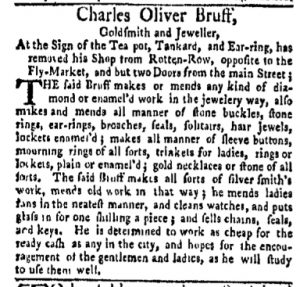
New-York Gazette and Weekly Mercury (January 6, 1772).

“Will sell them cheaper than any in the city.”

Charles Oliver Bruff, a goldsmith and jeweler, operated a shop at “the Sign of the Tea-pot, Tankard, and Ear-ring” on Maiden Lane in New York in the early 1770s.  He regularly placed newspaper notices to advise prospective clients of his services.  In the January 6, 1772, edition of the New-York Gazette and Weekly Mercury, for instance, he declared that he “makes or mends any kind of diamond or enamel’d work in the jewellery way” and “makes all sorts of silversmiths work, and mends old work.”  In addition, he mended “ladies fans in the neatest manner and at the lowest price” and sold rings, lockets, “hair jewels,” and a variety of other jewelry.

Bruff sought to draw attention to two other aspects of his business.  He informed readers that he had “just finished some of the neatest dies for making sleeve buttons, with the neatest gold cuts to them to stamp all sorts of gold buttons, silver, pinchbeck, or brass.”  Colonizers who desired such distinctive buttons could acquire them from Bruff … and at bargain prices.  He pledged to “sell them cheaper than any in the city.”  In addition to buttons, Bruff also highlighted his interest in working with “gentlemen merchants that travel the country, or pedlars,” anticipating that they would purchase in quantity for resale.  The goldsmith asserted that peddlers “may depend on being used well.”  That included maintaining good relationships as well as offering low prices.  Bruff confided that for such customers he would “make any kind of work cheaper than they can get it in the city elsewhere.”

Whether hawking buttons, cultivating relationships with retailers, or mending fans for fashionable ladies, Bruff deployed superlatives to compare his prices to those of his competitors in the bustling port city.  He did not merely declare that he offered comparable low prices; instead, he claimed that he undersold other goldsmiths and jewelers in New York, hoping that this strategy would bring customers into his shop.