September 16

What was advertised in a colonial American newspaper 250 years ago today?

Sep 16 - 9:16:1767 Georgia Gazette
Georgia Gazette (September 16, 1767).

“TWO POOR BOYS … will be taught to read, write, and cast accounts … by the bounty of Gentleman.”

As fall arrived in 1767, schoolmaster John Francklin incorporated philanthropy into his advertising campaign in the Georgia Gazette. Thanks in part to his previous newspaper notices, residents of Savannah and its hinterland may have already been aware that he taught reading, writing, and arithmetic, though in the newest iteration of his advertisement he further elaborated on his methods. That he utilized “a new and most concise method,” however, was not the most significant new information he provided for prospective pupils and their parents.

Francklin offered a scholarship, funded “by the bounty of a Gentleman,” to “TWO POOR BOYS … within the Town of Savannah.” Over the course of a year, these two students would learn “to read, write, and cast accounts.” In addition to tuition, the anonymous benefactor also provided “books, &c.” Presumably “&c.” (the eighteenth-century version of “etc.”) included other school supplies purchased from local booksellers or other shopkeepers, but not room or board. Francklin’s advertisements all suggested that he ran a day school, which may help explain why the recipients of this beneficence had to reside “within the Town of Savannah.”

Although Francklin may not have induced the anonymous gentleman to make this donation, he certainly attempted to extract as much benefit from it as possible. His association with this philanthropic effort would have made his services look even more attractive to the parents of prospective students. In evaluating the schoolmaster, parents would have been as interested in Francklin’s character and the morals imparted in the classroom as in the quality of his instruction. Lest anyone express concern about the influence “POOR BOYS” might have on other students at the school, Francklin specified that they would come from “industrious honest parents,” minimizing the possibility of introducing corrupting factors into interactions among students. The schoolmaster walked a fine line, welcoming recognition of his public spiritedness while simultaneously reassuring current and prospective students and their families that the scholarship students would not cause disruptions. Philanthropy made for a powerful marketing appeal, but Francklin also had to manage it carefully.

August 6

What was advertised in a colonial American newspaper 250 years ago today?”

Aug 6 - 8:6:1767 Massachusetts Gazette
Massachusetts Gazette (August 6, 1767).

“JACKSON’S Mineral-Well in Boston.”

The proprietor of “JACKSON’S Mineral-Well in Boston” deployed a philanthropic appeal to increase the allure of the spa. In a set of “RULES” published among the advertisements in the August 6, 1767, issue of the Massachusetts Gazette, Jackson first specified the rates for enjoying the waters: one copper for “the Use of the Water” and then another copper for “every Quart Bottle to carry away.” Lest he be seen as withholding access to the therapeutic qualities of the “Mineral-Well” by focusing exclusively on how much revenue it could generate from entry fees paid by middling and affluent colonists, Jackson also proposed a plan that more broadly served the interests of the general public. Should “any Physician in Town” prescribe visiting the spa to impoverished patients, Jackson offered free admission “to any poor Persons” who could produce a certificate verifying their circumstances. These “poor Persons” could enjoy the baths “gratis,” but only after providing sufficient documentation from their doctors. Charity, it seemed, had its limits; Jackson did not want his spa overrun by the lower sorts.

The advertisement also noted that “Rules for the hot, and for the cold Baths, will be fixed up in one of the Rooms.” That Jackson did not specify or elaborate on these additional rules in his notice suggests that he was less interested in informing the public of all the procedures for enjoying the “Mineral-Well” and more concerned with getting out the word that he incorporated humanitarian ventures into his business model. Other eighteenth-century advertisers made similar bids for approval from potential customers and the community in general, including schoolmasters who provided free lessons to less fortunate children. In modern times, corporate philanthropy is a standard public relations practice, but it was not invented after the rise of Madison Avenue. Some eighteenth-century entrepreneurs experimented with promoting their businesses by engaging the needs of the community, demonstrating that they were good citizens and neighbors who merited patronage from consumers.

June 9

What was advertised in a colonial American newspaper 250 years ago today?

Jun 9 - 6:9:1767 South-Carolina Gazette and Country Journal Page 2
South-Carolina Gazette and Country Journal (June 9, 1767).

“He first introduced into this Province the most expeditious Method of teaching Writing.”

Osborne Straton was not the only schoolmaster who advertised his services in the newspapers printed in Charleston, South Carolina, in 1767. He needed to distinguish his instruction from that provided by W. Adams and William Johnson, both of whom inserted much more extensive notices in the public prints. Rather than going into as much detail about his curriculum and teaching methods, Straton advanced two other reasons “Parents and Guardians” should enroll their children in “the British Academy on the Green, at the West End of BROAD-STREET.”

First, he underscored his experience, implying that the parents of prospective students should choose his academy because his competitors were newcomers who had not yet gained the public trust. Straton had been teaching in Charleston for half a decade; he considered it “his Duty to remind the Public, That A.D. 1762, he first introduced into this Province the most expeditious Method of teaching Writing, Drawing, &c. &c. in all their Branches.” His methods were particularly designed “to qualify Youth for Business in general,” a goal that Straton identified in an advertisement published several months earlier. He noted his long experience in that notice as well, stating that he had “forty years experience as head book-keeper in some of the first counting-houses in Europe” before migrating to South Carolina and becoming a schoolmaster. According to Straton, his experience, both in business and in teaching local youth, should cause parents to give him precedence over other schoolmasters.

Straton also argued that he served the public good in addition to earning a living by charging tuition of students who could afford it. He pledged to “Instruct six poor Children Gratis, every Thursday and Saturday in the Afternoon.” This was not the first time he made such an offer. Several weeks earlier he announced that “one youth may be qualified for business gratis, on a private benevolence,” an eighteenth-century scholarship of sorts. In making a new commitment to teach several poor children, Straton again played on his ties to the community established over the course of several years. He set a philanthropic example to make his academy more appealing to prospective students and their parents, suggesting that service rather than revenues motivated his instruction.

Compared to his competitors, Straton’s advertisement was relatively short. Despite its length, he included two appeals that made his academy both distinctive and attractive to residents of Charleston as they considered several options. Other schoolmasters might have offered effective instruction, but for Straton the work seemed to be a vocation rather than a mere occupation.

April 24

What was advertised in a colonial American newspaper 250 years ago today?

Apr 24 - 4:24:1767 South-Carolina and American General Gazette
South-Carolina and American General Gazette (April 24, 1767).

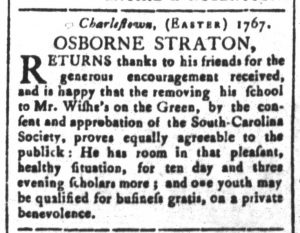
“He has room … for ten day and three evening scholars more.”

In recent weeks the guest curators of the Adverts 250 Project have examined advertisements placed by some of Savannah’s schoolmasters in the Georgia Gazette. Both schoolmasters promoted the subjects they taught, which were limited mostly to the basics of reading, writing, and arithmetic (though one also provided instruction in Latin). Meanwhile, Osborne Straton, a schoolmaster in Charleston, took a different approach in advertising his school. He did not discuss his curriculum at all, but instead noted the location – “on the Green” – and described the surroundings as a “pleasant, healthy situation.”

Most schoolmasters and schoolmistresses placed advertisements to attract pupils they expected to pay tuition. Such was the case with Straton, who indicated that he had slots to accommodate ten more “scholars” in the classes he offered during the day and three more for evening classes. One fortunate student, however, might have qualified to attend Straton’s classes on a scholarship: “one youth may be qualified for business gratis, on a private benevolence.”

Straton did not reveal the identity of the benefactor, but it might have been a civic organization mentioned earlier in his advertisement. He implied that moving his school to a new location “on the Green” had been done “by the consent and approbation of the South-Carolina Society.” Perhaps the members sponsored his school, formally or informally. The society or one of its members may have provided for the “private benevolence” as a means of bolstering the futures of the student, the city, and the colony. Alternately, someone else may have provided the funds to offer an education to a youth who otherwise might not have afforded it. The schoolmaster himself may have opted not to charge tuition of one of his charges, leveraging the decision into a public relations opportunity.

Regardless of the source of the “private benevolence,” Straton possessed a means to distinguish his school from others when he advertised for students. His association with a philanthropic venture positioned him as an instructor capable of overseeing the moral development of his students as well as their academic work.