December 25

What was advertised in a revolutionary American newspaper 250 years ago today?
New-York Gazette and Weekly Mercury (December 25, 1775).

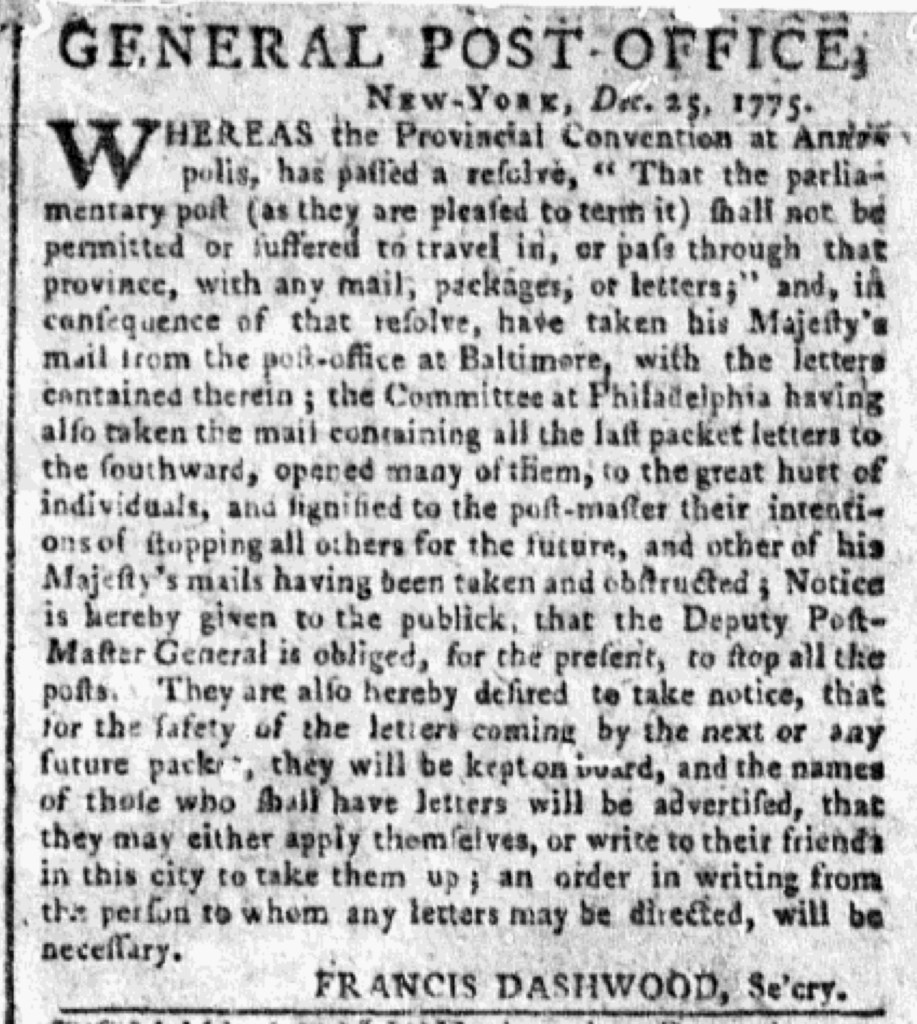
“The Deputy Post-Master General is obliged, for the present, to stop all the posts.”

In the summer and fall of 1775, advertisements for local Constitutional Post Offices, established by the Second Continental Congress as an alternative to the imperial system, appeared in newspapers printed in several colonies.  Postmasters provided schedules.  Post riders offered their services.  As winter arrived, the Deputy Postmaster General of the “parliamentary post (as [supporters of the American cause] are pleased to term it)” published an advertisement announcing that he “is obliged, for the present, to stop all the posts.”  He did not cite competition from the Constitutional Post.  Instead, he blamed the actions of provincial conventions meeting in some of the colonies and abuses by rogues who tampered with private letters.

In Maryland, for instance, one of those conventions passed a resolve that “the parliamentary post … shall not be permitted or suffered to travel in, or pass through, that province, with any mail, packages, or letters.”  In turn, they had confiscated “his Majesty’s mail from the post-office at Baltimore.”  Similarly, a committee in Philadelphia seized “the last packet letters to the southward … and signified to the post-master their intentions of stopping all others for the future.”  That was not all!  That committee also “opened many of [the letters], to the great hurt of individuals,” engaging in some of the same behavior that had caused William Goddard first to envision the Constitutional Post and then advocate that the Second Continental Congress officially endorse it.  The Deputy Postmaster General suggested that it was the Sons of Liberty and their supporters who had infringed on the liberties of others.

Yet this did not end the imperial postal system, though the procedures for delivering letters changed: “for the safety of the letters coming by the next or any future packet,” a ship that carried mail, “they will be kept onboard, and the names of those who shall have letters will be advertised.”  Even if Hugh Gaine, the printer of the New-York Gazette and Weekly Mercury who had recently published a local edition of the Journal of the Proceedings of the Continental Congress, did not care for every British policy, he almost certainly welcomed the advertising revenue for running this notice and the prospects for publishing lists of those who had letters waiting for them aboard packet ships in the harbor.  He was not a staunch patriot like John Holt, printer of the New-York Journal, and John Anderson, printer of the Constitutional Gazette, helping to explain why the advertisement concerning the “GENERAL POST-OFFICE” first appeared in his newspaper.

October 21

What was advertised in a revolutionary American newspaper 250 years ago today?

Constitutional Gazette (October 21, 1775).

The Public are hereby informed, that the Constitutional Post, goes three times a week between this city and Philadelphia.”

It was yet another advertisement for the Constitutional Post, this time in the October 21, 1775, edition of the Constitutional Gazette, a newspaper printed by John Anderson in New York.  William Goddard, himself a printer, first envisioned the Constitutional Post as an alternative to the imperial postal system in 1773.  The Second Continental Congress adopted a modified version of Goddard’s plan in the summer of 1775 following the outbreak of hostilities at Lexington and Concord.  By then, some local branches of the Constitutional Post had already been established.  Under the direction of Benjamin Franklin, selected as Postmaster General even though Goddard desired the position, the system approved by the Second Continental Congress added new branches and integrated those already in operation to create a network for disseminating information in letters and newspapers from New England to Georgia.

In the fall of 1775, advertisements promoting the Constitutional Post proliferated in American newspapers, especially in those published in the Mid Atlantic.  On October 11, Mary Katharine Goddard, printer of the Maryland Journal in Baltimore, postmaster in that town, and sister of William Goddard, inserted a notice about the schedule for the “CONSTITUTIONAL POST-OFFICE.”  Two days later, Richard Bache, the postmaster in Philadelphia (and son-in-law of Benjamin Franklin), published a more extensive advertisement in Story and Humphreys’s Pennsylvania Mercury.  A little over a week later, Anderson inserted an unsigned notice about the Constitutional Post in the Constitutional Gazette, the newspaper he established in support of the American cause at the beginning of August.   The placement of the notice does not reveal whether Anderson considered it news like the items that appeared immediately above it or an advertisement like his own for “American made DRUMS” immediately below it and the paid notices that appeared on the next page.  For Anderson, that may have been a distinction without a difference.  What mattered was letting the public know that the Constitutional Post dispatched riders to and from Philadelphia three times a week and the system reached “as far as New-Hampshire” in the north and “as far as Savanna, in Georgia,” to the south.

October 13

What was advertised in a revolutionary American newspaper 250 years ago today?

Story and Humphreys’s Pennsylvania Mercury (October 13, 1775).

“PHILADELPHIA CONSTITUTIONAL POST-OFFICE.”

At the same time that Mary Katharine Goddard, postmaster and printer of the Maryland Journal, advertised the Baltimore branch of the Constitutional Post Office in the fall of 1775, Richard Bache ran a notice for the “PHILADELPHIA CONSTITUTONAL POST-OFFICE” in the October 13 edition of Story and Humphreys’s Pennsylvania Mercury. Although Bache was not the printer of that newspaper, his advertisement received a privileged place similar to the one that Goddard’s notice enjoyed in her newspaper.  It appeared first among the advertisements that readers encountered when they perused the newspaper from start to finish, immediately below the “SHIP NEWS” and list of “ARRIVALS” in Philadelphia.  A double line did separate news from advertising, yet this item delivered news relevant to the imperial crisis that had become a war with the battles at Lexington and Concord the previous spring.  Over the summer, the Second Continental Congress established the Constitutional Post Office as an alternative to the imperial post office.  Enoch Story and Daniel Humphreys, the printers of the newspaper that carried Bache’s advertisement, apparently considered it in their best interest to increase the likelihood readers would take note of the information about the Constitutional Post Office by placing the notice right after the news.

Compared to Goddard’s advertisement, Bache’s notice gave readers a much more expansive glimpse of the scope of the enterprise.  Rather than simply stating which days the post arrived and departed, Bache reported that the Constitutional Post carried letters and newspapers “as far as Portsmouth in New-Hampshire” to the north and “as far as Savannah in Georgia” to the south.  The system linked the thirteen colonies.  On Tuesdays, Thursdays, and Saturdays, a rider set out for New York from Philadelphia.  On Tuesdays and Saturdays, another rider headed “to the Southward” to Baltimore, arriving there, according to Goddard’s advertisement, on Mondays and Thursdays.  This new system did more than move mail.  “Establishing a new post office,” Joseph M. Adelman argues, “placed the levers of information circulation in the hands of Americans.  …  Forming a ‘continental’ post office that could properly embody an intercolonial union and its resistance to imperial tyranny was crucial to Patriot mobilization at the height of the imperial crisis.”  Furthermore, “Patriot printers and their radical friends” played an integral role in establishing the new postal system.[1]  No wonder that Story and Humphreys placed Bache’s advertisement about the “PHILADELPHIA CONTSITUTIONAL POST-OFFICE” right after the “SHIP NEWS.”

**********

[1] Joseph M. Adelman, “‘A Constitutional Conveyance of Intelligence, Public and Private’: The Post Office, the Business of Printing, and the American Revolution,” Enterprise and Society 11, no. 4 (December 2010): 747-748.

June 4

What was advertised in a revolutionary American newspaper 250 years ago this week?

New-York Journal (June 1, 1775).

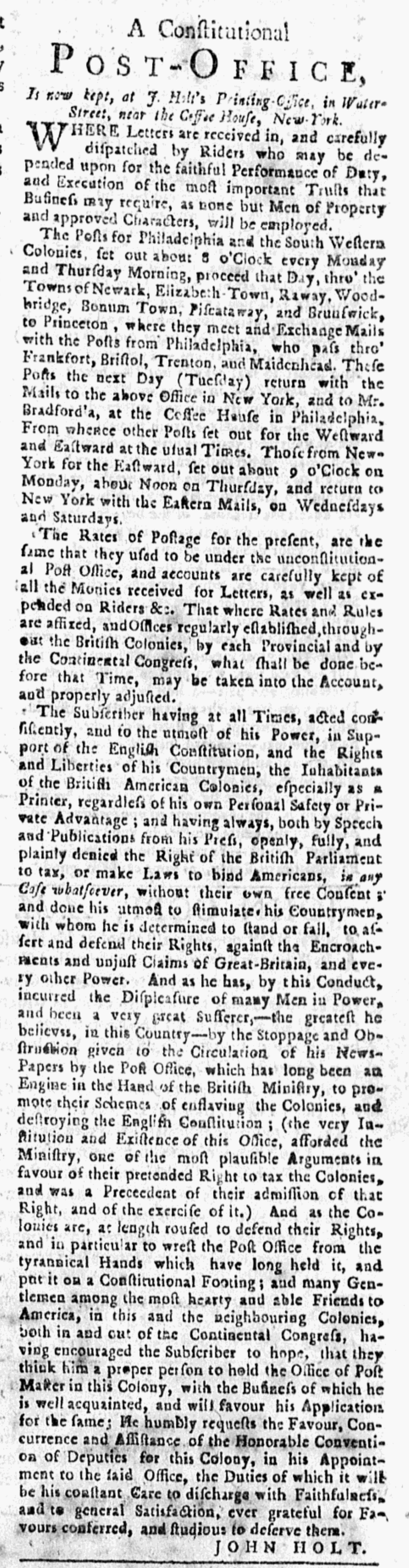
“A Constitutional POST-OFFICE, Is now kept, at J. Holt’s Printing-Office, in … New-York.”

William Goddard’s Pennsylvania Chronicle had a reputation for supporting the Patriot cause, so much so that the Crown Post drove it out of business by refusing to deliver it.  That prompted Goddard to establish the Constitutional Post, independent of British authority, as an alternative.  That service began with a route that connected Baltimore and Philadelphia in the summer of 1773.  The network expanded, yet the First Continental Congress decided to table Goddard’s plan rather than endorse it when he submitted it for consideration in the fall of 1774.  The Second Continental Congress took it up again following the battles at Lexington and Concord, adopting the plan on July 16, 1775.  To Goddard’s disappointment, the delegates named Benjamin Franklin as the first Postmaster General; he settled for serving as Riding Surveyor.

By the time that the Second Continental Congress acted on the measure, Goddard and others had already made progress putting an infrastructure in place.  For instance, newspaper advertisements confirm that “CONSTITUTIONAL Post-Riders” operated in Connecticut in the summer of 1774 and Massachusetts in the spring of 1775.  In June 1775, John Holt, the printer of the New-York Journal, advertised that a “Constitutional POST-OFFICE, Is now kept” at his printing office in New York.  He provided a schedule and noted that the “Rates of Postage for the present, are the same that they used to be under the unconstitutional Post Office.”  He would adjust the “Rates and Rules” as provincial congresses in the several colonies and the Continental Congress approved them.  In addition, “accounts are carefully kept of all the Monies received for Letters, as well as expended on Riders” and other costs.  Holt anticipated that the Continental Congress would indeed adopt Goddard’s plan for the Constitutional Post in the aftermath of Lexington and Concord.  Seeking an appointment as postmaster for New York, he devoted half of his advertisement to giving his credentials in hopes of attracting the attention of the delegates and other who might influence them:

“The Subscriber having at all Times, acted consistently, and to the utmost of his Power, in Support of the English Constitution, and the Rights and Liberties of his Countrymen, the Inhabitants of the British American Colonies, especially as a Printer, regardless of his own Personal Safety or Private Advantage; and having always, both by Speech and Publications from his Press, openly, fully, and plainly denied the Right of the British Parliament to tax, or make Laws to bind Americans, in any Case whatsoever, without their own free Consent; and done his utmost to stimulate his Countrymen, with whom he is determined to stand or fall, to assert and defend their Rights, against the Encroachment and unjust Claims of Great-Britain, and every other Power.”

That rationale corresponded to arguments advanced far and wide by Patriots.  Holt continued making his case with a review of the consequences he endured for his devotion to the cause:  “And as he has, by this Conduct, incurred the Displeasure of many Men in Power, and been a very great Sufferer,– the greatest he believes, in this Country – by the Stoppage and Obstruction given to the Circulation of his News-Papers by the Post Office, which has long been an Engine in the Hands of the British Ministry, to promote their Schemes of enslaving the Colonies, and destroying the English Constitution.”

With the siege of Boston continuing, Holt asserted that “the Colonies are, at length roused to defend their Rights, and in particular to wrest the Post Office from the tyrannical Hands which have long held it, and put it on a Constitutional Footing.”  Having established a Constitutional Post Office in New York, Holt hoped that the Continental Congress would appoint him “Post Master in this Colony.”  To that end, he “humbly requests the Favour, Concurrence and Assistance of the Honorable Convention of Deputies for this Colony, in his Appointment to the said Office,” pledging that “it will be his constant Care to discharge” the duties “with Faithfulness.”  From Holt’s perspective, there was no better candidate for the position.

The printer’s lengthy advertisement served two purposes.  He attempted to attract customers for the Constitutional Post Office now that New York had a branch at his printing office.  He did so by deploying familiar rhetoric that outlined the stance taken by those who supported the American cause against the abuses of Parliament.  He intended that as both a reason for colonizers to entrust their letters to the Constitutional Post Office and a demonstration of his devotion to the cause that merited an appointment as postmaster for the colony.  Holt supplemented familiar arguments with his own experience, further demonstrating that he deserved to be appointed as postmaster.  He sought the patronage of those who could award him the position while simultaneously seeking patrons for the Constitutional Post Office.

February 9

What was advertised in a colonial American newspaper 250 years ago today?

Providence Gazette (February 9, 1771).

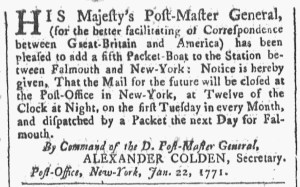
“HIS Majesty’s Post-Master General … has been pleased to add a fifth Packet-Boat to the Station between Falmouth and New-York.”

In January and February 1771, an advertisement that ran in newspapers published in several colonies informed colonists of an improvement to the communications infrastructure that connected them to Britain.  The postmaster general added “a fifth Packet-Boat to the Station between Falmouth and New-York” for the purpose of “better facilitating … Correspondence between Great-Britain and America.”  The advertisement gave notice that the mail “will be closed at the Post-Office in New-York … on the first Tuesday in every Month” and then “dispatched by a Packet the next Day for Falmouth.”

Dated “New-York, Jan. 22, 1771,” this advertisement appeared in the January 28 edition of the New-York Gazette and Weekly Mercury.  The notice next ran in the New-York Journal, the Pennsylvania Gazette, and the Pennsylvania Journal on January 31.  (It may have been in the January 24 edition of the New-York Journal; a page is missing from the digitized copy.)  The advertisement soon found its way into the Providence Gazette on February 2 and the Massachusetts Gazette and Boston Post-Boy on February 4.  By then, it ran in the New-York Gazette and Weekly Mercury a second time, though it did not run in every newspaper more than once.  The advertisement next appeared in the Maryland Gazette on February 7 and the New-Hampshire Gazette on February 8.  Additional newspapers in Boston carried it on February 11, including the Boston Evening-Post and the Boston-Gazette.  The Essex Gazette ran the notice on February 12, as did Purdie and Dixon’s Virginia Gazette and Rind’s Virginia Gazette on February 14.  It made a surprising late appearance in the Pennsylvania Chronicle on February 18 (though it may have been in that newspaper on February 4, an issue not available via the databases of digitized newspapers).  Unfortunately, several issues of newspapers published in North Carolina, South Carolina, and Georgia in the ensuing weeks have not survived, making it impossible to determine when or if readers in those colonies encountered the same advertisement.

Throughout the Middle Colonies, New England, and the Chesapeake, however, colonists had access to the notice within a matter of weeks.  It did not appear in every newspaper, but it did run in newspapers in the major newspapers published in the largest port cities as well as several minor newspapers in smaller towns.  Although formatting shifted from one newspaper to another, the copy remained the same.  In each case, the first appearance of the advertisement benefited from a privileged place on the page, often positioned immediately after news items and before other advertisements.  That likely increased the chances that readers uninterested in perusing the advertisements would at least see the notice about the additional packet boat that transported mail across the Atlantic.  Its placement allowed it to operate as both news and advertisement.  Newspapers, one vital component of colonial communications networks, kept readers informed about improvements to the postal system, another important component.

February 11

What was advertised in a colonial American newspaper 250 years ago today?

Providence Gazette (February 11, 1769).

“Great Inconveniences having arisen to the Public, by returning Letters for the Postage.”

The February 11, 1769, edition of the Providence Gazette carried a notice from the General Post Office in New York dated January 20. It announced that “the Mail for Falmouth will be made up at this Office on Saturday the 4th of February next.” Although that date had already passed, the notice remained relevant to readers in Providence and throughout the colonies as it further explained that mail intended for the other side of the Atlantic “will continue to be made up in the same Manner upon the first Saturday in every Month, and the Packet Boat ordered to sail with it the next day.” At the command of the Deputy Postmaster General, James Parker communicated other instructions and advice to those who sent letters “to any Part of His Majesty’s Dominions, either in Europe or America” and beyond.

Was this piece an advertisement or a news item? Did John Carter, the printer of the Providence Gazette receive payment for inserting it in his newspaper? Or did he run it as a public service to his subscribers and other readers? The placement of the notice within the newspaper makes it difficult to determine if Carter classified it as news or advertising. It ran in the final column on the third page, after news items from Savannah, Charleston, Philadelphia, New York, New Haven, Boston, and Providence yet before the prices current from New York. Lines that extended across the column separated the notice from the items above and below, whereas a shorter line that extended across only a portion of the column separated the various news items from other cities and towns. Paid notices comprised almost the entire fourth page, except for the first item, an “Extract [about sows that] may be acceptable to many of our Country Readers.” While the notice from the General Post Office might have appeared in the place of the extract, the latter was many lines longer. The compositor may have made choices about where to place the two items within the newspaper based on their relative lengths. Although advertisements generally appeared after other content in the Providence Gazette, the compositor did sometimes take such liberties for practical purposes.

Whether or not Carter received payment for running the notice concerning the General Post Office, the item served as both news and advertising. Its placement made it a bridge between items that were definitely news and other items that were definitely paid notices. Its contents underscore that advertisements often delivered valuable information to colonial readers. For instance, the Providence Engine Company placed the final notice in the February 11 issue. In it, the Company informed residents of the city to prepare their fire buckets for inspection or else they could “depend on being prosecuted as the Law directs.” Like the notice from the General Post Office, that one blurred the distinction between news and advertising.