February 14

What was advertised in a revolutionary American newspaper 250 years ago today?
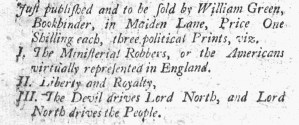
Constitutional Gazette (February 14, 1776).

The Devil drives Lord North, and Lord North drives the People.”

In the February 14, 1776, edition of the Constitutional Gazette, William Green, a bookbinder, advertised “three political Prints” for sale for one shilling each at his shop in Maiden Lane in New York.  He listed the titles, but he did not describe them to prospective customers.  Perhaps he did not wish to pay for the additional space in the newspaper.  Perhaps he thought the titles provided sufficient description.  Perhaps he considered the titles evocative enough to spark curiosity among readers, prompting them to visit his shop to discover for themselves what exactly each print depicted.  After all, titles like “The Ministerial Robbers, or the Americans virtually represented in England” and “The Devil drives Lord North, and Lord North drives the People” simultaneously told a story and expressed support for the American cause.  Notably, the purveyor of these “political Prints” was the first person to advertise Thomas Paine’s Common Sense outside of Philadelphia, doing so just eleven days after Robert Bell, the publisher of the first edition, announced its publication.

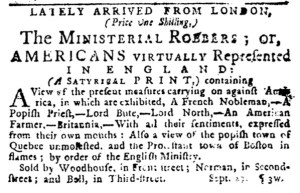
Readers may have been familiar with some of the political cartoons that Green advertised.  In the fall of 1775, William Woodhouse, John Norman, and Robert Bell placed an advertisement in the Pennsylvania Journal to promote “The MINISTERIAL ROBBERS; or AMERICANS VIRTUALLY Represented in ENGLAND,” a “SATYRICAL PRINT” that “LATELY ARRIVED FROM LONDON.”  Green may have sold copies from London or an American edition of the print.

Another of those political cartoons, “The Devil drives Lord North, and Lord North drives the People,” originated in London as “The State Hackney Coach,” a plate that adorned the London Magazine for December 1772.  The print depicted a coach pulled by eight men rather than horses with Lord North, the prime minister, driving them.  Most of those men did not have distinguishing features; they represented any of the members of Parliament and other officials who allowed the prime minister to dominate them.  The first figure had a face that looked more like a rat than a man, additional commentary on the character of those members of Parliament.  Henry Fox, one of North’s proteges, and Jeremiah Dyson, Lord of the Treasury, were recognizable.  Although North drove the men with a whip, a devil perched on the back of the coach had his own whip that he used to steer North’s course.  A caption above the image declared, “They go fast whom the Devil drives.”  Inside the carriage, George III slept, apparently oblivious to any problems.

Green almost certainly displayed these political cartoons in his shop.  Customers who came to purchase Common Sensewould have seen images that worked in tandem with Paine’s attitudes toward monarchy and calls to declare independence.  They may even have decided to purchase both a print and a pamphlet, expressing their own political principles through the choices they made in the marketplace.
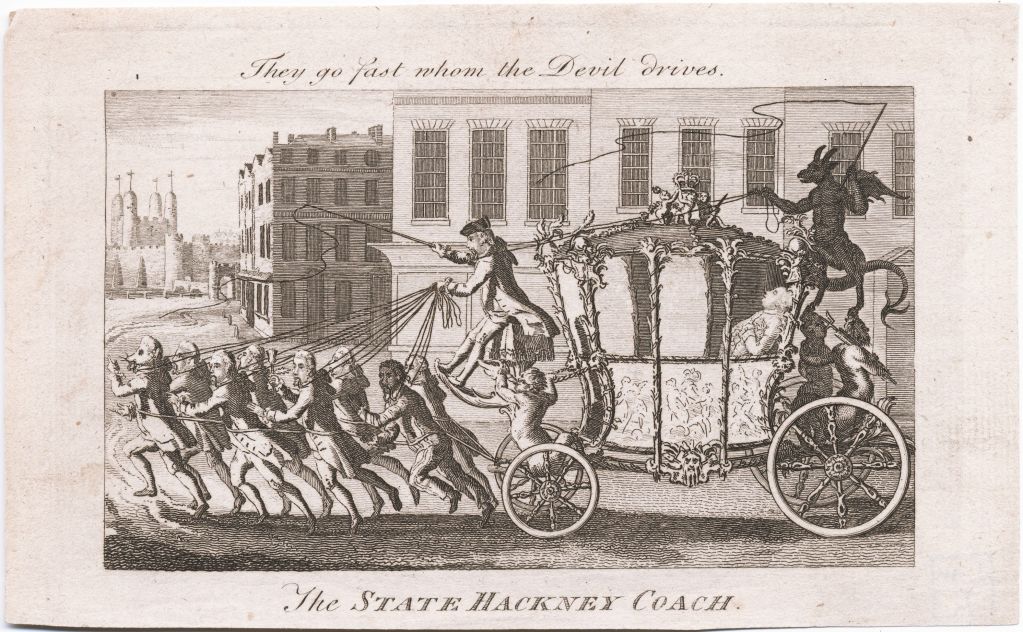
“The State Hackney Coach,” a print that adorned the London Magazine (December 1772). Courtesy Lewis Walpole Library, Yale University.

September 27

What was advertised in a revolutionary American newspaper 250 years ago today?

Pennsylvania Journal (September 27, 1775).

 “AMERICANS VIRTUALLY Represented IN ENGLAND: (A SATYRICAL PRINT.)”

As the imperial crisis intensified and hostilities commenced in Massachusetts in the spring of 1775, American colonizers had supporters in London.  In addition, some artists, engravers, and printers, whatever their own politics may have been, hoped to generate revenue by creating and publishing political cartoons that lambasted the British ministry for the abuses it perpetrated in the colonies.  Some of those prints found their way to eager audiences on the other side of the Atlantic.  In the fall of 1775, William Woodhouse, a bookseller and bookbinder, John Norman, an architect engraver building his reputation, and Robert Bell, the renowned bookseller and publisher, advertised a “SATYRICAL PRINT” that “LATELY ARRIVED FROM LONDON.”

The trio promoted “The MINISTERIAL ROBBERS; or, AMERICANS VIRTUALLY Represented IN ENGLAND,” echoing one of the complaints that colonizers made about being taxed by Parliament without having actual representatives serve in Parliament.  Based on the description of the print in the advertisement, Woodhouse, Norman, and Bell stocked “Virtual Representation, 1775” or a variation of it.  According to the newspaper notice, the image depicted a “View of the present measures carrying on against America, in which are exhibited, A French Nobleman,– A Popish Priest,– Lord Bute,– Lord North,– An American Farmer,– [and] Britannia.”  For each character, “their sentiments, expressed from their own mouths,” appeared as well.

Lord Bute, the former prime minister who inaugurated the plan of regulating American commerce to pay debts incurred during the Seven Years War, appeared at the center of the image, aiming a blunderbuss at two American farmers.  For his “sentiments,” he proclaimed, “Deliver your Property.”  Lord North, the current prime minister, stood next to Bute, pointing at one of the farmers and exclaiming, “I Give you that man’s money for my use.”  In turn, the first farmer stoutly declared, “I will not be Robbed.”  The second expressed solidarity: “I shall be wounded with you.”

The advertisement indicated that the print also showed a “view of the popish town of Quebec unmolested, and the Protestant town of Boston in flames; by order of the English ministry.”  Those parts of the political cartoon unfavorably compared the Quebec Act to the Coercive Acts (including the Boston Port Act and the Massachusetts Government Act), all passed by Parliament in 1774.  The Quebec Act angered colonizers because it extended certain rights to Catholics in territory gained from the French at the end of the Seven Years War.  In the print, the town of Quebec sat high atop its bluff, the flag of Great Britain prominently unfurled, in the upper left with the “French Nobleman” and “Popish Priest” in the foreground.  The legend labeled it as “The French Roman Catholick Town of Quebeck.”  The anti-Catholicism was palpable; the kneeling priest exclaiming “Te Deum” in Latin and holding a cross in one hand and a gallows in the other, playing on Protestant fears of the dangers they faced from their “Popish” enemies.

While Quebec appeared “unmolested” and even favored by Bute, North, and their allies in Parliament, the “English Protestant Town of Boston” appeared in the distance behind the American farmers in the upper right.  The town was indeed on fire, a reference to the battles fought in the vicinity as well as a metaphor for the way Parliament treated the town to punish residents for the Boston Tea Party.  As the advertisement indicated, Britannia, the personification of the empire, made an appearance in the print.  She wore a blindfold and exclaimed, “I am Blinded.”  She looked to be in motion, one foot at the edge of “The Pit Prepared for Others” and her next step surely causing her to fall into it.  There seemed to be no saving Britannia as Bute and North harassed the American farmers and their French and Catholic “Accomplices” watched with satisfaction.

The description of the “SATYRICAL PRINT” in the Pennsylvania Journal merely previewed the levels of meaning contained within the image, yet it likely piqued the curiosity of colonizers who supported the American cause and worried about their own liberties as events continued to unfold in Boston.  Such a powerful piece of propaganda supplemented newspaper reports, maps of the Battle of Bunker Hill, and political treatises circulating in the fall of 1775.

“Virtual Representation, 1775” (London, 1775). Courtesy Boston Public Library.

September 16

What was advertised in a revolutionary American newspaper 250 years ago today?

Pennsylvania Ledger (September 16, 1775).

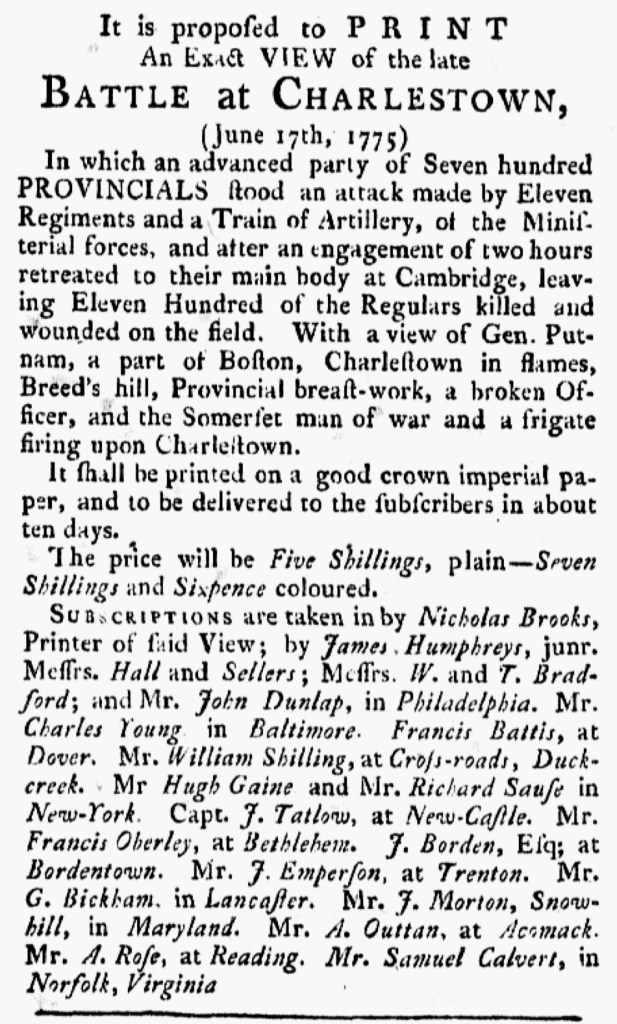
“It is proposed to PRINT An Exact VIEW of the late BATTLE at CHARLESTOWN.”

Bernard Romans, a cartographer, apparently met with sufficient success in marketing and publishing his “MAP, FROM BOSTON TO WORCESTER, PROVIDENCE AND SALEM” in the summer of 1775 that he launched a similar project as fall arrived.  He placed a subscription proposal for a print depicting “An Exact VIEW of the late BATTLE at CHARLESTOWN,” known today as the Battle of Bunker Hill, in the September 16, 1775, edition of the Pennsylvania Ledger.  The proposal stated that it “shall be printed on a good crown imperial paper” at a price of five shillings, “plain,” or seven shilling and six pence, “coloured.”

In promoting the print, Romans summarized the battle, though most readers likely already knew the details.  “[A]n advanced party of Seven hundred PROVINCIALS,” the cartographer narrated, “stood an attack made by Eleven Regiments and a Train of Artillery, of the Ministerial forces, and after an engagement of two hours retreated to their main body at Cambridge, leaving Eleven Hundred of the Regulars killed and wounded on the field.”  Even though the British prevailed, it was such a costly victory in terms of casualties that officers that British General Henry Clinton wrote in his diary, “A dear bought victory, another such would have ruined us.”  The Americans had reason to feel proud despite retreating.  Romans hoped to capitalize on that even as he aimed to publish a print that helped colonizers far from Boston visualize the battle.  The print included “a view of Gen. [Israel] Putnam,” an American officer, “a part of Boston, Charlestown in flames, Breed’s hill, Provincial breast-work, a broken Officer, and the Somerset man of war and a frigate firing upon Charlestown.”

As had been the case with his map, Romans collaborated with Nicholas Brooks, a shopkeeper and “Printer of said View” as well as local agents in several cities and towns from New York to Virginia.  The subscription proposal indicated that the print would be ready “to be delivered to the subscribers in about ten days,” not nearly enough time to disseminate the proposal and collect the names of subscribers before making the first impressions.  In both instances, Romans likely felt confident that consumers would be so interested in purchasing items that commemorated the newest chapter in the struggle against Britain that the demand for the map and the print would justify the expense of producing initial copies as well as prompt him to issue even more as local agents submitted their lists of subscribers.

September 6

What was advertised in a revolutionary American newspaper 250 years ago today?

Pennsylvania Journal (September 6, 1775).

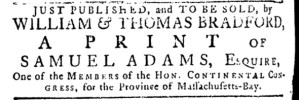
“A PRINT OF SAMUEL ADAMS, ESQUIRE, One of the MEMBERS of the HON. CONTINENTAL CONGRESS.”

The Second Continental Congress convened in Philadelphia after the battles of Lexington and Concord.  It met through most of the summer of 1775, took a recess during August, and started meeting again in September.  The delegates had just resumed their deliberations when William Bradford and Thomas Bradford, the printers of the Pennsylvania Journal, ran an advertisement promoting “A PRINT OF SAMUEL ADAMS, ESQUIRE, One of the MEMBERS of the HON. CONTINENTAL CONGRESS, for the Province of Massachusetts-Bay.”

Even though their advertisement stated, “JUST PUBLISHED, and TO BE SOLD, by WILLIAM & THOMAS BRADFORD,” this seems to have been another instance of printers treating those two phrases separately.  “TO BE SOLD” did indeed refer to the Bradfords stocking and selling the print at their printing office, but “JUST PUBLISHED” did not indicate that they had published the published the print, only that someone had recently published it and made it available for sale.  The Bradfords did not previously attempt to incite demand or gauge interest in a print of Adams among residents of Philadelphia with a subscription notice or other advertisement.

They most likely acquired and sold copies of the print that Charles Reak and Samuel Okey advertised in the Newport Mercury, the Massachusetts Spy, and the Boston-Gazette several months earlier.  In February, Reak and Okey took to the pages of the Newport Mercury to announce their intention to print a “striking likeness of that truly staunch Patriot, the Hon, SAMUEL ADAMS, of Boston.”  Near the end of March, a truncated advertisement in the Massachusetts Spy and the Boston-Gazette advised that “[i]n a few days will be published … A FINE mezzotinto print of that truly worthy Patriot S. A. … executed and published by and for Charles Reak and Samuel Okey, in Newport, Rhode-Island.”  The version in the Massachusetts Spy indicated that more information would appear in the next issue, but the printer, Isaiah Thomas, did not supply additional details in the last few issues printed in Boston before he suspended the newspaper for several weeks and relocated to Worcester just before hostilities commenced at Lexington and Concord.  Those events gave Reak and Okey an expanded market for a print of a Patriot leader already famous in New England.  Their advertisements in Boston’s newspapers listed local agents who would sell their print there.  The Bradfords likely became local agents in Philadelphia rather than publishers of another print of Adams.