November 22

What was advertised in a revolutionary American newspaper 250 years ago today?
Pennsylvania Gazette (November 22, 1775).

“A VOYAGE to BOSTON: A POEM.”

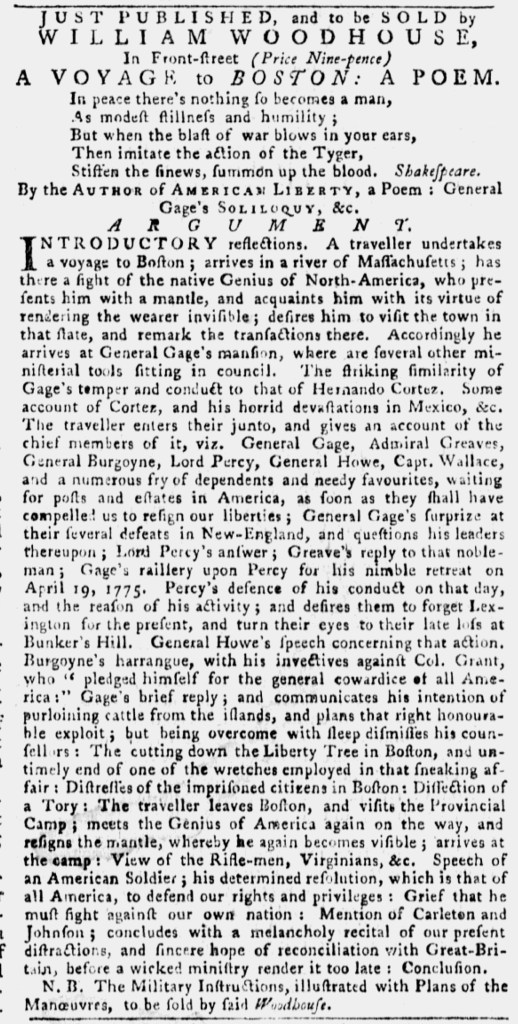
An advertisement for a new publication, “A Voyage to Boston: A Poem,” appeared on the front page of the November 18, 1775, edition of the Pennsylvania Ledger.  William Woodhouse, a bookseller, stationer, and bookbinder marketed a work that historians attribute to the pen of Philip Freneau and the press of Benjamin Towne.  The imprint on the title page merely stated, “Philadelphia: Sold by William Woodhouse, in Front-Street.”  The advertisement did advise that “A Voyage to Boston” was “By the same Author of AMERICAN LIBERTY: A Poem. General Gage’s SOLILOQUY, &c.”  A similar note appeared on the title page.  Woodhouse likely hoped that associating this publication with ones already familiar to readers would aid in inciting demand for the work.  He also inserted five lines about peace and war from Shakespeare, transcribing them from the title page of the pamphlet.

Four days later, he published a much more extensive advertisement in the Pennsylvania Gazette.  It contained all the content from the version in the Pennsylvania Ledger, including a nota bene that announced, “The Military Instructions, illustrated with Plans of the Manœuvres, to be sold by said Woodhouse.”  The new advertisement also featured the “ARGUMENT” of the poem.  That summary provided an overview of recent events as observed by an imaginary “traveller [who] undertakes a voyage to Boston” and, after being bestowed with a cloak of invisibility by the “Genius of North-America,” entered the city and witnessed General Thomas Gage and “several other ministerial tools sitting in council” as they discussed the battles at Lexington and Concord and “their late loss at Bunker’s Hill,” the “cutting down of the Liberty Tree in Boston,” and the “Distresses of the imprisoned citizens in Boston” as the siege of the city continued.  The traveler departed from Boston, visited “the Provincial Camp,” returned the cloak, saw “the Rifle-men, Virginians,” and others who supported the American cause, and listened to the “Speech of an American Soldier,” delivered with “determined resolution, which is that of all America, to defend our rights and privileges.”  The poem concluded with a “sincere hope of reconciliation with Great-Britain, before a wicked ministry render it too late.”  Most colonizers still sought a redress of grievances rather than separating from the British Empire.  In adding this lengthy “ARGUMENT” to the advertisement, Woodhouse did not compose original copy.  Instead, just as the lines from Shakespeare came from the title page of the pamphlet, the “ARGUMENT” filled two pages of the pamphlet preceding the poem.  Although he did not write the copy, Woodhouse apparently decided that providing more information about the contents of the poem would help to increase sales.
September 27

What was advertised in a revolutionary American newspaper 250 years ago today?

Pennsylvania Journal (September 27, 1775).

 “AMERICANS VIRTUALLY Represented IN ENGLAND: (A SATYRICAL PRINT.)”

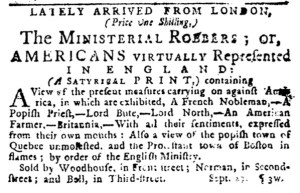
As the imperial crisis intensified and hostilities commenced in Massachusetts in the spring of 1775, American colonizers had supporters in London.  In addition, some artists, engravers, and printers, whatever their own politics may have been, hoped to generate revenue by creating and publishing political cartoons that lambasted the British ministry for the abuses it perpetrated in the colonies.  Some of those prints found their way to eager audiences on the other side of the Atlantic.  In the fall of 1775, William Woodhouse, a bookseller and bookbinder, John Norman, an architect engraver building his reputation, and Robert Bell, the renowned bookseller and publisher, advertised a “SATYRICAL PRINT” that “LATELY ARRIVED FROM LONDON.”

The trio promoted “The MINISTERIAL ROBBERS; or, AMERICANS VIRTUALLY Represented IN ENGLAND,” echoing one of the complaints that colonizers made about being taxed by Parliament without having actual representatives serve in Parliament.  Based on the description of the print in the advertisement, Woodhouse, Norman, and Bell stocked “Virtual Representation, 1775” or a variation of it.  According to the newspaper notice, the image depicted a “View of the present measures carrying on against America, in which are exhibited, A French Nobleman,– A Popish Priest,– Lord Bute,– Lord North,– An American Farmer,– [and] Britannia.”  For each character, “their sentiments, expressed from their own mouths,” appeared as well.

Lord Bute, the former prime minister who inaugurated the plan of regulating American commerce to pay debts incurred during the Seven Years War, appeared at the center of the image, aiming a blunderbuss at two American farmers.  For his “sentiments,” he proclaimed, “Deliver your Property.”  Lord North, the current prime minister, stood next to Bute, pointing at one of the farmers and exclaiming, “I Give you that man’s money for my use.”  In turn, the first farmer stoutly declared, “I will not be Robbed.”  The second expressed solidarity: “I shall be wounded with you.”

The advertisement indicated that the print also showed a “view of the popish town of Quebec unmolested, and the Protestant town of Boston in flames; by order of the English ministry.”  Those parts of the political cartoon unfavorably compared the Quebec Act to the Coercive Acts (including the Boston Port Act and the Massachusetts Government Act), all passed by Parliament in 1774.  The Quebec Act angered colonizers because it extended certain rights to Catholics in territory gained from the French at the end of the Seven Years War.  In the print, the town of Quebec sat high atop its bluff, the flag of Great Britain prominently unfurled, in the upper left with the “French Nobleman” and “Popish Priest” in the foreground.  The legend labeled it as “The French Roman Catholick Town of Quebeck.”  The anti-Catholicism was palpable; the kneeling priest exclaiming “Te Deum” in Latin and holding a cross in one hand and a gallows in the other, playing on Protestant fears of the dangers they faced from their “Popish” enemies.

While Quebec appeared “unmolested” and even favored by Bute, North, and their allies in Parliament, the “English Protestant Town of Boston” appeared in the distance behind the American farmers in the upper right.  The town was indeed on fire, a reference to the battles fought in the vicinity as well as a metaphor for the way Parliament treated the town to punish residents for the Boston Tea Party.  As the advertisement indicated, Britannia, the personification of the empire, made an appearance in the print.  She wore a blindfold and exclaimed, “I am Blinded.”  She looked to be in motion, one foot at the edge of “The Pit Prepared for Others” and her next step surely causing her to fall into it.  There seemed to be no saving Britannia as Bute and North harassed the American farmers and their French and Catholic “Accomplices” watched with satisfaction.

The description of the “SATYRICAL PRINT” in the Pennsylvania Journal merely previewed the levels of meaning contained within the image, yet it likely piqued the curiosity of colonizers who supported the American cause and worried about their own liberties as events continued to unfold in Boston.  Such a powerful piece of propaganda supplemented newspaper reports, maps of the Battle of Bunker Hill, and political treatises circulating in the fall of 1775.

“Virtual Representation, 1775” (London, 1775). Courtesy Boston Public Library.

October 28

What was advertised in a colonial American newspaper 250 year ago today?

Pennsylvania Gazette (October 28, 1772).

“A catalogue of new and old books … is given away gratis.”

William Woodhouse, a bookseller, stationer, and bookbinder in Philadelphia, regularly advertised in the public prints in the early 1770s.  For instance, he ran an advertisement in the October 28, 1772, edition of the Pennsylvania Gazette, advising consumers that he had recently received a shipment of new inventory from London.  Woodhouse provided some examples to entice prospective customer, starting with stationery items.  He stocked everything from “a large assortment of the best writing paper in all sizes” to “round pewter ink stands” to “sealing-wax, wafers, quills, [and] black and red pencils.”  Woodhouse also listed some of the “variety of new books” at his shop, including “Baskerville’s grand family folio bible, with cuts,” “Pope’s Young’s Swift’s Tillotson’s, Shakespear’s, Bunyan’s. and Flavel’s works,” and “Blackstone’s commentaries, 4 vols. 4to.”  The abbreviation “4to” referred to quarto, the size of the pages, allowing readers to imagine how they might consult or display the books.  Woodhouse even had “Newberry’s small books for children, with pictures” for his youngest customers.

The bookseller concluded his newspaper advertisement with a nota bene that invited consumers to engage with other marketing materials.  “A catalogue of new and old books, with the prices printed to each book,” the nota bene declared, “is given away gratis, by said Woodhouse.”  That very well may have been the “CATALOGUE OF A COLLECTION OF NEW AND OLD BOOKS, In all the Arts and Sciences, and in various Languages” that Woodhouse first promoted six weeks earlier in another newspaper, the Pennsylvania Packet.  That catalog also included “a large quantity of entertaining Novels, with the lowest price printed to each book.”  Most book catalogs, like newspaper advertisements, did not indicate prices.  Woodhouse apparently believed that stating his prices would help in convincing customers to purchase their books from him rather than from any of his many competitors in Philadelphia.  To draw attention to both the prices and his selection, he gave away the catalog for free.

This catalog may have been part of a larger advertising campaign that Woodhouse launched in the fall of 1772.  He might have also distributed handbills or posted broadsides.  In 1771, he circulated a one-page subscription proposal for “A Pennsylvania Sailor’s Letters; alias the Farmer’s Fall.”  A quarter of a century later, Woodhouse distributed a card promoting copies of “Constitutions of the United States, According to the Latest Amendments: To Which Are Annexed, the Declaration of Independence, and the Federal Constitution, with Amendments Thereto.”  It stands to reasons that Woodhouse used advertising media other than newspapers on other occasions, though such ephemeral items have not survived in the same numbers as newspaper advertisements.  I suspect that far more advertising circulated in early America than has been preserved and identified in historical societies, research libraries, and private collections.

September 14

What as advertised in a colonial American newspaper 250 years ago today?

Pennsylvania Packet (September 14, 1772).

“The curious in books … are requested to call for the Catalogue.”

An advertisement in the September 14, 1772, edition of the Pennsylvania Packet invited readers to visit “the Book-Store of WILLIAM WOODHOUSE” to receive a free copy of “A CATALOGUE OF A COLLECTION OF NEW AND OLD BOOKS, In all the Arts and Sciences, and in various Languages.”  The advertisement indicates that the lengthy title of the catalog included “Also, as large quantity of entertaining Novels, with the lowest price printed to each book.”  At a glance, it appears that Woodhouse was responsible for compiling and promoting this catalog, but closer inspection reveals that Woodhouse almost certainly collaborated with another bookseller, Robert Bell.

Ten months later, Bell distributed a catalog that replicated the title of the catalog advertised in September 1772, with the exception of adding his name: “ROBERT BELL’s SALE CATALOGUE Of a COLLECTION of NEW AND OLD BOOK, In all the Arts and Sciences, and in various Languages, Also, a large Quantity of entertaining NOVELS; with the lowest Price printed to each BOOK; NOW SELLING, At the BOOK-STORE of WILLIAM WOODHOUSE, Bookseller, Stationer, and Bookbinder, in Front-street, near Chestnut-street, Philadelphia.”  Woodhouse apparently provided retail space for Bell in both 1772 and 1773.

Yet more than merely identical titles testify to Bell’s role in producing and marketing the catalog.  The newspaper advertisement concluded with a nota bene that declared, “In this Collection are many uncommon BOOKS, seldom to be found;—therefore, the curious in books—the Directors of Libraries—and all others, that delight in the food of the mind, are requested to call for the Catalogue at said WOODHOUSE’S, as above.”  Those flourishes, especially “the curious in books” and “food of the mind,” echoed the language that the flamboyant Bell deployed in other advertisements.  For instance, he previously marketed “ROBERTSON’S celebrated History of CHARLES the Fifth” to “ALL Gentlemen that possess a sentimental TASTE.”

Bell was one of the most innovative and influential American booksellers and publishers of the eighteenth century.  Inserting the “lowest price” in the entry for each book in the catalog distinguished it from other catalogs that merely listed authors, titles, and, sometimes, sizes ranging from folio to quarto to octavo to duodecimo.  In addition, Bell supplemented newspaper advertisements and catalogs with broadsides and subscription notices, creating savvy marketing campaigns that incorporated multiple media to entice colonizers to become consumers of the books that he hawked.