What was advertised in a revolutionary American newspaper 250 years ago today?
“Enquire of the PRINTERS.”
Printing offices were busy places. In addition to the master printers, journeymen, apprentices, and others who worked in them, a variety of associates and customers frequently visited to share news and information or to conduct business. That was almost certainly the case in the printing office operated by Enoch Story and Daniel Humphreys in Norris’s Alley in Philadelphia when the American Revolution began. The colophon on the final page of their newspaper, Story and Humphreys’s Pennsylvania Mercury, advised that “Subscriptions, … Advertisements, [and] Articles and Letters of Intelligence” were “gratefully received” there. A constant stream of people likely visited their printing office.
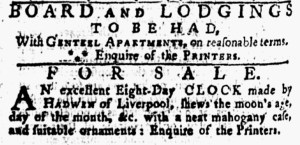
Some of them arrived seeking more information about advertisements that ran in the Pennsylvania Mercury. In addition to printing and disseminating notices on behalf of advertisers, the printers also served as brokers who provided additional information beyond what appeared in the public prints. The June 16, 1775, edition, for instance, carried two advertisements that instructed interested parties to “Enquire of the Printers” to learn more. One gave sparse details about “BOARD AND LODGING TO BE HAD, With GENTEEL APARTMENTS, on reasonable terms.” Which additional details did Story and Humphreys give to those who did enquire? Did they merely facilitate an introduction to the advertiser? Did they have details about price, furnishings, or the schedule for meals? The advertisement does not reveal how much information they relayed, only that both the printers and the advertiser anticipated that Story and Humphreys would have some involvement beyond publishing the advertisement.
Another advertisement offered for sale an “excellent Eight-Day CLOCK made by HADWEN of Liverpool” that “shews the moon’s age” and the “day of the month” in “a neat mahogany case” with “suitable ornaments.” Again, the advertisement did not indicate which additional details Story and Humphreys relayed to those who did “Enquire of the Printers,” but it testified to their additional involvement in the transaction after publishing the advertiser’s notice in their newspaper. Eighteenth-century printers brokered information both in print and in person, the latter an element of the customer service available to advertisers.