December 23

What was advertised in a colonial American newspaper 250 years ago today?
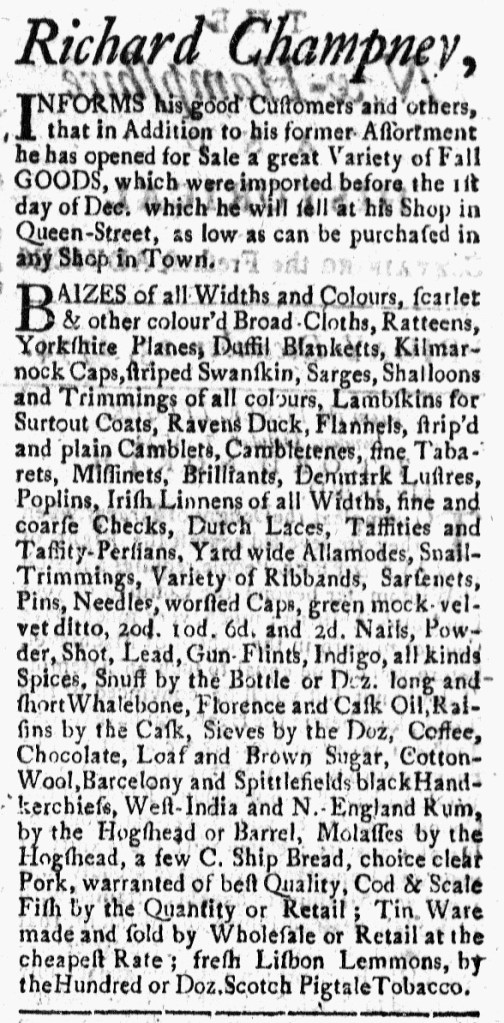
New-Hampshire Gazette (December 23, 1774).

“Fall GOODS, which were imported before the 1st of Dec.”

Richard Champney’s advertisement in the December 23, 1774, edition of the New-Hampshire Gazette looked like many others that had appeared in that newspaper and others throughout the colonies for about two decades.  The shopkeeper emphasized that he stocked “a great Variety of Fall GOODS” and promised competitive prices, declaring that consumers could acquire his merchandise “as low as can be purchased in any Shop in Town.”  To demonstrate the array of choices he offered, he devoted most of his advertisement to an extensive list that included “BAIZES of all Widths and Colours,” “Shalloons and Trimmings of all colours,” “strip’d and plain Camblets,” “fine and coarse Checks,” a “Variety of Ribbands,” “worsted Caps,” and “Barcelony and Spittlefields black Handkerchiefs.”  Although many of those textiles and accessories may not be immediately familiar to modern readers, they resonated with readers immersed in the consumer revolution of the eighteenth century.  They fluently spoke the language of consumption.

Despite the similarities with longstanding forms of advertising, Champney’s notice included one detail that distinguished it from what he would have published even a month earlier.  Although he had “opened” a new stock to supplement his “former Assortment,” those new goods “were imported before the 1st day of Dec[ember].”  That clarification was important for the shopkeeper to bring to the attention of prospective customers in Portsmouth and nearby towns and anyone who might read the New-Hampshire Gazette far and wide.  Champney explicitly specified that he observed the Continental Association, a nonimportation agreement adopted by the First Continental Congress that went into effect on December 1.  Since he had received this “great Variety of Fall GOODS” before that date, he could sell them with a clear conscience.  Similarly, consumers could purchase them without worrying whether they aided the shopkeeper in breaking the agreement.  For many years advertisers had noted when they imported their merchandise as a means of assuring prospective customers that they carried new items of the latest styles and taste.  After December 1, 1774, however, when a shipment arrived had political significance and new sorts of ramifications for both advertisers and buyers.
July 29

What was advertised in a colonial American newspaper 250 years ago today?

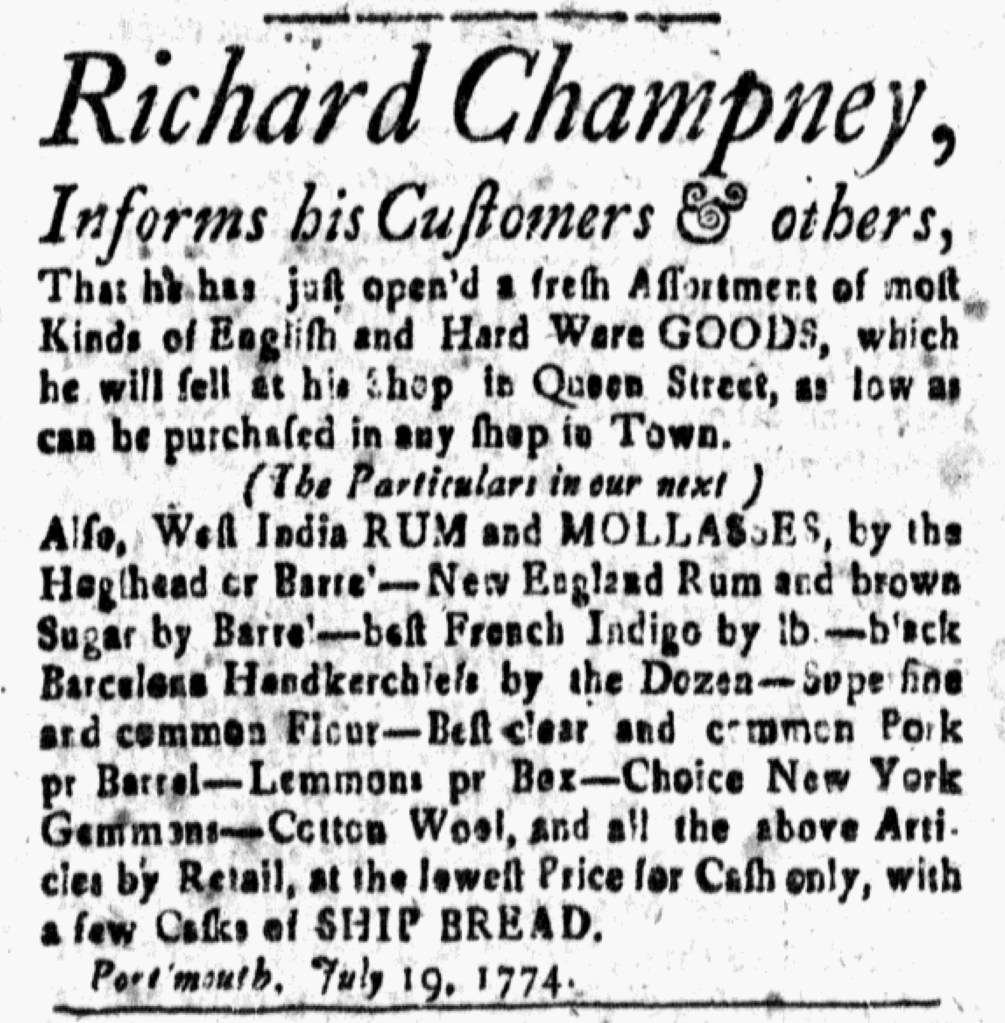
New-Hampshire Gazette (July 29, 1774).

(The Particulars in our next)

In the summer of 1774, Richard Champney took to the pages of the New-Hampshire Gazette to announce that he “has just open’d a fresh Assortment of most Kinds of English and Hard Ware GOODS” at his shop in Portsmouth.  He pledged that customers could acquire his merchandise “as low as can be purchased in any shop in Town.”  When his advertisement first ran on July 22, it did not list any of those items.  Instead, a note promised, “The Particulars in our next.”  Most likely the compositor devised that note due to lack of space in that issue; Champney’s advertisement appeared in the final column on the third page, the last of the content that would have been prepared for any edition.

The following week, however, his advertisement did not include the “Particulars.”  It ran exactly as it had, without any revision, though the compositor managed to find room for a new advertisement that featured an extensive catalog of goods that John Penhallow “Imported from LONDON” and sold at his store.  Had someone in the printing office overlooked the copy that should have appeared in Champney’s advertisement?  Did the shopkeeper raise an objection when his complete advertisement did not run as planned?  Was he frustrated that a competitor achieved greater visibility in the public prints even though he submitted his advertisement a week earlier?

Some exchange might have occurred between Champney and the printing office to rectify the situation.  The complete advertisement finally found its way into print in the August 5 edition of the New-Hampshire Gazette, two weeks after the shopkeeper first alerted readers that he had a “fresh Assortment” of goods.  It listed dozens of items to entice consumers, simultaneously demonstrating that the choices he offered to customers rivaled what Penhallow and other advertisers presented to the public.  Promising the “Particulars” in the next issue may have encouraged anticipation among prospective customers, especially in an issue that included only one other advertisement for imported wares, that one from a milliner who promoted a narrow range of goods, but not following through on it did not serve Champney well when his competitors published their own catalogs of merchandise.  Even though his complete notice eventually ran, any advantage from being the first in print had been squandered.

June 3

What was advertised in a colonial American newspaper 250 years ago today?

Jun 3 - 6:3:1768 New-Hampshire Gazette
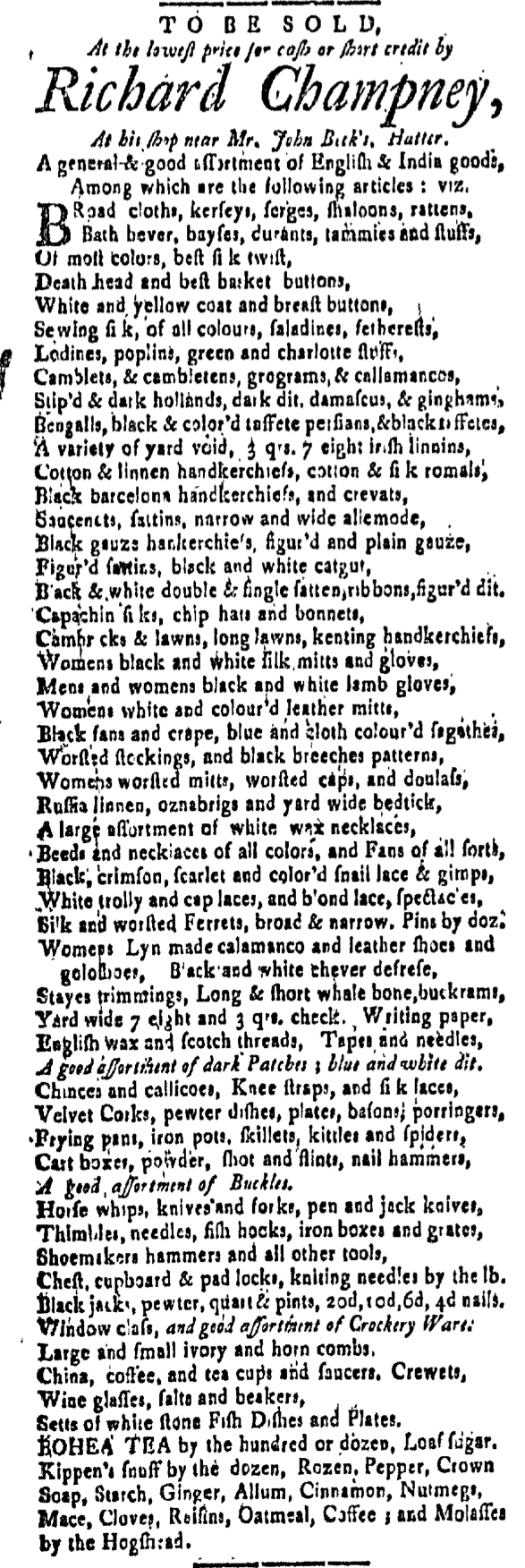
New-Hampshire Gazette (June 3, 1768).

“Mens and womens black and white lamb gloves.”

Thanks to unique typographical features, Richard Champney’s advertisement for “A general & good assortment of English & India goods” stood out among those published in the June 3, 1768, edition of the New-Hampshire Gazette. Like several of his competitors, Champney promoted his merchandise by listing dozens of items, prompting prospective customers to imagine the extensive variety he offered them, everything from “White and yellow coat and breast buttons” to “A large assortment of white wax necklaces” to “China, coffee, and tea cups and saucers.” Rather than publish his list in the form of a dense paragraph justified on both the left and right, Champney opted instead to name a limited number of items on each line and justify only the left margin. Especially given the length of his advertisement – more than half a column and twice as long as any other advertisement for consumer goods and services in the same issue – this format aided readers in distinguishing among his sweeping inventory, whether reading or skimming.

This layout may very well have been the work of the compositor rather than the result of a request by the advertiser, but other graphic design elements suggest that Champney at least consulted with those who produced the newspaper. For instance, the sparing use of italics called attention to a few items, including “A good assortment of dark Patches; blue and white dit[to]” and “A good assortment of Buckles.” One line appeared only partially in italics: “Window glass, and good assortment of Crockery Ware.” The compositor would have had no reason to randomly alter the format for those items; it seems more likely that Champney instructed that they receive some sort of special attention, not unlike “BOHEA TEA,” the only item that appeared in capitals. The white space that resulted from grouping like items together and proceeding to the next line without justifying the right margin increased the readability of the advertisement, making it more likely that prospective customers would notice the items that merited particular attention.

At a glance, Champney’s advertisement looked quite different than the other contents of the New-Hampshire Gazette, whether advertisements or news items. The format most resembled poetry, sometimes inserted in colonial newspapers as a transition between news selected by the editors and paid notices submitted by advertisers. Experimenting with the format may have drawn more eyes to the advertisement, prompting readers to scan it closely enough to determine that it was something other than the ode they anticipated. By the time they figured out it was not a poem, Champney had introduced them to some of the merchandise available at his shop.

April 18

GUEST CURATOR:  Trevor Delp

What was advertised in a colonial newspaper 250 years ago today?

Apr 18 - 4:18:1766 New-Hampshire Gazette
New-Hampshire Gazette (April 18, 1766).

“A few Barrels of good BROWN SUGAR.”

Richard Champney advertised “A few Barrels of South-Carolina PITCH, and a few Barrels of good BROWN SUGAR.” Soon after Columbus encountered the New World, Europeans realized the potential for sugar cane production. In the following years many European countries worked to colonize and establish sugar plantations throughout the Americas and the Caribbean.

This advertisement spurred me to look into who Richard Champney was. I found a letter written to George Washington from a Richard Champney. The letter does not confirm that it is the same Richard Champney as posted the advertisement, but it was addressed from Portsmouth and addressed sugar colonies in South America. Within the letter Champney expresses that the “Petitioners have for a number of years past been very considerably concerned and interested in the Trade to the Colony of Essequebo and Demarara on the Coast of Guiana in the West Indies formerly under the Government of the States of Holland.” This is interesting because the colony referenced in the letter was notorious for being a major producer of sugar cane throughout the eightheenth century. Champney’s advertisement combined with his letter to George Washington lead me to wonder if he was working to become a more prominent distributor of sugar in New Hampshire and beyond.

**********

ADDITIONAL COMMENTARY:  Carl Robert Keyes

Rather than situating today’s advertisement in the 1760s, Trevor takes a longer view of commerce in the early modern Atlantic world. In so doing, he addresses a misconception about motivations for exploration and colonization that I often discover during the first weeks of my courses on colonial America and the Atlantic world: namely, that America was settled (exclusively) for religious freedom. While religion was a primary motivation for many colonists, popular narratives all too often overlook the role that trade and commerce played in exploration and colonization.

Many scholars argue that Europeans first ventured into the Atlantic in search of sugar. They had previously obtained sugar via long distance trade with Asia, a trade with a hub in the Middle East. This made sugar expensive, so enterprising Europeans wanted to eliminate the middlemen. They wanted direct access to supplies of sugar themselves, and finding a water route to Asia seemed like one of the best means of gaining that access. Europeans did not, however, immediately venture across the Atlantic in search of sugar. Instead, they explored the African coast (setting up trading posts to obtain other goods) and sailed to island chains in the eastern Atlantic (including the Cape Verde Islands, the Canary Islands, and Madeira), where they established plantations to cultivate sugar (which, in turn, initiated the involuntary migration of unfree laborers). By the time Columbus voyaged to the New World, Europeans had gained a lot of experience looking for commercial opportunities and establishing colonies and plantations with the intention of increasing their access to sugar. Setting up such more plantations in the Americas and the Caribbean was an extension of activities already underway for decades.

Richard Champney advertised sugar to colonists who settled New Hampshire, in part, because of the importance of sugar as a commodity over the previous three centuries. An everyday staple in the modern world, it was a commodity that inspired exploration and settlement in the early modern period.