August 7

What was advertised in a colonial American newspaper 250 years ago today?

Aug 7 - 8:7:1767 New-Hampshire Gazette
New-Hampshire Gazette (August 7, 1767).

The Printers in this Town would without Charge publish such Accounts.”

Daniel Fowle and Robert Fowle, the printers of the New-Hampshire Gazette, regularly interspersed their own announcements among the other advertisements published in their newspaper. They inserted three such announcements in the August 7, 1767, edition. Two related notices had previously appeared, once requesting that “all Persons, who send Advertisements to this Press, would at the same Time send pay with them” and the other calling on “ALL Persons indebted for this Gazette, Advertisements, &c. … to make immediate Payment” or risk going to court. Both of these announcements addressed the financial operations of the publication.

The third, on the other hand, sought to enhance the content of the newspaper to better serve its subscribers, though the Fowles likely figured that new content of particular interest to readers would also enhance sales. Looking to their counterparts published in other cities, especially Philadelphia and New York, the Fowles noted that “the Publishers by some Means obtain Accounts from the Masters of Vessels on their Arrival of what Vessels they meet with on their Passage.” Such information was valuable to “those in the Mercantile Business” as well as the families of sailors who otherwise heard much less about the “Welfare of their Friends.”

The Fowles wished to include such information in the New-Hampshire Gazette, but they had difficulty collecting it. They called on the “Gentlemen Merchants” of Portsmouth to devise a method of reporting these accounts to the printing office, promising to publish them gratis as a service to the community. Their efforts to obtain these reports amounted to what would be described today as crowdsourcing, accepting and collating contributions of data or information from multiple participants to achieve a cumulative result. The process of crowdsourcing (as well as the term itself) became especially popular in the digital age, but new technologies improved and expanded a method already in practice much earlier. In their advertisements, the Fowles encouraged readers to participate in the production of the news via crowdsourcing the late 1760s.
July 10

What was advertised in a colonial American newspaper 250 years ago today?

Jul 10 - 7:10:1767 New-Hampshire Gazette
New-Hampshire Gazette (July 10, 1767).

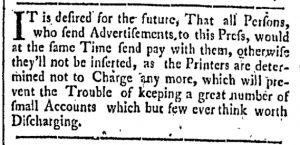
“All Persons, who send Advertisements to this Press, would at the same Time send pay with them.”

Daniel Fowle and Robert Fowle inserted this notice in the final column of the July 10, 1767, issue of the New-Hampshire Gazette. In it, they instructed that “all Persons, who send Advertisements to this Press” should “at the same Time send pay with them.” In making this request, the Fowles addressed two common questions about eighteenth-century newspaper advertising. Who wrote the advertisements? Did printers make money from advertising?

By comparing text and typography in advertisements published in multiple newspapers, it appears that advertisers wrote the copy and printers took primary responsibility for format and layout (though some exceptional advertisers also participated in designing the visual aspects of their own notices). The Fowles seem to confirm that advertisers composed the text, though they do not address the question of layout. Advertisers possibly sent along instructions, though the printers would have preferred payment instead.

This notice does not definitively answer whether advertising turned profits for printers, but it does cast light on some of their standard practices and challenges. The Fowles threatened not to insert any advertisements delivered without payment. They were “determined not to Charge any more” because extending credit was more hassle than it was worth. They had learned through unfortunate experience “the Trouble of keeping a great number of small Accounts which but few ever think worth Discharging.”

Historians of eighteenth-century printers have long argued that newspapers did not make money from subscriptions, that profits derived from advertising. This notice, however, suggests that in some cases – or “a great number” of cases, to borrow the Fowles’ phrase – advertising was no more likely to turn a profit than selling subscriptions. Colonists purchased advertising on credit, just as they participated in the consumer revolution by buying on credit. Sometimes they paid in a timely manner, but, if the Fowles were to be believed, quite often they were delinquent in settling their accounts. Historians of print culture cannot assume that advertisements published in eighteenth-century newspapers always generated revenues for the printers.

May 22

What was advertised in a colonial American newspaper 250 years ago today?

May 22 - 5:22:1767 New-Hampshire Gazette
New-Hampshire Gazette (May 22, 1767).

Fraught with Entertainment.”

Daniel Fowle and Robert Fowle, the printers of the New-Hampshire Gazette, also sold books that they imported from England or exchanged with other printers in the colonies. Their advertisement filled an entire column and nearly half of another on the final page of the May 22, 1767, issue of the New-Hampshire Gazette. Such lengthy advertisements were not uncommon for printers and booksellers, but the length of this one resulted from an innovative format not featured in most newspaper notices. Printers and booksellers usually followed one of two standard practices when advertising books. Either they provided a list of titles for sale, a catalog of sorts, or they marketed a single volume via lengthy explications of the contents and their practical usefulness for readers.

The Fowles did a little bit of each but more in this advertisement. They included a short list of additional titles at the conclusion, but first they described several books in chatty blurbs that took a very different tone than most advertisements for books inserted in newspapers in the 1760s. The Fowles aimed to entertain readers rather than strictly instruct them (though a heavy dose of instruction was still embedded in their marketing), offering an alternate rationale for why consumers should purchase their wares.

Consider, for example, the description of “The Clandestine Marriage, A COMEDY: As it is acted at the Theatre Royal in Drury Lane.” According to the blurb, the play was “fraught with Entertainment. Some of the Scenes are truly comic, others inculcate the strictest Morality.” It also included a description of the characters, including “the conceited, infirm, and antiquated yet generous Lord Ogleby – the vulgar, money loving Sterling – the sensible Lovewell – the sycophant Canton – the impudent Brush – Mrs. Heidelberg the Dutch Widow, an ignorant Pretender to Quality Mannersthe pert, spiteful Miss Sterling, displaying in reality the modern fine Lady, and the amiable, gentle, and delicate Miss Fanny – who altogether form a Group that must afford greta [sic] Entertainment to every Reader.” In addition, the Epilogue, in particular, was “very remarkable for its Singularity and Humour.”

This shift in tone, telling readers that they would be entertained as well as receive moral instruction, made sense as part of the reading revolution that took place in the eighteenth century. Reading habits experienced a transition from intensive reading of the bible and devotional literature to more extensive reading of works of all sorts for entertainment. The Fowles demonstrate that one mode of reading did not simply replace the other. Instead, they framed several of their books to appeal to whichever purpose their customers wished to achieve in their reading habits.

February 8

What was advertised in a colonial American newspaper 250 years ago this week?

feb-8-261767-new-hampshire-gazette
New-Hampshire Gazette (February 8, 1767).

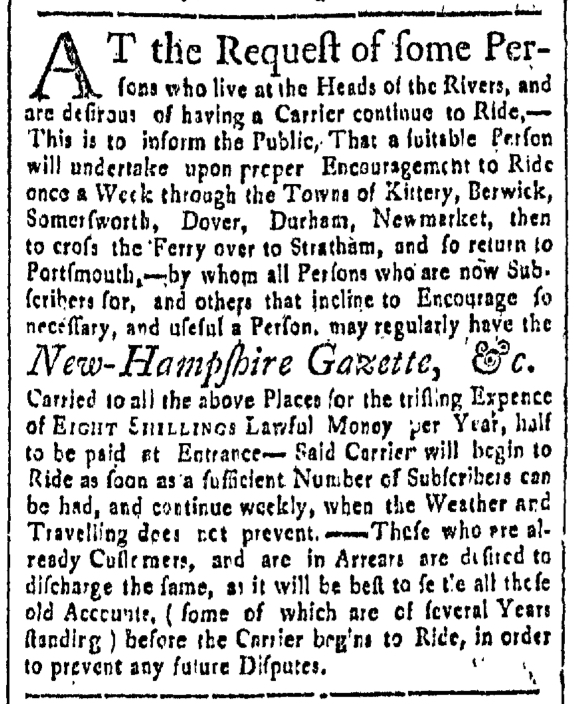
“Said Carrier will begin to Ride as soon as sufficient Number of Subscribers can be had.”

Like other colonial printers, Daniel and Robert Fowle inserted advertisements for their own business endeavors in the newspaper they published (though they did not use the colophon as a standing advertisement for the various services provided at their printing office in Portsmouth). The Fowles were responsible for four of the advertisements that appeared in the February 6, 1767, issue of the New-Hampshire Gazette.

Three of those advertisements were fairly short: four lines each. Two of them peddled leftover almanacs for 1767 and the third informed readers that the Fowles supplemented the revenues from newspaper subscriptions and advertisements by selling “BLANKS of all sorts – and a variety of Books, Pamphlets, &c.”

The fourth advertisement took up considerably more space on the page. It advertised the newspaper itself, the title appearing in a larger font and on a line by itself in the middle of the notice. The Fowles outlined a plan to have a rider continue to deliver newspapers to subscribers in towns and villages beyond Portsmouth. The proposed route included “the Towns of Kittery, Berwick, Somersworth, Dover, Durham, Newmarket, [and] Stratham.” The Fowles offered this as a service to subscribers, though they also indicated that demand already existed among “some Persons who live at the Heads of the Rivers” who were “desirous of having a Carrier continue to Ride.”

The printers placed this notice to gauge interest in this plan, stating that “Said Carrier will begin to Ride as soon as a sufficient Number of Subscribers can be had.” Yet interest was not sufficient to bring the plan to fruition: subscribers needed to demonstrate their commitment by paying half of the delivery in advance. The printers also requested that current subscribers “in Arrears” pay up “before the Carrier begins to Ride, in order to prevent any future Disputes.”

This advertisement made clear that the rider would provide a continuation of an existing service, delivery to the local town (if not directly to each subscriber’s home). In so doing, it demonstrated the geographic reach of colonial newspapers beyond the cities where they were printed and into the towns and villages in the hinterland. Certainly some copies were disseminated even further afield, but the success (or even the continuation) of newspapers depended on cultivating local and regional customers and readers.

December 5

What was advertised in a colonial American newspaper 250 years ago today?

dec-5-1251766-new-hampshire-gazette
New-Hampshire Gazette (December 5, 1766).

“The NEW-HAMPSHIRE ALMANCK, For the Year of our Lord CHRIST 1767.”

With only four weeks remaining until the first day of the new year, it was time for readers of the New-Hampshire Gazette to procure almanacs for 1767. Printers and booksellers in some colonial towns had been advertising their almanacs since early September, giving customers plenty of time to purchase one of the most widely distributed types of publication in colonial America.

Some readers of the New-Hampshire Gazette had apparently already acquired their almanacs by the time today’s advertisement appeared. “Those who are not already supplied,” Daniel Fowle and Robert Fowle warned, “must apply speedily, as but few remain unsold, and no more will be printed this Year.”

In making such a statement, the Fowles simultaneously deployed three appeals to potential customers. They made an appeal to scarcity, noting that “but few remain unsold.” The printers had limited stock to offer to those who had not yet bought their almanacs for the new year. They made an appeal to popularity, implying that the scarcity had been caused by the large volume of purchases on the part of customers (rather than the printers producing too limited a quantity). Many other readers apparently trusted David Sewall’s calculations and the other content of the almanac; they had already acquired their copies. Finally, the Fowles made an appeal to potential customers’ sense of urgency. Not only was the new year quickly approaching, those who wanted their own copy of the New-Hampshire Alamanack for reference needed to “apply speedily” because “no more will be printed this Year.” The Fowles had printed enough copies to sell the almanac both “Wholesale and Retail,” but they did not print so many that they would end up with leftover stock that could never be sold. This helped to create a sense of urgency as they cautioned potential customers that they risked being shut out if they waited too long to shop for this particular item.

Almanacs were certainly popular reading and reference material in colonial America. It would be hard to deny that latent demand for them existed. However, the Fowles’ advertisement did more than simply notify the public that they offered a product already in demand. Instead, the Fowles various appeals – scarcity, popularity, sense of urgency – to incite greater demand for the New-Hampshire Almanack for 1767.

July 4

What was advertised in a colonial newspaper 250 years ago today?

Jul 4 - 7:4:1766 New-Hampshire Gazette
New-Hampshire Gazette (July 4, 1766).

“We beg such Delinquent Customers would reflect upon their extreme Ill usage of us.”

Daniel Fowle and Robert Fowle, “THE Printers of this Paper,” meant business. They were exasperated with subscribers and advertisers who refused to pay their bills. To demonstrate that they were not going to put up with such “Arrearages” any longer, they placed this advertisement in a prominent location in their newspaper. It appeared at the top of the final column on the third page, the very last item readers encountered when scanning the interior of a broadsheet folded in half to create a four-page newspaper. In length, it extended halfway down the page. This was valuable space that the printers could have given over to advertising (assuming said advertisers actually paid their bills), but Fowle and Fowle determined that calling in debts was the better investment.

Fowle and Fowle offered a valuable service at a low price – “the most material Foreign and Domestick Intelligence carried with very trifling Expence” – and they expected to be compensated in a timely manner. Credit was an important part of the colonial economy, but the printers were more than generous in extending credit to their patrons. Some subscribers had fallen behind “three, four, five, six, seven, eight and nine Years.” As a result, the printers threatened to sue “delinquent Customers for News Papers, Advertisement, &c.” if those customers did not settle their accounts. The printers even arranged a series of meetings in the towns where they distributed their newspapers. It was not necessary for subscribers to visit their printing office in Portsmouth. The printers were willing pay the necessary expenses to come to them, if only they would pay their bills.

Benjamin Franklin famously made such a fortune as a printer that he was able to retire at a relatively young age to pursue a variety of other vocations. This advertisement demonstrates that other printers experienced challenges to achieving such success.

June 20

What was advertised in a colonial newspaper 250 years ago today?

Jun 20 - 6:20:1766 New-Hampshire Gazette
New-Hampshire Gazette (June 20, 1766).

To be Sold by the Printers.”

Eighteenth-century printers earned their living by offering a variety of services, as this short advertisement indicates. Publishing the New-Hampshire Gazette was not Daniel Fowle and Robert Fowle’s sole occupation in 1766. If they earned any profit at all from selling subscriptions, it was likely rather small. The important revenues from publishing newspapers came from the advertisements (which helps to explain why printers often gave over so much of the space in colonial newspapers to advertising rather than news or, on occasion, supplied half sheet supplements filled almost exclusively with commercial notices).

In this advertisement, the Fowles announced another branch of printers’ craft: printed blanks. Today such items are better known as blank forms. To record exchanges or legal transactions that took place so regularly that they were standardized, customers could purchase blank forms with boilerplate language. That meant that they did not have to start each new document from scratch with a quill pen. Printed blanks were convenient and saved time, making them a popular product. Often newspaper colophons indicated that the publishers printed the newspaper itself, standalone advertisements, and blanks, suggesting that the printed blanks were a significant part of their operations and revenues.

Some colonial printers also sold books, often imported books or imprints they exchanged with their counterparts in the colonies. Printing a book was a massive undertaking. Considering the time, effort, and capital required for newspapers, advertisements, printed blanks, and other job printing, printers who sold books tended to sell as many or more books printed by others than books that came off their own presses

This advertisement helps to demonstrate the various activities that took place in an eighteenth-century printing shop. Most printers did not specialize in one type of job. Instead, they generated revenues in multiple ways.