September 20

What was advertised in a revolutionary American newspaper 250 years ago today?
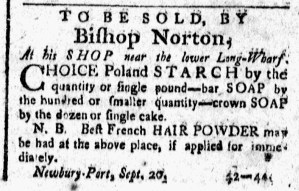
Essex Journal (September 20, 1776).

“Best French HAIR POWDER may be had … if applied for immediately.”

The first page of the September 20, 1776, edition of the Essex Journal featured the text of a resolution passed by the Continental Congress near the end of August, extracts of letters “from the West Indies,” “from a Planter in Grenada,” and “from a Merchant in Bermuda,” and news from Newport, Rhode Island.  Bishop Norton’s advertisement for starch and soap for sale at his shop “near the lower Long-Wharf” in Newburyport, Massachusetts, ran at the bottom of the final column.  He sold “CHOICE Poland STARCH by the quantity or single pound” as well as “bar SOAP by the hundred or smaller quantity” and “crown SOAP by the dozen or single cake.”

In a nota bene, Norton also promoted “Best French HAIR POWDER.”  The war did not deter readers from wanting to look their best.  Norton proclaimed that the hair powder “may be had … of applied for immediately,” creating a sense of urgency to acquire the product.  He likely hoped that scarcity would prompt prospective customers to make purchases.  The final line included the town and date, “Newbury-Port, Sept. 20.”  Readers could determine for themselves how recently Norton had placed the advertisement and imagine whether he any of the hair powder might still be available.  The final line also included a notation for the printer, “42-44,” that indicated the advertisement would run in three issues (No. 142 on September 20, No. 143 on September 27, and No. 144 on October 4) before being discontinued.  Norton’s admonition to place orders for his limited supply of hair powder “immediately” gained greater urgency in each subsequent insertion of his advertisement in the Essex Journal, especially when readers took note of the date at the end of the notice.  Not every advertisement included a date, but in this instance the date played an important part in making Norton’s appeal to prospective customers to act “immediately” or risk missing out on his “Best French HAIR POWDER.”

December 5

What was advertised in a colonial American newspaper 250 years ago today?

dec-5-1251766-new-hampshire-gazette
New-Hampshire Gazette (December 5, 1766).

“The NEW-HAMPSHIRE ALMANCK, For the Year of our Lord CHRIST 1767.”

With only four weeks remaining until the first day of the new year, it was time for readers of the New-Hampshire Gazette to procure almanacs for 1767. Printers and booksellers in some colonial towns had been advertising their almanacs since early September, giving customers plenty of time to purchase one of the most widely distributed types of publication in colonial America.

Some readers of the New-Hampshire Gazette had apparently already acquired their almanacs by the time today’s advertisement appeared. “Those who are not already supplied,” Daniel Fowle and Robert Fowle warned, “must apply speedily, as but few remain unsold, and no more will be printed this Year.”

In making such a statement, the Fowles simultaneously deployed three appeals to potential customers. They made an appeal to scarcity, noting that “but few remain unsold.” The printers had limited stock to offer to those who had not yet bought their almanacs for the new year. They made an appeal to popularity, implying that the scarcity had been caused by the large volume of purchases on the part of customers (rather than the printers producing too limited a quantity). Many other readers apparently trusted David Sewall’s calculations and the other content of the almanac; they had already acquired their copies. Finally, the Fowles made an appeal to potential customers’ sense of urgency. Not only was the new year quickly approaching, those who wanted their own copy of the New-Hampshire Alamanack for reference needed to “apply speedily” because “no more will be printed this Year.” The Fowles had printed enough copies to sell the almanac both “Wholesale and Retail,” but they did not print so many that they would end up with leftover stock that could never be sold. This helped to create a sense of urgency as they cautioned potential customers that they risked being shut out if they waited too long to shop for this particular item.

Almanacs were certainly popular reading and reference material in colonial America. It would be hard to deny that latent demand for them existed. However, the Fowles’ advertisement did more than simply notify the public that they offered a product already in demand. Instead, the Fowles various appeals – scarcity, popularity, sense of urgency – to incite greater demand for the New-Hampshire Almanack for 1767.