October 16

What was advertised in a colonial American magazine 250 years ago this month?

Detail from advertising wrapper: Royal American Magazine (August 1774).

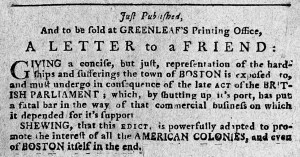
“A concise, but just, representation of the hardships and sufferings of the town of BOSTON.”

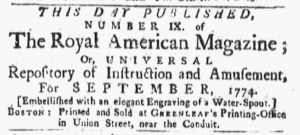
For eighteen months, the Adverts 250 Project has been tracing the efforts of, first, Isaiah Thomas and, eventually, Joseph Greenleaf in advertising and publishing the Royal American Magazine.  Newspaper advertisements have definitively demonstrated that the dates associated with most issues did not match when they were published and distributed to subscribers and other readers.  On October 13, 1774, for instance Greenleaf placed advertisements in both the Massachusetts Gazette and Boston Weekly News-Letter and the Massachusetts Spy to announce “This day was published, THE Royal American Magazine, No. 8. For AUGUST, 1774.  In the eighteenth century, magazines usually came out at the end of the month, so readers would have expected to see the September issue advertised in October. Greenleaf continued to work on catching up on delinquent issues after acquiring the magazine from Thomas.

Greenleaf packaged the August issue in wrappers intended to be removed when the subscriber had the monthly issues bound into a single volume.  The pages numbers continued from one issue to the next.  The wrapper supplemented a title page that included a list of contents within the issue; printers intended for the title page to remain after discarding the wrapper.  Unlike modern magazines, advertisements did not appear within the issue.  Instead, they ran only on the wrappers.  The front of the wrapper for the August 1774 issue of the Royal American Magazine featured the same items as the one for July: the coat of arms of Great Britain above the title of the magazine (along with an updated date and issue number), an address to subscribers from Thomas, and an advertisement for “A LETTER to a FRIEND: GIVING a concise, but just, representation of the hardships and sufferings the town of BOSTON is exposed to” available at Greenleaf’s printing office.

What about the back of the wrapper?  That presented a bit of a mystery that cannot be solved solely by examining the digital surrogates.  A list of books and blanks that Greenleaf sold filled the back of the wrapper that accompanied the July issue.  That was also the case for the September issue.  The digitized version of the August issue, however, does not include any trace of the back of the wrapper, not even images of blank pages.  It does include an image of the blank page that was the interior of the front of the wrapper with the impression of the title and date from the other side clearly visible.  The same database includes images of blank pages for the interiors of front and back wrappers for the July and September issues, demonstrating that production of the digital surrogates incorporated careful attention to capturing more than just the contents printed on the numbered pages of those issues.  It stands to reason, then, that if the back of the wrapper had been present with the August issue that it would have been digitized.  Perhaps it had been damaged and removed at some point.  Yet sometimes mistakes happen.  The only way to know for certain is to examine the original document.

Unfortunately, my teaching schedule will not allow me to visit the reading room at the American Antiquarian Society before publishing this entry.  On the other hand, I am fortunate to live and work in the same city as the research library that houses the original magazine that was digitized to make the Royal American Magazine more widely accessible.  That means that I have more ready access to the original and tracking down answers to these sorts of questions than most others who consult the images in the database.  I will update this entry when time allow, but leave this discussion intact since it demonstrates that even though digital surrogates expand access, they cannot replace original sources.

September 26

What was advertised in a colonial American newspaper 250 years ago today?

Boston Evening-Post (September 26, 1774).

“NUMBER VII. of The Royal American Magazine.”

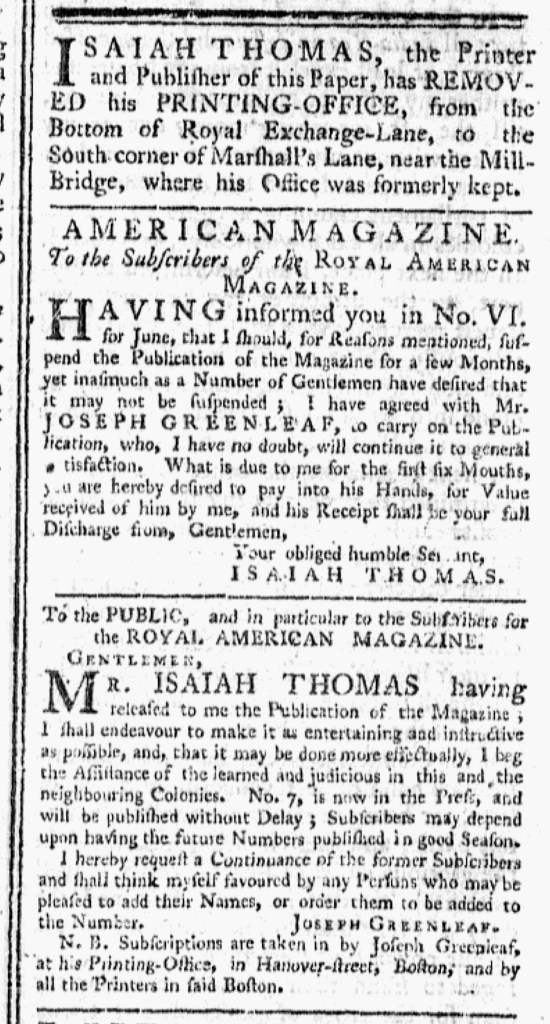
The Royal American Magazine experienced a disruption in publication during the summer of 1774.  In a notice in the June issue, Isaiah Thomas, the founder of the magazine, reported that the “Distresses of the Town of Boston” that resulted from the Boston Port Act forced him to suspend publication for a few months.  He hoped to resume once “the Affairs of this Country are a little better settled.”  Not long after making that announcement, however, he took to the pages of his own newspaper, the Massachusetts Spy, to inform subscribers and the public that he transferred the magazine to Joseph Greenleaf.  An address from Greenleaf appeared immediately below Thomas’s advertisement.  They were the latest entries in a marketing campaign that commenced when Thomas first revealed his intention to circulate subscription proposals in May 1773 and subsequent newspaper advertisements in June, July, August, September, October, November, and December 1773 and January, February, March, April, May, and June 1774.  The “Distresses” meant no newspaper advertisements for the magazine in July 1774, but they resumed with the notices from Thomas and Greenleaf in August.

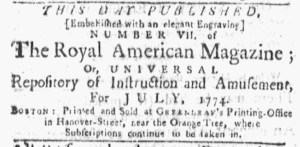
Those notices each made four more appearances in September.  Not surprisingly, the Massachusetts Spy accounted for three of them.  For four weeks, Thomas used his own newspaper to advise subscribers and others of the change in publisher for the magazine.  The companion notices also ran once in the Boston Evening-Post on September 5.  Greenleaf’s address indicated that the July issue of the magazine “is now in the Press, and will be published without Delay.”  On September 15, the last day that they ran in the Massachusetts Spy, that newspaper also carried a new advertisement from Greenleaf, one that declared, “THIS DAY PUBLISHED … NUMBER VII. of The Royal American Magazine.”  The July issue finally became available in September!  Greenleaf’s advertisement was brief and restrained compared to many that Thomas had inserted.  It stated that the issue was “Embellished with an elegant Engraving,” but did not give a description or even a name for Paul Revere’s engraving of “Spanish Treatment at Carthagena,” nor did the advertisement incorporate an extensive list of the contents to entice readers.  Instead, it succinctly noted that the magazine was “Printed and Sold at GREENLEAF’S Printing-Office … where Subscriptions continue to be taken in.” The new publisher hoped to expand the magazine’s circulation despite a less ambitious advertising strategy than Thomas sometimes deployed.  The announcement about the July issue ran only once in the Massachusetts Spy.  It appeared in the Boston Evening-Post for the first time in its next edition four days later and again the following week.  Amid the “Distresses of the Town of Boston,” Greenleaf’s first issue of the Royal American Magazine had less fanfare than many of the issues that Thomas published.

**********

To the Subscribers of the ROYAL AMERICAN MAGAZINE”

  • September 1 – Massachusetts Spy (second appearance)
  • September 5 – Boston Evening-Post (first appearance)
  • September 8 – Massachusetts Spy (third appearance)
  • September 15 – Massachusetts Spy (fourth appearance)

“To the PUBLIC, and in particular to the Subscribers”

  • September 1 – Massachusetts Spy (second appearance)
  • September 5 – Boston Evening-Post (first appearance)
  • September 8 – Massachusetts Spy (third appearance)
  • September 15 – Massachusetts Spy (fourth appearance)

“THIS DAY PUBLISHED … NUMBER VII”

  • September 15 – Massachusetts Spy (first appearance)
  • September 19 – Boston Evening-Post (first appearance)
  • September 26 – Boston Evening-Post (second appearance)

September 18

What was advertised in a colonial American magazine 250 years ago this month?

Advertising wrapper enclosing Royal American Magazine, July 1774 (published September 15, 1774).

“A concise, but just, representation of the hardships and sufferings of the town of BOSTON.”

An advertisement in the September 15, 1774, edition of the Massachusetts Spy informed readers that “NUMBER VII of the ROYAL AMERICAN MAGAZINE” was “This day published” and “will be ready to be delivered, to-morrow, to the subscribers.”  The notice referred to the July edition.  Isaiah Thomas, the original publisher, had always been behind in circulating new issues of the magazine, putting Joseph Greenleaf, the new proprietor, in a position to catch up.  The July issue was his first, published just three weeks after the first announcement that he now oversaw the magazine.

Like other eighteenth-century magazines, the Royal American Magazine did not feature advertisements interspersed among its contents, yet that did not mean that it lacked advertising altogether.  First Thomas and then Greenleaf distributed each issue enclosed in blue paper wrappers that featured advertisements.  In the last quarter of the century, other magazine publishers did the same.  The wrappers protected each issue until subscribers had six of them bound into a volume, though bookbinders usually removed the wrappers and other advertising ephemera, such as trade cards, subscription proposals, and book catalogs, within them.  Bound volumes preserved in research libraries give the impression that advertising was not part of eighteenth-century magazines, yet intact individual issues demonstrate that was not the case at all.

Advertising wrapper enclosing Royal American Magazine, July 1774 (published September 15, 1774).

Over time, the kinds of advertisements on the wrappers evolved to include an array of goods and services, but in the 1770s they almost exclusively came from the book trades and, especially, the publisher of the magazine.  Such was the case with the Royal American Magazine.  The wrappers for the July 1774 issue had a message to the subscribers from Thomas, the same one that announced the change of publisher in the Massachusetts Spy, an advertisement for “A LETTER to a FRIEND: GIVING a concise, but just, representation of the hardships of the town of BOSTON” sold at Greenleaf’s printing office, and a list of books and printed blanks also available from the publisher of the magazine.  The wrappers for the June 1774 edition had included advertisers not affiliated with the magazine, yet still members of the book trades.  Benjamin Edes and John Gill, printers of the Boston-Gazette, advertised “OBSERVATIONS on the ACT of PARLIAMENT, commonly called the BOSTON PORT BILL,” the legislation that resulted in the “hardships of the town” outlined in the pamphlet Greenleaf promoted.  Nathaniel Mills and John Hicks, printers of the Massachusetts Gazette and Boston Post-Boy, advertised an array of books they stocked, while Bernard Romans outlined his “PROPOSALS For printing by Subscription, A CONCISE Natural HISTORY of EAST and WEST FLORIDA.”

The Adverts 250 Project has tracked newspaper advertisements concerning the Royal American Gazette from Thomas’s first mention of his intention to circulate subscription proposals through the publication of the first six issues and transferring the magazine to a new publisher.  That story, however, has not examined the Royal American Magazine as a delivery mechanism for advertising.  Subsequent entries will take a closer look at the advertisements that appeared on the magazine’s wrappers throughout its run.

August 28

What was advertised in a colonial American newspaper 250 years ago this month?

Massachusetts Spy (August 25, 1774).

“Suspend the Publication of the Magazine for a few Months.”

For more than a year, the Adverts 250 Project has traced Isaiah Thomas’s advertising campaign for the Royal American Magazine, from his first announcement that he intended to circulate subscription proposals in May 1773 through the notices that ran in newspapers in June, July, August, September, October, November, and December 1773 and January, February, March, April, May, and June 1774.  Last month, I noted that Thomas did not advertise the magazine in July 1774, that the sole marketing effort in the public prints was a poem “From the ROYAL AMERICAN MAGAZINE” that appeared in the “POETS CORNER” in the July 21, 1774, edition of the Massachusetts Spy, the newspaper that Thomas printed.  I also commented that newspaper advertisements do not reveal when the June 1774 issue of the magazine became available to readers.

Further investigation, however, reveals that newspaper advertisements do indeed provide that information.  The June 1774 issue of the Royal American Magazine was not published until August 1774.  Eighteenth-century magazines commonly came out at the end of the month, unlike modern magazines issued in advance of the dates on their covers.  Subscribers would have expected the June issue in late June or early July, but Thomas was more than a month late in distributing it.  He had perpetually been behind the anticipated publication schedule since the first issue.

On Thursday, August 4, the Massachusetts Spy carried a notice that “Saturday next will be published … NUMBER VI. of THE ROYAL American Magazine.”  To promote that issue, Thomas proclaimed that it would be “Embellished with elegant Engravings, I. The able Doctor, or America swallowing the bitter Draught.  II. The Hooded Serpent.”  Paul Revere produced both engravings.  The “Able Doctor,” depicting America personified as an Indigenous woman being held down by members of Parliament and forced to drink tea, protested the Boston Port Act.  It is now considered one of the most important examples of visual propaganda supporting the patriot cause produced during the imperial crisis.

By Monday, Thomas took the overdue issue to press.  The August 8 edition carried a nearly identical advertisement with the headline updated to “THIS DAY PUBLISHED.”  On August 11, an announcement received a prominent place in the Massachusetts Spy, running as the first item in the first column on the first page.  Although delinquent in publishing the June issue, Thomas privileged promoting it when he could finally declare, “This day was published … NUMBER VI. of THE ROYAL American Magazine.”  As he had done with previous issues, Thomas highlighted the engravings and provided a list of the contents to entice readers who were not already subscribers to purchase copies.  The articles included a “Description of the Hooded Serpent” to accompany the second engraving.

The June issue included an address “To the PUBLIC” in which Thomas informed “all those Gentlemen and Ladies, in this and the other Provinces, who have favoured him with their Subscriptions” that current events forced him to suspend publication of the magazine.  “The Distresses of the Town of Boston, by the shutting up of our Port,” Parliament’s response to the Boston Tea Party, had “throw[n] all Ranks of Men into Confusion,” including “those good Gentlemen … who kindly promised to assist the Editor with their various Lucrubrations.”  Thomas had regularly published advertisements seeking original content for the magazine, but now those who had volunteered to contribute had found themselves overcome by other priorities.  As a result, Thomas received “but few original Pieces.”  He could not provide readers with “that Entertainment and Instruction, which they have a Right to expect.”  Accordingly, he planned to suspend publication for a few months “until the Affairs of this Country are a little better settled” and his correspondents could once again turn their attention to supplying the magazine with content.

Not long after subscribers saw that notice in the June issue of the American Royal Magazine, Thomas took to the Massachusetts Spy with a new update on August 25.  He reported that “a Number of Gentlemen have desired that it may not be suspended.”  Not in a position to continue with the magazine at that time, Thomas “agreed with Mr. JOSEPH GREENLEAF, to carry on the Publication.”  He assured subscribers that the new publisher “will continue it to general satisfaction.”  He also instructed them to submit subscription fees for the first six issues to Greenleaf.  A notice from Greenleaf “To the PUBLIC, and in particular to the Subscribers for the ROYAL AMERICAN MAGAZINE” immediately followed.  He pledged to make the magazine “as entertaining and instructive as possible,” yet, like Thomas, needed the “Assistance of the learned and judicious in this and the neighbouring colonies.”  He was on track to make good on his promise to subscribers, declaring that the next issue “is now in the Press, and will be published without Delay.”  In addition, subscribers “may depend upon having the future Numbers published in good Season,” implicitly acknowledging that publication of previous issues had often been deferred longer than anticipated.  The new publisher concluded with a request that current subscriber continue and new subscribers “add their Names,” either at his printing office or with any other printers in Boston.

The suspension could have been the end of the Royal American Magazine, but Greenleaf managed to publish new issues through February 1775.  The Adverts 250 Project will continue to document advertisements for the magazine to compare Greenleaf’s marketing efforts to those of Thomas.

**********

“Saturday next will be published … NUMBER VI.”

  • August 4 – Massachusetts Spy (first appearance)

“THIS DAY PUBLISHED … NUMBER VI.”

  • August 8 – Boston Evening-Post (first appearance)
  • August 15 – Boston Evening-Post (second appearance)

“This day was published … NUMBER VI.” [with list of contents]

  • August 11 – Massachusetts Spy (first appearance)

To the Subscribers of the ROYAL AMERICAN MAGAZINE”

  • August 25 – Massachusetts Spy (first appearance)

“To the PUBLIC, and in particular to the Subscribers”

  • August 25 – Massachusetts Spy (first appearance)

July 31

What was marketed in a colonial American newspaper 250 years ago this month?

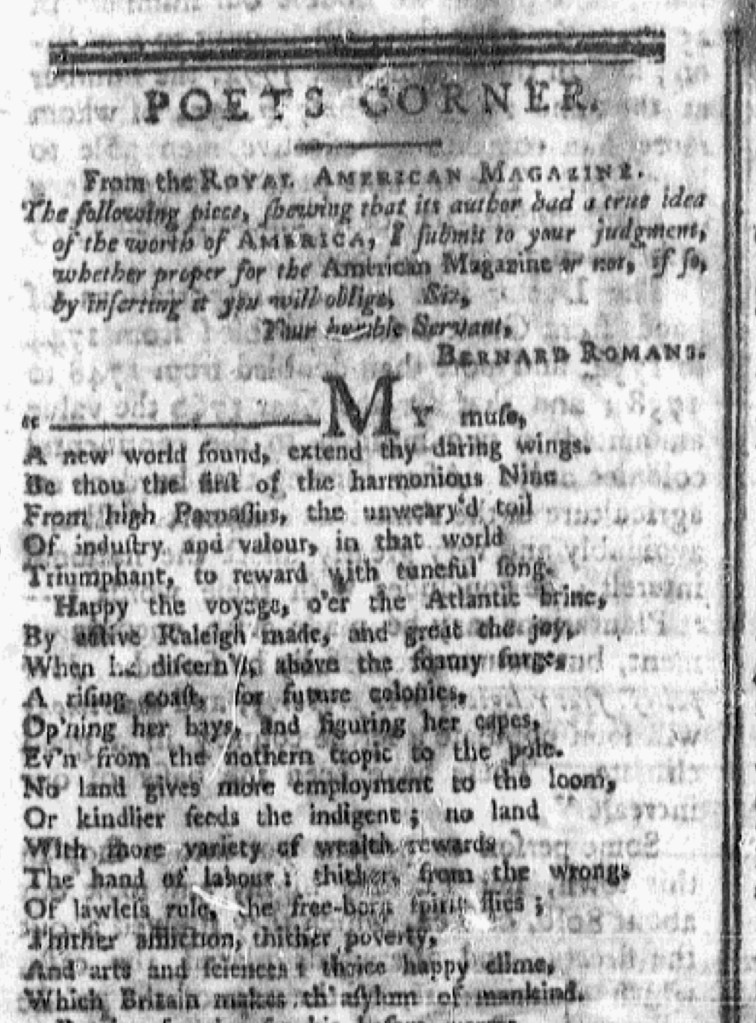
Massachusetts Spy (July 21, 1774).

“From the ROYAL AMERICAN MAGAZINE.”

Isaiah Thomas did not publish any newspaper advertisements for the Royal American Magazine in July 1774.  When he first proposed the magazine and sought subscribers, he ran advertisements in newspapers from New Hampshire to Maryland, sometimes dozens of them a month, yet once he published and distributed the first issue the extensive advertising campaign tapered off and, eventually, went on hiatus.  The Adverts 250 Project has tracked Thomas’s efforts to promote the Royal American Magazine from the first time he announced his intention to circulate subscription proposals in May 1773 through the advertisements in newspapers in June, July, August, September, October, November, and December 1773 and January, February, March, April, May, and June 1774.

In the eighteenth century, publishers typically distributed new issues at the end of the month, unlike today’s practice of circulating magazines in advance of the publication date.  Readers considered the January 1774 issue, for instance, an overview of that month, expecting to receive it just as February arrived.  Even by those standards, Thomas was perpetually behind in delivering the Royal American Magazine to subscribers.  He published the January issue on February 7 following a delay in receiving new types ordered for the magazine.  The May 1774 issue did not appear until June 17.

Newspaper advertisements do not reveal when the June 1774 issue became available to readers.  Thomas did not place any advertisements for the Royal American Magazine in July 1774, not even in his own newspaper, the Massachusetts Spy.  As Frank Luther Mott documents, Thomas did announce in the June issue that “he was under the necessity of suspending the publication of his magazine ‘for a few Months, until the Affairs of this Country are a little better settled.’”[1]  He lamented “the Distresses of the Town of Boston, by the shutting up of our Port, and throwing all Ranks of Men into confusion.”[2]  The Boston Port Act, one of the repercussions Parliament instituted following the Boston Tea Party, took its toll on the Royal American Magazine.  The magazine resumed publication in September, though by then Joseph Greenleaf was at the helm.

Although Thomas did not advertise the Royal American Magazine in July 1774, it did not go unreferenced in the public prints.  The “POETS CORNER,” a regular feature on the final pages of many colonial newspapers, in the July 21 edition of the Massachusetts Spy featured a poem by Bernard Romans “From the ROYAL AMERICAN MAGAZINE.”  It filled nearly an entire column.  On occasion, Thomas inserted excerpts from the magazine in the Massachusetts Spy or the Essex Journal, the newspaper that his junior partner, Henry-Walter Tinges, published in Salem.  That gave readers who had not yet subscribed a glimpse of the magazine’s content.  For previous issues, Thomas had also attempted to incited interest by including an extensive table of contents in his advertisements along with descriptions of the engravings that accompanied each issue.  Yet the lack of advertising for the June 1774 issue meant that he did not promote the frontispiece, “The Able Doctor, or America Swallowing the Bitter Draught.”  That political cartoon condemning the Boston Port Act, engraved by Paul Revere, fit with the politics of the magazine.  It remains one of the most significant images advocating the patriot cause produced in the colonies during the imperial crisis.  As savvy as Thomas was about publishing propaganda, he missed an opportunity to call attention to such a powerful image.

**********

[1] Frank Luther Mott, A History of American Magazines, 1741-1850 (Cambridge: Harvard University Press, 1939), 85.

[2] Quoted in Mott, History of American Magazines, 85.

June 26

What was advertised in a colonial American newspaper 250 years ago this month?

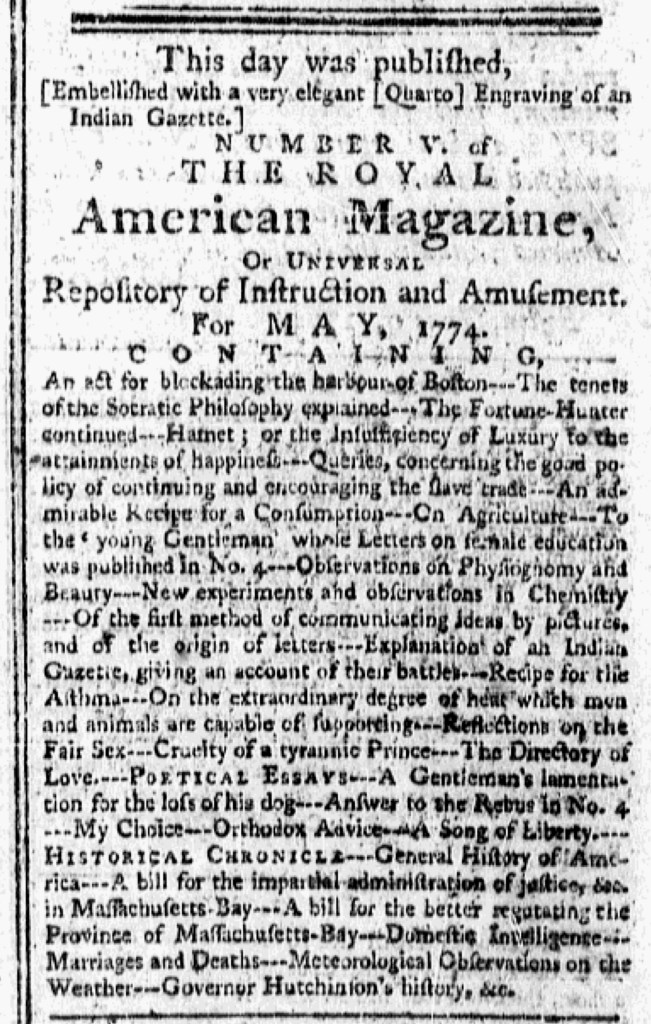
Massachusetts Spy (June 23, 1774).

“NUMBER V. of THE ROYAL American Magazine.”

Isaiah Thomas significantly scaled down advertising for the Royal American Magazine in June 1774 compared to previous months.  The Adverts 250 Project has chronicled the printer’s marketing efforts from the first time he announced his intention to publish a magazine, the only one in America at the time, in May 1773 through the advertisements that appeared in newspapers from New England to Maryland in June, July, August, September, October, November, and December 1773 and January, February, March, April, and May 1774.

Thomas did not publish the May 1773 issue of the Royal American Magazine until well into June.  That accounts for some of the lack of advertising.  His first notice for the month ran in the June 16 edition of his own newspaper, the Massachusetts Spy.  In a brief update, he informed the public that “TO-MORROW will be published, No. V. of the ROYAL AMERICAN MAGAZINE,” but he did not mention any reason for the delay.  Six days later, the Essex Journal carried a notice that “Friday last was published in Boston, NUMBER V. of THE Royal AMERICAN MAGAZINE OR UNIVERSAL Repository of Instruction and Amusement.”  It was “Printed and sold by I. THOMAS, in Boston; sold also at the Printing-Office in Newbury-Port.”  Henry-Walter Tinges operated that printing office, where he published the Essex Journal in partnership with Thomas.  As Tinges had done in connection with the first issue of the magazine, he previewed some of the contents in the Essex Journal.  For the weekly selection in the “Poets Corner” on the final page, he reprinted “FEMALE ADVICE,” a poem “From the ROYAL AMERICAN MAGAZINE.”

The most extensive advertisement for the magazine first appeared in the June 23 edition of the Massachusetts Spy.  It resembled advertisements from previous months, announcing publication of the latest issue, promoting the copperplate engraving that “Embellished” the magazine, and listing the contents, starting with “An act for blockading the harbour of Boston” that had attracted so much attention in that city and throughout the colonies.  That advertisement ran a second time in the Massachusetts Spy a week later.  That Thomas did not publish and distribute the May 1774 issue of the Royal American Magazine until June 17 offers a cautionary tale about using dates on eighteenth-century magazines to assess when readers gained access to the information contained in them.  In contrast to modern magazines distributed in advance of the dates on their covers, early American magazines were typically published at the end of the month. The May issue, for instance, would come out during the final days of May … yet in this instance the May issue of the Royal American Magazine did not appear until the middle of June.

In total, only four newspaper advertisements promoted the Royal American Magazine in June 1774, all of them in newspapers published by Thomas.  Unlike previous months, he did not insert announcements in any of the other newspapers printed in Boston.  In addition, he did not publish other sorts of notices related to the magazine, such as calls for contributors to make submissions.  The unfolding political situation in combination with his efforts to continue publishing the Massachusetts Spy may have occupied more of his time than in previous months, making it less of a priority to advertise the magazine.

**********

“TO-MORROW will be published, No. V”

  • June 16 – Massachusetts Spy (first appearance)

Friday last was published in Boston, NUMBER V”

  • June 22 – Essex Journal (first appearance)

“This day was published … NUMBER V” (with contents)

  • June 23 – Massachusetts Spy (first appearance)
  • June 30 – Massachusetts Spy (second appearance)

May 29

What was advertised in a colonial American newspaper 250 years ago this month?

Massachusetts Spy (May 26, 1774).

“NUMBER IV. of THE ROYAL American Magazine … For APRIL, 1774.”

A year after he first announced plans to distribute subscription proposals for the Royal American Magazine, Isaiah Thomas continued advertising the only magazine published in the colonies at the time.  It took more than half a year to engage enough subscribers to make the venture viable.  Thomas intended to publish the first issue in January 1774, but the types did not arrive in time, so the inaugural edition came out in early February (though still bearing January as its date).  Once the magazine began circulating among subscribers and other readers, Thomas promoted it in the public prints, especially his own Massachusetts Spy, though not in as many newspapers as carried the subscription proposals.  The Adverts 250 Project has tracked advertisements for the Royal American Magazine that appeared in June, July, August, September, October, November, and December 1773 and JanuaryFebruary, March, and April 1774.  This entry provides an overview of Thomas’s marketing campaign in May 1774.

Two advertisements ran simultaneously in the Massachusetts Spy on May 5.  In one, Thomas announced that “Tuesday next will be published, No, IV of the Royal American Magazine … For APRIL, 1774.”  Publication continued to lag behind the date of the publication, but magazines followed a different schedule in the eighteenth century compared to today.  Modern magazines often circulate with dates that have not yet arrived, while eighteenth-century publishers tended to distribute a magazine for a particular month at the end of that month.  Such magazines featured content compiled during that month, not material intended to be read that month.  In the other advertisement in that issue of the Massachusetts Spy, Thomas called on “THOSE Gentlemen who are inclined to favour the Royal American Magazine, for MAY, with their Productions … to send them with all convenient Speed, to the Publisher.”  Thomas worked throughout May to gather the contents for that month’s issue of the magazine.  That notice appeared each week.  In contrast, he did not run announcements about the impending publication of the April edition in any newspapers except the Massachusetts Spy.

On May 12, Thomas announced publication of “NUMBER IV. of THE ROYAL American Magazine … For APRIL, 1774” in the Massachusetts Spy.  Similar to advertisements for previous editions, this one included a list of the contents to entice prospective subscribers as well as a header that highlighted the “elegant Engravings” that accompanied the magazine.  For April, those illustrations included “The Bust of Mr. Samuel Adams,” an influential leader in the dispute with Parliament over taxing tea and blockading the harbor as punishment for the Boston Tea Party, and “The Hill-Tops: A new Hunting Song, set to Music, with a Representation of the Death of the Stag.”  Paul Revere engraved the portrait of Adams, but Thomas did not consider that notable enough to mention in the advertisement.  The publisher inserted this notice in the Massachusetts Spy for three consecutive weeks.  It also appeared once in the Boston Evening-Post on May 16.

The Boston-Gazette and the Essex Journal each ran an abbreviated version of that advertisement on two occasions.  That variation included only the header about the engravings and the announcement that the magazine “was Published,” but not the list of contents.  Henry-Walter Tinges printed the Essex Journal in Salem in partnership with Thomas, helping to explain the multiple insertions in that newspaper.  The second time that the advertisement appeared in the Boston-Gazette, it was on the final page of a supplement.  Thomas may have arranged for a second insertion in that newspaper, but the printers might have opted to fill remaining space in the supplement with type already set for advertisements that ran in previous issues.  Thomas did not arrange to have an advertisement in the Massachusetts Gazette and Boston Post-Boy nor the Massachusetts Gazette and Boston Weekly News-Letter.  His advertising efforts in even Boston’s newspapers contracted in May 1774, down to only three of the five newspapers published there.

Only one advertisement for the Royal American Magazine ran in a newspaper published beyond Boston in May 1774.  On May 20, a notice announced the publication of the April issue, but did not include the header about the engravings or the list of contents.  It did advise “Subscribers in Portsmouth, York, Berwick, New-Castle, Dover, Windham, and Kittery … to apply to Mr. Isaac Williams of Portsmouth for their Books.”  Apparently local agents in other towns and colonies distributed the new issue of the magazine without resorting to newspaper advertisements.

Overall, five distinct advertisements for the Royal American Magazine appeared a total of fourteen times in American newspapers in May 1774, including eight insertions of three of those advertisements in Thomas’s own Massachusetts Spy and two more insertions of one of the other notices in the Essex Journal, the newspaper operated by Tinges in partnership in Boston.  Thomas continued to actively promote the magazine in his own newspapers, but advertising in other publications did not range as far and wide as in previous months, especially the period for attracting subscribers before taking the first issue of the magazine to press.

**********

“Tuesday next will be published”

  • May 5 – Massachusetts Spy (first insertion)

“with their Productions”

  • May 5 – Massachusetts Spy (first insertion)
  • May 12 – Massachusetts Spy (second insertion)
  • May 19 – Massachusetts Spy (third insertion)
  • May 26 – Massachusetts Spy (fourth insertion)

“This Day was published … NUMBER IV” (variation with contents and header)

  • May 12 – Massachusetts Spy (first insertion)
  • May 16 – Boston Evening-Post (first insertion)
  • May 19 – Massachusetts Spy (second insertion)
  • May 26 – Massachusetts Spy (third insertion)

“This Day Published … NUMBER IV” (variation with header and without contents)

  • May 16 – Boston-Gazette (first insertion)
  • May 18 – Supplement to the Essex Journal (first insertion)
  • May 25 – Essex Journal (second insertion)
  • May 30 – Supplement to the Boston-Gazette (second insertion)

“JUST PUBLISH’d, Number IV”

  • May 20 – New-Hampshire Gazette (first insertion)

April 28

What was advertised in a colonial American newspaper 250 years ago today?

Massachusetts Spy (April 28, 1774).

“He will carry this and other papers, and the Royal American MAGAZINE.”

Following the successful launch of the Royal American Magazine a few months earlier, Isaiah Thomas continued advertising the new publication in April 1774.  His marketing efforts that month, however, were not as robust as in previous months.  Only twelve advertisements appeared in April, with seven of them in Thomas’s own Massachusetts Spy.  The Adverts 250 Project has examined his advertising campaign, starting with an announcement, published in May 1773, that he planned to distribute subscription proposals and then the subsequent advertisements, appearing in newspapers from New Hampshire to Maryland, in June, July, August, September, October, November, and December 1773 and JanuaryFebruary, and March 1774.

The first advertisement for the month ran in the April 4 edition of the Massachusetts Gazette and Boston Post-Boy, the only newspaper (other than the Massachusetts Spy) that carried more than one notice about the Royal American Magazine in April.  It advised that “Monday next will be published, NUMBER II. of THE ROYAL American Magazine, For MARCH, 1774.”  The compositor made an error with “NUMBER II” instead of “NUMBER III.”  That advertisement gave a week’s notice of publication of the March issue.  Thomas had fallen behind on the intended publications dates as a result of new types for the magazine not arriving when expected.  He published the January issue in early February and the February issue in early March.  Accordingly, the March issue came out in April.  On April 7, Thomas ran the same advertisement (correctly specifying “NUMBER III”) in the Massachusetts Spy.

On the same day, his newspaper also ran Moses Cleveland’s notice about establishing a “post to ride weekly between NORWICH and BOSTON,” carrying the Norwich Gazette, the Massachusetts Spy, other newspapers, and the Royal American Gazette.  Cleveland’s original advertisement in the Norwich Gazette and subsequent advertisement in the Massachusetts Gazette and Boston Post-Boy did not mention the Royal American Gazette, suggesting that Thomas adapted the post rider’s notice for his own purposes.  He seized an opportunity to promote the magazine to prospective subscribers who lived in towns in Massachusetts and Connecticut along the proposed route.  Cleveland’s advertisement ran in all four issues of the Massachusetts Spy published in April, accounting for one-third of the advertisements that month.

On April 15, the Connecticut Gazette carried a brief notice that “The Ist. And IId. Numbers Of the ROYAL AMERICAN MAGAZINE, are ready to be delivered to those who subscribed for them with T. GREEN,” the printer of that newspaper and local agent for the magazine.  That was the only advertisement for the Royal American Magazinepublished in a newspaper beyond Boston in April.  Timothy Green likely placed it of his own volition, rather than acting on instructions from Thomas, upon receiving copies of the magazine he was responsible for distributing to subscribers in and near his town.

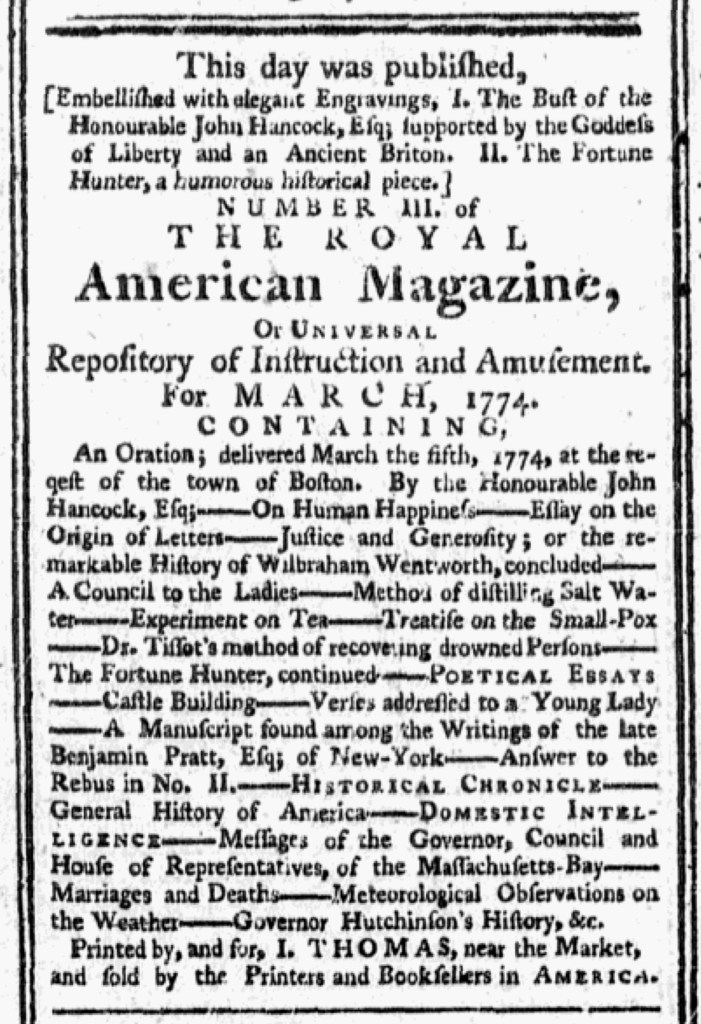
Massachusetts Spy (April 15, 1774).

Also on April 15, Thomas announced that “NUMBER III” of the magazine “was published.”  As he had done with previous issues, he listed the contents to entice readers, including essays on “Justice and Generosity” and an “Experiment on Tea,” “POETICAL ESSAYS,” a new entry for an ongoing “HISTORICAL CHRONICLE,” and “DOMESTIC INTELLIGENCE.”  The March issue was “Embellished” with two copperplate engravings, one of a “Bust of the Honourable John Hancock, Esq; supported by the Goddess of Liberty and an Ancient Briton” and the other depicting “The Fortune Hunter, a humorous historical piece.”  Thomas ran this advertisement once more in the Massachusetts Spy on April 22.  In the time between its appearances in that newspaper, he inserted it once in the Boston Evening-Post (on April 18), the Massachusetts Gazette and Boston Post-Boy (on April 18), and the Massachusetts Gazette and Boston Weekly Newsletter (on April 21).  Of the newspapers published in Boston at the time, only the Boston-Gazette, printed by Benjamin Edes and John Gill, did not carry this advertisement.  Perhaps the printers objected to the inclusion of the first item in the list of contents, “An Oration; delivered March the fifth, 1774, at the reqest of the town of Boston. By the Honourable John Hancock, Esq.”  Edes and Gill printed and marketed a pamphlet containing Hancock’s address commemorating the fourth anniversary of the Boston Massacre.  They may not have appreciated the competition from Thomas distributing the oration via other means.

Thomas may not have considered it necessary to advertise as aggressively following the launch of the Royal American Magazine as he had in the months that he encouraged subscribers to show their support for the venture.  With the assistance of local agents in many cities and towns, he may have garnered a sufficient number of subscribers that allowed him to shift his focus to producing the magazine and other responsibilities in his printing office.  He continued running Moses Cleveland’s advertisement, which he first adapted in March, but did not oversee extensive announcements about the publication of the newest issue of the magazine.  Maybe he learned from similar campaigns for the first and second issues that such advertisements did not attract enough new subscribers to justify the investment. The April 15 and 22 editions of the Massachusetts Spy appeared on Fridays instead of Thursdays, a day later than usual, suggesting that the printer was preoccupied with matters other than marketing the Royal American Magazine.

**********

“will be published … NUMBER III”

  • April 4 – Massachusetts Gazette and Boston Post-Boy (first appearance)
  • April 7 – Massachusetts Spy (first appearance)

“MOSES CLEVELAND”

  • April 7 – Massachusetts Spy (second appearance)
  • April 15 – Massachusetts Spy (third appearance)
  • April 22 – Massachusetts Spy (fourth appearance)
  • April 28 – Massachusetts Spy (fifth appearance)

“Ist. And IId. Numbers”

  • April 15 – Connecticut Gazette (first appearance)

“NUMBER III” with contents

  • April 15 – Massachusetts Spy (first appearance)
  • April 18 – Boston Evening-Post (first appearance)
  • April 18 – Massachusetts Gazette and Boston Post-Boy (first appearance)
  • April 21 – Massachusetts Gazette and Boston Weekly News-Letter (first appearance)
  • April 22 – Massachusetts Spy (second appearance)

April 18

What was advertised in a colonial American newspaper 250 years ago today?

Massachusetts Gazette and Boston Post-Boy (April 18, 1774).

“He will carry Papers and deliver them to such Gentlemen as are pleased to encourage him.”

When Moses Cleveland set about establishing “a Post to ride weekly between Norwich and Boston” in 1774, he initially advertised in the Norwich Packet.  He pledged that he “will carry this Paper, and deliver it to such Gentlemen as are pleased to encourage it, with the utmost Regularity.”  Soon after, he ran a nearly identical advertisement in the Massachusetts Spy, the newspaper that Isaiah Thomas printed in Boston.  Cleveland realized that the success of the venture depended on attracting as many customers as possible at both ends of his route and places on the way.

His notice in the Massachusetts Spy featured a small, but important, variation.  It stated that he “will carry this and other papers,” acknowledging that five newspapers were published in Boston at the time, “and the Royal American MAGAZINE.”  When I first examined that advertisement, I conjectured that Cleveland had not written that last bit of copy but instead Thomas seized an opportunity to market the new magazine he launched a couple of months earlier.  Cleveland’s advertisement gave the magazine more visibility, while the post rider’s service made the magazine accessible to prospective subscribers in Norwich, “WINDHAM, POMFRET, MENDON,” and other towns in Connecticut and Massachusetts.

Cleveland did not advertise in all the Boston newspapers.  Perhaps that would have been prohibitively expensive as he sought to raise funds for his venture.  Yet he did not confine his advertising to the Massachusetts Spy.  Instead, he placed a notice in the Massachusetts Gazette and Boston Post-Boy, again nearly identical.  In that one, he declared that he “will carry Papers and deliver them to such Gentlemen as are pleased to encourage him,” making no mention of the Royal American Magazine.  This strongly suggests that Thomas did indeed make an editorial intervention in Cleveland’s advertisement, grafting his own marketing efforts onto the newspaper notice purchased by the post rider.

April 3

What was advertised in a colonial American newspaper 250 years ago this week?

Massachusetts Spy (March 24, 1774).

“Numb. III. is now in the press.”

Isaiah Thomas continued marketing the new Royal American Magazine in March 1774.  The Adverts 250 Project has traced his efforts to promote and launch the magazine in 1773 and 1774, starting with his initial announcement, published in May 1773, that he intended to circulate subscription proposals and his advertising campaign undertaken from New Hampshire to Maryland in throughout June, July, August, September, October, November, and December 1773 and January and February 1774 .  Newspaper announcements beyond Massachusetts tapered off once Thomas took the first issue to press.

March 1774 opened with the third and final insertion of an advertisement that Thomas had “Lately PUBLISHED … NUMBER I” of the magazine in the Essex Journal, the newspaper that his partner, Henry-Walter Tinges, printed in Newburyport.  On Thursday, March 3, Thomas placed a new notice in the newspaper he printed in Boston, the Massachusetts Spy, alerting the public that “Monday next will be published, NUMBER II. of THE ROYAL American Magazine … For FEBRUARY, 1774.”  He remained behind schedule following the late arrival of new types for the magazine, but he did indeed release the second issue of the magazine the following Monday.  An advertisement in the Massachusetts Gazette and Boston Post-Boy on March 7 proclaimed, “THIS DAY PUBLISHED … NUMBER II. of THE ROYAL American Magazine.”  It asserted that “the Printers and Booksellers in America” sold the magazine, though few advertised it in March 1774.  The Massachusetts Gazette and Boston Post-Boy carried that advertisement for three consecutive weeks, the only newspaper printed in Boston (with the exception of Thomas’s own Massachusetts Spy) to run more than one notice about the Royal American Magazine in March 1774.

Beyond Boston and beyond Massachusetts, the Newport Mercury featured an advertisement about the first issue of the magazine on the same day that the Massachusetts Gazette and Boston Post-Boy ran Thomas’s notice that the second issue was published.  “THE first number of the ROYAL AMERICAN MAGAZINE is come to hand,” it stated, also providing instructions that “all those persons who subscribed with the printer hereof for it, and have not had theirs, are desired to send for the same.”  That advertisement ran for two weeks.  A few days later, on March 11, the New-Hampshire Gazette circulated an advertisement about the magazine “FOR JANUARY AND FEBRUARY 1774,” informing subscribers in Portsmouth, York, Berwick, New Castle, Dover, Windham, and Kittery to apply to Isaac Williams in Portsmouth for their copies.  That notice also ran for two weeks.

The remaining advertisements for the Royal American Magazine published in March 1774 all ran in newspapers printed in Boston.  On March 10, Thomas inserted his own “This day published” notice in the Massachusetts Spy, supplementing the copy with a list of the contents and a note that the second edition was “Embellished with elegant engravings of Sir Wilbraham Wentworth; and a Night Scene.”  He inserted the same advertisement once again on March 24 and may have done so on March 17 (a missing page in the digitized edition causing the confusion).  The Boston Evening-Post carried the same advertisement on March 14, while the Massachusetts Gazette and Boston Weekly News-Letter carried it on March 17.  It appeared in both newspapers only once, compared to two insertions of a similar advertisement about the first issue of the magazine in each newspaper the previous month.  The Boston-Gazette did not carry any notices about the Royal American Magazine in March 1774.  Perhaps Thomas did not consider it imperative to advertise as aggressively once the magazine began circulating in Boston.

Thomas took to the pages of the Massachusetts Spy once again on March 17, that time with a brief notice that “Numb. III. is now in the press.”  He called on “Those Gentlemen who have original pieces, useful extracts, &c. prepared for said number” to submit them for publication.  That notice ran once again the following week.  At the end of the month, on March 31, Thomas revised Moses Cleveland’s advertisement to indicate that the post rider carried the Royal American Magazine as well as newspapers printed in Boston on his route between that city and Norwich, Connecticut.  It was a clever means of gaining more exposure for the magazine and encouraging more subscriptions, a return, however brief, to the more expansive advertising campaign and marketing strategies that Thomas had adopted in previous months.

**********

“NUMBER I” (“Lately PUBLISHED” variant)

  • March 2 – Essex Journal (third appearance)

“will be published, NUMBER II”

  • March 3 – Massachusetts Spy (first appearance)

“THIS DAY PUBLISHED … NUMBER II”

  • March 7 – Massachusetts Gazette and Boston Post-Boy (first appearance)
  • March 14 – Massachusetts Gazette and Boston Post-Boy (second appearance)
  • March 21 – Massachusetts Gazette and Boston Post-Boy (third appearance)

“first number … come to hand”

  • March 7 – Newport Mercury (first appearance)
  • March 14 – Newport Mercury (first appearance)

“This day published … NUMBER II” with contents

  • March 10 – Massachusetts Spy (first appearance)
  • March 14 – Boston Evening-Post (first appearance)
  • March 17 – Massachusetts Gazette and Boston Weekly News-Letter (first appearance)
  • March 10 – Massachusetts Spy (possible second appearance)
  • March 10 – Massachusetts Spy (second known appearance; possible third appearance)

“FOR JANUARY AND FEBRUARY 1774”

  • March 11 – New-Hampshire Gazette (first appearance)
  • March 18 – New-Hampshire Gazette (second appearance)

“Numb. III. is now in the press”

  • March 17 – Massachusetts Spy (first appearance)
  • March 24 – Massachusetts Spy (second appearance)

“MOSES CLEVELAND”

  • March 31 – Massachusetts Spy (first appearance)