August 25

What was advertised in a revolutionary American newspaper 250 years ago today?
Essex Journal (August 25, 1775).

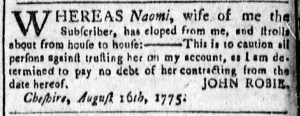
“This is to caution all persons against trusting her on my account.”

It was a familiar sight.  Advertisements about runaway wives peppered the pages of early American newspapers.  Husbands, like John Robie, took to the public prints to warn that since their wives, in this case Naomi Robie, “eloped” from them that those women no longer had access to credit.  “This is to caution all persons against trusting [Naomi] on my account,” John proclaimed, “as I am determined to pay no debt of her contracting from the date hereof.”  He presented himself as the aggrieved husband, yet his wife likely had her own version of the origins of their marital discord.  Running away may have been the best option to remove her from a bad situation.

When John placed his advertisement about Naomi in the August 25, 1775, edition of the Essex Journal, it ran immediately after a petition from “The FEMALE SUPPORTERS of LIBERTY” reprinted from the Newport Mercury.  “WHEREAS our country has long groaned under the oppression of a tyrannical ministry; and has lately been invaded by our enemies, who stained the land with the blood of our dear brethren,” the petition began, “THEREFORE we, the subscribers, are determined to defend our liberties, both civil and religious, to do the utmost that lies in our power.”  These women took a stand to defend their “liberties” in a manner considered acceptable, while Naomi had asserted her liberty in an inappropriate manner.  “We do not mean to take up arms,” the petitioners continued, “for that does not become our sex.”  They affirmed that they knew their proper place, unlike Naomi who departed from John’s household “and strolls from house to house.”  The petitions vowed to “put our hands to the plough, hoe and rake, and till the ground, for our men to go to the assistance of our distressed brethren, there to conquer our enemies or die in the attempt.”  Those women faced uncertain futures, realizing that the deaths of husbands, fathers, and brothers would be sacrifices that affected them and their families.  They also pledged to “forsake the gaieties of the world,” such as abiding by nonimportation and nonconsumption agreements, “before we will give up our country’s liberties and religion.”

The petition ended with a vow of mutual support: “Our company is to consist of as many true daughters of liberty as will undertake the noble cause.”  Furthermore, “No one to be admitted who retains any of the tory principles.”  Women (and men) recognized legitimate ways for women to participate in politics and advocate for their own interests, but only to any extent.  In this instance, advocacy extended to words and deeds that supported women (and their country) collectively, defending their “liberties and religion,” but not to condoning individual acts of resistance like Naomi Robie’s plan for self-determination when they ran counter to her husband’s wishes.  Many of the women who signed the petition may have privately sympathized with Naomi, but the press carried nothing but condemnations of her actions even as it celebrated the “FEMALE SUPPORTERS of LIBERTY” and their commitment to the American cause.

August 2

What was advertised in a revolutionary American newspaper 250 years ago today?

Pennsylvania Journal (August 2, 1775).

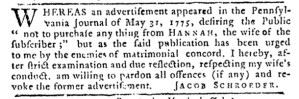
“I hereby … am willing to pardon all offences (if any) and revoke the former advertisement.”

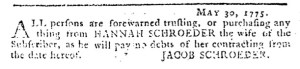
It was a rare retraction.  Jacob Schroeder asked the public to disregard the advertisement he placed regarding his wife, Hannah, a few months earlier.  Some sort of marital discord occurred within the Schroeder household, prompting Jacob to run an advertisement with these instructions: “ALL persons are forewarned trusting, or purchasing any thing from HANNAH SCHROEDER the wife of the Subscriber, as he will pay no debts of her contracting from the date hereof.” Similar advertisements regularly appeared in newspapers throughout the colonies, sometimes more than one in a single issue.  Usually, they indicated that a wife had “eloped” or run away from her husband.  In turn, the husband instructed merchants, shopkeepers, artisans, and others not to allow his wife access to his credit.  Such advertisements often alleged various kinds of bad behavior perpetrated by the wife.  However, husbands set the narrative.  In many instances, the wife likely removed herself from an unhappy or even abusive marriage.  Deprived of credit, most did not have an opportunity to publish their side of the story, though occasionally a wife did find the means to respond in an advertisement.

Retractions made by the husbands were also few and far between in early American newspapers, making Jacob’s advertisement even more noteworthy.  “WHEREAS an advertisement appeared in the Pennsylvania Journal of May 31, 1775, desiring the Public ‘not to purchase any thing from HANNAH, the wife of the subscriber,’” he wrote, “but as the said publication has been urged to me by the enemies of matrimonial concord, I hereby, after strict reflection, respecting my wife’s conduct, an willing to pardon all offences (if any) and revoked the former advertisement.”  He did not offer additional details.  A shorter advertisement cost less, but a desire to avoid as much public scrutiny as possible may have been the deciding factor in not elaborating on the “offences (if any)” or the insinuations made to Jabob by “the enemies of matrimonial concord.”  After all, it would have been embarrassing enough to resort to an advertisement in the first place, an admission that Jacob had been unable to exercise proper authority within his own household.  That the details of Jacob and Hannah’s did not appear in print did not mean that they did not circulate in their neighborhood and beyond.  Those “enemies of matrimonial concord,” whether relatives, friend, or acquaintances, likely gossiped about the couple, as did others.  The appearance of both Jacob’s original advertisement and his retraction may have sparked more conversations and speculation about what occurred in the Schroeder household.  The newspaper notices captured only part of the story.

Pennsylvania Journal (May 31, 1775).

March 12

What was advertised in a colonial American newspaper 250 years ago this week?

New-York Journal (March 9, 1772).

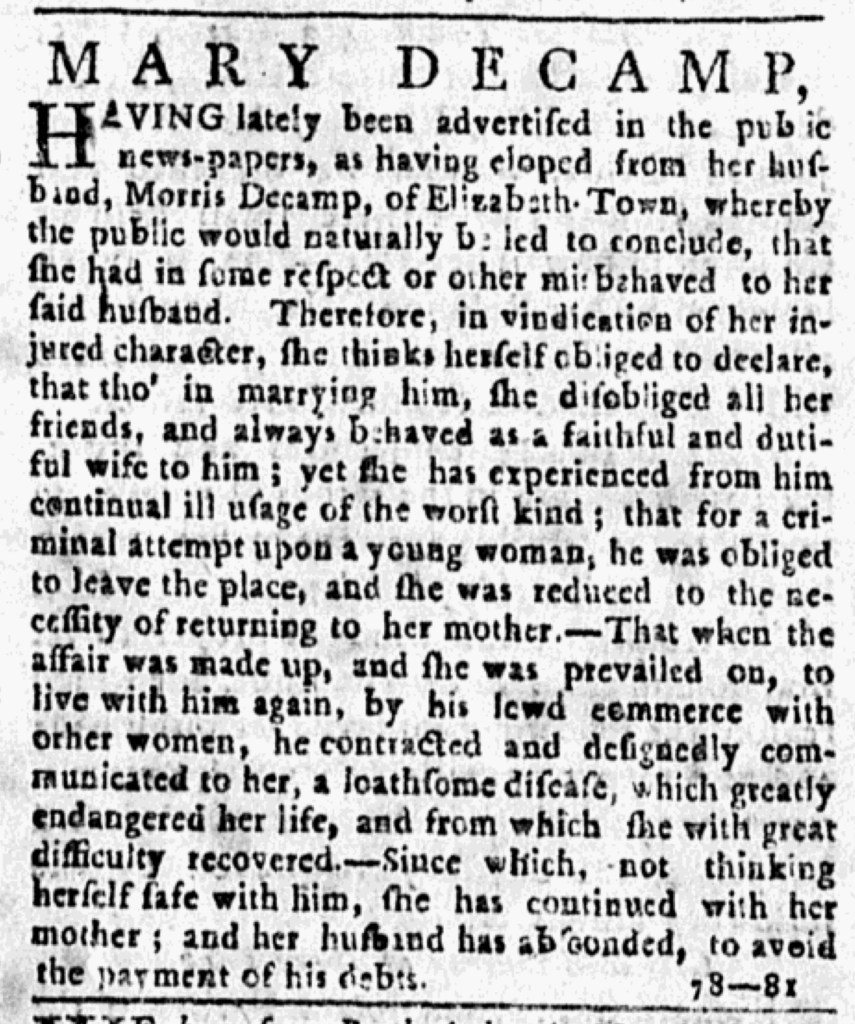
“Her husband has absconded, to avoid the payment of his debts.”

It began as a standard “runaway wife” advertisement in the January 19, 1775, edition of the New-York Journal.  “WHEREAS my Wife Mary has lately eloped from me, and my perhaps endeavour to run me into Debt,” Morris Decamp proclaimed, “these are therefore to warn all Persons not to Trust or entertain her on my Account, as I will pay no Debts she may contract.”  That advertisement ran for four weeks, but not without going unnoticed or unanswered by Mary.

Most women who appeared in the public prints as the subject of such advertisements did not have the means or opportunity to respond.  Mary, however, did, perhaps with assistance from some of her relations.  Her own advertisement began its run in the March 2 edition of the New-York Journal, placing it before the eyes of the same readers who saw her husband’s missive.  She acknowledged that “the public would naturally be led to conclude, that she had in some respect or other misbehaved to her said husband” based on what they knew from his advertisement.  On the contrary, she asserted, she “always behaved as a faithful and dutiful wife to him.”  The misbehavior had been solely on his part.  Mary “experienced from him continual ill usage of the worst kind,” yet his villainy extended beyond their household.  The aggrieved wife alleged that Morris committed “a criminal attempt upon a young woman” that resulted in him having to leave town.  Abandoned by her husband, Mary “was reduced to the necessity of returning to her mother.”  Morris somehow managed to resolve that situation; Mary did not provide details but reported that “when the affair was made up, … she was prevailed on, to live with him again,” much to her regret.  Her husband remained unreformed: “by his lewd commerce with other women, he contracted and designedly communicated to [Mary], a loathsome disease, which greatly endangered her life, and from which she with great difficulty recovered.”

The real story, Mary insisted, reflected poorly on her husband, not on her.  She took to the pages of the New-York Journal“in vindication of her injured character.”  Rather than “eloping” from Morris, she had returned to her mother because she did not consider herself safe with him.  It was actually Morris who “has absconded, to avoid the payment of his debts.”  Even as he tried to cut her off from his credit, her notice likely prompted others to think twice about doing business with him.  Wives rarely placed rebuttals to the advertisements published by their husbands.  In the rare instances that they did, women like Mary Decamp attempted to harness the power of the press to defend their reputations by setting the record straight.

August 10

Who was the subject of an advertisement in a colonial American newspaper 250 years ago today?

Pennsylvania Gazette (August 10, 1774).

“SAMUEL PENNOCK … has thought fit … to publish me in the Pennsylvania Gazette.”

Martha Pennock was not having it.  Her husband, Samuel, a hatter, ran a newspaper advertisement that claimed she was not legally his wife because she had previously been married to John Morton of the Royal American Regiment.  Her first husband was still alive for several years after Samuel married Martha, making her a bigamist and invalidating her marriage to the hatter.  That being the case, Samuel advised the public “not to trust her on my account, for I will not pay any debts of her contracting.”  It was quite a twist on the usual “runaway wife” advertisements that appeared so frequently in colonial newspapers.

In another twist, Martha responded in the public prints.  Most women did not have the resources to counter the claims made by their husbands, especially after being cut off from their credit.  That meant that the public had access to only one account, the one from the husband’s perspective, in newspapers, though conversations and gossip likely circulated alternate versions of what occurred.  Martha not only published her rejoinder but did so very quickly.  Samuel inserted his advertisement in the August 3, 1774, edition of the Pennsylvania Gazette.  Martha’s notice ran in the next issue on August 10.  If she became aware of what Samuel had done quickly enough, she could have responded in Dunlap’s Pennsylvania Packet on August 8, but waiting two more days meant that she presented her side of the story to readers in the same publication that carried her husband’s diatribe against her.

Martha’s narrative was quite different.  She blamed the discord on “the instigation of his malicious friends,” asserting that Samuel and his friends “have used me extremely ill, at sundry times.”  She denied “with a safe conscience” that she had another living husband, stating that she had been married to Samuel for eight years and “always behaved as a prudent wife to him.  If necessary, she could provide “a sufficient testimonial of my lawful marriage to the said Pennock” as well as “an authentic power of attorney, under hand and seal, to collect his debts, and enjoy all that is or may be belonging to him hereafter.”  Martha aimed to invalidate any claims that Samuel made, whether about having a first husband or about her rights as Samuel’s “lawful” wife.  In doing so, she joined the ranks of relatively few women who responded in print to husbands who used advertisements to disavow their wives and blame them for discord within their households.

August 6

What was advertised in a colonial American newspaper 250 years ago today?

Providence Gazette (August 6, 1774).

“The Forgery being so gross, that the Author had not even the Precaution to spell my Name right.”

As readers flipped through the August 6, 1774, edition of the Providence Gazette, they encountered news and editorials on the first three pages, followed by advertisements in the final column on the third page and filling the entire final page.  The news and editorials included an “Address to the Citizens of New-York on the present critical Situation of Affairs … here inserted by Request” signed by “ANGLUS AMERICANUS,” a letter from London’s Morning Post addressed to Lord North, the prime minister, by “A SOLDIER,” and updates from Paris, London, Philadelphia, New York, and Boston.  The short section for news with the header “PROVIDENCE, August 6” relayed six items, including a note that “the Honourable JAMES BOWDOIN, Esq; of Boston, one of the Delegates appointed for the General Congress,” now known as the First Continental Congress, “passed through this Town” two days earlier “on a Journey Southward.”  Most of those items did not relate to local news at all; instead, they drew from reports received in Providence.  For instance, the final item mentioned “a provincial Meeting of Deputies, from the several Counties of Pennsylvania, … held at Philadelphia” with a promise to print the “Resolves and Proceedings” in the next issue.

Providence Gazette (August 6, 1774).

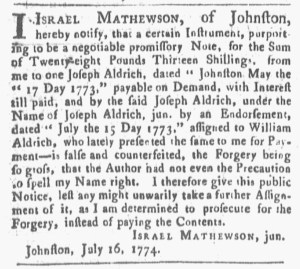
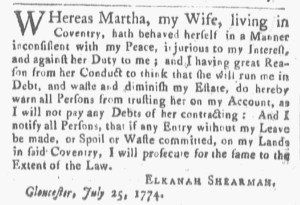
That did not mean that the Providence Gazette did not carry local news.  Indeed, the advertisements, including legal notices, kept readers updated about some of what was occurring in Providence and nearby towns.  In Johnston, Israel Mathewson, Jr., contended with a case of fraud and sought to warn the public against becoming victims of an unscrupulous forger.  He described a “negotiable promissory Note, for the Sum of Twenty-eight Pounds Thirteen Shillings, from me to one Joseph Aldrich.”  That instrument, Mathewson exclaimed, “is false and counterfeited, the Forgery being so gross, that the Author had not even the Precaution to spell my Name right.”  He cautioned others not to “unwarily” accept the note because “I am determined to prosecute for the Forgery, instead of paying the Contents.”  Reading that news among the advertisements in the Providence Gazette had the potential to prevent trouble and inconvenience.  In another notice, Elkanah Shearman of Glocester revealed discord within his household, asserting that his wife, Martha, then “living in Coventry, hath behaved herself in a Manner inconsistent with my Peace, injurious to my Interest, and against her Duty to me.”  He feared that she “will run me in Debt” as well as “diminish my Estate.”  Accordingly, he issued instructions that he would pay “any Debts of her contracting,” expecting merchants, shopkeepers, and other purveyors of goods and services to take note.  Furthermore, he threatened to prosecute for any “Spoil or Waste” on his land or even “Entry without my Leave.”  Martha did not possess any authority to grant access on behalf of her husband.  Her husband expected others to take note of this news.

Several other advertisements delivered local news to readers of the Providence Gazette.  Although John Carter, the printer, limited the amount of local news he selected to publish under the header “PROVIDENCE, August 6,” that did not mean that the newspaper did not contain news from nearby towns.  Advertisers placed notices for a variety of purposes, many of them delivering news in an alternate format.

August 3

Who was the subject of an advertisement in a colonial American newspaper 250 years ago today?

Pennsylvania Gazette (August 3, 1774).

“MARTHA MORTON … is not my lawful wife.”

Notices advising merchants, shopkeepers, and others not to extend credit to wives of aggrieved husbands regularly appeared in colonial newspapers.  Termed “runaway wife advertisements” by historians, such notices often followed a familiar format and deployed standardized language.  For instance, consider James Paulhill’s advertisement in the August 3, 1774, edition of the Pennsylvania Gazette: “WHEREAS my wife MARY hath eloped from me, I therefore warn all persons not to trust her on my account, as I will pay no debts of her contracting from the date hereof.”  Many offered more detail, but each established that a wife absconded from her husband and, in turn, he would no longer cover her expenses.  These advertisements revealed marital discord to the community, as well as husbands’ inability to exert masculine authority over their households.

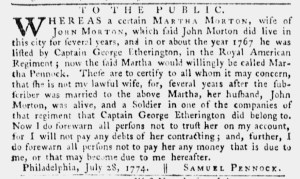
At the same time that Paulhill published his advertisement, Samuel Pennock inserted a much more elaborate notice in which he disavowed his wife, Martha, and accused her of bigamy.  According to Pennock, she was actually Martha Morton, wife of John Morton, who “did live in this city,” Philadelphia, “for several years, and in or about the year 1767 he was listed by Captain George Etherington, in the Royal American Regiment.”  For her part, she “would willingly be called Martha Pennock,” but Samuel adamantly declared that “she is not my wife” because “her husband, John Morton, was alive” for several years after Samuel married her, not realizing that she already had a husband.  Samuel sought to sever his relationship with Martha.  That included making a public announcement that he “will not pay any debts of her contracting” so others should not “trust her on [Samuel’s] account.”  Furthermore, he “forewarn[ed] all persons not to pay her any money that is due to me, or that may become due to me hereafter.”  Samuel aimed to eliminate Martha’s access to any of his financial resources.

As was the case with every runaway wife advertisement, this notice relayed only the perspective of the husband.  Cut off from their sources of support, most wives did not have the means to publish responses to defend themselves and tell their side of the story.  Husbands almost always wielded the power of the press to their advantage.  In this instance, however, Martha inserted a response in the next issue of the Pennsylvania Gazette.  The Adverts 250 Project will feature it next week on the 250th anniversary of its publication.

February 5

Who were the subjects of advertisements in a colonial American newspaper 250 years ago today?

Providence Gazette (February 5, 1774).

“RUN away … an Apprentice Lad, named John Bates.”

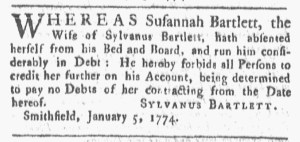
“Susannah Bartlett, the Wife of Sylvanus Bartlett, hath absented herself.”

“RUN away … a Servant Man, named Kimbal Ramsdill, a pretended Carpenter or Joiner.”

Colonizers used various kinds of “runaway” advertisements in their efforts to maintain social order.  Such was the case in the February 5, 1774, edition of the Providence Gazette.  Several colonizers published stories of subordinates who ran away, giving directions about how others should interact with them if they happened to encounter them.

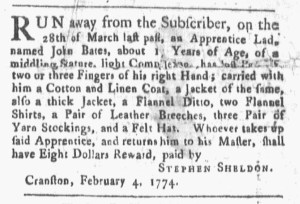
In the first of those advertisements that readers saw if they perused the newspaper from the first page to the last, Stephen Sheldon of Cranston announced, “RUN away … an Apprentice Lad, named John Bates.”  The apprentice had departed on March 28, 1773, nearly a year earlier, but Sheldon hoped that his advertisement would result in recovering him.  He offered “Eight Dollars Reward” to “Whoever takes up said Apprentice, and returns him to his Master.”  He also provided a physical description to aid in identifying the runaway, including an especially distinctive feature.  The young man “has lost two or three Fingers on his right Hand.”

Providence Gazette (February 5, 1774).

The next advertisement revealed marital discord in the Bartlett household in Smithfield.  “Susannah Bartlett, the Wife of Sylvanus Bartlett,” the husband proclaimed, “hath absented herself from his Bed and Board, and run him considerably in Debt.”  Accordingly, he no longer assumed responsibility for her expenses.  Invoking language that appeared in such advertisements throughout the colonies, Sylvanus declared that he “hereby forbids all Persons to credit her further on his Account, being determined to pay no Debts of her contracting.”  As had been the case with Sheldon running an advertisement about Bates, Sylvanus had much greater access to the public prints than Susannah, so readers of the Providence Gazette knew only one side of the story.  The apprentice and the wife may have had good reasons to leave the Sheldon and Bartlett households.

Providence Gazette (February 5, 1774).

In another advertisement, Benjamin Cargill of Pomfret, Connecticut, described Kimbal Ramsdill, a “Servant Man” and a “Pretended Carpenter or Joiner” who had “RUN away” the previous December.  Cargill indicated that Ramsdill often misrepresented himself, not only in terms of his trade but also his origins.  “The above Fellow,” he stated in a nota bene, “pretends at Times he was born at Lynn, and at other Times at Newbury.”  Indeed, he was “much given to Lying, and apt to tell of his having Land in different Parts.”  In this instance, Cargill did not ask readers to accept his word alone that Ramsdill engaged in unsavory behavior.  He reported that the indentured servant “hath lately been convicted of Stealing, and publicly whipped seven Lashes, the Marks of which perhaps may yet be seen.”  Cargill promised “Ten Dollars Reward” to “Whoever will take up said Servant, and secure him in any of his Majesty’s Goals [Jails].”

The advertisements in the Providence Gazette and other colonial newspapers did not merely market goods and services to consumers.  Many of them instead delivered news about local events, including cases of runaway apprentices, wives, and indentured servants.  The colonizers who placed those advertisements did so for their own purposes, but also thought they did the community a service by warning about men and women who did not abide by behavior considered appropriate to their status or, sometimes, had even been convicted of crimes.  While there are many reasons not to lump John Bates, Susannah Bartlett, and Kimbal Ramsfill together, the men who placed advertisements about them belonged to a common category of colonizers who used the power of the press in their efforts to impose order on subordinates who they reported had misbehaved.

September 13

What was advertised in a colonial American newspaper 250 years ago today?

Massachusetts Gazette and Boston Post-Boy (September 13, 1773).

“After reading the above I leave the World to judge of my unhappy State.”

Most newspaper advertisements concerning runaway wives went unanswered, at least in the public prints.  Friends, neighbors, and acquaintances almost certainly discussed the circumstances of the marital discord that prompted wives to depart from the households of their husbands, sharing what they knew or heard from others and checking for new developments when they engaged in the rituals of gossip.  On occasion, however, some of those wives published their own advertisements in response.  Such was the case with Judith Walker.

Her husband, Simeon, inserted an advertisement in the March 29, 1773, edition of the Massachusetts Gazette and Boston Post-Boy.  It ran for three weeks.  Simeon did not provide much detail, instead resorting to formulaic language that readers would have associated with any notice from the genre.  “WHEREAS Judith, my Wife,” Simeon announced, “has Eloped from me, and refuses to Bed and Board with me:— I now forbid all Persons trusting her on my Account, as I will not pay any Debt of her contracting after this Date.”  Curiously, Simeon dated the advertisement January 18, though it did not run until ten weeks later.

Judith’s response was anything but formulaic.  She spilled a lot more ink than her estranged husband, first citing his advertisement and then offering her reasons for “absenting myself from him.”  Judith asserted that Simeon did not provide “the common Necessaries of Life,” but instead perpetrated “abusive Treatment … for a Number of Years.”  She contended that Simeon “oblig[ed] me to take the Care of Cattle thro’ several Winters, and many unreasonable Tasks he used to compel me to, which I, nor scarce any other Woman, could perform.”  Rather than asking readers to take her word for it, Judith presented a note “from [Simeon’s] own Handwriting, and attested by two credible Persons,” Stephen Felton and Ruth Wheeler, in which he acknowledged that his wife “hath been a faithful, just Attorney in my Business … and she has just Occasion to harden her Heart against me.”  Furthermore, this passage concluded with Simeon expressing his desire for “Church and State to have Charity for my Wife, for she has been obedient to me in Sickness and in Health.”  That note bore the date “February 20th, 1773,” after the date on Simeon’s advertisement but before his advertisement appeared in the newspaper.

Their relationship apparently did not improve over the next several months.  Nearly half a year after Simeon first placed his notice in the Massachusetts Gazette and Boston Post-Boy, Judith took to the pages of the same newspaper.  Those relatively few women who did respond to “runaway wife” advertisements usually did so within weeks.  Why did Judith wait months?  Given the sentiments in Simeon’s handwritten note, had the couple perhaps reconciled temporarily and then found themselves at odds once again?  Whatever had occurred, Judith presented her perspective to the public.  “After reading the above,” she declared, “I leave the World to judge of my unhappy State.”  Husbands usually controlled the narrative in the public prints, but in this instance Judith Walker managed to gain access to the power of the press to offer a competing account.

August 17

Who was the subject of an advertisement in a colonial American newspaper 250 years ago today?

Connecticut Courant (August 17, 1773).

“Ruth, the Wife of me the subscriber threatens to run me in debt.”

Colonizers placed newspaper advertisements for a variety of purposes.  In many ways, their paid notices served as an extension of local news coverage, though in such instances the advertisers rather than the printers made editorial decisions about the information disseminated to readers.  Consider the August 17, 1773, edition of the Connecticut Courant.  An advertisement for the “SAY-BROOK BARR LOTTERY,” held for the purpose of “fixing Buoys and other Marks on an near Say-brook Barr at the Mouth of Connecticut River” to “render the Navigation into and out of said River, both safe and easy,” informed the public about where to buy tickets and when the drawing would be held.  Another advertisement described a horse “Stray’d or stolen out of the pasture of Martin Smith” and offered a reward for its return.  In yet another advertisement, Samuel Russel, “Sheriffs Deputy,” warned that Solomon Bill, “who the greater part of his life has been strongly suspected to be concern’d in counterfeiting money,” had escaped before his trial and offered a reward for his capture.

Other advertisements testified to marital discord in local homes, likely overlapping with the gossip that both men and women shared as they went about their daily routines.  Moses Phelps declared that his wife, Ruth, “threatens to run me in debt.”  Accordingly, he ran his advertisement “to forbid all persons trusting her on my account, as I will pay no debt contracted by her.”  Unable to exercise his patriarchal authority at home, Moses resorted to the public prints to try to compel his wife to behave in a manner he considered appropriate.  Cornelias Flowers, Jr., did so as well, stating that throughout his marriage to Mary that she “behaved herself in a very unbecoming manner, and has injured me in the most tender part.”  No doubt some readers gossiped and speculated about the particulars of what happened between Cornelias and Mary.  Utilizing the same formulaic language as Moses Phelps, Cornelias stated that Mary “intends to run me in debt” and instructed “all persons not to trust her on my account, for I will pay no debt she shall contract.”

Such news may not have been as momentous as some of the accounts from London, Paris, New York, Philadelphia, Boston, Charleston, and other places that the printer chose to include elsewhere in that issue of the Connecticut Courant, but, for many colonizers, it likely had just as much impact on their daily lives.  News of a notorious counterfeiter at large in the colony, a lottery to improve navigation of a river important to local commerce, and troubled marriages spread by word of mouth, yet the inclusion of these items among newspaper advertisements helped raise awareness and keep conversations about them flowing.

March 24

Who was the subject of an advertisement in a colonial American newspaper 250 years ago today?

Pennsylvania Journal (March 24, 1773).

“I had not just cause to attack her reputation in the manner I have published.”

It was a rare retraction.  James Harding instructed William Bradford and Thomas Bradford, printers of the Pennsylvania Journal, to discontinue an advertisement in which he advised the community against extending credit to his wife, Margaret.

James did not reveal the circumstances the prompted him to place his first advertisement in the March 3, 1773, edition of the Pennsylvania Journal.  In that notice, he succinctly declared, “LET no Person credit my Wife, MARGARET HARDING, on my account, for I will pay none of her debts, after this date.”  Throughout the colonies, aggrieved husbands regularly placed similar notices concerning recalcitrant wives.  In many instances, they provided much more detail about how the women misbehaved or even “eloped” or abandoned their husbands.  Without access to the family’s financial resources, controlled by each household’s patriarch, most wives could not publish rebuttals.  Those who did offered very different accounts of marital discord and who was really at fault.  For many women, running away was the most effective means of protecting themselves from abusive husbands.

Less than a week after placing the advertisement, James had a change of heart and sent instructions for the printers to remove the notice from subsequent issues.  “HAVING published an advertisement in your last Paper, prohibiting persons from crediting my Wife, MARGARET HARDING, on my account,” James stated, “I do hereby, in justice to my Wife’s character, declare, that I had not just cause to attack her in the manner I have published.”  Having reached that realization, he “therefore do forbid the continuance of said advertisement.”  Once again, James did not go into details, though friends, neighbors, and acquaintance – women and men alike – probably shared what they knew and what they surmised as they gossiped among themselves.

Pennsylvania Journal (March 24, 1773).

James intended for his initial advertisement to run for a month, according to the “1 m,” a notation for the compositor, that followed his signature.  In the end, that notice appeared just one before the Bradfords published his retraction in the March 10, 17, and 24 editions of the Pennsylvania Journal.  Someone in the printing office may have felt some sympathy for Margaret.  The retraction ran immediately below the “PRICES-CURRENT in PHILADELPHIA” on March 10, making it the first advertisement readers encountered as they transitioned from news items to paid notices.  That likelihood increased the chances of readers noticing the retraction, even if they only skimmed the rest of the advertisement.  Margaret did not share her side of the story in the newspaper, but it may have been some consolation that James’s acknowledgement that he erred in “attack[ing] her reputation” appeared repeatedly and the initial notice only once.  That was more satisfaction than most women targeted by similar advertisements received from their husbands in the public prints.