September 13

What was advertised in a colonial American newspaper 250 years ago today?

Massachusetts Gazette and Boston Post-Boy (September 13, 1773).

“After reading the above I leave the World to judge of my unhappy State.”

Most newspaper advertisements concerning runaway wives went unanswered, at least in the public prints.  Friends, neighbors, and acquaintances almost certainly discussed the circumstances of the marital discord that prompted wives to depart from the households of their husbands, sharing what they knew or heard from others and checking for new developments when they engaged in the rituals of gossip.  On occasion, however, some of those wives published their own advertisements in response.  Such was the case with Judith Walker.

Her husband, Simeon, inserted an advertisement in the March 29, 1773, edition of the Massachusetts Gazette and Boston Post-Boy.  It ran for three weeks.  Simeon did not provide much detail, instead resorting to formulaic language that readers would have associated with any notice from the genre.  “WHEREAS Judith, my Wife,” Simeon announced, “has Eloped from me, and refuses to Bed and Board with me:— I now forbid all Persons trusting her on my Account, as I will not pay any Debt of her contracting after this Date.”  Curiously, Simeon dated the advertisement January 18, though it did not run until ten weeks later.

Judith’s response was anything but formulaic.  She spilled a lot more ink than her estranged husband, first citing his advertisement and then offering her reasons for “absenting myself from him.”  Judith asserted that Simeon did not provide “the common Necessaries of Life,” but instead perpetrated “abusive Treatment … for a Number of Years.”  She contended that Simeon “oblig[ed] me to take the Care of Cattle thro’ several Winters, and many unreasonable Tasks he used to compel me to, which I, nor scarce any other Woman, could perform.”  Rather than asking readers to take her word for it, Judith presented a note “from [Simeon’s] own Handwriting, and attested by two credible Persons,” Stephen Felton and Ruth Wheeler, in which he acknowledged that his wife “hath been a faithful, just Attorney in my Business … and she has just Occasion to harden her Heart against me.”  Furthermore, this passage concluded with Simeon expressing his desire for “Church and State to have Charity for my Wife, for she has been obedient to me in Sickness and in Health.”  That note bore the date “February 20th, 1773,” after the date on Simeon’s advertisement but before his advertisement appeared in the newspaper.

Their relationship apparently did not improve over the next several months.  Nearly half a year after Simeon first placed his notice in the Massachusetts Gazette and Boston Post-Boy, Judith took to the pages of the same newspaper.  Those relatively few women who did respond to “runaway wife” advertisements usually did so within weeks.  Why did Judith wait months?  Given the sentiments in Simeon’s handwritten note, had the couple perhaps reconciled temporarily and then found themselves at odds once again?  Whatever had occurred, Judith presented her perspective to the public.  “After reading the above,” she declared, “I leave the World to judge of my unhappy State.”  Husbands usually controlled the narrative in the public prints, but in this instance Judith Walker managed to gain access to the power of the press to offer a competing account.

August 17

Who was the subject of an advertisement in a colonial American newspaper 250 years ago today?

Connecticut Courant (August 17, 1773).

“Ruth, the Wife of me the subscriber threatens to run me in debt.”

Colonizers placed newspaper advertisements for a variety of purposes.  In many ways, their paid notices served as an extension of local news coverage, though in such instances the advertisers rather than the printers made editorial decisions about the information disseminated to readers.  Consider the August 17, 1773, edition of the Connecticut Courant.  An advertisement for the “SAY-BROOK BARR LOTTERY,” held for the purpose of “fixing Buoys and other Marks on an near Say-brook Barr at the Mouth of Connecticut River” to “render the Navigation into and out of said River, both safe and easy,” informed the public about where to buy tickets and when the drawing would be held.  Another advertisement described a horse “Stray’d or stolen out of the pasture of Martin Smith” and offered a reward for its return.  In yet another advertisement, Samuel Russel, “Sheriffs Deputy,” warned that Solomon Bill, “who the greater part of his life has been strongly suspected to be concern’d in counterfeiting money,” had escaped before his trial and offered a reward for his capture.

Other advertisements testified to marital discord in local homes, likely overlapping with the gossip that both men and women shared as they went about their daily routines.  Moses Phelps declared that his wife, Ruth, “threatens to run me in debt.”  Accordingly, he ran his advertisement “to forbid all persons trusting her on my account, as I will pay no debt contracted by her.”  Unable to exercise his patriarchal authority at home, Moses resorted to the public prints to try to compel his wife to behave in a manner he considered appropriate.  Cornelias Flowers, Jr., did so as well, stating that throughout his marriage to Mary that she “behaved herself in a very unbecoming manner, and has injured me in the most tender part.”  No doubt some readers gossiped and speculated about the particulars of what happened between Cornelias and Mary.  Utilizing the same formulaic language as Moses Phelps, Cornelias stated that Mary “intends to run me in debt” and instructed “all persons not to trust her on my account, for I will pay no debt she shall contract.”

Such news may not have been as momentous as some of the accounts from London, Paris, New York, Philadelphia, Boston, Charleston, and other places that the printer chose to include elsewhere in that issue of the Connecticut Courant, but, for many colonizers, it likely had just as much impact on their daily lives.  News of a notorious counterfeiter at large in the colony, a lottery to improve navigation of a river important to local commerce, and troubled marriages spread by word of mouth, yet the inclusion of these items among newspaper advertisements helped raise awareness and keep conversations about them flowing.

March 24

Who was the subject of an advertisement in a colonial American newspaper 250 years ago today?

Pennsylvania Journal (March 24, 1773).

“I had not just cause to attack her reputation in the manner I have published.”

It was a rare retraction.  James Harding instructed William Bradford and Thomas Bradford, printers of the Pennsylvania Journal, to discontinue an advertisement in which he advised the community against extending credit to his wife, Margaret.

James did not reveal the circumstances the prompted him to place his first advertisement in the March 3, 1773, edition of the Pennsylvania Journal.  In that notice, he succinctly declared, “LET no Person credit my Wife, MARGARET HARDING, on my account, for I will pay none of her debts, after this date.”  Throughout the colonies, aggrieved husbands regularly placed similar notices concerning recalcitrant wives.  In many instances, they provided much more detail about how the women misbehaved or even “eloped” or abandoned their husbands.  Without access to the family’s financial resources, controlled by each household’s patriarch, most wives could not publish rebuttals.  Those who did offered very different accounts of marital discord and who was really at fault.  For many women, running away was the most effective means of protecting themselves from abusive husbands.

Less than a week after placing the advertisement, James had a change of heart and sent instructions for the printers to remove the notice from subsequent issues.  “HAVING published an advertisement in your last Paper, prohibiting persons from crediting my Wife, MARGARET HARDING, on my account,” James stated, “I do hereby, in justice to my Wife’s character, declare, that I had not just cause to attack her in the manner I have published.”  Having reached that realization, he “therefore do forbid the continuance of said advertisement.”  Once again, James did not go into details, though friends, neighbors, and acquaintance – women and men alike – probably shared what they knew and what they surmised as they gossiped among themselves.

Pennsylvania Journal (March 24, 1773).

James intended for his initial advertisement to run for a month, according to the “1 m,” a notation for the compositor, that followed his signature.  In the end, that notice appeared just one before the Bradfords published his retraction in the March 10, 17, and 24 editions of the Pennsylvania Journal.  Someone in the printing office may have felt some sympathy for Margaret.  The retraction ran immediately below the “PRICES-CURRENT in PHILADELPHIA” on March 10, making it the first advertisement readers encountered as they transitioned from news items to paid notices.  That likelihood increased the chances of readers noticing the retraction, even if they only skimmed the rest of the advertisement.  Margaret did not share her side of the story in the newspaper, but it may have been some consolation that James’s acknowledgement that he erred in “attack[ing] her reputation” appeared repeatedly and the initial notice only once.  That was more satisfaction than most women targeted by similar advertisements received from their husbands in the public prints.

November 18

Who was the subject of an advertisement in a colonial American newspaper 250 years ago today?

Pennsylvania Gazette (November 18, 1772).

“I AM very sorry for advertising my Wife.”

Marital discord in the Elwell household spilled over into the public prints in the fall of 1772.  In a notice dated October 20, John Elwell of “Salem County, West New-Jersey” revealed some of those difficulties to the readers of the Pennsylvania Gazette.  His advertisement ran a week later in the October 28 edition, stating that “MARCEY ELWELL, my Wife, hath eloped from me, and I am apprehensive that she will run me in Debt.”  Accordingly, he placed the notice “to forewarn all Persons not to trust her on my Account, as I am determined not to pay any Debts of her contracting, after the Date hereof.”  Elwell used formulaic language that appeared in many similar advertisements published throughout the colonies.  As in almost every other instance, the notice told only a portion of the story without any commentary from the wife who reportedly “eloped” from her husband.  Only in rare instances did women publish rebuttals.

Marcey Elwell was not one of those wives who found the resources to run her own advertisement, but a short time later her husband apparently had a change of heart.  In a notice dated November 2, he rescinded his previous statement.  “I AM very sorry for advertising my Wife,” he wrote, “it being done through the Heat of Passion and Inconsideration; which I now retract.”  It took longer for that advertisement to reach the printing office in Philadelphia than the initial one.  The updated notice ran in the November 18 edition, more than two weeks after John wrote it.  By that time, news that the Elwells reconciled may have spread via word of mouth in their local community.  The second newspaper notice served as an update and conclusion for the broader public, alerting shopkeepers, artisans, and others that they could once again do business with Marcey.  Although John did not discuss the particulars in either advertisement, the second notice may have also been part of his penance in convincing his wife to return to him.  The husbands who placed such advertisements sought to shape the narratives about what occurred in their households, though readers knew that the wives had their own perspectives about what happened.  Marcey’s side of the story did not appear in print, but her husband did make a rare public acknowledgment that it was he who had given in to “the Heat of Passion and Inconsideration.”  Few wives received such apologies in the public prints.

September 24

Who were the subjects of advertisements in a colonial American newspaper 250 years ago today?

New-York Journal (September 24, 1772).

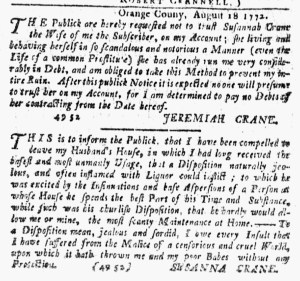
THE Publick are hereby requested not to trust Susannah Crane the Wife of me the Subscriber.”

THIS is to inform the Publick, that I have been compelled to leave my Husband’s House.”

For four weeks in August and September 1772, Jeremiah Crane ran a “runaway wife” advertisement in the New-York Journal to inform the public “not to trust” his wife, Susanna, “on my Account … for I am determined to pay no Debts of her contracting.”  He complained that “she has already run me very considerably in Debt,” forcing him to place the notice “to prevent my entire Ruin.”  Similar advertisements frequently appeared in newspapers throughout the colonies, often deploying formulaic language as they described marital discord in full view of the public.  Jeremiah took a harsher tone in his advertisement, not only accusing Susanna of “living and behaving herself in so scandalous and notorious a Manner” to justify a “publick Notice” but also accusing her of leading “the Life of a common Prostitute.”  Even when they made insinuations about infidelity, husbands who placed “runaway wife” advertisements rarely leveled such accusations so explicitly.  That Jeremiah took that approach testified to the tumult in the Crane household.

In most instance, frustrated husbands set the narrative, at least in the public prints.  Wives could share their version of events via conversations and gossip, but usually lacked the resources to place their own notices in newspapers.  Susanna, however, did run her own notice, declaring that she had been “compelled to leave my Husband’s House, in which I had long received the basest and most unmanly Usage.”  She described a “Disposition naturally jealous, and often inflamed with Liquor,” suggesting that the problems in the Crane household did not originate with her.  Without naming names, Susanna addressed the allegations made by her husband, stating that “he was excited by the Insinuations and base Aspersions of a Person at whose House he spends the best Part of his Time and Substance.”  Jeremiah spent so much time away from his own home that he neglected his wife and her “poor Babes” by not providing “the most scanty Maintenance at Home.”  According to Susanna, the problem was not her comportment, falsely represented by an acquaintance, but rather her husband spending too much time drinking and partaking in tales told by that acquaintance.

In those relatively few instances when wives did place their own advertisements, they almost always appeared in response to notices placed their husbands.  Susanna, however, managed to publish her notice in the same issue in which Jeremiah’s advertisement first appeared.  The compositor chose to place those notices together, perhaps to aid readers with a more complete story or perhaps in sympathy with Susanna.  Either way, readers saw her rebuttal immediately following Jeremiah’s notice.  In most instances when wives responded, their advertisements appeared separately, often on another page completely.  That increased the likelihood that some readers perused only a husband’s side of the story.  The placement of Susanna’s notice aided her in using the power of the press to defend her reputation against Jeremiah’s “churlish Disposition.”

August 8

Who was the subject of an advertisement in a colonial American newspaper 250 years ago today?

Pennsylvania Chronicle (August 8, 1772).

“My wife, HANNAH FREDERICK, did … elope from my bed and board.”

In the eighteenth century, aggrieved husbands often took to the pages of newspapers to warn others not to extend credit to misbehaving wives who “eloped” from them.  Readers regularly encountered “runaway wife” advertisements in newspapers published throughout the colonies.  Those notices continued to appear during the era of the American Revolution and, as Mary Beth Sievens demonstrates, well into the nineteenth century.[1]

Although most notices followed a pattern, each provided details specific to a particular household.  Wives usually “eloped” from their husbands on their own, but in an advertisement in the August 8, 1772, edition of the Pennsylvania Chronicle one husband reported that his wife, Hannah Frederick, “did … elope from my bed and board … with a certain Abraham Hudson.”  The husband believed that the two of them traveled “from Fish-Kills, in Duchess County, in New-York government … to Elizabeth-Town” in New Jersey “and from thence to Philadelphia.”  To aid readers in identifying his wife, the advertiser reported that her “maiden name was Hannah Coleman” and she “served her time,” likely as an indentured servant, “with John Taylor, at Tinicum-Island.”  He concluded with a formulaic statement cutting his wife off from his credit: “these are therefore to forewarn all persons from trusting her on my account, as I shall pay no debts of her contracting after the date hereof.”

Printers published such advertisements without offering commentary of their own, but, in this instance, William Goddard did insert a clarification.  “In the copy of the foregoing Advertisement, which was sent to the Printer,” he explained, “the Advertiser’s name was omitted.”  As a result, the husband’s name appeared as “———- FREDERICK.”  That being the case, how did Goddard handle payment for the advertisement?  Some printers required advertisers to pay in advance, even though they extended credit to subscribers.  After all, advertising comprised a lucrative revenue stream.  Occasional notices in eighteenth-century newspapers, however, make clear that some printers did allow credit for advertisements as well as subscriptions.  This husband may have submitted payment, but not his name, to the printing office … or Goddard may have taken a chance that he would settle up in a timely manner.  Even if that was the case, the printer’s trust only went so far.  The advertisement ran just twice (August 8 and 15), though most newspapers initially published advertisements for three or four weeks for a set fee before charging a lower fee for each insertion.  Goddard may have been carefully managing how much credit he extended to “———- FREDERICK” even as that husband attempted to exert control over his credit when it became clear his wife was beyond his influence.

**********

[1] Mary Beth Sievens, “Female Consumerism and Household Authority in Early National New England,” Early American Studies:  An Interdisciplinary Journal 4, no. 2 (Fall 2006):  353-371.

June 5

What was advertised in a colonial American newspaper 250 years ago today?

Connecticut Journal (June 5, 1772).

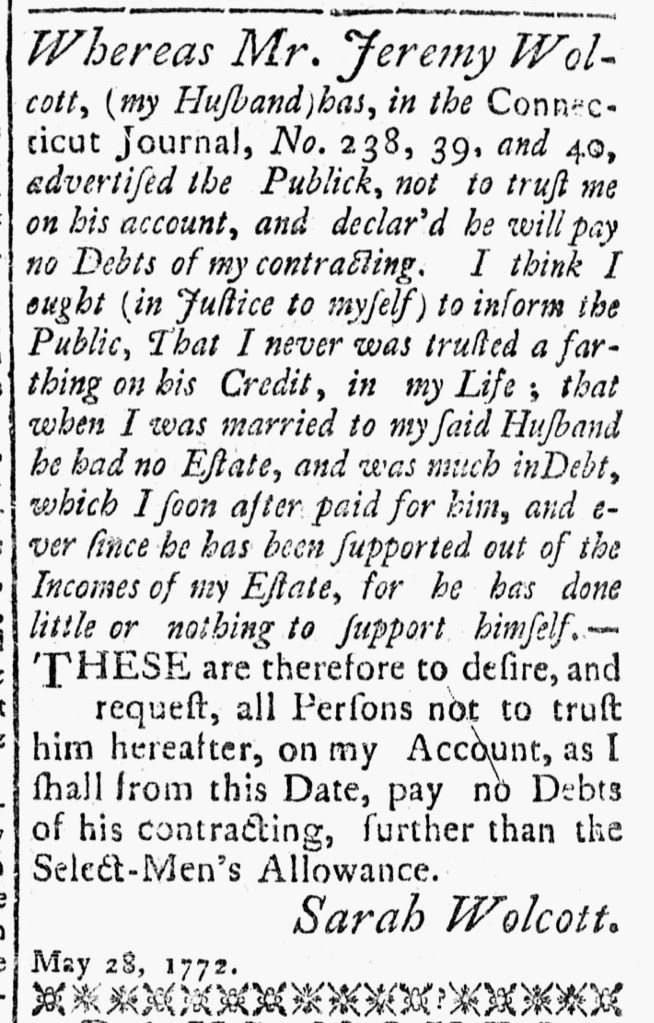
“I shall from this Date, pay no Debts of his contracting.”

Advertisements that ran in the Connecticut Journal and New-Haven Post-Boy in the spring of 1772 testified to marital discord in the Wolcott household.  In the May 8 edition, Jeremy Wolcott inserted a notice informing the public that “My wife SARAH, and MYSELF, being unhappy in the Marriage State !! which had subjected me to great anxiety; and for Reasons, I hereby forbid any Person trusting her on my Account, for I will not pay any Debts by her contracted, after this Date.”  It was one of dozens of similar advertisements placed by anxious patriarchs in newspapers published in New England that year.  Throughout the colonies, aggrieved husbands ran similar notices in their attempts to assert control over wives they claimed did not obey their commands.  Jeremy’s advertisement appeared in the next two issues as well.

When it concluded its run, something unusual happened.  Sarah inserted her own advertisement in response, a rare instance of a wife answering her husband’s charges in print.  Not surprisingly, Sarah told a very different story than the one rehearsed by Jeremy, one that likely humiliated him even more than placing his own advertisement that implicitly confessed his inability to exercise proper authority within his household.  In a notice that first appeared in the May 29 edition, Sarah referred to Jeremy’s notices “in the Connecticut Journal, No. 238, 39, and 40” that advised “the Publick, not to trust me on his account, and declar’d he will pay no Debts of my contracting.”  Given the actual state of affairs, according to Sarah, that advertisement misrepresented Jeremy’s record of providing for his wife.  “I think I ought (in Justice to myself),” she proclaimed, “inform the Public, That I never was trusted a farthing on his Credit, in my Life.” Furthermore, “when I was married to my said Husband, he had no Estate, and was much in Debt, which I soon after paid for him, and ever since he has been supported out of the Incomes of my Estate, for he has done little or nothing to support himself.”  In Sarah’s version, Jeremy had never fulfilled his responsibilities as husband and head of household.

She then turned the tables on him, issuing similar directions “not to trust him hereafter, on my Account, as I shall from this Date, pay no Debts of his contracting, further than the Select-Men’s Allowance.”  Sarah paid taxes legitimately levied by locally elected representatives, but she asserted that she did not want the resources she brought to the marriage used by Jeremy for any other purposes.  That must have resulted in further embarrassment for Jeremy, especially since the vast majority of women targeted in the sort of advertisement that he placed did not have the means to offer any sort of rebuttal in print.  Most of the time, husbands exercised exclusive access to the power of the press.  On occasions, however, women like Sarah Wolcott published forceful responses that may have caused their husbands to wish that they have never gotten the printing office involved at all.

August 27

Who was the subject of an advertisement in a colonial American newspaper 250 years ago today?

Connecticut Courant (August 27, 1771).

“I think it high time to clip the wings of these public spirited gentlemen, that make so great an appearance in our weekly papers.”

A trio of advertisements about “runaway wives” appeared in the August 13, 1771, edition of the Connecticut Courant, each of them describing the misbehavior of a woman who absconded from her husband and warning others not to extend credit because their aggrieved husbands refused to pay any debts they contracted.  Richard Smith placed one of those advertisements, claiming that his wife, Hannah, “makes it her business to pass from house to house with her [busy] news, tattling and bawling and lying.”  In addition, he accused her of “carrying out things out of my house, things contrary to my knowledge.”

Such advertisements told only part of the story.  In most instances, wives did not possess the same access to the press as their husbands, especially once husbands published notices that they refused to make payments on behalf of recalcitrant wives, so runaway wife advertisements largely went unanswered in the public prints.  Occasionally, however, women defended their behavior and their reputations by publishing notices of their own.  When Hannah Smith did so, she told a very different story than the one her husband previously presented in the Connecticut Courant.

Hannah blamed both her husband and his children from a previous marriage for the discord in their household.  She first pointed to the “perfidious instigation” of his children that “represented me in a false and ungenerous light, to be wastful, tattling, and wilfully absenting myself.”  Problems arose, Hannah claimed, because she had a husband “who keeps himself (for the most part) intoxicated ten degrees below the level of a beast.”  She also experienced emotional and physical abuse, reporting that Richard “allows some of his children to treat a step mother with the most abusive, ignominious language, not sparing to kick her.”  None of these details appeared in Richard’s advertisement!

Since Richard made accusations against her in a public forum, Hannah in turn insisted that the situation “absolutely necessitated” that she “ask the public, how a woman ought to behave” in such circumstances.  At the same time, she critiqued advertisements for runaway wives more generally, perhaps reacting to the three that appeared one after the other and concluded with Richard’s advertisement concerning her alleged misconduct.  “As the woman is the weaker vessel,” Hannah asserted, “I think it high time to clip the wings of these public spirited gentlemen, that make so great an appearance in our weekly papers.”  Richard Smith had not told an accurate or complete story in his advertisement; neither had Samuel Pettibone and John Savage in their notices.  In a rare rebuttal that appeared in print, Hannah Smith defended not only herself but also Mary Pettibone, Nancy Savage, and other women targeted by runaway wife advertisements.

August 14

What was advertised in a colonial American newspaper 250 years ago this week?

Connecticut Courant (August 13, 1771).

“I am so unhappy in my last marriage.”

Samuel Pettibone, John Savage, and Richard Smith had something in common.  Each of them experienced marital discord and failed to exercise proper patriarchal authority to maintain order in their households.  The situation for each spiraled so far out of control that all three men resorted to placing advertisements in the Connecticut Courant to instruct others in their communities not to extend credit to their wives.

“I am so unhappy in my last marriage,” lamented Pettibone, “as to inform the public that my wife Mary has privately run me in debt at many places, and has absented herself from my bed and board.”  Furthermore, she “carried off with her all she bro’t with her” to the marriage “and thirty pounds or upwards of my estate.”  Smith told a similar tale about his wife, Hannah, who “makes it her steady business to pass from house to house with her [busy] news, tattling and bawling and lying.”  Just as Mary Pettibone supposedly had done to her husband, Richard accused Hannah of “carrying out things out of my house, things contrary to my knowledge.”  Savage was not nearly as animated in his account, instead resorting to standardized language that appeared in many “runaway wife” advertisements.  “Whereas Nancy the wife of me the subscriber,” he stated, “has eloped from my bed an[d] board and has run me in debt … I utterly refuse paying any debt contracted by her after this date.”  Pettibone and Smith could have also deployed formulaic accounts; that they did not testifies to the exasperation they felt in the face of such recalcitrance and disobedience by their wives.

Pettibone, Savage, and Smith intended for others to view them as aggrieved husbands.  They published unflattering narratives about their wives, using the power of the press to frame events according to their understanding or liking.  Eighteenth-century readers, especially those who knew the families or heard gossip, certainly realized that none of these men provided all of the details of what transpired in their households.  Arranged one after another, these advertisements served as a catalog of misbehaving women, but they also demanded readers ask questions about how the men who placed the notices comported themselves.  In what ways did the husbands contribute to the turmoil in their households?

July 3

What was advertised in a colonial American newspaper 250 years ago this week?

Pennsylvania Chronicle (July 1, 1771).

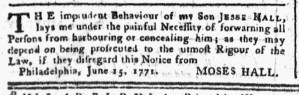
“THE imprudent Behaviour of my Son JESSE HALL, lays me under the painful Necessity of forwarning all Persons from harbouring or concealing him.”

Conradt Wolff lamented that his wife, Jenny, “hath behaved herself in such a manner as lays me under a necessity of forbidding any persons from trusting her on my account.”  In an advertisement in the July 1, 1771, edition of the New-York Gazette and Weekly Mercury, he warned the public that he “will pay no debts of her contracting.”  Throughout the colonies, similar notices frequently ran in eighteenth-century newspapers.  Aggrieved husbands deployed “runaway wife” advertisements to discipline disobedient women, though their notices told only one side of a story of marital discord. Relatively few wives possessed the resources to respond in print.  Those that did usually provided much different narratives, often accusing their husbands of abuse and neglect.  From their perspective, running away was an act of self-preservation and principled resistance rather than willful disobedience.

On occasion, colonists resorted to the public prints in the wake of other sorts of tumult within their households.  On the same day that Wolff placed an advertisement in the New-York Gazette, Moses Hall placed his own notice in the Pennsylvania Chronicle.  Hall, however, deplored the misbehavior of his son, Jesse.  “THE imprudent Behaviour of my Son,” Hall declared, “lays me under the painful Necessity of forwarning all Persons from harbouring or concealing him.” Furthermore, “they may depend on being prosecuted to the utmost Rigour of the Law, if they disregard this Notice.”  Hall did not elaborate on his son’s “imprudent Behaviour,” though gossip and rumors likely circulated beyond the newspaper.  That was almost certainly the case for the Camps and the Brents in Elizabethtown, New Jersey.  John D. Camp, Jr., informed readers of the New-York Gazette that he had been “compel’d by David Brent, to marry Catherine, his daughter.”  Camp vowed to “allow her a separate Maintenance, in all Respects suitable to her Degree,” but he would not pay “any Debts of her Contracting.”  Camp carefully avoided the details about events that resulted in his unwelcome wedding.  If friends and acquaintances had not been discussing whatever transpired between John and Catherine and her father before the advertisement ran in the New-York Gazette, its appearance probably prompted them to share what they knew for certain and speculate on what they did not.

Wolff, Hall, and Camp all attempted to focus attention on the subjects of their advertisements:  an absent wife, a troublesome son, or an imperious father-in-law.  In even publishing their notices, however, they called attention to themselves and their shortcomings in maintaining order within their households.  They sought to regain authority through the power of the press, but in the process they made their private altercations all the more visible to the public.  They framed the narratives and obscured the details, yet they still alerted others to scenes of difficulty and embarrassment that did not reflect well on them despite their efforts to shift responsibility to the actions of others.