September 7

What was advertised in a revolutionary American newspaper 250 years ago today?

Massachusetts Gazette and Boston Weekly News-Letter (September 7, 1775).

“At the Sign of the Unicorn and Mortar … the best and freshest drugs and medicines.”

An unsigned advertisement in the September 7, 1775, edition of the Massachusetts Gazette and Boston Weekly News-Letter promoted “ALL kinds of the best and freshest drugs and medicines” available “At the Sign of the Unicorn and Mortar in Marlborough Street.”  Silvester Gardiner advertised “Drugs and Medicines, both Chymical and Galenical,” and “Doctor’s Boxes” and “Surgeon’s Chests” for ships that he sold “at the Sign of the Unicorn and Mortar inMarlborough-Street” in the Boston Evening-Post as early as June 18, 1744.  He continued running advertisements that featured both his name and his shop sign for seven years, but by the middle of the 1750s advertisements that directed prospective customers to the Unicorn and Mortar no longer included the name of the proprietor.  Perhaps Gardiner believed that his name had become synonymous with the image that branded his shop.  If so, he may have been the apothecary who placed the advertisement in the fall of 1775.  On the other hand, another entrepreneur may have acquired the shop and the sign at some point and determined that it made good business sense to continue selling medicines at a familiar location marked with a familiar image.

The Unicorn and Mortar was a popular device among apothecaries in colonial America.  Just as Boston had a shop “At the Sign of the Unicorn and Mortar,” so did Hartford, New York, Philadelphia, Providence, and Salem.  The partnership of Gardiner and Jepson sold a “complete Assortment” of medicines “at the Sign of the Unicorn and Mortar, in Queen-Street, HARTFORD,” according to advertisements in the May 5, 1759, edition of the Connecticut Gazette, published in New Haven, and the March 21, 1760, edition of the New-London Summary.  Hartford did not have its own newspaper until 1764, so Gardiner and Jepson resorted to newspapers published in other towns to encourage the public to associate the Unicorn and Mortar with their business.  The experienced Silvester Gardiner may have taken William Jepson as a junior partner to run the shop in Hartford.  A few years later, Jepson, “Surgeon and Apothecary, at the Unicorn and Mortar, in Queen Street, Hartford,” ran advertisements on his own, starting with the December 21, 1767, edition of the Connecticut Courant.  Within a decade, Hezekiah Merrill, “APOTHECARY and BOOKSELLER,” advertised his own shop “at the Sign of the Unicorn and Mortar, a few Rods South of the Court-House in Hartford.”  He ran a full-page advertisement in the December 21, 1773, edition of the Connecticut Courant and many less extensive advertisements in other issues.  When Merrill opened his “New STORE” he did not refer to it as the Unicorn and Mortar.  Perhaps he eventually acquired the sign from Jepson, whose advertisements no longer appeared, and hoped to leverage the familiar image at a new location.  Residents of Hartford recognized the Unicorn and Mortar and associated it with medicines no matter who ran the shop, whether Gardiner and Jepson, Jepson alone, or Merrill.

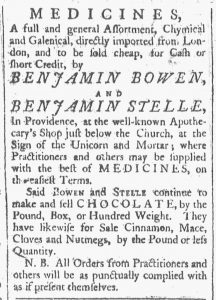
Apothecaries in other towns also marked their locations with the Unicorn and Mortar.  Patrick Carryl announced that he moved “to the Sign of the Unicorn and Mortar” in the May 23, 1748, edition of the New-York Gazette.  He ran advertisements for more than a decade, always associating his name with his shop sign.  John Prince ran an advertisement in the February 6, 1764, edition of the Boston Post-Boy to announce that “he has lately Opened his Shop at the Sign of the Unicorn and Mortar, near the Town-House in Salem.”  John Sparhawk operated his own apothecary shop “At the Unicorn and Mortar, in Market-Street, near the Coffee-House,” in Philadelphia, according to his advertisement in the December 18, 1766, edition of the Pennsylvania Gazette.  By the time he advertised in the Pennsylvania Chronicle on March 4, 1771, he gave the full name as the “London Book-store, and Unicorn and Mortar.”  In that notice and others, he promoted a “NEAT edition of TISSOT’s Advice to the People respecting their Health” in addition to “Drugs and Medicines of all kinds as usual.”  Building his brand, Sparhawk placed many newspaper advertisements that mentioned the Unicorn and Mortar over the course of several years.  Benjamin Bowen and Benjamin Stelle sold “MEDICINES … at the well-known Apothecary’s Shop … at the Sign of the Unicorn and Mortar,” according to their advertisement in the August 25, 1770, edition of the Providence Gazette.  Apothecaries in other towns likely marked their locations with a sign depicting the Unicorn and Mortar.  It became a familiar emblem that consumers easily recognized by the time that the anonymous advertiser ran a notice in the Massachusetts Gazette and Boston Weekly News-Letter in the fall of 1775.
October 5

What was advertised in a colonial American newspaper 250 years ago today?

Connecticut Courant (October 5, 1773).

“At the Sign of the Unicorn & Mortar.”

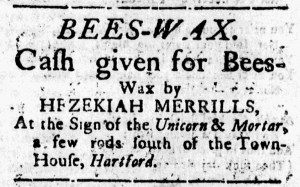
Hezekiah Merrill ran an apothecary shop in Hartford in the early 1770s.  In October 1773, he placed advertisements in the Connecticut Courant to promote the variety of patent medicines that he sold, including Bateman’s Drops and Cordials, Turlington’s Balsam of Life, and Hooper’s Female Pills.  Each of those remedies would have been as familiar to eighteenth-century readers as popular over-the-counter medications are to modern consumers.  Merrill, like others who sold the same patent medicines, did not believe that they required descriptions when advertising them.  The apothecary also stocked books at his shop.

Merrill marked the location of his shop with “the Sign of the Unicorn & Mortar,” an appropriate image for an apothecary, and further advised prospective customers that they could find it “a few rods south of the Town-House.” Residents of Hartford regularly passed the shop and its sign, making it a familiar sight in their daily routines.  For visitors from the countryside, the sign made Merrill’s location unmistakable as they navigated town.  The apothecary encouraged consumers to associate the image of the Unicorn and Mortar with his business, treating it as a logo of sorts.  He inserted two advertisements in the October 5, 1773, edition of the Connecticut Courant, both of them invoking his shop sign.  A longer one on the first page listed the patent medicines and other merchandise, while a shorter one on the third page solicited beeswax in exchange for cash.  Just as residents of Hartford frequently glimpsed the sign, readers of the Connecticut Courant encountered “the Sign of the Unicorn & Mortar” more than once when they perused that issue.

Today, those advertisements testify to some of the sights that colonizers saw as they traversed the streets of colonial Hartford.  According to Thomas Hilldrup’s advertisement in the same issue of the Connecticut Courant, “the sign of the Dial” adorned the shop where he cleaned and repaired watches near the court house.  Other purveyors of goods and services in Hartford almost certainly displayed signs, contributing to the visual landscape of commercial activity in the town.  Few of those signs survive today, except for the descriptions of them in newspaper advertisements.

July 7

What was advertised in a colonial American newspaper 250 years ago this week?

Pennsylvania Journal (July 4, 1771).

“At the London Book-Store and Unicorn and Mortar.”

Like many booksellers, John Sparhawk also sold patent medicines.  He did not, however, do so as a side venture but instead cultivated a specialization in health and medicine when marketing the merchandise available as his “London Book-Store” in Philadelphia in the early 1770s.  To underscore that he carried “Drugs and Medicines of all kinds as usual,” he marked his location with a sign depicting a unicorn and mortar.  In selecting an image associated with apothecaries, the bookseller suggested that he did not merely stock a variety of elixirs but also possessed greater expertise than most shopkeepers, booksellers, and others who listed patent medicines among the many items available at their shops.

Sparhawk further enhanced that reputation by publishing an American edition of “TISSOT’s ADVICE to the People, Respecting their HEALTH” in the spring of 1771.  In describing the contents of the popular volume by Swiss physician Samuel-Auguste Tissot, first published in 1761, portions of the advertisement Sparhawk placed in the Pennsylvania Journal echoed the lengthy subtitle.  “THIS book,” the advertisement explained, “is calculated particularly for those who may not incline, or live too far distant, to apply to a doctor on every occasion.”  It included “a table of the cheapest, yet effectual remedies, and the plainest directions for preparing them readily.”  Originally published in French at Lyon, Tissot’s Avis au Peuple sur sa Santé became one of the bestselling medical texts of the eighteenth century.  By the time Sparhawk produced an American edition just ten years after the first publication of the book, it had already been through four editions in London.  The title page noted, though Sparhawk’s advertisement did not, that the American edition included “all the notes in the former English editions” as well as “some further additional notes and prescriptions.”

Sparhawk also mentioned that he stocked “Burn’s Justice, Blackstone’s Commentaries, and a general assortment of Books, on all subjects,” but he made Tissot’s manual the centerpiece of his advertisement.  Having invested in its publication, he certainly wanted the American edition to do well, but selling as many copies as possible was not his only goal.  After all, he could have published American editions of any number of books, but he chose Advice to the People to buttress his image as a knowledgeable purveyor of both books and medicines.  Publishing the book and associating it with “Unicorn and Mortar” was in itself a marketing strategy.

September 1

What was advertised in a colonial American newspaper 250 years ago today?

Sep 1 - 9:1:1770 Providence Gazette
Providence Gazette (September 1, 1770).

“At the Sign of the Unicorn and Mortar.”

On the first day of September in 1770, Benjamin Bowen and Benjamin Stelle advertised “MEDICINES, A full and general Assortment, Chymical and Galenical,” in the Providence Gazette.  They informed prospective customers that they could purchase these medicines “at the well-known Apothecary’s Shop just below the Church, at the Sign of the Unicorn and Mortar.”  In case that shop was not as familiar to readers as Bowen and Stelle suggested it might be, they named the sign that adorned it.  That landmark identified the exact location to acquire “the best of MEDICINES” and “CHOCOLATE, by the Pound, Box, or Hundred Weight.”

Newspaper advertisements placed by entrepreneurs like Bowen and Stelle testify to the visual landscape that colonists encountered as they traversed the streets of towns and cities in eighteenth-century America.  In addition to the “Sign of the Unicorn and Mortar,” that same issue of the Providence Gazette included directions to John Carter’s printing office at “the Sign of Shakespeares Head.”  Not all advertisers always included their shop signs in their notices.  Joseph Russell and William Russell placed an advertisement for gun powder and shot that did not make reference to the “Sign of the Golden Eagle.”  On other occasions, however, they were just as likely to include the sign without their name, so familiar had it become in Providence.

Very few eighteenth-century shop signs survived into the twenty-first century.  Evidence that the “Unicorn and Mortar,” “Shakespeares Head,” and the “Golden Eagle” once marked places of commercial activity and aided colonists in navigating the streets of Providence and other places comes from newspaper advertisements and other documents from the period.  Any catalog of such signs draws heavily from advertisements since colonists so often referenced them in their notices.  Even those who did not have shop signs of their own listed their locations in relation to nearby signs, suggesting the extent that shop signs helped colonists make sense of their surroundings and navigate the streets of towns and cities.