
What was advertised in a revolutionary American newspaper 250 years ago today?
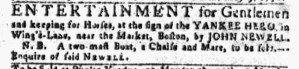
“The Sign of the YANKEE HERO.”
The May 9, 1776, edition of the New-England Chronicle once again carried an advertisement for the “American Coffee-House,” the establishment that Daniel Jones opened on King Street not long after British troops brought the siege to an end by departing from Boston on March 17. Jones invited the “Gentlemen of the UNITED COLONIES” to enjoy the “best of liquors, lodgings, and a variety of provisions” in addition to coffee. Jones made clear that the “American Coffee-House” was a place for patriots to gather.
That was also the case at the tavern that John Newell ran “in Wing’s-Lane, near the Market.” He published a short advertisement that announced, “ENTERTAINMENT for Gentlemen and keeping for Horses, at the sign of the YANKEE HERO.” That name honored the accomplishments and the sacrifices made in Massachusetts over the past year and throughout the imperial crisis. It included the victims of the Boston Massacre on March 5, 1770, and the Sons of Liberty who tossed tea into the harbor on December 16, 1773. The “YANKEE HERO” referred to the men involved in the first battles of the war, the battles at Lexington and Concord on April 19, 1775. Some had been killed, but others forced the British back into Boston where they were besieged for nearly a year. The “YANKEE HERO” referred to the men from Massachusetts and throughout New England who left their towns to participate in the siege. It also referred to the men who fought at the Battle of Bunker Hill on June 17, 1775, especially the men died in that engagement. Those casualties included Joseph Warren, recently commissioned a major general in the colony’s militia, president of the Massachusetts Provincial Congress, and an advocate of American liberties during the imperial crisis that became a war. Yet Newell did not name his tavern after Warren nor after John Adams, Samuel Adams, John Hancock, or any of the other leaders who had been so active at town meetings in Boston or represented Massachusetts in the Second Continental Congress. Instead, he likely intended for prospective patrons to think of the many men who answered the call to defend their colony and their liberties, some making a final sacrifice to do so, and perhaps even to see themselves in the character of the “YANKEE HERO” as they continued in their resistance to British tyranny. Where they chose to gather to drink, socialize, and discuss politics resonated with an identity shifting from British to American on the eve of declaring independence.