
What was advertised in a colonial American newspaper 250 years ago today?
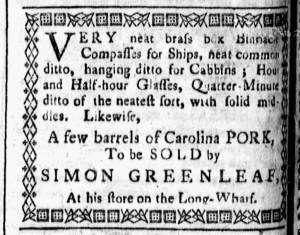
“Hour and Half-hour Glasses … of the neatest sort.”
Simon Greenleaf advertised “VERY neat brass box Binnacle Compasses for Ships” and hourglasses “of the neatest sort” for sale at his store “on the Long-Wharf” in Newburyport in the summer of 1774. He also hawked a “few barrels of Carolina PORK” in his advertisement in the Essex Journal. Readers likely considered the decorative border that enclosed Greenleaf’s notice the most distinctive aspect of his marketing efforts. It certainly distinguished his notice from the other advertisements in the July 6 edition and had done so since its first appearance on June 22.
Greenleaf apparently made a request when he submitted his copy to the printing office or met with the printer, Henry-Walter Tinges, to work out an arrangement for this enhancement to his advertisement. Tinges and Isaiah Thomas commenced publication of the Essex Journal seven months earlier, with Tinges running the printing office in Newburyport while Thomas continued publishing the Massachusetts Spy in Boston. Had Thomas overseen the Essex Journal, Greenleaf might not have managed to have the border included in his advertisement. In the past, Thomas seemingly had not been amenable to such flourishes in the Massachusetts Spy, even when advertisers managed to have borders included with their notices published simultaneously in other newspapers. Ultimately, graphic design depended not only on the imagination of advertisers and compositors but also the preferences of printers who published colonial newspapers.
For the Essex Journal, Greenleaf’s advertisement was a milestone. It was the first that incorporated decorative type. Tinges had experiments with using ornaments to as dividers between news items and in the headline for the “POETS-CORNER” on the final page of the newspaper. Occasionally, he placed the first letter of the first word in an article or letter within a decorative border, but this was the first time that a border enclosed any content, whether news or advertising. In addition, Tinges did not provide any of the common stock images, such as ships or houses, for the use of advertisers. Throughout the publication of the Essex Gazette to that point, the only visual images appeared in the masthead, the coat of arms of the colony on the left of the title and a packet ship on the right. That made Greenleaf’s advertisement even more noteworthy and memorable when readers encountered it since its appearance differed from anything else in that newspaper.