September 23

What was advertised in a colonial American newspaper 250 years ago today?
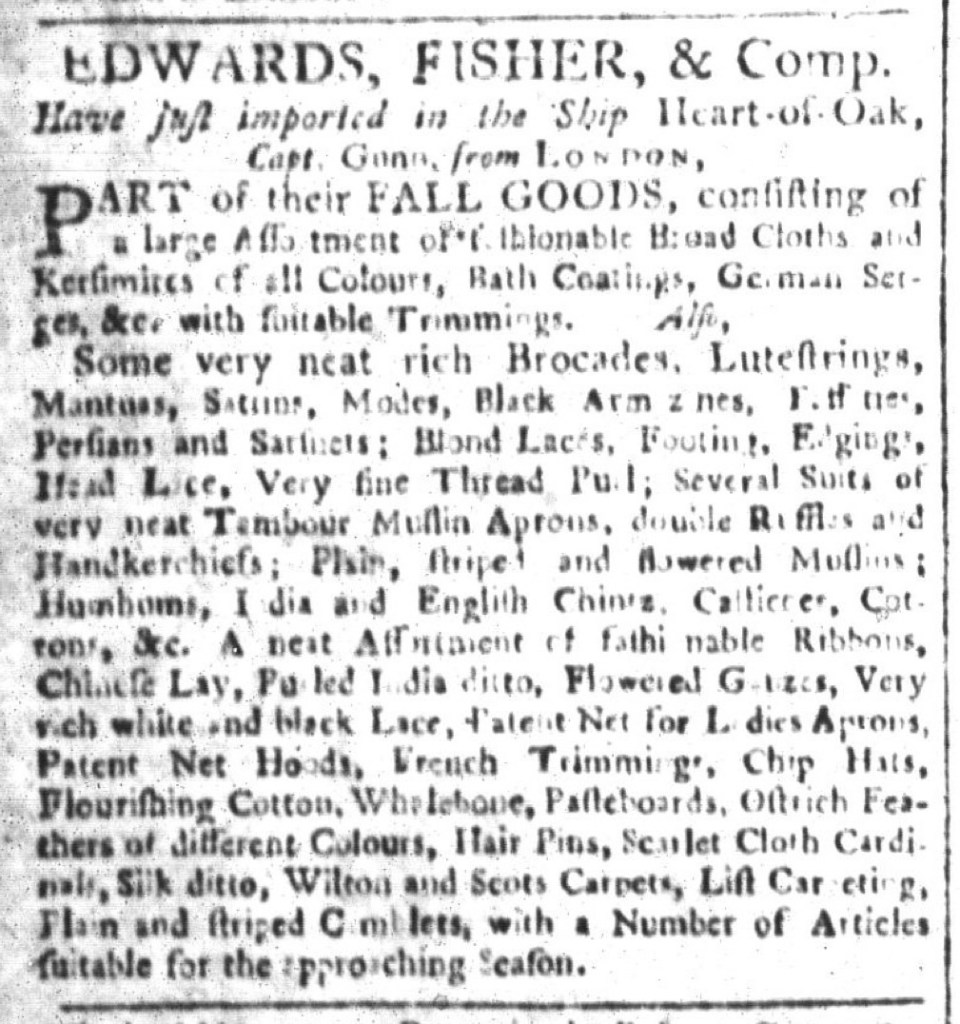
South-Carolina and American General Gazette (September 23, 1774).

“Just imported … from LONDON, PART of their FALL GOODS.”

Like many other merchants and shopkeepers, Edwards, Fisher, and Company in Charleston updated their merchandise with the changing of the seasons.  With the arrival of fall in 1774, they ran advertisements in the South-Carolina and American General Gazette, the South-Carolina Gazette, and the South-Carolina Gazette and Country Journal to announce that they had “just imported” a “large Assortment” of textiles and other items.  This new inventory accounted for “PART of their FALL GOODS,” suggesting that they would continue to supplement their wares as ships arrived from London.

Edwards, Fisher, and Company may have believed that they had a narrow window of opportunity to import and sell these goods.  Earlier in the month, a competitor acknowledged that “a Non-importation Agreement will undoubtedly soon take Place here,” encouraging consumers (“Ladies” in particular) to shop while they had the chance.  The First Continental Congress had recently convened in Philadelphia to discuss coordinated measures in response to the Coercive Acts.  Their deliberations would result in the Continental Association, a nonimportation, nonconsumption, and nonexportation agreement set to go into effect on December 1.  In late September, merchants, shopkeepers, and consumers in Charleston and other American cities and towns did not yet know exactly which measures the First Continental Congress would adopt, but they reasonably anticipated that importing and purchasing goods would be constrained in the coming months.

That gave Edwards, Fisher, and Company an opportunity to sell the “Number of Articles suitable for the approaching Season” that had already arrived as “PART of their FALL GOODS.”  They probably kept their fingers crossed that other shipments would arrive from London before news of a nonimportation agreement arrived from Philadelphia.  They sought to entice prospective customers with an extensive list of their wares, describing them as “fashionable” more than once.  What consumers would consider fashionable, however, evolved when nonimportation agreements went into effect.  Homespun textiles produced in the colonies rather than “very neat rich Brocades” and other imported fabrics became fashionable because of the political principles they communicated.  Edwards, Fisher, and Company would have to content with that another day; for the moment, they could continue following familiar strategies for marketing imported textiles and other goods.
September 2

What was advertised in a colonial American newspaper 250 years ago today?

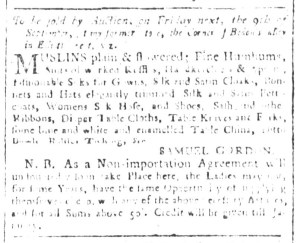
South-Carolina and American General Gazette (September 2, 1774).

“A Non-importation Agreement will undoubtedly soon take Place here.”

A week in advance of an auction to be held on September 9, 1774, Samuel Gordon took to the pages of the South-Carolina and American General Gazette to promote the various items up for bids.  The sale would include “MUSLINS plain & flowered; Fine Humhums, … fashionable Silks for Gowns, Silk and Satin Cloaks, Bonnets and Hats elegantly trimmed, Silk and Satin Petticoats, Womens Silk Hose, and Shoes, [and] Sash and other Ribbons.”  In addition, Gordon listed “Table Cloths, Table Knives and Fork, [and] some blue and white and enamelled Table China.”  He concluded with “&c.” (an abbreviation for et cetera) to indicate that consumers could acquire a variety of other wares at the auction.

Gordon appended a nota bene to his notice: “As a Non-importation Agreement will undoubtedly soon take Place here, the Ladies may not, for some Years, have the same Opportunity of supplying themselves cheap, with any of the above necessary Articles.”  The auctioneer referred to measures under consideration in response to the Boston Port Act, the Massachusetts Government Act, and the other Coercive Acts passed by Parliament in retaliation for the Boston Tea Party.  Throughout the colonies, patriots came to the defense of Massachusetts, rallying to determine common measures to address infringements on their liberty and rights as English subjects.  At the moment that Gordon published his advertisement, delegates were already arriving in Philadelphia for what would become known as the First Continental Congress.  Their deliberations would result indeed result in the Continental Association, a trade boycott intended as political leverage.  Colonizers had previously adopted similar nonimportation agreements in response to the Stamp Act and the duties on certain goods levied in the Townshend Acts.

Gordon encouraged readers to draw on their memories of the conditions during those boycotts or imagine what would likely happen when another nonimportation agreement went into effect.  He stoked fear and anxiety that goods would become scarce and, as a result, much more expensive.  Colonizers needed to acquire textiles and housewares while they were available and while they were affordable.  To facilitate that, he offered credit until January for purchases that exceeded fifty pounds.  That suggests that even though he addressed “Ladies,” the colonizers so often accused of the vice of luxuriating in consumption in newspaper editorials of the era, that he actually anticipated that it would be merchants and retailers, most of them men, who would make bids and purchase this merchandise with the intention of selling it once again.  Still, readers considered Gordon’s warning as they perused the many other advertisements for imported goods in the newspaper.  The auctioneer committed to print what many colonizers were likely thinking about their prospects for purchasing goods in the coming months and years.

August 5

What was advertised in a colonial American newspaper 250 years ago today?

South-Carolina and American General Gazette (August 5, 1774).

“*Extract from Dr. RUSH’s Oration.”

Robert Wells had sufficient content to fill a four-page supplement (though printed on a smaller sheet) as well as the standard four-page issue when he took the August 5, 1774, edition of the South-Carolina and American General Gazetteto press.  With so much space to fill, he devoted the entire final page of the standard issue to a book catalog, listing dozens and dozens of titles in four columns.  His inventory represented an array of subjects, though he did not classify or categorize his offerings under headings like other booksellers sometimes did.  Instead, he left it to readers to discover the variety as they perused the catalog.  Among the many titles, he hawked “THE VISIONS of THOMAS SAY of the City of Philadelphia, which he saw in a Trance.”  Wells was either unaware that Say had disavowed that publication in an advertisement in the Pennsylvania Gazette several months earlier or he disregarded it in favor of generating revenue from selling the curious work.

The printer and bookseller also stocked “AN ORATION delivered … before the American Philosophical Society at Philadelphia, containing an Enquiry into the NATURAL HISTORY of MEDICINE among the INDIANS in NORTH-AMERICA … By BENJAMIN RUSH, M.D. Professor of Chemistry in the College of Philadelphia*.”  The asterisk directed readers to an “*Extract from Dr. RUSH’s Oration” that filled the bottom third of the column.  Despite the title, the excerpt (starting on page 67) warned against “luxury and effeminacy” among colonizers, stating that the damage was not so extensive that it could not be remedied.  He offered a series of recommendations, including improved education for children and temperance for adults, while some of them reflected the imperial crisis.  Politics and medicine intertwined when Rush commented on “the ravages which Tea is making upon the health and populousness of our country.  Had I a double portion of all that eloquence which has been employed in describing the political evils which lately accompanied this East-India herb, it would be too little to set forth the numerous and complicated diseases which it has introduced among us.”  The doctor described tea as a hydra, asserting that colonizers needed the strength of Hercules “to vanquish monsters.”  Parliament, the East India Company, and colonizers’ own desire for tea were presumably among the many heads of that monstrous hydra.  The excerpt concluded with an argument that “America is a theatre where human nature will probably receive her last and principal literary, civil and military honours.”

Wells almost certainly selected passages intended to pique the curiosity of readers and leave them wanting more.  They could examine Rush’s entire argument and learn what his comments about education, temperance, and tea had to do with “MEDICINE among the INDIANS” by purchasing the book.  Just as modern publishers provide excerpts to entice prospective customers, Wells published an “Extract” to help boost sales.

South-Carolina and American General Gazette (August 5, 1774).

July 22

What was advertised in a colonial American newspaper 250 years ago today?

South-Carolina and American General Gazette (July 22, 1774).

“Orders for Books, Stationary Wares, Book-binding & Printing Work.”

Like many other printers, Robert Wells, printer of the South-Carolina and American General Gazette used the colophon of his newspaper as an advertisement for that newspaper and a variety of goods and services available at his printing office.  His colophon, however, appeared in a different place than most others that ran either at the bottom of the final page or, less often, within the masthead at the top of the first page.  Wells placed his colophon at the bottom of the first page, extending across all four columns.  He sometimes devoted each of those columns to news, as was the case for the July 22, 1774, edition, yet other times included paid notices on the first page.  No matter what other content appeared, readers encountered an advertisement on the front page in the form of the colophon.  They did so repeatedly if they perused all four columns before examining the rest of the newspaper.

In that colophon, Wells gave a grand name to the site where he conducted business, calling it the “OLD PRINTING-HOUSE, GREAT STATIONARY and BOOK STORE.”  That name testified to his experience as a printer (“OLD”) and the quality and array of merchandise he stocked (“GREAT”).  He advised that he received “SUBSCRIPTIONS andADVERTISEMENTS for this Paper, which is circulated through all the SOUTHERN COLONIES, &c.”  That included Georgia and North Carolina in addition to South Carolina with “&c.” (et cetera) suggesting Virginia and Maryland as well.  The South-Carolina and American Gazette directly competed with the South-Carolina Gazette, printed by Peter Timothy, and the South-Carolina Gazette and Country Journal, printed by Charles Crouch, both published in Charleston.  In emphasizing the vast reach of his newspaper’s circulation, Wells sought to encourage advertisers who wished to disseminate information as widely as possible, whether they aimed to sell consumer goods, enslaved people, or real estate, or called on colonizers to settle accounts with businesses or the executors of estates or described enslaved people who had liberated themselves by running away from their enslavers.  The printer also accepted “Orders for Books, Stationary Wares, Book-binding & Printing Work,” a variety of goods and services enmeshed within the book trades.  “Printing Work” included broadsides, handbills, trade cards, catalogs, and other advertising ephemera for customers to distribute on their own, contributing to the culture of marketing in the colonies and disseminating information in print via means other than newspapers.  Wells wished to generate greater demand for printed materials, including advertisements, that would benefit both his customers and his business.  In doing so, he devised a colophon that did more than identify the location and printer of the South-Carolina and American General Gazette.

June 17

What was advertised in a colonial American newspaper 250 years ago today?

South-Carolina and American General Gazette (June 17, 1774).

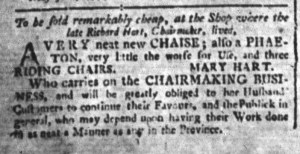
“MARY HART … will be greatly obliged to her Husband’s Customers to continue their Favours.”

When she took to the pages of the South-Carolina and American General Gazette in the summer of 1774, Mary Hart advertised several wheeled vehicles for sale “remarkably cheap, at the Shop where the late Richard Hart, Chairmaker, lived” in Charleston.  Her inventory included a “VERY neat new CHAISE,” described by the Oxford English Dictionaryas a “light open carriage for one or two persons, often having a top,” and a “PHAETON, very little the worse for Use,” described as a “light four-wheeled open carriage, usually drawn by a pair of horse, and having one or two seats facing forward.”  Like the modern automobile industry, Hart marketed both new and used vehicles.  She also had three “RIDING CHAIRS,” which public historians at George Washington’s Mount Vernon describe as a “wooden chair on a cart with two wheels … pulled by single horse.”  They explain that riding chairs “could travel country lanes and back roads more easily than bulkier four-wheeled chariots and coaches.”  Hart offered different kinds of wheeled vehicles to suit the needs, tastes, and budgets of her customers.

The widow did not merely seek to sell carriages previously produced by her late husband.  Instead, she announced that she “carries on the CHAIRMAKING BUSINESS.”  Eighteenth-century readers understood that she referred to making wheeled vehicles, not household furniture.  Her husband had cultivated a clientele for the family business, one that Hart wished to maintain and even expand.  She declared that she “will be greatly obliged to her Husband’s Customers to continue their Favours, and the Publick in general, who may depend upon having their Work done in as neat a Manner as any in the Province.”  Did Hart construct carriages herself?  Perhaps, though if that was the case it demonstrated what was possible rather than what was probable.  In a dissertation on “Women Shopkeepers, Tavernkeepers, and Artisans in Colonial Philadelphia,” Frances May Manges demonstrated that female entrepreneurs worked in a variety of trades.[1]  Hart may have worked alongside her husband before his death and then continued.  Rather than building carriages, she may have supervised employees in the workshop, running other aspects of the business both before and after her husband’s passing.  Either way, she confidently asserted that a workshop headed by a woman produced carriages equal in quality to any others made in the colony.  Out of necessity, Hart joined the ranks of widows who continued operating family businesses in colonial America.

**********

[1] Frances May Manges, “Women Shopkeepers, Tavernkeepers, and Artisans in Colonia Philadelphia” (Ph.D. diss., University of Pennsylvania, 1958).

May 27

What was advertised in a colonial American newspaper 250 years ago today?

South-Carolina and American General Gazette (May 27, 1774).

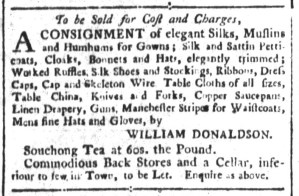
“Souchong Tea at 60s. the Pound.”

As summer approached in 1774, William Donaldson advertised a variety of goods in the South-Carolina and American General Gazette.  On May 27, he promoted “elegant Silks, Muslins and Humhums for Gowns; Silk and Sattin Petticoats, Cloaks, Bonnets and Hats, elegantly trimmed; [and] Table China,” among other merchandise.  He had a separate entry for “Souchong Tea at 60s. the Pound.”  As in other towns, decisions about buying, selling, and consuming tea were part of an unfolding showdown between the colonies and Parliament.

Residents of Charleston were well aware of the Boston Tea Party that occurred the previous December.  They also anticipated some sort of response from Parliament, but at the time that Donaldson ran his advertisement, word of the Boston Part Act had not yet arrived in South Carolina.  Indeed, four days after Donaldson’s advertisement appeared in the South-Carolina and American General Gazette, another newspaper, the South-Carolina Gazette and Country Journalcarried updates from London, dated March 15, that included an overview of the proposed act to close Boston Harbor until the town paid for the tea that had been destroyed and “made proper concession for their tumultuous behaviour.”  In addition, the report stated that a “light vessel is said to have been kept ready by some friends to the Bostonians in England, in order to carry accounts of the first determination of a Great Assembly.”  By the end of May, colonizers in New England and New York knew that the Boston Port Act had passed and would go into effect on June 1.  The news was still making its way to South Carolina.

When it arrived, Peter Timothy, the printer of the South-Carolina Gazette, considered it momentous enough to merit an extraordinary, a supplemental issue.  Timothy usually published his newspaper on Mondays, but felt that this news could not wait three more days.  He rushed the South-Carolina Gazette Extraordinary to press on Friday, June 3.  The masthead included thick black borders, traditionally a sign of mourning the death of an influential member of the community but increasingly deployed by American printers to lament the death of liberty.  Confirmation of the Boston Port Act inspired new debates about consuming tea and purchasing other imported goods, eventually leading to a boycott known as the Continental Association, but colonizers did not immediately forego buying, selling, drinking, or advertising tea following the Boston Tea Party.  That happened over time (and loyalists like Peter Oliver claimed that even those who claimed to support the boycott devised ways to cheat).  In the interim, Donaldson continued marketing tea along with other merchandise.

May 13

What might have been advertised in a colonial American newspaper 250 years ago today?

Handbill (recto) perhaps distributed with the South-Carolina and American General Gazette (May 13, 1774).

“WELLS’S REGISTER: TOGETHER WITH AN ALMANACK … For the Year of our LORD, 1774.”

Most colonial newspapers consisted of four pages created by printing two pages on each side of a broadsheet and folding it in half.  On occasion, printers issued supplements, postscripts, or extraordinaries, sometimes just two pages on a half sheet and other times another four pages.  Robert Wells, the printer of the South-Carolina and American General Gazette, took a different approach when he distributed additional content.  He printed additional pages without a masthead that designated them as part of a supplement.  Instead, they featured continuous numbering with the other pages in the issue, which continued the numbering from the previous edition, and no indication that they were not part of the standard issue for that week.  The May 13, 1774, edition of the South-Carolina and American General Gazetteincluded two extra pages, numbered 129 and 130.  When delivering the newspaper to subscribers, that additional half sheet would have been tucked inside the broadsheet portion, between pages 126 and 127.  Eighteenth-century readers understood the system for navigating such issues.

A broadsheet or handbill, likely printed on a smaller sheet, may have also accompanied that edition of the newspaper.  Accessible Archives, the database that provides the most complete coverage of newspapers from colonial South Carolina, includes an advertisement for “WELLS’S REGISTER: TOGETHER WITH AN ALMANACK … For the Year of our LORD, 1774.”  What seems certain is that the archive with the run of the South-Carolina and American General Gazette originally photographed for greater accessibility and eventually digitized by Accessible Archives has that handbill in its collection.  If the newspaper had been bound into a volume with other newspapers, by Wells or a subscriber or a collector, then the handbill was bound between the May 13 and May 20 issues.  Sometimes the binding is so tight that it distorts the image of the newspaper, especially the column nearest the binding.  While the images of the South-Carolina and American General Gazette in Accessible Archives suggest that the individual issues were part of a bound volume, they have been cropped in such a way as to hide the binding.  If the pages are indeed in a bound volume, the binding is not so tight that it resulted in distorted images when photographing the newspaper.  If the pages are not in a bound volume, then the handbill may have been tucked into the four-page broadsheet portion of the newspaper along with the additional half sheet of news.

Handbill (verso) perhaps distributed with the South-Carolina and American General Gazette (May 13, 1774).

That these items ended up together in an archive, however, does not necessarily mean that they were distributed together in 1774.  The middle of May seems rather late for Wells to distribute a handbill promoting an almanac and register for that year.  More than a third of the material in the almanac would not have much utility for readers, the months of January, February, March, and April having passed.  The register, on the other hand, with its lists of officials in Great Britain, Ireland, North America, Virginia, North Carolina, South Carolina, and Georgia and other information about local governance in the southern colonies, retained its full value.  Printers sometimes continued advertising almanacs well into the year, hoping to find buyers for surplus copies.  If Wells did happen to distribute this handbill in May 1774, then the handbill itself, proclaiming that “THIS DAY IS PUBLISHED … WELLS’S REGISTER,” was likely left over from previous marketing efforts.  The printer may have been trying to get both the handbill and remaining copies of the Register out of his shop.

The inclusion of this handbill as part of the May 13, 1774, edition of the South-Carolina and American General Gazetteraises questions about its production, distribution, and preservation.  While those questions do not have ready answers, that the handbill is part of the newspaper collection, regardless of how it ended up there, testifies to Wells’s use of media beyond newspaper notices to promote the Register.  Handbills and other advertising media, like broadsides and trade cards, were much more ephemeral than newspapers and, in turn, less likely to become part of collections that historians can examine.  They sometimes survived in quirky ways, such as a handbill tucked inside a newspaper.  Those instances suggest a much more vibrant culture of advertising than the scattered examples in research libraries, historical societies, and private collections.

May 6

What was advertised in a colonial American newspaper 250 years ago today?

Top to bottom: South-Carolina and American General Gazette (May 6, 1774); South-Carolina Gazette and Country Journal (May 10, 1774); Supplement to the South-Carolina Gazette (May 16, 1774).

“Whom he has had under his [illegible] these ten Years past.”

It had been a while since Mr. Pike, the dancing master, ran advertisements in any of the newspapers printed in Charleston in the 1770s.  In September 1773, he announced that he opened his “Dancing and Fencing SCHOOLS … for the Season.”  A little more than six months later, he once again took to the public prints with a final notice that he would leave “the Province some Time next Month” due to ill health.  It appeared in the May 6 edition of the South-Carolina and American General Gazette and the May 10 edition of the South-Carolina Gazette and Country Journal.  He likely placed it in the South-Carolina Gazette simultaneously, but some issues have not survived.  It ran in the Supplement to the South-Carolina Gazette on May 16, probably moved to that portion of the newspaper after appearing in the standard issue in previous weeks.  By placing his notice in all three newspapers published in the colony, Pike disseminated his farewell message widely, making his intended departure as visible as possible.

The reiteration of his advertisements across multiple newspapers eventually made it more accessible to historians and other modern readers, especially those who rely on digital surrogates.  However, Pike’s advertisement is fully legible in only one of the digital images of the issues listed above.  It is possible to make out most of the content of the advertisement from the South-Carolina and American General Gazette, but not all of it.  While it might be tempting to blame poor printing, that does not seem to be solely responsible for the quality of the image.  Robert Wells, the printer, would not have been able to keep his newspaper in business for years if the contents were not legible, especially when competing with two other newspapers.  Digital images of some, but not all, pages of the May 6 edition of the South-Carolina and American General Gazette are more legible.  Others are much less legible.  The primary problem seems to lie with the photography rather than the printing.  Technological errors that occurred during the digitization of the South-Carolina Gazette certainly made a portion of Pike’s advertisement in the May 16 supplement illegible.  A glitch of some sort cut off the bottom third of the first page of the supplement, presenting solid grey rather than an image of the advertisements on that portion of the page.  The first several lines of Pike’s advertisement are visible, but not the rest.  In contrast, the entire advertisement is legible in the digital image of the South-Carolina Gazette and Country Journal for May 10, though some combination of printing, wear over time, and modern photography has made some words more difficult to decipher than others.

These examples demonstrate that digitization is not a panacea for providing access to primary sources.  Digital images do not always offer the same access as examining the original documents.  The lower third of the page is not actually missing from the South-Carolina Gazette.  The South-Carolina and American General Gazette may be much more legible when viewed in person.  Unfortunately, the quality of the digital images undermines their accessibility.

October 5

What was advertised in a colonial American newspaper 250 years ago today?

South-Carolina and American General Gazette (October 5, 1772).

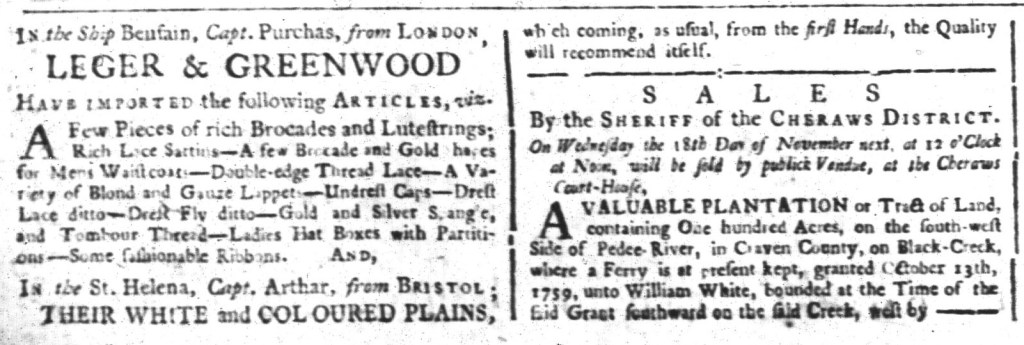
“THEIR WHITE and COLOURED PLAINS, which coming, as usual, from the first Hands, the quality will recommend itself.”

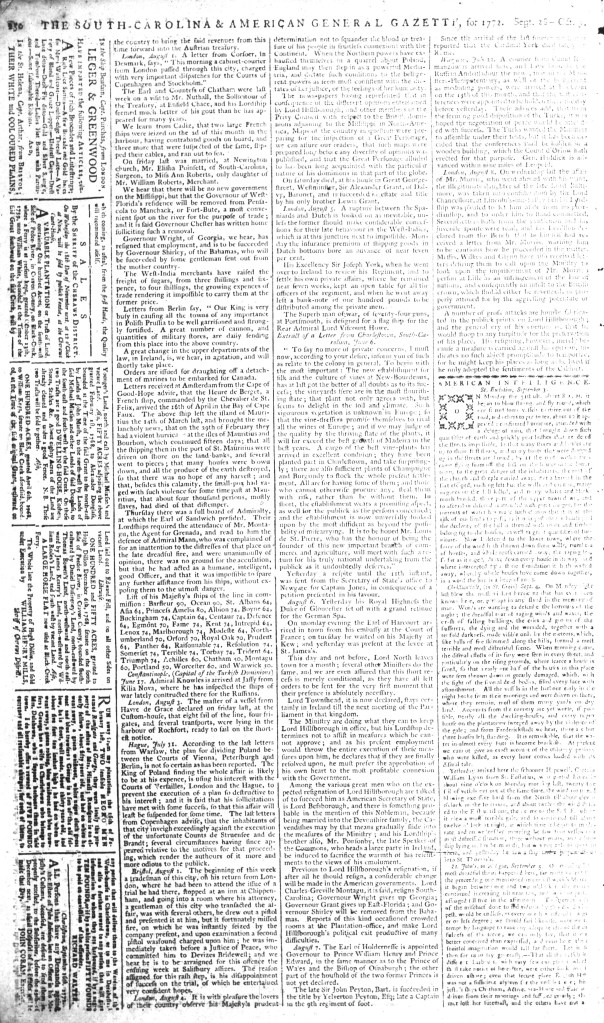
Robert Wells, the printer of the South-Carolina and American General Gazette, may have experienced a disruption in his paper supply in October 1772.  That would explain the unusual format of the October 5 edition.  The newspaper usually featured four columns per page.  The October 5 edition did indeed have four columns on each page, but one of those columns was narrower than the other three.  In order to reuse advertisements with type already set, Wells rotated the text ninety degrees to fill the fourth column with six short columns that ran perpendicular to the rest of the text.  In the past, he had sometimes adopted this strategy when forced to use paper of a different size than usual.  Wells usually selected short advertisements and left them intact.  In contrast, this time he used advertisements that overflowed from one column to another in the October 5 edition.

Whether Wells was forced to do so remains a mystery, due in part to working with digitized images of the newspaper rather than original documents.  Digitized images do not have any particular dimensions.  They fit the size of the screen of the viewer.  They can be magnified to see details betters.  They do not have a fixed size the reader can measure.  As a result, I cannot measure pages of the September 28 and October 5 editions to compare them.  An inspection of one visual aspect further suggests that Wells used a slightly smaller sheet on October 5.  There does not appear to be as much space between the title of the newspaper and the page number running across the top on pages from October 5 compared to pages from September 28.

Those page numbers introduce another uncertainty into figuring out why Wells might have decided to distribute an edition with an unusual format.  The September 28 edition concluded with page 244.  The available pages for the October 5 edition commence with page 249.  It does not have the standard masthead.  This was not a numbering error. Page 249 includes “EUROPEAN INTELLIGENCE. (Continued from Page 246.)”  The four pages with a narrow column of perpendicular text were likely an insert that accompanied the standard issue for the week.  Did Wells use the usual size sheet for the standard issue and then a slightly smaller size for the insert?  Printers sometimes did so with significantly smaller sheets when they did not have sufficient content to fill pages of the usual size, but these pages were not significantly smaller.  Rotating the type and breaking advertisements that previously appeared in a single column into shorter segments that ran in multiple columns seems like unnecessary labor when Wells could have instead inserted more “EUROPEAN INTELLEIGENCE” or “AMERICAN INTELLIGENCE” or even inserted an advertisement from a previous edition gratis to fill the space.

The combination of the missing pages and working with digital surrogates make it difficult to know for certain why Wells adopted an unusual format for the October 5 edition of the South-Carolina and American General Gazette.  Did that format work to the advantage of advertisers?  Did it draw attention to the items in the column set perpendicular to the rest of the page?  Readers may indeed have been curious to discover what kind of content ran along the edges.

Page 250: South-Carolina and American General Gazette (October 5, 1772).

February 12

What was advertised in a colonial American newspaper 250 years ago today?

South-Carolina and American General Gazette (February 12, 1772).

“A SECOND-HAND SPINNET cheap, and of very fine tone.”

James Juhan offered a variety of services to colonizers in Charleston who were interested in learning to play musical instruments.  In an advertisement in the February 12, 1772, edition of the South-Carolina and American General Gazette, he informed prospective pupils that he gave lessons on the “Violin, German Flute and Guittar.”  In addition, he also sold instruments and supplies, including violins, bows, and strings.

His inventory included a “SECOND-HAND SPINNET,” a small harpsichord.  Juhan informed prospective buyers that the spinet possessed “very fine tone,” attempting to reassure them that even though it previously had been played in another home it was not defective.  In addition, Juhan described the price as “cheap,” a word that meant inexpensive in the eighteenth century but did not yet have negative associations with poor quality.  A family could acquire, play, and display the spinet in their home for a bargain price, a good investment for anyone looking for accessories to testify to their good taste, gentility, and status.  For those not yet committed to owning a spinet, even a secondhand one, Juhan also advertised “Spinnets in good order to let.”  Rather than make a major purchase, colonizers could participate in the rental market.

Whether they bought or rented their musical instruments, residents of Charleston could turn to Juhan for assistance in maintaining them.  He tuned “HARPSICHORDS, SPINNETS, FORTE-PIANOS, GUITTARS,” and other stringed instruments “with care and diligence.”  He also repaired “all kinds of Musical instruments … in the neatest manner,” setting his rates “on as reasonable terms as they can be done in this place.”  Colonizers who needed musical instruments tuned or repaired would not find better bargains than those offered by Juhan.

One of the largest urban ports in the colonies, Charleston was as cosmopolitan as New York and Philadelphia.  Merchants like Mansell and Corbett hawked a “Very neat Assortment of the most fashionable” foods imported from England, while goldsmith Philip Tidyman promoted a “Most ELEGANT ASSORTMENT” of jewelry.  In addition to acquiring and displaying garments, adornments, and housewares, colonizers had opportunities to signal their gentility and status through learning to play musical instruments and performing when guests visited their homes.  In particular, this allowed families to demonstrate that wives and daughters possessed both grace and the leisure time necessary to learn to play musical instruments.