December 19

What was advertised in a revolutionary American newspaper 250 years ago today?
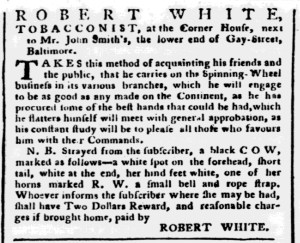
Dunlap’s Maryland Gazette (December 19, 1775).

“He carries on the Spinning-Wheel business in its various branches.”

In the final weeks of 1775, Robert White, a tobacconist in Baltimore, diversified his business.  He inserted an advertisement in the December 19 edition of Dunlap’s Maryland Gazette that announced that “he carries on the Spinning-Wheel business in its various branches.”  Why would a tobacconist decide to go into that line of business?  The Continental Association, a nonimportation and nonconsumption agreement devised by the Furst Continental Congress, remained in effect.  It called on colonizers to replace imported goods, including textiles, with alternatives produced in the colonies.  That meant more time spent spinning, a domestic chore that gained political significance.  Women styled Daughters of Liberty in newspaper accounts participated in public spinning bees to demonstrate their patriotism and inspire others to follow their example in their own homes.  To do so, they needed the right equipment.  White saw an expanding market for spinning wheels.

He was not alone in marketing equipment for producing homespun cloth.  His advertisement happened to appear immediately above Fergus McIllroy’s notice promoting “LOOMS made properly, for carrying on the Linen and Woolen Weaving-business.”  McIllroy, a “House Joiner,” also pursued a new line of work, though in his case doing so did not depart nearly as much from his primary occupation.  In addition, he reported that he had previously constructed more than two hundred looms in Ireland before migrating to the colonies.  White, the tobacconist, did not invoke such experience when it came to spinning wheels, yet he confidently proclaimed that he “will engage” his spinning wheels “to be as good as any made on the Continent” because “he has procured some of the best hands that could be had.”  In turn, White “flatters himself” that his workers and the spinning wheels they produced “will meet with general approbation” or approval from customers.  The tobacconist apparently served as a supervisor, an entrepreneur who established a business when he identified need for it during difficult time yet did not participate in making the spinning wheels.  Instead, in overseeing his new business, he pledged that “his constant study will be to please all those who favours him with their Commands.”  With no resolution in sight for the imperial crisis that became a war the previous April, White’s advertisement likely resonated with readers who understand the political implications of a tobacconist deciding to produce spinning wheels.
November 16

What was advertised in a revolutionary American newspaper 250 years ago today?

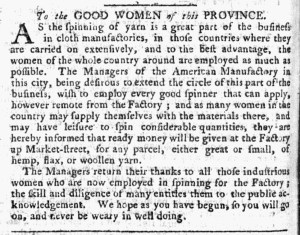
Pennsylvania Evening Post (November 16, 1775).

“The Managers of the American Manufactory … wish to employ every good spinner that can apply.”

The proprietors of the American Manufactory in Philadelphia periodically took to the public prints to encourage the public to support their enterprise.  In the March 1775, they called a general meeting at Carpenters’ Hall, the site where the First Continental Congress held its meetings the previous fall.  They invited prospective investors to attend as well as sign subscription papers already circulating.  A month later, the proprietors ran a brief advertisement, that one seeking both materials (“A Quantity of WOOL, COTTON, FLAX, and HEMP”) and workers “(a number of spinners and flax dressers”).  That notice happened to appear in the Pennsylvania Journal on April 19, 1775, the day of the battles at Lexington and Concord, though it would take a while for residents of Philadelphia to learn about the outbreak of hostilities near Boston.  The mission of the American Manufactory to produce an alternative to imported textiles became even more urgent.  In August, the proprietors once again sought workers, publishing an address “To the SPINNERS in thisCITY and the SUBURBS.”  They offered women an opportunity to participate in politics and “help to save the state from ruin.”

In November 1775, the proprietors or “Managers of the American Manufactory” made another appeal “To the GOOD WOMEN of this PROVINCE.”  They explained that “the spinning of year is a great part of the business in cloth manufactories” and “in those countries where they are carried on extensively, and to the best advantage, the women of the whole country are employed as much as possible.”  Having already engaged women “in this CITY and the SUBURBS” who responded to their previous advertisement and apparently needing even more yarn to make into textiles, the managers found themselves “desirous to extend the circle … to employ every good spinner than can apply, however remote from the Factory.”  They believed that women in the countryside “may supply themselves with the materials there” and had “leisure to spin considerable quantities.”  They may have been right on the first count, but perhaps overestimated how many other responsibilities wives, mothers, sisters, and daughters had in their households.  For those who made the time, the managers offered “ready money … for any parcel, either great or small, of hemp, flax, or woollen yarn.”

The managers also lauded the contributions of “those industrious women who are now employed in spinning for the Factory,” declaring that “the skill and diligence of many entitles them to the public acknowledgement.”  They served the American cause in their own way according to their own abilities, just as the delegates to the Second Continental Congress did and just as the soldiers and officers participating in the siege of Boston did.  “We hope as you have begun,” the managers encouraged, “so you will go on, and never be weary in well doing.”

August 7

What was advertised in a revolutionary American newspaper 250 years ago today?

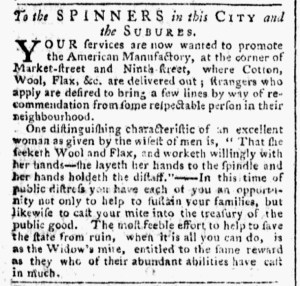
Dunlap’s Pennsylvania Packet (August 7, 1775).

To the SPINNERS in this CITY and the SUBURBS, YOUR services are now wanted to promote the American Manufactory.”

The proprietors of the American Manufactory in Philadelphia published a recruiting notice that first appeared in Dunlap’s Pennsylvania Packet on August 7, 1775, and then in other newspapers printed in the city for several weeks.  They had previously advertised an organizing meeting to gain subscribers (or investors) in the enterprise in March.  A month later, the same day as the battles at Lexington and Concord, they ran a notice seeking a “Quantity of WOOL, COTTON, FLAX, and HEMP.”  That advertisement also advised that “a number of spinners and flax dressers may meet with employment.”  Their latest advertisement devoted significantly more effort to recruiting the “SPINNERS in this CITY and theSUBURBS” to work at the American Manufactory.

“YOUR services are now wanted to promote” the enterprise, the proprietors proclaimed, though they did not plan to hire everyone who presented themselves.  Instead, they followed the eighteenth-century version of letters of recommendation and checking references, instructing that “strangers who apply are desired to bring a few lines by way of recommendation from some respectable person in their neighborbood.”  Working at the American Manufactory offered women “an opportunity not only to help to sustain your families, but likewise to cast your mite into the treasure of the public good” during a “time of public distress.”  They expected that readers would recognize the reference to a story that Jesus told in Mark 12:41-44 and Luke 21:1-4 about a poor widow who donated two coins, called mites, to the temple.  Her small donation, being all she had, far overshadowed much larger donations by the wealthy who could have given much more.  “The most feeble effort to help to save the state from ruin, when it is all you can do,” the proprietors of the American Manufactory explained, “is as the Widow’s mite, entitled to the same reward as they who of their abundant abilities have cast in much.”  Working as a spinner at the American Manufactory, therefore, amounted to service to the American cause by “excellent wom[e]n,” service just as important as that undertaken by the men who participated in local meetings, provincial congresses, and the Second Continental Congress or mustered to defend their liberties.  Women’s work had political meaning during the era of the American Revolution.