December 6

What was advertised in a revolutionary American newspaper 250 years ago today?

Pennsylvania Journal (December 6, 1775).

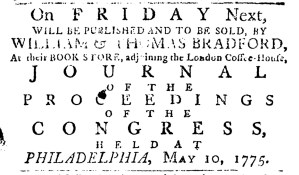
“JOURNAL OF THE PROCEEDINGS OF THE CONGRESS, HELD AT PHILADELPHIA, MAY 10, 1775.”

On Wednesday, December 6, 1775, William Bradford and Thomas Bradford, printers of the Pennsylvania Journal, announced that “On FRIDAY Next, WILL BE PUBLISHED … [the] JOURNAL OF THE PROCEEDINGS OF THE CONGRESS, HELD AT PHILADELPHIA, MAY 10, 1775.”  The contents of that volume covered the period from May 10 through August 1.  Throughout the colonies, readers had been able to follow news from the Second Continental Congress reprinted from newspaper to newspaper.  Local printers made editorial decisions about which items to include.  With this volume, however, readers gained access to the entire proceedings.  It supplemented the news they previously read or heard.  It also provided a convenient means of collecting the information in a single place, though some colonizers did save newspapers and one, Harbottle Dorr, even created an extensive index to aid him as he reviewed news of the imperial crisis that eventually became a revolution.

The Bradfords announced publication of the Journal of the Proceedings of the Congress in advance in hopes that the anticipation would incite demand.  They gave their advertisement a privileged place in their newspaper, placing it immediately after the news.  The “ARTICLES of CAPITULATION made and entered into between Richard Montgomery, Esq; Brigadier General of the Continental army, and the citizens and inhabitants of Montreal” on November 12 appeared in the column to the left of the Bradfords’ advertisement.  They may have hoped that news of an American victory in the two-pronged invasion of Canada that targeted Montreal and Quebec City would help to sell copies of the Journal of the Proceedings of the Congress.  In addition to publishing the journal documenting the first months of the Second Continental Congress, the Bradfords previously printed and advertised a complete journal of the proceedings of the First Continental Congress held in Philadelphia in September and October 1774.  Nearly as soon as that body adjourned, the Bradfords published and advertised a collection of Extracts that included “a List of Grievances” and the Continental Association, a nonimportation and nonconsumption agreement intended to use commercial leverage to achieve political goals.  Within a month of marketing the Extracts, the Bradfords made the complete journal available to the public.  These publications supplemented and expanded newspaper coverage of the debates and decisions made by delegates meeting in Philadelphia.

September 6

What was advertised in a revolutionary American newspaper 250 years ago today?

Pennsylvania Journal (September 6, 1775).

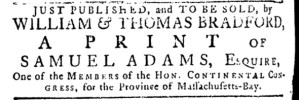
“A PRINT OF SAMUEL ADAMS, ESQUIRE, One of the MEMBERS of the HON. CONTINENTAL CONGRESS.”

The Second Continental Congress convened in Philadelphia after the battles of Lexington and Concord.  It met through most of the summer of 1775, took a recess during August, and started meeting again in September.  The delegates had just resumed their deliberations when William Bradford and Thomas Bradford, the printers of the Pennsylvania Journal, ran an advertisement promoting “A PRINT OF SAMUEL ADAMS, ESQUIRE, One of the MEMBERS of the HON. CONTINENTAL CONGRESS, for the Province of Massachusetts-Bay.”

Even though their advertisement stated, “JUST PUBLISHED, and TO BE SOLD, by WILLIAM & THOMAS BRADFORD,” this seems to have been another instance of printers treating those two phrases separately.  “TO BE SOLD” did indeed refer to the Bradfords stocking and selling the print at their printing office, but “JUST PUBLISHED” did not indicate that they had published the published the print, only that someone had recently published it and made it available for sale.  The Bradfords did not previously attempt to incite demand or gauge interest in a print of Adams among residents of Philadelphia with a subscription notice or other advertisement.

They most likely acquired and sold copies of the print that Charles Reak and Samuel Okey advertised in the Newport Mercury, the Massachusetts Spy, and the Boston-Gazette several months earlier.  In February, Reak and Okey took to the pages of the Newport Mercury to announce their intention to print a “striking likeness of that truly staunch Patriot, the Hon, SAMUEL ADAMS, of Boston.”  Near the end of March, a truncated advertisement in the Massachusetts Spy and the Boston-Gazette advised that “[i]n a few days will be published … A FINE mezzotinto print of that truly worthy Patriot S. A. … executed and published by and for Charles Reak and Samuel Okey, in Newport, Rhode-Island.”  The version in the Massachusetts Spy indicated that more information would appear in the next issue, but the printer, Isaiah Thomas, did not supply additional details in the last few issues printed in Boston before he suspended the newspaper for several weeks and relocated to Worcester just before hostilities commenced at Lexington and Concord.  Those events gave Reak and Okey an expanded market for a print of a Patriot leader already famous in New England.  Their advertisements in Boston’s newspapers listed local agents who would sell their print there.  The Bradfords likely became local agents in Philadelphia rather than publishers of another print of Adams.

November 23

What was advertised in a colonial American newspaper 250 years ago today?

Pennsylvania Journal (November 23, 1774).

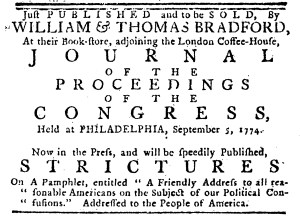
“JOURNAL OF THE PROCEEDINGS OF THE CONGRESS, Held at PHILADELPHIA.”

Just three weeks after they first advertised a pamphlet containing “EXTRACTS FROM THE VOTES AND PROCEEDINGS OF THE AMERICAN CONTINENTAL CONGRESS,” William Bradford and Thomas Bradford announced that they “Just PUBLISHED” a more extensive “JOURNAL OF THE PROCEEDINGS OF THE CONGRESS, Held at PHILADELPHIA, September 5, 1774.”  Although printers in towns throughout the colonies produced, marketed, and sold local editions of the Extracts to keep the public informed about what occurred at the First Continental Congress, the Bradfords were nearly alone in printing the Journal.  Hugh Gaine, the printer of the New-York Gazette and Weekly Mercury, joined them in that endeavor.

The Bradfords gave their advertisement for the Journal a privileged place in the November 23, 1774, edition of their newspaper, the Pennsylvania Journal.  It appeared on the third page, immediately following the list of prices current in Philadelphia.  While that may not seem like a spot of any significance in modern newspapers, consider the production of newspapers in eighteenth-century America.  Printers created each four-page issue by first printing the first and fourth pages on one side of a broadsheet, letting the ink dry, and then printing the second and third pages on the other side.  That meant that the most current news often appeared on the interior pages of an issue since printers set type and printed those pages last.  In most newspapers, the shipping news from the customs house or the prices current were the last news items before the advertisements, a familiar visual cue for readers that one type of content came to an end and another began.  For readers examining the news more carefully than the advertisements, an advertisement’s placement immediately following the shipping news and prices current likely increased its visibility.

That their advertisement for the Journal occupied that privileged place was not unique to the Bradfords marketing it in their own newspaper.  On the same day, they placed a notice in the Pennsylvania Gazette.  It ran on the third page, immediately following the shipping news and the prices current.  Among more than fifty paid notices in that issue, the printers of that newspaper apparently believed that the Journal deserved special treatment.  Marketing and selling both the Extracts and the Journal became an extension of keeping the public informed via coverage of the First Continental Congress that appeared in newspapers.

November 2

What was advertised in a colonial American newspaper 250 years ago today?

Pennsylvania Journal (November 2, 1774).

“EXTRACTS FROM THE VOTES AND PROCEEDINGS OF THE AMERICAN CONTINENTAL CONGRESS.”

Delegates to the First Continental Congress met in Philadelphia from September 5 through October 26, 1774.  When the meetings adjourned, an advertisement for “EXTRACTS FROM THE VOTES AND PROCEEDINGS OF THE AMERICAN CONTINENTAL CONGRESS” appeared in the next issue of the Pennsylvania Journal.  William Bradford and Thomas Bradford, printers of that newspaper, did not merely announce their plans to print the Extracts; they proclaimed that the pamphlet was “JUST PUBLISHED AND TO BE SOLD” at their printing office.  The Extracts hit the presses as soon as the delegates finished their business, providing an overview of “The BILL of RIGHTS; a List of GRIEVANCES; occasional RESOLVES; the ASSOCIATION; an ADDRESS to the People of Great-Britain; and a MEMORIAL to the Inhabitants of the British American Colonies.”

In their coverage of the meetings, the Bradfords promoted the Extracts, simultaneously distributing them as a service to the public and a seeking to generate revenue from their sale.  “On Wednesday last,” they reported, “the AMERICAN CONTINENTAL CONGRESS broke up, after having passed a Number of spirited Resolves, wrote several Letters, &c. which are printed in a Pamphlet, and may be had of the Printers.”  Just as Thomas Fleet and John Fleet, printers of the Boston Evening-Post, had taken the unusual step of interspersing news and advertising to hawk a publication related to recent meetings in Massachusetts earlier that same week, the Bradfords directed readers who consumed the news to consume a pamphlet they printed as well.  Readers could do more than learn about current events; they could participate in them by purchasing the Extracts, becoming better informed about colonial grievances, and following the directions for boycotting imported goods detailed in the Continental Association.

Such opportunities quickly became available in other places.  The Bradfords had the scoop for the moment, yet other printers soon published and disseminated other editions in Philadelphia and nearly a dozen other towns.  By the end of the year, one or more local editions appeared in Albany; Annapolis; Boston; Hartford; Lancaster, Pennsylvania; New London, Connecticut; Newport, Rhode Island; New York; Norwich, Connecticut; Providence; and Williamsburg, Virginia.  Heinrich Miller, the printer of the Wochentliche Pennsylvanische Staatsbote, also printed a German translation of the Extracts.  This important pamphlet supplemented newspaper coverage by conveniently collating a summary of the First Continental Congress for easy reference.

July 22

What was advertised in a colonial American newspaper 250 years ago today?

Pennsylvania Journal (July 22, 1772).

“We have determined to publish the PENNSYLVANIA JOURNAL, or WEEKLY ADVERTISER, regularly every Wednesday.”

When William Bradford and Thomas Bradford shifted the weekly publication day of the Pennsylvania Journal from Thursdays to Wednesdays in July 1772, they inserted a notice at the top of the first column on the first page in the first issue published on a Wednesday.  That notice appeared in larger font than the news items that filled the rest of the page. The following week, they removed the notice from the first page, but not entirely from the newspaper.

The shift in the publication day was no longer breaking news, but the Bradfords wished to continue promoting both the change in particular and their newspaper in general.  The notice underscored the reason for shifting the publication day.  Both the Pennsylvania Gazette and the Pennsylvania Journal had been published on Thursdays.  According to the Bradfords, a “Great number of our friends, thinking that the publication of two Papers on the same day was rather inconvenient to the public, have solicited us to alter our from Thursday to Wednesday.”  The adjustment, they claimed, amounted to a public service.  In addition, the Bradfords pledged to continue to “make it our constant endeavour, to keep up the well-known spirit and impartiality of the paper” for the benefit of both subscribers and advertisers.  When addressing prospective advertisers, the Bradfords underscored that they published an “extensive paper” that attracted many readers.  They also made a bid for other business, promising that colonizers who “employ us un any other kind of printing” would have their jobs “done with care, punctuality, and dispatch.”

A compositor reset the type for this message “To the PUBLIC” and moved it from the first page to the third page in the July 22 edition, inserting it among the various advertisements published there.  Unfortunately for the Bradfords, that was their last opportunity to publish that notice.  A week later the printers of the Pennsylvania Gazette moved their publication day to Wednesdays in order to compete with the Pennsylvania Journal.

July 15

What was advertised in a colonial American newspaper 250 years ago today?

Pennsylvania Journal (July 15, 1772).

“The publication of two Papers on the same day was rather inconvenient to the public.”

In the summer of 1772, William Bradford and Thomas Bradford, printers of the Pennsylvania Journal, altered their publication schedule, moving their weekly issues from Thursdays to Wednesdays.  They placed an announcement on the first page on July 15, explaining that a “Great number of our friends” convinced them to make the change because “the publication of two Papers on the same day was rather inconvenient to the public.”  They did not name the Pennsylvania Gazette, but residents of Philadelphia knew that new issues of both newspapers became available on Thursdays as well as new issues of the Pennsylvania Chronicle and the Pennsylvania Packet on Mondays.  Heeding the advice of their friends, the Bradfords decided to publish the Pennsylvania Journal “regularly every Wednesday,” but assured readers that all other aspects of the newspaper remained the same.  They pledged that they “shall still make it our constant endeavour, to keep up the well-known spirit and impartiality of the paper” to serve subscribers and those who “chuse to have advertisements inserted in this extensive paper.”

Whether or not the publication of two newspapers on the same day was “inconvenient” for readers or advertisers, that remained the schedule for the Pennsylvania Chronicle and the Pennsylvania Journal as well as the newspapers published in Boston.  In that city, all five newspapers clustered publication on just two days, the Boston Evening-Post, the Boston-Gazette, and the Massachusetts Gazette and Boston Post-Boy on Mondays and the Massachusetts Gazette and Boston Weekly News-Letter and the Massachusetts Spy on Thursdays.  In New York, the printers of the New-York Gazette and Weekly Mercury and the New-York Journal distributed new issues on different days in 1772, but other newspapers previously competed with them.  In Charleston, the printers of the South-Carolina and American General Gazette, the South-Carolina Gazette, and the South-Carolina Gazette and Country Journal usually managed to publish new issues on different days of the week, but their schedules had significantly more variability than newspapers in other cities and towns.

The Bradfords may or may not have been counseled by a “Great number” of friends and patrons to publish the Pennsylvania Journal on a different day than their competitors published the Pennsylvania Gazette, but they certainly recognized an opportunity to promote the change to prospective subscribers and advertisers.  That change will have an impact on the advertisements featured on the Adverts 250 Project.  No other eighteenth-century newspapers that have been digitized were published on Wednesdays, making it necessary to necessary to select advertisements from newspapers published earlier in the week.  The change in the Pennsylvania Journal’s publication schedule means that the Adverts 250 Project will feature one of its advertisements once a week.  That has the benefit of giving readers access to an advertisement published 250 years ago that day, but the shortcoming of disproportionately representing content from the Pennsylvania Journal … at least “until” another eighteenth-century printer commences (commenced) publication of a newspaper on Wednesdays.

March 8

What was advertised in a colonial American newspaper 250 years ago this week?

Pennsylvania Journal (March 5, 1772).

“There is another edition, JUST PUBLISHED.”

Get a copy while they are still available!  That was the message that William Bradford and Thomas Bradford delivered to prospective customers in Philadelphia when they advertised their own edition of A Dissertation on the Gout, and All Chronic Diseases by William Cadogan, a “Fellow of the College of PHYSICIANS.”  The Bradfords noted that “a number of Gentlemen were disappointed in the purchase of the first publication” so they set about producing “another edition” in order to meet demand.  Still, copies went so fast the first time around that the Bradfords warned consumers not to miss their opportunity to purchase the volume this time.

The printers underscored the popularity of the book on both sides of the Atlantic, stating that it was “so much esteemed in England, that it has already past through Eight Editions.”  This testified to the reputation it had earned.  Printers would not have published so many editions, the Bradfords implied, if the public did not clamor for them.  Furthermore, all sorts of people, not just physicians, found the “rational METHOD of CURE” helpful.  “The Doctrines advanced,” the Bradfords advised, “are delivered in a familiar style, which renders them intelligible to Gentlemen of all professions, as well as to Physicians.”

The Bradfords were not alone in publishing American editions of Cadogan’s Dissertation on the Gout in 1772.  Printers in two other cities produced their own editions.  Hugh Gaine did so in New York, while John Boyle, Benjamin Edes and John Gill, and Henry Knox published competing editions in Boston.  In Philadelphia, Robert Aitken appended the work to William Buchan’s Domestic Medicine or, The Family Physician, perhaps as a bonus intended to make the entire volume more attractive to perspective customers.  With a “first publication” that sold out in 1771, the Bradfords confirmed that Cadogan’s Dissertation on the Gout likely had as much potential in American markets as it did in England.

August 18

What was advertised in a colonial American newspaper 250 years ago this week?

Supplement to the Pennsylvania Journal (August 15, 1771).

“The following BOOKS, many of them late publications.”

During the week of August 15, 1771, William Bradford and Thomas Bradford had more content than would fit in the four pages of a standard issue of the Pennsylvania Journal.  To solve that dilemma, they distributed a two-page supplement composed entirely of advertising.  One side consisted primarily of twenty-two paid notices submitted by residents of Philadelphia and nearby towns, though the Bradfords interspersed five advertisements for books published and available at their printing office among them.  The other side, however, promoted books sold by the Bradfords exclusively.  In effect, they published a full-page advertisement, one that resembled a broadside catalog and could have been produced and distributed separately if they wished.

Although the list of books filled an entire page, the advertisement featured only fifty-five titles.  In most instances, the Bradfords provided more than the names of the authors and short titles of the books.  Instead, they offered blurbs that previewed the contents for prospective customers.  For instance, one entry described “Salmon’s New Geographical and Historical Grammar, or the present state of the several kingdoms of the world, containing their situation and extent, cities, chief towns, history, present state, form of government, forces, revenues, taxes, revolutions, and memorable events; together with an account of the air, soil, produce, traffic, arms, curiosities, religion, languages, &c. &c. illustrated with a new set of maps and other copper-plates.”  In crafting the blurbs, the Bradfords drew heavily from the extensive subtitles of the books and the tables of contents, but they also noted any ancillary items that added value, such as the maps and images that accompanied Thomas Salmon’s Geographical and Historical Grammar.  For works divided into multiple volumes, they also listed how many were included in a complete set.

Publishing this book catalog as part of an advertising supplement for their newspaper presented an opportunity for the Bradfords to market “A New Publication,” an imported History of France during the Reigns of Francis II and Charles IXby Walter Anderson, as well as hawk other titles among their inventory.  The fees they collected from other advertisers whose notices appeared on the other side of the supplement reduced or eliminated the expense of publishing and distributing a full-page advertisement.

Supplement to the Pennsylvania Journal (August 15, 1771).

February 21

What do newspaper advertisements published 250 years ago today tell us about the era of the American Revolution?

Pennsylvania Journal (February 21, 1771).

“LIBERTY.  A POEM.”

“RUN-AWAY … a Negro Boy named SAY.”

Like every other newspaper printer in colonial America, William Bradford and Thomas Bradford published advertisements about enslaved people.  The pages of the Pennsylvania Journal contained advertisements offering enslaved men, women, and children for sale as well as notices that described enslaved people who liberated themselves and offered rewards for their capture and return to their enslavers.  The Bradfords generated revenues from both kinds of advertisements.  In the process, they facilitated the buying and selling of enslaved Africans and African Americans.  Their newspaper became part of a larger infrastructure of surveillance of Black people, encouraging readers to scrutinize the physical features, clothing, and comportment of every Black person they encountered in order to determine if they matched the descriptions in the advertisements.

Simultaneously, the Bradfords published news about politics and current events that informed readers about colonial grievances and shaped public opinion about the abuses perpetrated by Parliament.  In addition, advertisements underscored concerns about the erosion of traditional English liberties in the colonies when they underscored the political dimensions of participating in the marketplace.  Purveyors of goods encouraged consumers to support “domestic manufactures” by purchasing goods produced in the colonies as alternatives to imported items.  News, editorials, and many advertisements all supported the patriot cause.

Those rumblings for liberty, however, stood in stark contrast to advertisements that perpetuated the widespread enslavement of Black men, women, and children.  The two ideologies did not appear in separate portions of the Pennsylvania Journal or any other newspaper.  Instead, they ran side by side.  Readers who did not spot the juxtaposition chose not to do so.  Consider, for instance, two advertisements in the February 21, 1771, edition of the Pennsylvania Journal.  The Bradfords advertised “LIBERTY.  A POEM” available at their printing office.  Their advertisement appeared next to a notice about “a Negro Boy named SAY,” a chimneysweeper born in the colonies.  Isaac Coats offered a reward to whoever “secures [Say] so that his Master may have him again.”  For his part, Say seized the liberty that so animated the conversations of those who attempted to keep him in bondage.

That was not the first time that the Bradfords placed advertisements about liberty and slavery in such revealing proximity to each other.  Three months earlier, they advertised the same poem and placed an advertisement offering a young man and woman for sale immediately below it.  “LIBERTY” in capital letters and a larger font appeared right above the words “To be sold by JOHN BAYARD, A Healthy active young NEGRO MAN, likewise a NEGRO WENCH.”  This paradox of liberty and slavery was present at the founding of the nation, not only in the ideas expressed by the founding generation but also plainly visible among the advertisements in the public prints.

November 22

What was advertised in a colonial American newspaper 250 years ago today?

Pennsylvania Journal (November 22, 1770).

“LIBERTY.”

“To be sold … A Healthy active young NEGRO MAN.”

Liberty and enslavement were intertwined in the 1770s, a paradox that defines the founding of the United States as an independent nation.  As white colonists advocated for their own liberty and protested their figurative enslavement by king and Parliament, they continued to enslave Africans and African Americans.  Even those who did not purport to be masters of Black men and women participated in maintaining an infrastructure of exploitation.  The juxtaposition of liberty and enslavement regularly found expression in the pages of newspapers during the era of the American Revolution as news items and editorial letters rehearsed arguments made by patriots and advertisements encouraged consumers to factor political considerations into the choices they made in the marketplace while other news items documented fears of revolts by enslaved people and other advertisements offered Black men, women, and children for sale or announced rewards for capturing enslaved people who liberated themselves by running away from those who held them in bondage.

Such contradictory items always appeared within close proximity to one another, especially considering that newspapers of the era usually consisted of only four pages.  In some instances, the juxtaposition should have been nearly impossible for readers to miss.  Consider two advertisements that ran in the November 22, 1770, edition of the Pennsylvania Journal.  William Bradford and Thomas Bradford, the printers of the newspaper, inserted a short notice about “LIBERTY.  A POEM” available for sale at their printing office.  Immediately below that notice appeared John Bayard’s advertisement offering a “Healthy active young NEGRO MAN” and an enslaved woman for sale.  The word “LIBERTY” in the Bradfords’ very brief notice appeared in all capitals and such a large font that it could have served as a headline for the next advertisement, an exceptionally cruel and inaccurate headline.  Both advertisements represented revenues for the Bradfords, the first potential revenues of potential sales and the second actual revenues paid by Bayard to insert the advertisement.

Examining either advertisement in isolation results in a truncated history of the era of the era of the American Revolution.  The advertisement for “LIBERTY.  A POEM” must be considered in relation to the advertisement for a “Healthy young NEGRO MAN” and woman to tell a more complete story of the nation’s past, even when some critics charge that the inclusion of the latter is revisionist and ideologically motivated.  It is neither.  Instead, it is a responsible and accurate rendering of the past.  The Bradfords positioned these advertisements together on the page 250 years ago.  We cannot separate them today.