October 19

What was advertised in a colonial American newspaper 250 years ago today?

Essex Gazette (October 19, 1773).

“The REPRESENTATIONS of Governor Hutchinson, and others, Contained in certain LETTERS transmitted to England.”

Among the various advertisements in the October 19, 1773, edition of the Essex Gazette, Samuel Hall and Ebenezer Hall, the printers of the newspaper, offered a pamphlet “Just published in Boston” and available at their printing office.  Many readers likely already knew about the contents of the pamphlet, “The REPRESENTATIONS of Governor Hutchinson, and others, Contained in certain LETTERS transmitted to England, and afterwards returned from thence, and laid before the GENERAL ASSEMBLY of the MASSACHUSETTS-BAY, Together with the RESOLVES of the two Houses thereon.”  Acquiring the pamphlet and reading the correspondence for themselves, however, gave colonizers an opportunity to see for themselves exactly what Thomas Hutchinson and others had reported to ministers and members of Parliament in letters that had not been intended for public consumption.  Purchasing and perusing the pamphlet also presented another means of participating in politics.

As Jordan E. Taylor explains in Misinformation Nation: Foreign News and the Politics of Truth ion Revolutionary America, this was not the first instance of printers publishing private letters from colonial officials to associates in London.[1]  In the wake of the arrival of British soldiers in Boston in 1768, Benjamin Edes and John Gill, printers of the Boston-Gazette, published Letters to the Ministry from Governor Bernard, General Gage, and Commodore Hood.  The Halls reprinted the pamphlet and sold it in Salem.  Taylor describes the letters as “quite benign – dull even,” yet a “few passages, nevertheless, aroused indignation,” including “Bernard’s suggestion that the Massachusetts charter be altered to weaken the council and strengthen the office of the governor.”  In addition, letters from customs commissioners recommended “two or three Regiments” to “restore and support Government” in Boston.  From the perspective of the printers and many colonizers, these letters were “hard evidence that a group of officials was conspiring to intentionally exaggerate the disorder in Massachusetts and bring troops into Boston.”

In 1773, the Representations of Governor Hutchison and Others further misrepresented the situation in Massachusetts, at least according to colonizers who advocated for the patriot cause and who recognized a pattern in how the misunderstandings between the colonies and Parliament occurred.  This pamphlet included letters from Thomas Hutchinson, Andrew Oliver, the lieutenant governor, and Charles Paxton, a customs officer.  One passage written by Hutchinson addressed “the abridgment of the colonists’ liberties,” though the governor “claimed that he was predicting, rather than prescribing, that those liberties might eventually be limited.”  Paxton requested “two or three regiments” or else “Boston will be in open rebellion.”  Taylor notes that printers “widely shared the letters in their newspapers,” making them widely accessible and perhaps even generating demand for a volume that collected them together.  The letters gained sufficient interest for the pamphlet to go through ten editions as colonizers examined what Hutchinson and others had written for themselves and constructed their own narrative that the Representations and representations of colonial officials amounted to misrepresentations that caused and exacerbated the imperial crisis.

**********

[1] For a more complete account of Letters to the Ministry and Representations of Governor Hutchinson, see Jordan E. Taylor, Misinformation Nation: Foreign News and the Politics of Truth in Revolutionary America (Baltimore: Johns Hopkins University Press, 2022), 52-54.
January 28

What was advertised in a colonial American newspaper 250 years ago today?

Massachusetts Spy (January 28, 1773).

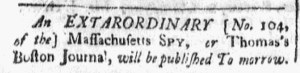
An EXTRAORDINARY … will be published To morrow.”

“Extra!  Extra!  Read all about it!”  That was Isaiah Thomas’s message to readers of the Massachusetts Spy.  The printer included an announcement in the January 28, 1773, edition, alerting subscribers and other readers that “An EXTRAORDINARY [No. 104, of the] Massachusetts SPY, or Thomas’s Boston Journal, will be published To morrow.”  Unlike the supplements and postscripts that sometimes accompanied early American newspapers, Thomas considered the extraordinary, distributed on a Friday, a separate issue.  As he noted in his announcement, it had its own number, 104, following “NUMB. 103,” distributed on Thursdays as usual for the Massachusetts Spy.  Thomas or a compositor who worked in his printing office updated the masthead to include “EXTRAORDINARY.”

The “extra” issue consisted of two pages, compared to four for the weekly standard issues of the Massachusetts Spy and other American newspapers published at the time.  It consisted almost entirely of a single item from the “HOUSE of REPRESENTATIVES” in Boston, along with half a column of news from Salem and one short advertisement for grocery items.  (In similar circumstances, other printers took the opportunity to insert advertisements about the goods and services available at their printing offices.)  The main item that prompted publication of the extraordinary was an “ANSWER to [Governor Thomas Hutchinson’s] SPEECH, to both Houses, at the opening of this session.”  Representatives “ORDERED” that a committee comprised of “Mr. Adams, Mr. Hancock, Mr. Bacon, Col. Bowes, Major Hawley, Capt. Darby, Mr. Philips, Col. Thayer, and Col. Stockbridge” compose that answer.  Members of the committee agreed with the governor that “the government at present is in a very disturbed state.”  They did not, however, identify the same causes.  “[W]e cannot ascribe it to the people’s having adopted unconstitutional principles,” as the governor claimed.  Instead, they believed that problems arose as a result of “the British House of Commons assuming and exercising a power inconsistent with the freedom of the constitution to give and grant the property of the colonists, and appropriate the same without their consent.”

When Thomas published the extraordinary, he already had a reputation as a printer devoted to principles espoused by the patriots.  The masthead for his newspaper described it as “A Weekly, Political, and Commercial PAPER:– Open to ALL Parties, but Influenced by None,” yet immediately below that sentiment appeared this message: “DO THOU Great LIBERTY INSPIRE our Souls,– And make our Lives in THY Possession happy,– Or our Deaths glorious in THY JUST Defence.”  Thomas likely had two reasons for quickly publishing the committee’s response as an extraordinary.  He scooped his competitors while also disseminating rhetoric that matched his own views.  (Most other newspapers printed in Boston included the response as part of their coverage when they distributed their next weekly edition, but that took several days or, in the case of the Massachusetts Gazette and Boston Weekly News-Letter, printed by Loyalist Richard Draper, an entire week.)  Thomas previously published the governor’s speech as an extraordinary, dated and distributed on the same day as the weekly issue on Thursday, January 7.  In so doing, he upheld his pledge that the Massachusetts Spy was “Open to ALL Parties,” yet publishing the governor’s speech also kept colonizers informed about the dangers they faced from the narrative of recent events that Hutchinson constructed.  Releasing the committee’s response as its own extraordinary on a day that no other newspapers were published in Boston and announcing his plans to issue that extraordinary may have garnered more attention more quickly to the version of events that matched Thomas’s own views.  Patriots and imperial officials vied over how to represent what was occurring in Boston and throughout the colonies.  Thomas may have considered getting the committee’s response to the governor in print as quickly as possible an important counteroffensive against the governor’s speech that he published three weeks earlier.

Massachusetts Spy Extraordinary (January 29, 1773).