
What was advertised in a revolutionary American newspaper 250 years ago today?
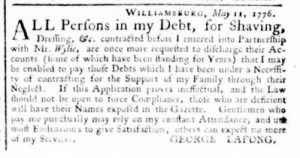
“Those who are deficient will have their Names exposed in the Gazette.”
George Lafong, a hairdresser in Williamsburg, meant business. In the spring of 1776, he took to the pages of John Dixon and William Hunter’s Virginia Gazette to call on “ALL Persons in my Debt, for Shaving, Dressing,” and other services “to discharge their Accounts.” In particular, he addressed clients from “before I entered into Partnership with Mr. Wylie” at the beginning of the year, reporting that some of those unsettled accounts “have been standing for years.”
He started by asking those clients to be reasonable and consider his own situation and, especially, his responsibilities to support his family. He asked them to make payment “that I may be enabled to pay those Debts which I have been under a Necessity of contracting for the Support of my Family” but had been forced to “Neglect” because of his recalcitrant clients. In other circumstances he could have threatened legal action against those who refused to pay their overdue bills, but Lafong suggested the possible that “the Law” (or the courts) might not “be open to force Compliance,” perhaps due to disruptions caused by the war that began at Lexington and Concord and spread to other colonies. Without legal remedies, he would resort to public shaming by publishing the names of those who owed for the services he provided: “those who are deficient will have their Names exposed in the Gazette.” Notices about settling accounts frequently appeared in early American newspapers, but rarely did anyone make such threats. In November 1768, Daniel Fowle and Robert Fowle, the printers of the New-Hampshire Gazette, threatened to publish “a List of those Customers … whose Accounts are of long standing, with the Sum due, in order to show how injuriously they are treated by them,” though they did not follow through on it. In September 1774, Charles Willson Peale did publish an advertisement calling on Elie Vallette to pay for a family portrait he had painted. Peale and Vallette made their dispute public with a series of advertisements in the Maryland Gazette.
Would Lafong publish the names of clients who did not settle accounts? He made clear that “Gentlemen who pay me punctually may rely on my constant Attendance, and utmost Endeavours to give Satisfaction,” yet “others can expect no more of my Service.” At the very least, they could not depend on Lafong extending additional credit, but the possibility of even more drastic consequences remained.