February 10

Who was the subject of an advertisement in a revolutionary American newspaper 250 years ago today?

Virginia Gazette [Dixon and Hunter] (February 10, 1776).

“Runaway Negroes … going to the Governor.”

For several weeks in January and February 1776, the Virginia Gazette carried an advertisement about a canoe recovered from “some runaway Negroes” making their way down the James River.  John Watkins described the canoe and noted that the enslaved men also possessed “sundry Clothes, some of which were stolen, and have since been claimed by the Owners.”  He assumed that the remaining clothes belonged to the enslaved men.  Watkins offered the canoe to its rightful owner and the clothes to the enslavers of the Black men who sought to liberate themselves.  He did not, however, indicate that those men had been captured and imprisoned until their enslavers claimed them.  Perhaps the men managed to make their escape when Watkins seized the canoe.

Whatever happened, Watkins believed that the men “were going to Governor.”  That detail meant a lot to eighteenth-century readers of the Virginia Gazette and even more to enslaved people residing in the colony.  On November 7, 1775, John Murray, the earl of Dunmore and royal governor of Virginia, issued a proclamation that declared martial law in the colony.  He hoped to restore order as the fighting that started at Lexington and Concord in Massachusetts spread to Virginia.  To that end, he “declare[d] all indented Servants, Negroes, or others, (appertaining to Rebels,) free that are able and willing to bear Arms, they joining His MAJESTY’s Troops as soon as may be.”  In other words, Dunmore offered freedom to enslaved people (and indentured servants and other unfree laborers) who fled from their enslavers, joined his forces, and fought for the king (but only those Black people enslaved by Patriots since the governor did not want to alienate Loyalists).  As word spread, enslaved men, women, and children flocked to Dunmore’s lines.  The men who stole the canoe that Watkins advertised had good reason for acting when they did.  They recognized what may very well have been their best possible chance to make good on their escape and achieve freedom.  As colonizers complained about their figurative enslavement by Parliament, enslaved people saw this offer by the British as a beacon of liberty.  Several months later, the Declaration of Independence counted Lord Dunmore’s Proclamation among the many grievances against George III.  The charge that the king “has excited domestic insurrections amongst us” referred to Dunmore’s efforts to rally enslaved people to join him in fighting against the “Rebels” who opposed the king.

January 28

What was advertised in a revolutionary American newspaper 250 years ago this week?

Virginia Gazette [Dixon and Hunter] (January 27, 1776).

“I cannot publish such Advertisements as ought to have appeared this Week.”

John Pinkney should have printed and distributed an edition of his weekly newspaper, the Virginia Gazette, on January 27, 1776, but he did not.  Instead, he placed a notice in the newspaper printed by John Dixon and William Hunter, also named the Virginia Gazette.  “AFTER having received so many Instances of public Favour,” he explained, “I should think myself inexcusable did I not make known the Reason why I do not this Week publish a Gazette.”  It turned out that he experienced the same disruption in his supply of paper that many other printers faced during the first year of the Revolutionary War.  He did not publish a new issue “owing to a Disappointment in receiving Paper from the Northward.”  In their own notice on the next page, Dixon and Hunter confirmed that “a stock of printing-paper … at this time is very scarce” and acquiring it involved “an infinite deal of trouble and expence in transporting it from Pennsylvania.”  Pinkney claimed that “no human Prudence could have prevented” the situation.

He also informed readers that “Next Week … or in a short Time, I expect a very considerable Quantity” and when it arrived he would “endeavour to make up for all Deficiencies.”  Through “unwearied Diligence,” he would continue to collate and disseminate items of “instructive Amusement” and “every Piece of authentic Intelligence.”  He concluded with an acknowledgement for advertisers: “It gives me the greatest Uneasiness that I cannot publish such Advertisements as ought to have appeared this Week, but as far as a Restitution of Money can atone for the Disappointment, it shall be made.”  Advertising was an important revenue stream for most printers who published newspapers.  This “Restitution of Money” put Pinkney in an even more precarious position, especially since Dixon and Hunter indicated that paper “cannot be had without cash.”  Pinkney could not purchase paper on credit.  He managed to get his hands on enough paper to print a new issue on February 3, as promised in his notice, but most likely did not continue printing for long after that.  The February 3 edition is the last known.  Disruptions in Pinkney’s supply of paper likely played a significant role in his Virginia Gazette folding.

January 6

What was advertised in a revolutionary American newspaper 250 years ago today?

Virginia Gazette [Dixon and Hunter] (January 6, 1776).

Monsieur LAFONG, HAIR-DRESSER, &c. AND BARBER GENERAL!”

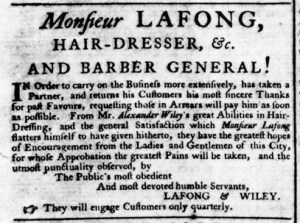
George Lafong, a “French HAIR-DRESSER” in Williamsburg, occasionally placed newspaper advertisements in the early 1770s.  When he took to the pages of the first issue of John Dixon and William Hunter’s Virginia Gazette for 1776, he presented himself as “Monsieur LAFONG, HAIR-DRESSER, &c. AND BARBER GENERAL!”  That elaborate and spectacular title served as the headline for his advertisement.  He had not previously dropped his first name in favor of referring to himself as “Monsieur LAFONG,” but apparently decided that circumstances merited this affectation.

That may have been because he jointly placed the advertisement with his new partner, Alexander Wiley, explaining that they went into business together “IN Order to carry on the business more extensively.”  Wiley possessed “great Abilities in Hair-Dressing,” according to the advertisement, yet neither his name nor reputation seemed to suggest any connection to French styles.  Hairdressers frequently benefited from the cachet that their clientele associated with French fashion, something that Lafong understood when he introduced himself as a “French HAIR-DRESSER” and there in a French phrase, “TOUT A LA MODE,” in 1770.  He doubled down on that in his new advertisement, naming himself “Monsieur Lafong” in the body as well as “Monsieur LAFONG” in the headline.

The new partners hoped that the combination of Wiley’s “great Abilities in Hair-Dressing, and the general Satisfaction which Monsieur Lafong flatters himself to have hitherto given” would yield “Encouragement” (or appointments) “from the Ladies and Gentlemen of this City.”  Lafong deserved to lean on his reputation.  According to the entry on wigmakers from the Williamsburg Craft Series, Lafong operated one of the premiere wig shops in the town in the early 1770s.[1]  In his own marketing, he declared that he “makes Head Dresses for Ladies, so natural as not to be distinguished by the most curious Eye.”  If former clients (or their acquaintances who knew who dressed their hair) agreed with that assessment, it did indeed suggest a “general Satisfaction” with Lafong’s work.  Furthermore, Lafong and Wiley promised that “the greatest Pains will be taken” to earn the approval of their clients.

**********

[1] Thomas K. Bullock and Maurice B. Tinkin, Jr., The Wigmaker in Eighteenth-Century Williamsburg: An Account of his Barbering, Hair-Dressing, and Peruke-Making Services, and Some Remarks on Wigs of Various Styles (Colonial Williamsburg: 1959, 1987).

December 23

What was advertised in a revolutionary American newspaper 250 years ago today?

Virginia Gazette [Dixon and Hunter] (December 23, 1775).

“A large and exact VIEW of the late BATTLE at CHARLESTOWN.”

Like other printers, John Dixon and William Hunter sold books, pamphlets, almanacs, stationery, and other merchandise to supplement the revenues they generated from newspaper subscriptions, advertisements, and job printing.  They frequently placed advertisements in their newspaper, the Virginia Gazette, to generate demand for those wares.  The December 23, 1775, edition, for instance, included three of their advertisements, one for “SONG BOOKS and SCHOOL BOOKS For SALE at this OFFICE” and another for the “Virginia ALMANACK” for 1776 with calculations “Fitting VIRGINIA, MARYLAND, [and] NORTH CAROLINA” by “the ingenious Mr. DAVID RITTENHOUSE of Philadelphia,” the same mathematician who did the calculations for Father Abraham’s Almanack marketed in Philadelphia and Baltimore.

Their third advertisement promoted memorabilia related to the hostilities that erupted at Lexington and Concord earlier in the year.  “Just come to Hand, and to be SOLD at this PRINTING-OFFICE,” Dixon and Hunter proclaimed, “A large and exact VIEW of the late BATTLE at CHARLESTOWN,” now known as the Battle of Bunker Hill.  The copies they stocked were “Elegantly coloured” and sold for “one Dollar.”  Dixon and Hunter apparently carried a print, “An Exact View,” engraved by Bernard Romans and published by Nicholas Brooks, rather than a striking similar (and perhaps pirated) print, “A Correct View,” that Robert Aitken included in a recent issue of the Pennsylvania Magazine, or American Monthly Museum and sold separately.  Romans and Brooks had advertised widely and designated local agents to accept subscriptions for the print.  Dixon and Hunter also advertised another collaboration between Romans and Brooks, “an accurate MAP of The present SEAT of CIVIL WAR, Taken by an able Draughtsman, who was on the Spot at the late Engagement.”  The map also sold for “one Dollar.”  Previous efforts to market the map included a broadside subscription proposal that listed local agents in various towns, including “Purdie and Dixon, Williamsburgh.”  Romans and Brooks apparently had not consulted with all the printers, booksellers, and other men they named as local agents when they drew up the list or else they would have known that Alexander Purdie and John Dixon had dissolved their partnership in December 1774.  Dixon took on Hunter as his new partner while Purdie set about publishing his own Virginia Gazette.  Those details may have mattered less to Romans and Brooks than their expectation that printers, booksellers, and others with reputations for supporting the American cause would indeed aid them in marketing and selling a map depicting the conflict underway in Massachusetts.  Whether or not Purdie or Dixon and Hunter collected subscriptions, local agents in Williamsburg did eventually sell the print and the map that supplemented newspaper accounts and encouraged feelings of patriotism among the consumers who purchased them.

November 26

What was advertised in a revolutionary American newspaper 250 years ago this week?

Virginia Gazette [Dixon and Hunter] (November 25, 1775).

“FOLIOS … QUARTOS … OCTAVOS … DUODECIMOS.”

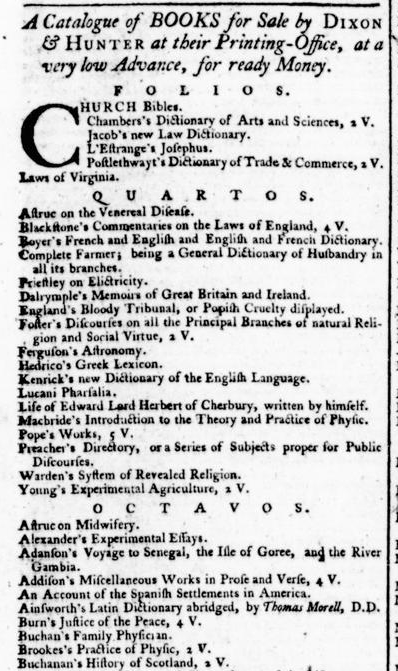
John Dixon and William Hunter, printers of the Virginia Gazette, published a “Catalogue of BOOKS for Saleat their Printing-Office” in the November 25, 1775, edition.  It covered most of the first page, except for the masthead and a short advertisement in which William Hewitt announced his intention to leave the colony and called on associates to settle accounts, and continued onto the second page, where it filled an entire column and overflowed into another.  Overall, Dixon and Hunter’s book catalog accounted for four of the twelve columns of news and advertising in that issue.  The printers could have printed a separate catalog (and very well may have done so), but disseminating the list of books they sold in the newspaper guaranteed that they reached consumers throughout the colony and beyond.

The printers deployed two principles in organizing the contents of their book catalog.  First, they separated the books by size – folios, quartos, octavos, and duodecimos – and then they roughly alphabetized them.  The catalog featured only half a dozen folios, including “CHURCH Bibles,” “Chambers’s Dictionary of Arts and Sciences” in two volumes, and the “Laws of Virginia,” along with nearly a score of quartos.  Dixon and Hunter stocked many more octavos and duodecimos with more than one hundred of each for prospective customers to choose.  In roughly alphabetizing the titles, they first indicated the author and then, if the book did not have an author associated with it, the title.  They clustered titles together by the first letter, but they did not observe strict alphabetical order within those clusters.  For example, the entries for “A” among the duodecimos appeared in this order:

     Addison’s Mescellaneous Works in prose and verse, 4 V.
Adventurer, 4 V.
American Gazetteer, 3 V.
Adventures of a Jesuit, with several remarkable Characters and Scenes in real Life, 2 V.
Agreeable Ugliness, or the Triumph of the Graces.
Apocrypha.
Alleine’s, Alarm to Unconverted Sinners.

A single entry for “Y” – “Yorrick’s Sermons, 7 V.” – appeared at the end of the catalog, immediately above “INTELLIGENCE from the Northern Papers.”

Even with all the “INTELLIGENCE” from London and Philadelphia and proclamation from the royal governor of Virginia, Dixon and Hunter made room in the Virginia Gazette for their book catalog.  They delivered news to their readers, but they also depended on book sales to supplement subscriptions, advertising, and job printing.  Compared to many book catalogs published earlier in the century, they presented a more organized list of titles.  Earlier book catalogs often separated titles by size.  By roughly alphabetizing the entries, Dixon and Hunter attempted to help prospective customers find the titles that interested them.

October 28

What was advertised in a revolutionary American newspaper 250 years ago today?

Virginia Gazette [Dixon and Hunter] (October 28, 1775).

“SKETCHLEY’s New Invented CONVERSATION CARDS.”

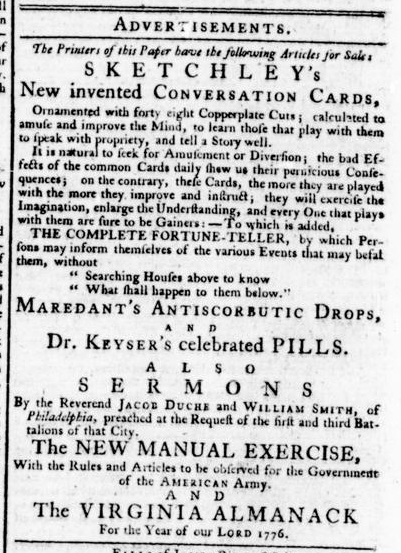
Like other newspaper printers, John Dixon and William Hunter provided a variety of goods and services to supplement the revenues from subscriptions and advertisements.  The masthead of the Virginia Gazette solicited customers for “Printing Work done at this Office in the neatest Manner, with Care and Expedition.”  In addition to job printing, they also published books, pamphlets, and almanacs and, according to their advertisement in the October 28, 1775, edition, they even sold patent medicines.  Many colonial printers kept a stock of similar “MAREDANT’S ANTISCORBUTIC DROPS” and “Dr. KEYSER’S celebrated PILLS” on hand, promoting them in their own newspapers.

Hawking yet another product accounted for nearly half of Dixon and Hunter’s advertisement in that issue of the Virginia Gazette: “SKETCHLEY’s New invented CONVERSATION CARDS, Ornamented with forty eight Copperplate Cuts.”  Today, conversation cards serve a variety of purposes.  They can be used for icebreakers at social gatherings, teambuilding exercises for businesses and organizations, or discussion starters among people seeking to explore topics of common interest and forge stronger personal connections.  While consumers may have used Sketchley’s conversation cards in a variety of ways, the advertisement stated that they were “calculated to amuse and improve the Mind, to learn those that play with them to speak with propriety, and tell a Story well.”  In that regard, these cards differed from playing cards for popular games of “Amusement and Diversion” and the “bad Effects of the common Cards” that “daily show us their pernicious Consequences.”  Card games did not have to devolve to the vices of too much luxury and leisure, too much gossip and idle chatter, and too much drinking and gambling.  Sketchley’s conversation cards, “on the contrary, … the more they are played with the more they improve and instruct; they will exercise the Imagination, enlarge the Understanding, and every One that plays with them are sure to be the Gainers.”  In the company of friends, those who used the cards would become more articulate in their speech, more refined in their comportment, and more enlightened in their understanding of the world.

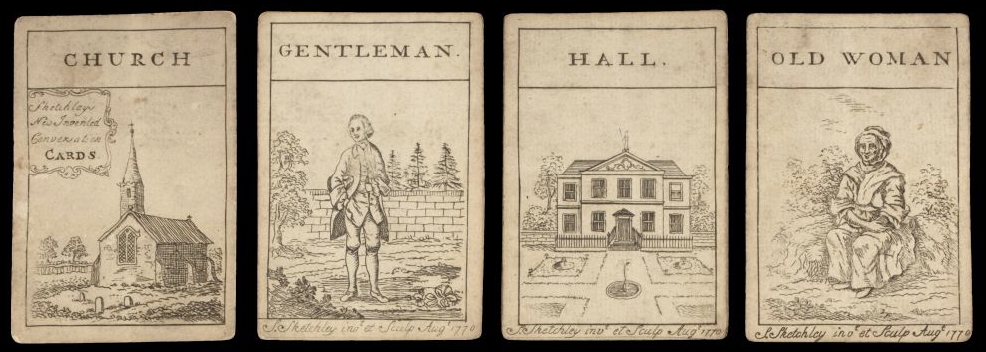
What did consumers acquire when they purchased their own deck of Sketchley’s conversation cards?  Dominic Winter Auctioneers offer this description: “copper engraved playing cards,” measuring 3.75 inches by 2.5 inches, “each with a word [in the] upper margin and [the] associated illustration below.”  The partial set that the auctioneers offered for bids included seventeen cards, such as “Hope,” “Honour,” “Heart,” and “Ruin.”  According to the online auction catalog, those are the only cards from this set known to survive.  “The only other similar, but not identical, set we have been able to trace,” the catalog states, “is that held by the Osborne Collection …, which comprises 52 cards.”  It also features images of sixteen of the cards.  In addition, the catalog notes the advertisement in the Virginia Gazette.  Like most shop signs and many book catalogs, early American newspaper advertisements reveal details that otherwise have been lost because the artifacts do not survive.

By the time that James Sketchley first marketed his “New invented CONVERSATION CARDS” in 1770, he had been producing playing cards for about two decades.  With these cards, he offered an alternative to games of leisure that passed the time with little else to show for it, just as John Ryland had done with a set of “Geographical Cards” that Nichols Brooks advertised in the Pennsylvania Journal in March 1773.  Dixon and Hunter prompted genteel readers and those who aspired to gentility to consider these conversation cards a valuable resource to purchase when their bought they almanac for the coming year or a military manual that included “the Rules and Articles to be observed for the Government of the AMERICAN Army.”

“CHURCH,” “GENTLEMAN,” “HALL,” and “OLD WOMAN,” from Sketchley’s New Invented Conversation Cards (1770).  Courtesy Dominic Winter Auctioneers.

October 15

What was advertised in a revolutionary American newspaper 250 years ago this week?

Virginia Gazette [Dixon and Hunter] (October 14, 1775).

“Will be sold a large BOW WINDOW, with Bars and Shutters, some SHOW GLASSES, and GLASS CASES.”

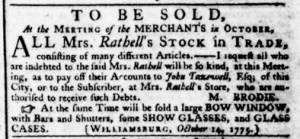
In the spring of 1775, Catherine Rathell, a milliner in Williamsburg, advertised her intention to “dispose of my Goods” and go to England “till Liberty of Importation is allowed.”  The Continental Association, a nonimportation agreement devised by the First Continental Congress in protest of the Coercive Acts, disrupted trade for merchants, shopkeepers, and others who sold imported goods.  When she first placed her advertisement, Rathell and the rest of the residents of Williamsburg had not yet received word of the battles at Lexington and Concord.  The outbreak of hostilities may have prompted her to adjust her plans because she did not wait until she sold all her merchandise to depart.  Instead, she left her wares in the hands of Margaret Brodie, a mantuamaker who had worked with Rathell since 1771, to sell “At theMEETING of the MERCHANTS in OCTOBER.”  The milliner did not return to Williamsburg.  Unfortunately, she died when the ship taking her to England got caught in a hurricane and sank.

Brodie’s advertisement in the October 14, 1775, edition of John Dixon and William Hunter’s Virginia Gazette concerned more than just selling Rathell’s remaining merchandise.  It also called on those indebted to Rathell to settle accounts with Brodie.  A short note at the end of the notice, marked with a manicule to draw attention, noted that “a large BOW WINDOW, with Bars and Shutters, some SHOW GLASSES, and GLASS CASES” would be sold at the same time as “Mrs. Rathell’s STOCK in TRADE.”  That provides a glimpse of Rathell’s merchandising strategies.  By the early eighteenth century, bow windows became popular features of shops in London, so common that some critics complained about the way that they jutted into the street and made it more difficult for pedestrians to pass.  Yet that was one of the intended purposes, causing prospective customers to slow down and view the merchandise on display.  In addition, bow windows offered more space for displaying goods than windows flush with exterior walls.  Some American retailers, including Rathell, adopted this strategy for marketing their wares.  Rathell also invested in glass cases to showcase some of her merchandise for visitors to her shop.  She could protect valuable items from shoplifters while still making them visible to entice customers.  Similarly, the bars on shutters on the bow window protected goods from burglars when the shop was closed.  Without contemporary visual images of American shops, Rathell’s advertisement helps reconstruct their interiors and the experience of shopping in eighteenth-century America.

October 14

Who was the subject of an advertisement in a revolutionary American newspaper 250 years ago today?

Virginia Gazette [Dixon and Hunter] (October 14, 1775).

“Several very valuable FAMILY SERVANTS.”

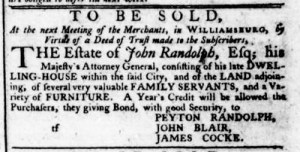
A notice concerning the “Estate of John Randolph, Esq; his Majesty’s Attorney General,” first appeared in the October 14, 1775, edition of John Dixon and William Hunter’s Virginia Gazette.  It was not Randolph’s death that occasioned the notice.  Instead, the Loyalist and his family departed for England at the beginning of the Revolutionary War, leaving trustees in charge of selling “his late DWELLING-HOUSE” in Williamsburg, “several very valuable FAMILY SERVANTS, and a Variety of FURNITURE.”

At a glance, modern readers might assume that those “FAMILY SERVANTS” consisted of indentured servants like the ones that had “JUST ARRIVED” in Virginia on the Saltspring.  According to an advertisement on the next page, those servants included “many Tradesmen,” such as carpenters, blacksmiths, shoemakers, weavers, a cabinetmaker, and a wheelwright, as well as “FARMERS and other COUNTRY LABOURERS.”  Yet that almost certainly was not the case for the “FAMILY SERVANTS” in the notice about Randolph’s estate.  They did indeed possess a variety of skills like the indentured servants recently arrived in the colony, yet that phrase – “FAMILY SERVANTS” – referred to enslaved people who had been part of the Randolph household.

Virginia Gazette [Pinkney] (November 9, 1775).

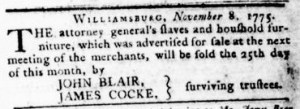
A subsequent advertisement did not use the same turn of phrase.  After Peyton Randolph, one of the trustees, died suddenly on October 22, a new advertisement that first appeared in the November 9 edition of John Pinkney’s Virginia Gazette clarified that the “attorney general’s slaves and household furniture, which was advertised for sale at the next meeting of the merchants, will be sold the 25th day of this month, by JOHN BLAIR, [and] JAMES COCKE, surviving trustees.”  Of course, eighteenth-century readers understood the reference to “FAMILY SERVANTS” in the original advertisement.  They did not need a subsequent notice to clarify that it meant enslaved men and women.  They knew the lexicon of newspaper notices about enslaved people just as well as they knew the lexicon of consumer culture in advertisements that promoted all sorts of goods, especially textiles, with names that seem unfamiliar to today’s readers.

October 7

What was advertised in a revolutionary American newspaper 250 years ago today?

Virginia Gazette [Dixon and Hunter] (October 7, 1775).

“An ACADEMY … distinguished by the Name of HAMPDEN-SIDNEY.”

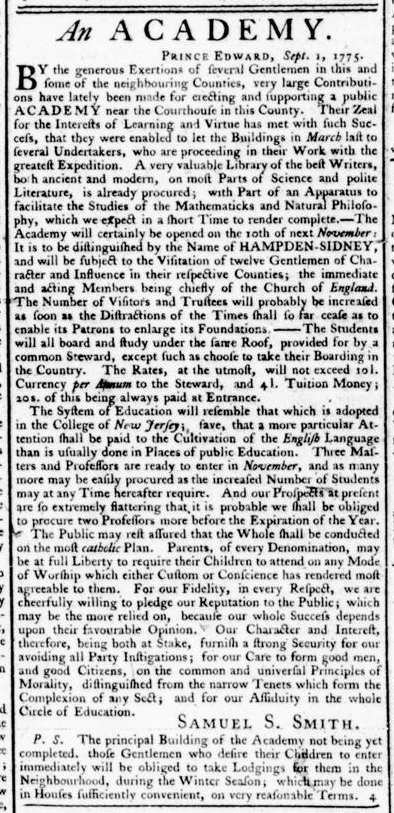
An advertisement for a new academy “distinguished by the Name of HAMPDEN-SIDNEY” ran for the first time in the October 7, 1775, edition of John Dixon and William Hunter’s Virginia Gazette.  It delivered an overview of the last American college founded before the Declaration of Independence, announcing that classes would begin on November 10.  As the “History of Hampden-Sydney College” posted on the institution’s website explains, “The first president, at the suggestion of Dr. John Witherspoon, the Scottish president of the College of New Jersey (now Princeton University), chose the name Hampden-Sydney to symbolize devotion to the principles of representative government and full civil and religious freedom which John Hampden (1594-1643) and Algernon Sydney (1622-1683) had outspokenly supported, and for which they had given their lives, in England’s two great constitutional crises of the previous century.”

That first president of Hampden-Sydney College was Samuel Stanhope Smith, the valedictorian of the College of New Jersey (now Princeton University) in 1769.  Six years later, his connections to that institution influenced more than just the name of the academy he founded in Virginia.  “The System of Education will resemble that which is adopted in the College of New Jersey,” he noted in the advertisement, “save, that a more particular Attention shall be paid to the Cultivation of the EnglishLanguage than is usually done in Places of public Education.”  Three “Masters and Professors” had already been hired, yet Smith anticipated that enrollments would justify engaging two more instructors “before the Expiration of the Year.”  The academy had also procured a “very valuable Library of the best Writers, both ancient and modern, on most Parts of Science and polite Literature.”  Construction of the “principal Building of the Academy” had begun but would not be complete before classes commenced on November 10.  Students would need to find lodging “in the Neighbourhood, during the Winter Season,” though Smith assured prospective pupils and their parents that there were “Houses sufficiently convenient” available “on very reasonable terms.”

For governance and oversight, the academy “will be subject to the Visitation of twelve Gentlemen of Character and Influence in their respective Counties.”  They included, according to the College’s “History,” James Madison, Patrick Henry, and “other less well-known but equally vigorous patriots.”  Smith mused that the “Number of Visitors and Trustees will probably be increased as soon as the Distractions of the Times shall so far cease as to enable its Patrons to enlarge its Foundation.”  He referred, as readers knew, to events in Massachusetts over the past six months, including the battles at Lexington and Concord, the siege of Boston, and the Battle of Bunker Hill.

The imperial crisis that led to those events certainly played a role in naming the academy and formulating its mission.  Even though the first trustees were “chiefly of the Church of England,” Smith pledged that “the Whole shall be conducted on the most catholic” or universal “Plan.”  Inspired by Hampden and Sydney’s commitment to civil and religious freedom, the academy adopted a policy of toleration: “Parents, of every Denomination, may be at full Liberty to require their Children to attend on any Mode of Worship which either Custom or Conscience has rendered most agreeable to them.”  Smith also made a series of promises grounded in the academy’s “Character and Interest,” stating that the faculty and trustees “furnish a strong Security for our avoiding all Party Instigations; for our Care to form good men, and good Citizens, on the common and universal Principles of Morality, distinguished from the narrow Tenets which form the Complexion of any Sect; and for our Assiduity in the whole Circle of Education.”  From its inception during the era of the American Revolution, Smith’s academy, Hampden-Sydney College, emphasized civic virtue and religious freedom as hallmarks of the education it provided for young men.

**********

Hampden-Sydney College features an image and transcription of the advertisement on its website as well as a brief “History of Hampden-Sydney College.”

May 6

What was advertised in a revolutionary American newspaper 250 years ago today?

Virginia Gazette [Dixon and Hunter] (May 6, 1775).

“LADIES RIDING HABITS made in the newest Fashion.”

When James Davis, a tailor, opened a shop at a new location in Yorktown in the spring of 1775, he placed an advertisement in John Dixon and William Hunter’s Virginia Gazette.  He opened by extending “his most grateful Acknowledgments to all those who have hitherto been his Customers,” incorporating an appeal in common use throughout the colonies.  Advertisers often thanked existing customers as a means of enhancing their reputations.  Yet that was not Davis’s only purpose; instead, he “takes this Opportunity to inform them, as well as the Public in general, that he has just opened Shop nearly opposite Swan Tavern.”  Any client could expect the tailor’s “close Application to his Business, and the utmost Endeavours to give Satisfaction,” prompting Davis to hope for “general Encouragement” from the residents of Yorktown.

The tailor concluded with a note that singled out one item in particular: “LADIES RIDING HABITS made in the newest Fashion.”  He may have benefited from where his advertisement appeared within the May 6 edition of the Virginia Gazette, immediately following the “POETS CORNER.”  That entry presented a new poem each week.  This time it featured “VERSES by a Lady, on gathering a SNOW-DROP in the garden of her lover.”  That was almost certainly by coincidence rather than by design.  After all, Davis’s advertisement ran at the bottom of the middle column on the fourth page of the supplement the previous week.  Still, the poem may have helped in directing more readers, especially “LADIES” interested in “the newest fashion,” to Davis’s notice.  Even if the verses did not, the decorative printing that called attention to the “POETS CORNER” also distinguished Davis’s advertisement from others on that page.  It was not the first time it had such a fortuitous place.  Two weeks earlier, it followed “AN ODE TO LIBERTY” in the “POETS CORNER.”  If the tailor perused the pages of the Virginia Gazette to confirm that it indeed carried his notice, he may have been more satisfied with where it happened to appear in some issues.  Its proximity to the “POETS CORNER” may have boosted engagement on those occasions that the one followed the other, though via happenstance rather than sophisticated and intentional marketing strategy.