
Who was the subject of an advertisement in a revolutionary American newspaper 250 years ago today?
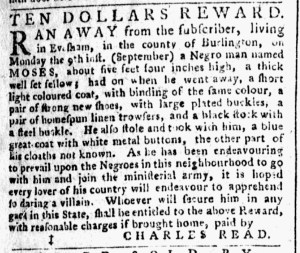
“A Negro man named MOSES … has been endeavouring to … join the ministerial army.”
Moses, an enslaved man, made his own declaration of independence in 1776 when he liberated himself by running away from his enslaver. Charles Read of Evesham, “in the county of Burlington,” New Jersey, provided a brief account in an advertisement on the front page of the October 1, 1776, edition of Dunlap’s Pennsylvania Packet. According to Read, Moses, “about five feet four inches high, a thick well set fellow,” made his escape on September 9. When he went away, he was wearing “a short light coloured coat, with binding of the same colour a pair of strong new shoes, with large plated buckles, a pair of homespun linen trowsers, and a black stock with a steel buckle.” That should have made Moses easy to recognize, but there was also a chance that he would change clothes since he “stole and took with him, a blue great-coat with white metal buttons” and “the other part of his cloaths [were] not known” to Read.
While those details were specific to Moses, his enslaver followed a formula for advertisements that described enslaved people who liberated themselves by running away. The next part of Read’s account, however, revealed that current events played a part in Moses’s decision about when to seek his freedom. Read lamented that Moses “has been endeavouring to prevail upon the Negroes in this neighbourhood” in New Jersey “to go with him to join the ministerial army.” In other words, Moses planned to join the British and encouraged other enslaved people to join him. He did not merely hope to elude his enslaver by getting away from Evesham and keeping a low profile elsewhere; instead, he aimed to secure his freedom by “join[ing] the ministerial army.” Moses almost certainly knew that nearly a year earlier John Murray, Lord Dunmore, the king’s governor in Virginia, offered freedom to enslaved people “appertaining to Rebels” (or enslaved by Patriots) in exchange for “joining his Majesty’s troops, as soon as may be.” Many enslaved men and women responded to the call, alarming and enraging both their enslavers and other residents of Virginia. The final grievance in the Declaration of Independence referred to Dunmore’s Proclamation, stating that the king “has excited domestic insurrections amongst us” by encouraging enslaved people to fight against those who enslaved them. Moses left Evesham just as the British occupation of New York began. He likely saw his best opportunity yet to secure his freedom. That gave additional urgency to Read’s efforts to capture him. Readers of Dunlap’s Pennsylvania Packet, he declared, should assist not only for the “TEN DOLLARS REWARD” but also out of a sense of patriotism. Read called on “every lover of his country [to] endeavour to apprehend so daring a villain” who had the audacity to seek his freedom by siding with those who promised him liberty rather than a life of enslavement. Moses was not the first or only such “villain” featured in newspaper advertisements during the Revolutionary War, yet stories of joining the British were not a common element of what have become known as “runaway advertisements.” Though rare, advertisements that reported enslaved people sought to join the British appeared on occasion, supplementing similar stories that circulated in conversation and in print. Read meant to condemn Moses, but the additional details he provided about the circumstances of his escape contributed to a complicated and nuanced narrative of the American Revolution.
