October 15

What was advertised in a revolutionary American newspaper 250 years ago this week?
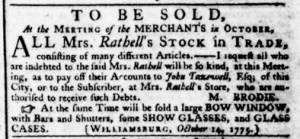
Virginia Gazette [Dixon and Hunter] (October 14, 1775).

“Will be sold a large BOW WINDOW, with Bars and Shutters, some SHOW GLASSES, and GLASS CASES.”

In the spring of 1775, Catherine Rathell, a milliner in Williamsburg, advertised her intention to “dispose of my Goods” and go to England “till Liberty of Importation is allowed.”  The Continental Association, a nonimportation agreement devised by the First Continental Congress in protest of the Coercive Acts, disrupted trade for merchants, shopkeepers, and others who sold imported goods.  When she first placed her advertisement, Rathell and the rest of the residents of Williamsburg had not yet received word of the battles at Lexington and Concord.  The outbreak of hostilities may have prompted her to adjust her plans because she did not wait until she sold all her merchandise to depart.  Instead, she left her wares in the hands of Margaret Brodie, a mantuamaker who had worked with Rathell since 1771, to sell “At theMEETING of the MERCHANTS in OCTOBER.”  The milliner did not return to Williamsburg.  Unfortunately, she died when the ship taking her to England got caught in a hurricane and sank.

Brodie’s advertisement in the October 14, 1775, edition of John Dixon and William Hunter’s Virginia Gazette concerned more than just selling Rathell’s remaining merchandise.  It also called on those indebted to Rathell to settle accounts with Brodie.  A short note at the end of the notice, marked with a manicule to draw attention, noted that “a large BOW WINDOW, with Bars and Shutters, some SHOW GLASSES, and GLASS CASES” would be sold at the same time as “Mrs. Rathell’s STOCK in TRADE.”  That provides a glimpse of Rathell’s merchandising strategies.  By the early eighteenth century, bow windows became popular features of shops in London, so common that some critics complained about the way that they jutted into the street and made it more difficult for pedestrians to pass.  Yet that was one of the intended purposes, causing prospective customers to slow down and view the merchandise on display.  In addition, bow windows offered more space for displaying goods than windows flush with exterior walls.  Some American retailers, including Rathell, adopted this strategy for marketing their wares.  Rathell also invested in glass cases to showcase some of her merchandise for visitors to her shop.  She could protect valuable items from shoplifters while still making them visible to entice customers.  Similarly, the bars on shutters on the bow window protected goods from burglars when the shop was closed.  Without contemporary visual images of American shops, Rathell’s advertisement helps reconstruct their interiors and the experience of shopping in eighteenth-century America.
April 22

What was advertised in a revolutionary American newspaper 250 years ago today?

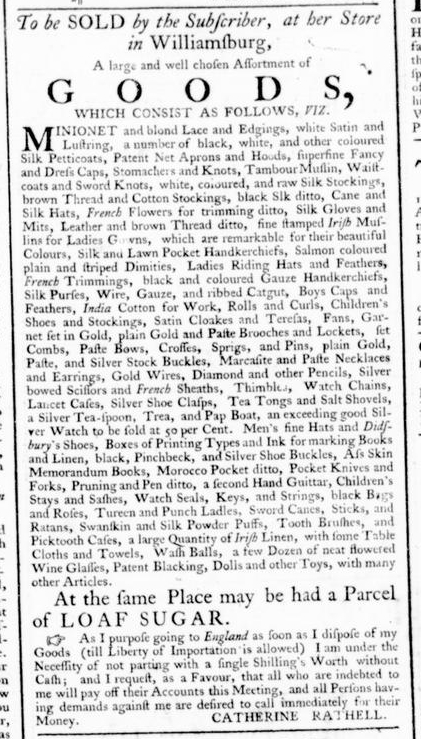
Virginia Gazette [Dixon and Hunter] (April 22, 1775).

“I purpose going to England as soon as I dispose of my Goods (till Liberty of Importation is allowed).”

In the spring of 1775, Catherine Rathell advertised a “large and well chosen Assortment of GOODS” available at her store in Williamsburg in John Dixon and William Hunter’s Virginia Gazette.  She demonstrated the choices available to consumers with a lengthy list that included “black, white, and other coloured Silk Petticoats,” “fine stamped Irish Muslims for Ladies Gowns, which are remarkable for their beautiful Colours,” “plain Gold and Paste Brooches and Lockets,” “a few Dozen of neat flowered Wine Glasses,” and “Dolls and other Toys.”

Rathell did not mention when she acquired her merchandise.  Taglines that proclaimed, “Just Imported,” or some variation of that sentiment no longer appeared in American newspapers as often as they had in recent years.  The Continental Association, a nonimportation agreement devised by the First Continental Congress in response to the Coercive Acts, had been in effect since December 1, 1774.  The shopkeeper did not state that her inventory arrived in the colony before that date, yet she suggested that was the case when she declared that she planned to go to England “as soon as I dispose of my Goods (till Liberty of Importation is allowed).”  In acknowledging the Continental Association, Rathell implied that she abided by it.

She also indicated the effect it had on her business.  She did not consider it viable to continue operating her store in Williamsburg.  She planned to close it as soon as she could liquidate her wares and visit England until regular trade resumed, not knowing when she composed her advertisement that a war for independence would disrupt commerce even more significantly.  For the moment, she insisted on cash sales instead of credit, “not parting with a single Shilling’s Worth” with payment in hand, and settling accounts with both those indebted to her and others “having demands against” her.  Except for “an exceeding good Silver Watch to be sold at 50 per Cent,” Rathell did not mention any discounts, but prospective customers may have recognized an opportunity to bargain with a shopkeeper determined to leave the colony.

November 6

What was advertised in a colonial American newspaper 250 years ago this week?

Nov 6 - 11:3:1768 Virginia Gazette Purdie and Dixon
Virginia Gazette [Purdie and Dixon] (November 3, 1768).
“All the above are fashionable, new, and good.”

Like her male counterparts, shopkeeper Catherine Rathell ran lengthy advertisements that listed all sorts of goods, especially textiles, adornments, apparel, and accessories, that she “Just imported from London” and sold at low prices. In the process of enumerating her inventory, Rathell also offered further descriptions of several items. For instance, she stocked “a large and fashionable assortment of ribands [ribbons], caps, egrets [decorative feathers], plumes, feathers, and fillets [headbands]” as well as “a neat assortment of garnet and paste, hoop, and other rings.” As these examples make clear, Rathell emphasized variety and consumer choice in her marketing efforts. Her customers did not have to be content with a narrow range of options shipped across the Atlantic. Instead, they could choose which items they liked best, even when it came to accessories like fans. Rathell sold “a very neat and genteel assortment of wedding, mourning, second mourning, and other fans.” In addition, visitors to her shop would encounter “many other articles too tedious to insert” in a newspaper advertisement.

Yet choice was not the only appeal this shopkeeper made to prospective customers. After concluding her list she underscored that “all the above goods are fashionable, new, and good.” Quality was important, but when it came to the sorts of wares that Rathell peddled fashion may have been even more important. Her customers did not have to choose from among castoffs that had lingered on shelves and not sold in London. Rathell’s merchandise was “new” as well as “fashionable.” Note that she described her assortment of fans as “genteel.” She offered the most extensive description for “breast flowers, equal in beauty to any ever imported, and so near resemble nature that the nicest eye can hardly distinguish the difference.” Here Rathell combined appeals to quality and fashion into a single description of artificial flowers intended to adorn garments according to the latest styles.

In making appeals to choice, fashion, and quality, Rathell advanced some of the most popular marketing strategies deployed by shopkeepers throughout the colonies in the middle of the eighteenth century. T.H. Breen has argued that colonists from New England to Georgia experienced a standardization of consumer culture in terms of the goods available to them. They also often experienced a standardization of advertising. Although some advertisers did introduce innovations into their marketing efforts, many relied on the most familiar means of promoting their goods to the public. Rathell’s advertisement was more than a mere announcement that she had goods for sale, but she reiterated the sorts of appeals known far and wide in colonial America.