December 4

What was advertised in a colonial American newspaper 250 years ago this week?
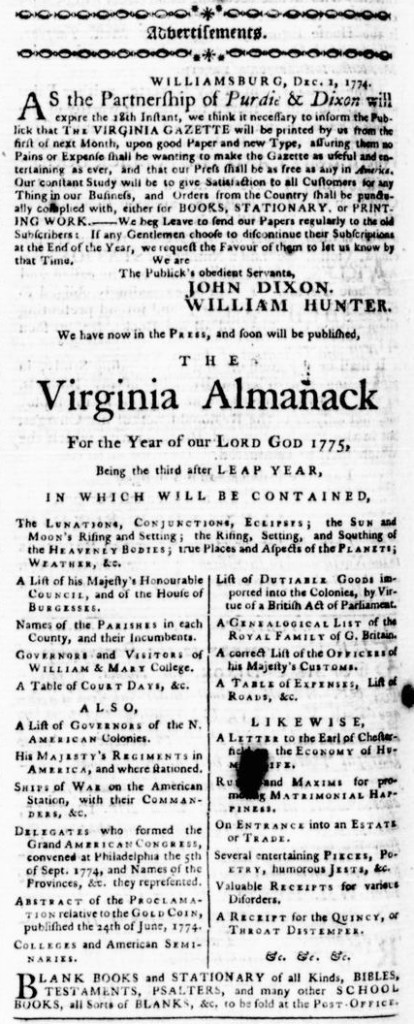
Virginia Gazette [Purdie and Dixon] (December 1, 1774).

“Our Press shall be as free as any in America.”

The first page of the December 1, 1774, edition of the Virginia Gazette featured two notices about the future endeavors of the partners who printed that newspaper.  In the first, Alexander Purdie announced his withdrawal from that partnership and outlined his plans to publish another newspaper on his own as soon as he garnered enough subscribers to make it a viable venture.  In the other, John Dixon expressed his appreciation for customers who had supported the partnership and revealed that he would continue to publish the Virginia Gazette with a new partner, William Hunter.

Although those were the only advertisements on the first page, they were not the only advertisements in that issue, nor the end of the notices inserted by the printers.  The remainder of the advertisements appeared after news and essays, commencing in the final column of the second page.  A notice placed by Dixon and Hunter led those advertisements, making clear that the new partnership would actively serve current and prospective customers.  They asserted that their newspaper “will be printed … upon good Paper and new Type.”  Beyond that investment that would benefit readers, Dixon and Hunter pledged that “no Pains or Expense shall be wanting to make this Gazette as useful and entertaining as ever.”  In other words, the newspaper would maintain the same quality that readers expected when the new management went into place.  Furthermore, they proclaimed that “our Press shall be as free as any in America.”  They hoped that would convince customers to continue their patronage, yet did not make assumptions.  “We beg Leave,” they declared, “to send put Papers regularly to the old Subscribers,” but recognized that some might not wish to renew.”  “If any Gentlemen choose to discontinue their Subscriptions at the end of the Year,” they instructed, “we request the Favour of them to let us know by that Time.”  The new partners also promoted other branches of their business, offering “BOOKS, STATIONARY, or PRINTING WORK” to residents of Williamsburg who visited their shop and customers in the country who sent orders.

That, however, did not conclude their advertisement.  Instead, Dixon and Hunter alerted readers that they would soon publish “THE Virginia Almanack For the Year of our LORD GOD 1775.”  The list of contents, intended to entice prospective customers, occupied more space than their announcement about upcoming changes in the partnership.  It contained the usual astronomical data and a selection of informative and “entertaining PIECES” along with several items related to current events.  Those included a list of “DELEGATES who formed the Grand AMERICAN CONGRESS convened at Philadelphia the 5th of Sept, 1774, and Names of the Provinces, &c. they represented,” a “List of DUTIABLE GOODS imported into the Colonies, by Virtue of a British Act of Parliament,” “His MAJESTY’S REGIMENT in AMERICA, and where stationed,” and “SHIPS of WAR on the American Station, with their COMMANDERS.”  The imperial crisis loomed large among the materials selected for inclusion in Dixon and Hunter’s almanac.  Before they began publishing the Virginia Gazette together, they disseminated information about the troubled relationship between the colonies and Britain in an almanac that customers would consult throughout the entire year of 1775.

December 1

What was advertised in a colonial American newspaper 250 years ago today?

Virginia Gazette [Purdie and Dixon] (December 1, 1774).

“I have sent Subscription Papers into all publick Places of the Country.”

Two advertisements that led the front page of the December 1, 1774, edition of Alexander Purdie and John Dixon’s Virginia Gazette provided important updates from the printers.  In the first, Purdie reported that he planned to “resign the Conduct of this Gazette” and wished to express his “sincere and most grateful Acknowledgments to all our Customers, and to the Publick in general,” for years of support.  In addition, he announced that he “shall begin doing Business for myself, and intend to print a GAZETTE as soon as I am furnished with a moderate Number of Customers.”  To entice them, he unveiled the proposed newspaper’s motto: “ALWAYS FOR LIBERTY AND THE PUBLICK GOOD.”  To acquire content, Purdie asked “the Favour of my BROTHER PRINTERS to the Northward to furnish me with their Newspapers, and they shall be sure to have mine, as soon as I begin to print.”  No doubt he and Dixon already participated in such exchanges.

Purdie planned to launch that enterprise “Immediately after Christmas,” but there was no guarantee that he would attract enough subscribers and advertisers to make a go of it.  After all, his newspaper would compete with the Virginia Gazettethat Dixon continued to publish and another Virginia Gazette printed by John Pinkney.  Was Williamsburg and the rest of the colony ready to support three newspapers?  To get a better sense of the market, Purdie “sent Subscription Papers into all publick Places of the Country” and instructed prospective customers that they could also contact him by letter or visit his printing office.  He eventually gained the “moderate Number of Customers” that he needed, though it took a couple of months before he distributed the first issue of his Virginia Gazette on February 3, 1775.  In that time, he also operated a shop where he sold books, sheet music, and stationery, pledging to circulate “a Catalogue of all my Books, &c. as soon as I possibly can.”  Purdie resorted to a variety of marketing media: newspaper advertisements, subscription papers, book catalogs.

In the second advertisement, Dixon revealed William Hunter, “Son of the late Mr. WM. HUNTER of this City, Printer,” would become his new partner in printing the Virginia Gazette and running a book and stationery shop.  He suggested that customers would experience a seamless transition, expressing his “most grateful Thanks for their many Favours” in the past, reminding them that “my Conduct, while in Company with Mr. PURDIE, met with general Approbation,” and pledging that “my future Endeavours to serve the Publick … will render me an Object worthy of their Encouragement.”  Aas Purdie sought subscribers and advertisers for his proposed newspaper, Dixon hoped to maintain the clientele they had cultivated over nearly a decade of working together.

Before perusing news articles or essays in the December 1 edition of Purdie and Dixon’s Virginia Gazette, readers first encountered two advertisements that delivered important news about the future of that newspaper and the possibility that another newspaper might soon be published in Williamsburg.  As was so often the case, printers used advertising space in their own publication to promote their enterprises, framing their work as service to the public.

November 6

What was advertised in a colonial American newspaper 250 years ago this week?

Postscript to the Virginia Gazette [Purdie and Dixon] (November 3, 1774).

“It has been thought necessary, for the publick Good, to enter into several particular Resolves.”

As the imperial crisis intensified in the fall of 1774, the distinction between news items and advertisements in colonial newspapers became blurry with greater frequency.  Such was the case with letter-advertisements expressing regret for signing “an Address to the late Governor Hutchinson, on his leaving this Province” in several newspapers in Massachusetts.  Another instance appeared in the Virginia Gazette, published by Alexander Purdie and John Dixon in Williamsburg.  On November 3, they distributed a two-page Postscript to accompany the standard four-page issue.  That supplement included nothing but advertising except, perhaps, the first item in the first column on the first page.  With a dateline that read, “EDENTON, NORTH CAROLINA, October 25, 1774,” it featured the petition signed by fifty-one women at the Edenton Tea Party and listed their names in two columns.

Those women expressed their support for resolutions protesting the Tea Act of 1773 passed by the North Carolina Provincial Congress in August.  They proclaimed, “AS we cannot be indifferent on any Occasion that appears nearly to affect the Peace and Happiness of our Country, and as it has been thought necessary, for the publick Good, to enter into several particular Resolves, by a Meeting of Members deputed from the whole Province, it is a Duty which we owe, not only to our near and dear Connections, who have concurred in them, but to ourselves, who are essentially interested in their Welfare, to do every Thing as far as lines in our Power to testify our sincere Adherence to the same; and we do therefore accordingly subscribe this Paper, as a Witness of our fixed Intention and solemn Determination to do so.” In a single sentence, the women of Edenton declared their position on current events and pledged to participate in politics through the decisions they made about consumption.  They added their voices to those who adopted nonimportation agreements.

Why did their petition appear in an advertising supplement?  Had the women involved in the Edenton Tea Party sent their petition to Purdie and Dixon to feature in the Virginia Gazette?  Probably not, but they may have submitted it to the printer of the North-Carolina Gazette in New Bern.  The few extant issues of that newspaper have not been digitized for greater accessibility, making it difficult to determine if the petition appeared in that newspaper and then Purdie and Dixon reprinted it.  After all, colonial printers constantly reprinted items from other newspapers.  The printers in Williamsburg could have received an issue of the North-Carolina Gazette with the petition from the Edenton Tea Party after they printed the November 3 edition of the Virginia Gazette but did not wish to wait a week to disseminate it in the next issue.  Take into consideration as well that news, especially “Extracts from the Votes and Proceedings of the AMERICAN CONTINENTAL CONGRESS,” filled much of the newspaper, crowding out advertisements.  The printers had reason to produce an advertising supplement, yet they may have also wished to highlight the petition signed by patriotic women in Edenton.  The “Extracts” started with an overview of the Continental Association, a nonimportation agreement, as the first news item.  The women’s petition ran as the first item in the Postscript, mirroring the placement of the Continental Association and demonstrating the commitment already expressed for such measures even before the First Continental Congress formally adopted them.  At a glance, it looked like another advertisement among those in the Postscript, yet it delivered important news to readers.

August 12

What was advertised in a colonial American newspaper 250 years ago today?

Virginia Gazette [Purdie and Dixon] (August 12, 1773).

“PROPOSALS FOR PRINTING A WEEKLY NEWSPAPER, AT NORFOLK.”

It was a busy year for proposing and establishing new newspapers in the colonies.  In 1773, printers in several colonies announced their intentions to publish new newspapers, some in towns that did not yet have their own newspapers and others in places already served by one or more newspapers.  The first new newspaper of the year appeared in New York following an extensive campaign to attract subscribers in the city and far beyond.  James Rivington distributed the first issue of Rivington’s New-York Gazetteer; or the Connecticut, New-Jersey, Hudson’s-River, and Quebec Weekly Advertiser on April 22, 1773.  Alexander Robertson, James Robertson, and John Trumbull sought subscribers during the summer and began publishing the Norwich Packet and the Connecticut, Massachusetts, New-Hampshire, and Rhode-Island Weekly Advertiser in the fall.  The first newspaper published in Norwich, it became the fourth published in Connecticut at the time.  In Baltimore, William Goddard launched the Maryland Journal and the Baltimore Advertiser on August 20 after disseminating subscription proposals for many months.  It was the first newspaper in a city not yet prepared for two weekly publications.  Robert Hodge and Frederick Shober did not manage to attract enough subscribers to make their proposed newspaper a viable venture.

William Duncan hoped for a different outcome when he placed “PROPOSALS FOR PRINTING A WEEKLY NEWSPAPER, AT NORFOLK,” in the August 12 edition of Purdie and Dixon’s Virginia Gazette.  Duncan hoped to gather enough subscribers to support the Norfolk Gazette and Virginia Advertiser.  If successful, it would be the first newspaper published in that town and the first one published in Virginia beyond Williamsburg.  Duncan indicated the cost for both subscriptions and advertisements “will be the same as those published in WILLIAMSBURG” in Purdie and Dixon’s Virginia Gazette and Rind’s Virginia Gazette.  According to the colophons in both newspapers, subscriptions cost twelve shillings and six pence per year and advertisements “of a moderate Length” ran for three shillings for the first week and then two shillings for each additional insertion.  Duncan pledged to subscribers that he would devote “Attention to their Interest, by procuring the earliest Intelligences” and selecting only “what may be really useful as well as entertaining” while avoiding filler that did not matter to readers.

To aid in this endeavor, “SUBSCRIPTIONS will be taken in by the different GENTLEMEN instructed with PROPOSALS,” a common practice for gauging interest in books, newspapers, magazines, and other publications in early America.  Printed proposals usually included both an overview of the purpose of the publication, the plan for taking it to press, and the conditions for subscribing, including cost and descriptions of the paper and type.  In his newspaper advertisement, Duncan acknowledged that a “Specimen or Paper, Size, and Arrangement, may be expected by some” who wished to examine a sample before subscribing.  However, he had not yet arrived in Virginia and in his absence “does not purpose that any Thing of that Nature should be shown until he carries the Work into Execution.”  Such circumstances may have made some prospective subscribers wary.  William Duncan and Company did eventually distribute the first edition of the Virginia Gazette or Norfolk Intelligencer on June 9, 1774, ten months after the subscription proposals first appeared in Purdie and Dixon’s Virginia Gazette in Williamsburg.  Duncan began working on the project in the summer of 1773, but it took the better part of a year to commence publication.

July 18

What was advertised in a colonial American newspaper 250 years ago this week?

Virginia Gazette (July 15, 1773).

“He hath provided every Thing for the Accommodation of Gentlemen, their Servants, and Horses.”

Daniel Grant, the proprietor of the “INN and TAVERN, at the Sign of the Fountain” in Baltimore, expanded his advertising campaign.  That city did not yet have a newspaper, though subscriptions proposals circulated in hopes of establishing one, so the proprietor of the inn and tavern resorted to advertising in newspapers published in Annapolis and Philadelphia.  Even if Baltimore did have a newspaper at the time that Grant opened his doors to “the Publick,” he likely would have placed notices in newspapers published in other cities in the region.  Colonizers in and near Baltimore would have learned of the new inn and tavern as they traversed the streets of the city and conversed with friends and acquaintances.  Advertisements in newspapers published in Annapolis and Philadelphia, on the other hand, helped to entice readers who might travel to Baltimore.  In addition, Grant previously “kept TAVERN at the Sign of the BUCK, near PHILADELPHIA.”  Advertisements in the Pennsylvania Packet likely reached former patrons familiar with his reputation.

Prospective patrons in Williamsburg and throughout the rest of Virginia may not have been familiar with the tavern at the Sign of the Buck, unless they had happened to travel to Philadelphia, but Grant likely expected that the fact that he had experience operating a tavern would resonate with colonizers in Virginia who might have cause to venture to Baltimore.  His expression of “grateful Thanks to the Gentlemen who did him the Honour to frequent his former House” doubled as a testimonial to his experience.  Noting that he had regulars at the Sign of the Buck suggested that he provided satisfactory service that convinced patrons to return.  In his new establishment, he needed to cultivate a new clientele, both locals and travelers.  To thatend, the innkeeper and tavernkeeper invested in an advertisement in Purdie and Dixon’s Virginia Gazette, extending the reach of his marketing to readers served by that newspaper.  The copy matched what already appeared in the Maryland Gazette and the Pennsylvania Packet, promising that Grant “hath provided every Thing for the Accommodation of Gentlemen, their Servants, and Horses, in the best Manner.”  Rather than seek out food and lodging when they arrived in Baltimore, Grant wanted travelers from Virginia to anticipate staying at the Sign of the Fountain.

June 10

What was advertised in a colonial American newspaper 250 years ago today?

Virginia Gazette [Purdie and Dixon] (June 10, 1773).

“A CATALOGUE of BOOKS, STATIONARY, &c.”

Alexander Purdie and John Dixon, the printers of the Virginia Gazette, placed a full-page advertisement in the June 10, 1773, edition of their newspaper.  Their “CATALOGUE of BOOKS, STATIONARY, &c. To be SOLD at the PRINTING OFFICE, WILLIAMSBURG,” occupied the entire third page.  While rare, full-page advertisements were not unknown in eighteenth-century newspapers.  Printers and booksellers, especially newspaper printers who also sold books, most frequently adopted this format, but merchants and shopkeepers sometimes utilized it as well.

Purdie and Dixon’s catalog consisted of four columns with one title per line throughout most of it.  They organized the entries first by size, with headings for “FOLIOS,” “QUARTOS,” “OCTAVOS,” and “DUODECIMOS.”  Within each category, the printers arranged the entries roughly in alphabetical order according to the author’s name or the title of the book.  They also had auxiliary categories for “FRENCH SCHOOL BOOKS,” “GREEK SCHOOL BOOKS,” and “LATIN SCHOOL BOOKS,” in the fourth column.  To conserve space, titles of school books, many of them familiar to prospective customers, appeared in paragraphs rather than each receiving its own line.  Rather than a header for “STATIONERY” (or “STATIONARY” as it was most commonly spelled in the eighteenth century), a line indicated where the list of writing supplies and other items began.  There, once again, Purdie and Dixon listed only one item per line to help prospective customers navigate their catalog.

In addition to inserting their catalog in their newspaper, Purdie and Dixon may have published it separately and distributed it via other means, as they seemingly had done on at least one previous occasion.  They could have passed it out to customers who visited their printing office.  Treating it as a broadside, the printers could have posted it around town or made arrangements for associates in other towns to hang it in their stores and shops.  They may even have folded it over, sealed and addressed it, and had it delivered to prospective customers, though printers and others experimented with circular letters less often than they distributed broadsides, handbills, and catalogs in the eighteenth century.  The catalog might have appeared solely in the Virginia Gazette, but given the printers’ access to the press and their other efforts to distribute book catalogs it seems more likely that they published and disseminated this catalog separately as well.

January 24

What was advertised in a colonial American newspaper 250 years ago this week?

Virginia Gazette [Purdie and Dixon] (January 21, 1773).
“He likewise makes Head Dresses for Ladies, so natural as not to be distinguished by the most curious Eye.”

George Lafong described himself as a “Hair Cutter and Dresser” in an advertisement he placed in the January 21, 1773, edition of the Virginia Gazette.  He aimed to generate business by suggesting that he already served a satisfied clientele, extending his “humble Thanks to such Ladies and Gentlemen as have been pleased to honour him with their Commands.”  In addition, he invited new clients to engage his services.

Lafong deployed several appeals in his efforts to convince residents of Williamsburg and nearby towns to hire him.  For instance, he did not require that clients visit his shop.  Instead, they could schedule appointments in advance “by giving timely Notice” and the hairdresser traveled to their homes and “waited upon [them] at any Distance from Town.”  He did not charge exorbitant prices, but instead set “very reasonable Terms” for such excursions.

In addition, Lafong promoted an associate that he recently hired, reporting that he “has engaged a Man from London who dresses in the newest and most elegant Taste.”  That gave Lafong an advantage over other hairdressers who relied on correspondence to learn about the latest trends in the cosmopolitan center of the empire.  His associate had firsthand knowledge and experience with the latest styles in London.  That advantage transferred to clients; not only did their appearance testify to making good choices in selecting a hairdresser but they could also boast about that hairdresser to friends and acquaintances.

In case that was not enough to convince prospective clients, Lafong also indicated that someone in his shop, either his new associate or Lafong himself, “makes Head Dresses for Ladies, so natural as not to be distinguished by the most curious eye.”  In other words, he created wigs and extensions, such as the popular high roll, that withstood close scrutiny.  Observers would not be able to tell which portions, if any, of his client’s hairstyle was not her actual hair.  Such authenticity helped in projecting grace, elegance, and other genteel attributes.

Fashion found its way to places far removed from London as colonizers participated in a transatlantic consumer revolution in the eighteenth century.  Hairdressers offered their services in major urban ports, like Charleston, New York, and Philadelphia, while also seeking to generate demand among prospective clients in the countryside “any Distance from Town.”  Fashion, both as a practice and as a motivation, was not confined to early American cities.

December 13

What was advertised in a colonial American newspaper 250 years ago this week?

Virginia Gazette [Purdie and Dixon] (November 26, 1772).

“In your Gazette of the 26th Ultimo, I observe and Advertisement signed by Alexander Wodrow.”

Colonizers placed newspaper advertisements to serve a variety of purposes.  They hawked consumer goods and services.  They described enslaved people who liberated themselves by running away and offered rewards for their capture and return.  They called on debtors and creditors to settle accounts with the executors of estates.  They offered real estate for sale.  They notified readers about stray livestock to claim.

Some colonizers used advertisements to pursue feuds with others or to defend their reputations to the public.  Such was the case with notices placed by Alexander Wodrow and William Love, both of Falmouth, in Alexander Purdie and John Dixon’s Virginia Gazette in November and December 1772.  It began with a “letter” addressed to the printers but placed among the paid notices in the November 26 edition.  Wodrow asked the printers “to acquaint the Publick that William Love, by the Connivance of David Kerr,” Wodrow’s former attorney, “has this Day in his Possession an accepted Note for near two Hundred Pounds, drawn by Kerr on Mr. Gavin Lawson, and accepted by Mr. Lawson, payable to William Love, and Company.”  Furthermore, “the said Note was fraudulently obtained” and accepted by Lawson “inadvertently.”  Wodrow did not specify his relationship to Lawson or his interest in the matter.

Virginia Gazette [Purdie and Dixon] (December 10, 1772).

That did not matter to Love.  What did matter was that his reputation had been impugned in the public prints.  In response, he dispatched his own “letter” to the printers.  It appeared among other paid notices in column with a header that read, “Advertisements,” in the December 10 edition.  Love cited the Wodrow’s advertisement, directing the printers (and readers) to “your Gazette of the 26th Ultimo.”  For those who had not seen the previous advertisement and did not have access to the newspaper from two weeks ago, Love provided a summary of Wodrow’s allegations.  He then declared that “the said Note is still in my Hands.”  To defend his reputation, he invited “any Persons who will give themselves the Trouble to inquire into the Matter of Mr. Gavin Lawson, or the Gentlemen of Falmouth” to consult with Love directly.  Upon doing so, Love was convinced that they would “be satisfied that there was no Fraud done or intended in this Transaction.”  Even if no readers went to “the Trouble” of contacting Love for more information, he did not allow Wodrow the sole power of framing their dispute in the public prints.

It was a convoluted story.  A significant sum and, just as valuable, the reputations of several colonizers were on the line.  Dressing up their notices as letters to the printers and purchasing space in a newspaper gave both Wodrow and Love an opportunity to air their grievances, warn others of a potentially fraudulent note, and defend their reputations to the broader public beyond their local community in Falmouth.  Purdie and Dixon published updates from London, Boston, Philadelphia, Charleston, and Williamsburg in the section of the newspaper devoted to news, but readers sometimes encountered accounts of local affairs, like the quarrel in Falmouth, among the advertisements.

December 6

Who was the subject of an advertisement in a colonial American newspaper 250 years ago this week?

Virginia Gazette [Purdie and Dixon] (December 3, 1772).

To be HIRED for a Year, and delivered on New Year’s Day, FOUR Negro MEN, five young WOMEN, and a BOY.”

As the new year approached in December 1772, “FOUR Negro MEN, five young WOMEN, and a BOY” faced the prospects of their living and working conditions changing significantly, though they may not have been aware that was the case.  Anne Blair took to the pages of Alexander Purdie and John Dixon’s Virginia Gazette to advertise that she offered those enslaved people “To be HIRED for a Year, and delivered on New Year’s Day.”  In other words, she did not seek to sell them to other enslavers but instead “rent” them, just as she offered a plantation in Prince George County “to be rented, for a Year, or Years.”  Blair did not provide any additional details about the enslaved men, women, and boy.  She did not list their skills or occupations, nor did she mention whether any of them were relations who risked separation upon being “HIRED for a Year.”

Blair was not alone in acting as an absentee enslaver who sought to collect the wages earned by enslaved people hired out to other colonizers.  On the same day that her advertisement appeared in the Virginia Gazette, a notice about a “smart, sensible” enslaved woman, “Who is a good Sempstress, a plain Cook, and extreamly well qualified to do every Business about a House,” ran on the first page of the South-Carolina Gazette.  The advertisement advised that the woman was “To be Sold, or hired by the Month.”  The shorter term meant more flexibility for any colonizer who “hired” the enslaved woman.  It did not take into account anything that she might think about the arrangement.  All that mattered was the convenience of “her present Proprietor,” an anonymous advertiser who depended on the printers to act as intermediaries and brokers.  That “Proprietor” stated that he wished to sell or hire out the enslaved woman only because “he has no Employment for her” in his own household.

Before, during, and after the era of the American Revolution, enslaved people faced upheavals in their lives beyond the buying and selling undertaken by enslavers.  Many also experienced the hiring out system, an alternate form of extracting their labor while treating them as commodities rather than people.  The early American press played a role in perpetuating those practices.  Newspaper advertisements and the printers who published them facilitated various forms of buying, selling, trading, and hiring out enslaved people.

November 15

Who was the subject of an advertisement in a colonial American newspaper 250 years ago this week?

Virginia Gazette [Purdie and Dixon] (November 12, 1772).

“NED, a Mulatto Fellow belonging to me, intends procuring a Passage in some Vessel or other to get out of the Colony.”

Alexander Purdie and John Dixon generated significant revenue for the Virginia Gazette by publishing advertisements about enslaved people.  The November 12, 1774, edition, for instance, carried fourteen such advertisements.  Five of them presented enslaved men, women, and children for sale.  The remainder concerned enslaved people who attempted to liberate themselves by running away from the colonizers who held them in bondage.  Four of the advertisements provided description of fugitives seeking freedom and offered rewards for their capture and return, including one about Edith who escaped from her enslaver “upwards of two Years ago.”  Jailers published four other advertisements in which they described Black men “COMMITTED” to their jails and called on their enslavers “to pay Charges, and fetch [them] away.”

The final advertisement also concerned enslaved people who attempted to liberate themselves, but it did not document an attempt already made.  Instead, Giles Samuel, Sr., sought to preemptively foil any plans made by Ned, “a Mulatto Fellow belonging to [him].”  The enslaver confided that he had “great reason to believe” that Ned “intends procuring a Passage in some Vessel or other to get out of the Colony.”  Samuel believed that Ned had been working toward that goal by “endeavouring to obtain a Pass” in order that he “may pass for a Freeman” and make good on his escape.  In response, the enslaver made a declaration that appeared in many advertisements that described enslaved men and women who liberated themselves: “I hereby caution all Masters of Vessels from carrying him off at their Peril.”  By “Peril,” Samuel did not mean that Ned posed any danger but rather that the enslaver would invoke laws designed to punish anyone who assisted enslaved people in liberating themselves.  Colonizers understood something that the phrase “liberating themselves” does not fully capture.  Black men and women who liberated themselves by running away and remaining hidden or beyond the reach of their enslavers often did so with the aid of family, friends, and others in extended communities.

That made some enslavers all the more vigilant.  Samuel suspected that Ned already had a plan in motion.  Rather than wait for the enslaved man to run away and then run advertisements, Samuel issued a warning to anyone who might aid him in acquiring a forged pass or leaving the colony.  In so doing, he deployed the power of the press to maintain his authority over the enslaved man, one more factor that worked to the advantage of enslavers in the era of the American Revolution.