November 25

What was advertised in a revolutionary American newspaper 250 years ago today?
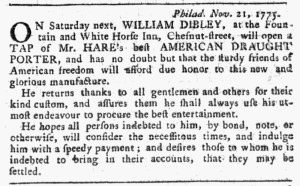
Pennsylvania Evening Post (November 25, 1775).

“WILLIAM DIBLEY … will open a TAP of Mr. HARE’s best AMERICAN DRAUGHT PORTER.”

William Dibley was no stranger to advertising his tavern in the public prints.  In February 1775, he announced that he “removed from the Cross Keys … to the Fountain and Three Tuns.”  Both were located on “Chesnut-street” in Philadelphia, so his regular patrons did not have to go far to continue enjoying Dibley’s hospitality, yet he made sure that both “his Friends in particular and the public in general” knew about the “considerably improved” amenities available at his new location.

Nine months later, Dibley ran an advertisement in which he “returns thanks to all gentlemen and others for their kind custom, and assures them he shall always use his utmost endeavour to procure the best entertainment.”  By that time, he updated the name of his establishment to the Fountain and White Horse Inn, perhaps an effort to retain some continuity with a device, the Fountain, that had marked the location while simultaneously distinguishing his business from the one that Anthony Fortune previously operated at the same location, exchanging the Three Tuns for the White Horse.  Dibley’s expression of gratitude suggested that patrons continued gathering at his tavern when he rebranded it.

He aimed to give them more reasons to gather at the Fountain beyond the amenities he highlighted in his earlier advertisement, proclaiming that on Saturday, November 25, he would “open a TAP of Mr. HARE’s best AMERICAN DRAUGHT PORTER.”  This porter was for patriots!  Dibley declared that he “has no doubt but that the sturdy friends of American freedom will afford due honor to this new and glorious manufacture.”  As George Washington and the American army continued the siege of Boston and the Second Continental Congress continued meeting in Philadelphia, Dibley offered an opportunity for supporters of the American cause to drink a porter brewed in the colonies as they gathered to socialize and discuss politics at his tavern.  The tavernkeeper made the porter, a new product, the highlight of a visit to the Fountain, announcing when he would “open a TAP” to create anticipation among prospective patrons.  They may have expected an informal ceremony and a round of toasts to mark the occasion, another enticing reason to visit the Fountain on that day.  Consumption certainly had political overtones at the time.  Dibley tapped into the discourses about purchasing American goods when he marketed a visit to his tavern,
July 29

What was advertised in a revolutionary American newspaper 250 years ago today?

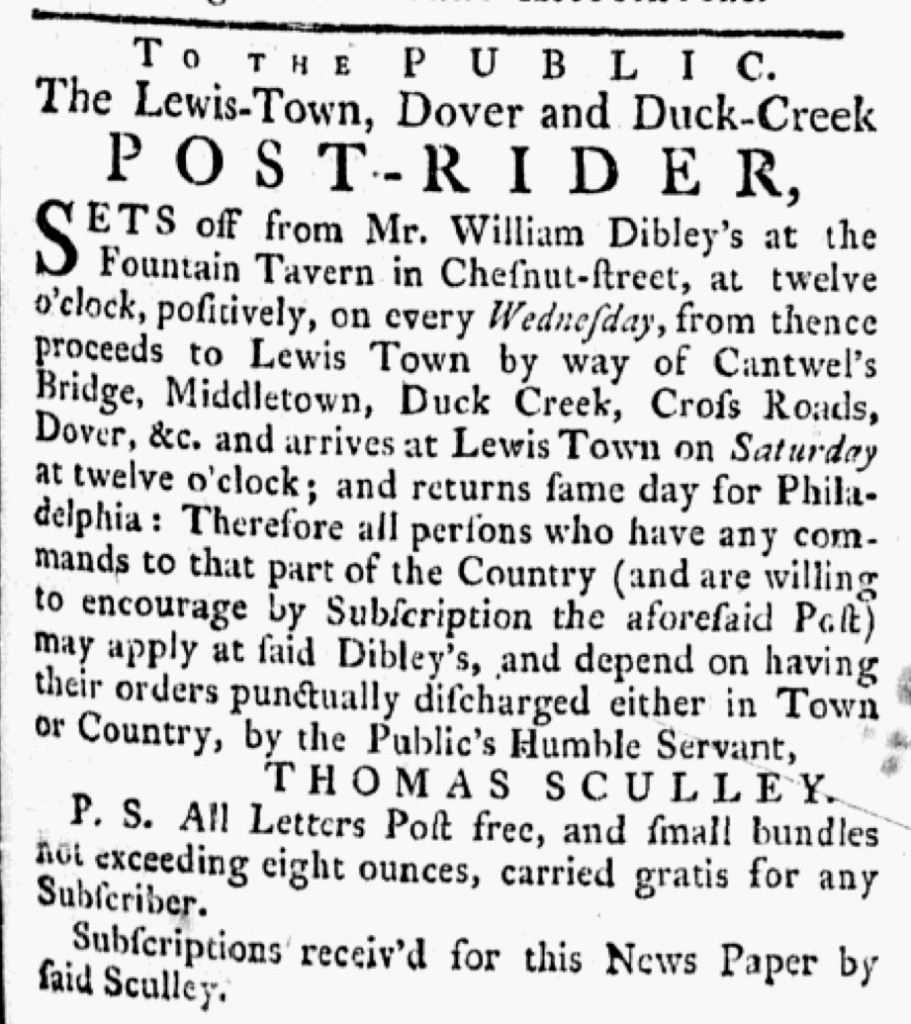
Pennsylvania Ledger (July 29, 1775).

“All Letters Post free, and small bundles not exceeding eight ounces, carried gratis for any Subscriber.”

As the Revolutionary War commenced, Thomas Sculley, a post rider, followed a route that connected several towns in Delaware to Philadelphia.  At noon on every Wednesday, he departed from William Dibley’s Fountain Tavern on Chestnut Street and made for Lewis Town (now Lewes).  He stopped at Middletown, Dover, and other towns along the way, delivering letters, newspapers, and packages.  That took three days.  Sculley arrived at Lewis Town by noon on Saturday and started the return trip later the same day.  Presumably he made it to Philadelphia on Tuesday, giving customers an opportunity to consult with him at the Fountain Tavern.

Sculley placed an advertisement for his services in the July 29, 1775, edition of the Pennsylvania Ledger.  Like some other post riders, he did not charge solely by the letter, package, or newspaper subscription but instead marketed a subscription service.  Subscribers paid a set fee on a regular basis whether they made use of the service or not.  In return, they could post as many letters as they wished as well as send “small bundles not exceeding eight ounces.”  Anything else incurred additional charges.  Even if customers did not use Sculley’s service every time he rode between Philadelphia and Lewes, the subscription fee could have been a bargain compared to paying for each letter or package each time.  In addition, Sculley intended for subscriptions, if paid on time, to yield steady income that made serving his route possible. Prospective customers who wanted to make sure that a post rider was available when they desired needed to support the enterprise with their subscriptions, not just when they had letters and packages to send.

Sculley also accepted subscriptions for the Pennsylvania Ledger.  He may have also delivered other newspapers printed in Philadelphia at the time, including Dunlap’s Pennsylvania Packet, the Pennsylvania Evening Post, the Pennsylvania Gazette, and the Pennsylvania Journal.  Subscriptions to his service also supported dissemination of news about the imperial crisis, the hostilities that had recently commenced in Massachusetts, the meeting of the Second Continental Congress in Philadelphia, and reactions from throughout the colonies.  Post riders like Thomas Sculley played an important role in the communications infrastructure that disseminated news during the era of the American Revolution.

February 18

What was advertised in a colonial American newspaper 250 years ago today?

Pennsylvania Ledger (February 18, 1775).

“The Fountain and Three Tuns, … [an] old accustomed and commodious tavern.”

When William Dibley, an experienced tavernkeeper, became the proprietor of the Fountain and Three Tuns in Philadelphia in February 1775, he placed an advertisement in the Pennsylvania Ledger to promote some of the amenities available at his new location.  He hoped that a variety of conveniences would encourage prospective patrons to visit the Fountain and Three Tuns.

Dibley made some of the most common appeals that appeared in advertisements for inns and taverns during the era of the American Revolution.  He highlighted the hospitality that he offered to guests, pledging that they would receive “the most civil treatment.”  He served “the best of liquors and provisions” in a “commodious tavern” that he had “considerably improved” or renovated for the comfort of his patrons.

Those improvements included updating the stables to accommodate sixty horses.  Travelers who visited Philadelphia could expect to find space for their horses in Dibley’s stables while they enjoyed their time at the Fountain and Three Tuns.  Those stables had easy access to the streets of Philadelphia via a “convenient passage either from Market or Chesnut streets.”  For affluent patrons, the tavernkeeper also had a “house for carriages.”

The tavernkeeper provided other services to entice merchants and others to visit the Fountain and Three Tuns, including messengers dispatched to other towns every Wednesday.  One “goes through Newark [in Delaware] to Nottingham [in Maryland],” carrying “packages and orders” to colonies to the south.  The other headed to the west, going “through Goshen to Strasburg, in Lancaster County.”  In addition, the “Virginia and Baltimore posts also call at the said inn every week.”  Dibley positioned the Fountain and Three Tuns at the center of networks for conducting commerce.

Dibley certainly hoped that his reputation would attract former customers and “his Friends in particular” who knew him from the Cross Keys on Chestnut Street.  His advertisement advised them that they could expect the same level of service at his new location.  Yet the tavernkeeper did not merely wish to transfer his current clientele from one establishment to another.  His extensive advertisement notified both locals and travelers of the many reasons they should choose the Fountain and Three Tuns over other inns and taverns in Philadelphia.