February 27

What was advertised in a revolutionary American newspaper 250 years ago today?

Pennsylvania Evening Post (February 27, 1776).

“BOTTLES wanted by ROBERT HARE and Co. at their Porter Brewery.”

During the first year of the Revolutionary War, Robert Hare and Company gained a following for “HARE’s best AMERICAN DRAUGHT PORTER.”  Hare, the son of an English brewer, arrived in Philadelphia in 1773.  He established a brewery, reportedly the first to produce porter in the colonies.  As the imperial crisis intensified and Americans leveraged their participation in the marketplace for political purpose, Hare’s porter became a popular alternative to imported beer.

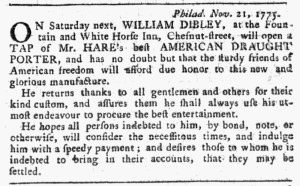
Tavernkeepers, innkeepers, and others promoted Hare’s porter when they invited patrons to their establishments.  In the November 25, 1775, edition of the Pennsylvania Evening Post, for instance, William Dibley, the proprietor of the Fountain and White Horse Inn, announced that he would soon “open a TAP” of Hare’s porter and declared that he “has no doubt but that the sturdy friends of American freedom will afford due honor to this new and glorious manufacture.”  Not long after that, Patrick Meade invited the “TRUE FRIENDS to LIBERTY” to the Harp and Crown in Southwark, just outside of Philadelphia, to enjoy “HARE’s and Co. AMERICAN PORTER, which he will sell in its purity.”  Rather than offer a selection of beverages, he stated that he “intends no beer of any other kind shall enter his doors.”  As far as Meade was concerned, it was the only beer for the “Associators of Freedom.”  He hoped they would “give the encouragement to the American Porter it deserves.”  Joseph Price also served Hare’s porter “in the greatest purity and goodness” to “all the SONS of AMERICAN LIBERTY” at the “sign of the Bull and Dog” in Philadelphia.  Jeremiah Baker served Hare’s porter at the “sign of Noah’s Ark.”  Lewis Nicola opened an “AMERICAN PORTER HOUSE” where he no doubt served Hare’s porter.

With all that buzz for their beer, Hare and Company did not need to advertise in the public prints, at least not to gain customers.  They did, however, need supplies.  At the end of February 1776, the brewers placed an advertisement soliciting bottles “at their Porter Brewery.”  Readers could show their support for the American cause by drinking Hare’s porter, but that was not the only way.  They could also supply the brewery with bottles to aid in distributing the porter to even more consumers who wanted to drink beer produced in America rather than imported from England.

January 23

What was advertised in a revolutionary American newspaper 250 years ago today?

Pennsylvania Evening Post (January 23, 1776).

“HARE’s BEST AMERICAN DRAUGHT PORTER.”

Brand recognition usually was not an element of eighteenth-century advertisements, yet there were exceptions.  Consumers knew a variety of patent medicines by name, in part from the frequency of advertisements in American advertisements.  For instance, retailers regularly ran notices that promoted Keyser’s Pills for treating venereal disease.  The same went for almanacs, such as “POOR WILL’s POCKET ALMANACK” advertised in the January 23, 1776, edition of the Pennsylvania Evening Post.  In the same issue, Edward Jollie, a tobacconist, advertised “IRISH SNUFF” and “SCOTS SNUFF,” but those monikers referred to the style rather than the producer.  Like most consumer goods, they did not have a brand name associated with them.

That newspaper, however, also featured advertisements for a product that had recently achieved brand recognition, at least in and near Philadelphia.  Lewis Nicola once again ran his advertisement for the “AMERICAN PORTER HOUSE” that he operated on Water Street.  He no doubt served “HARE’s BEST AMERICAN DRAUGHT PORTER,” the local brew that William Dibley, Patrick Meade, and Joseph Price all advertised that they served to “the sturdy friends of American freedom,” “the Associators of Freedom,” and “the SONS of AMERICAN LIBERTY” at their establishments.  Immediately to the left of Nicola’s advertisement, another local tavernkeeper announced that he also served porter produced at Robert Hare’s brewery.  Jeremiah Baker took to the pages of the Pennsylvania Evening Post to announce to “his friend and customers, that he has laid in a stock of HARE’s BEST AMERICAN DRAUGHT PORTER” at his tavern “at the sign of Noah’s Ark” on Front Street.  Baker pledged that he served the Hare’s porter “in its greatest purity,” signaling that he did not water down the drinks, but did not consider it necessary to say anything else about the porter.  The name, all in capital letters to attract attention, spoke for itself, an early example of brand recognition.

January 7

What was advertised in a revolutionary American newspaper 250 years ago this week?

Pennsylvania Evening Post (January 6, 1776).

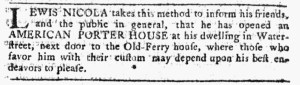
“He has opened an AMERICAN PORTER HOUSE.”

During the first week of 1776, Lewis Nicola took to the pages of the Pennsylvania Evening Post “to inform his friends, and the public in general, that he has opened an AMERICAN PORTER HOUSE at his dwelling in Water-street” in Philadelphia.  He promised that “those who favor him with their custom may depend upon his best endeavors to please.

Nicola assumed that readers knew who brewed the porter that he served at his establishment.  After all, “Mr. HARE’s best AMERICAN DRAUGHT PORTER” had been the subject of several advertisements that recently ran in the Pennsylvania Evening Post.  William Dibley served “this new and glorious manufacture” at the Fountain and White Horse Inn on Chestnut Street.  Joseph Price encouraged “all the SONS of AMERICAN LIBERTY” to drink “Messrs. HARE’s and Co. best DRAUGHT and BOTTLED AMERICAN PORTER” at his tavern “at the sign of the Bull and Dog” on Market Street.  Similarly, Patrick Meade offered “Messrs. HARE and Co. AMERICAN PORTER” to “the TRUE FRIENDS to LIBERTY” at the Harp and Crown in nearby Southwark.

Robert Hare, the son of an English brewer who specialized in porter, arrived in Philadelphia in 1773.  He established his own brewery where he brewed porter, “the first person to brew the drink in America.”  The timing worked well for Hare; he commenced brewing American porter as the imperial crisis intensified and the Revolutionary War began.  Colonizers looked to support local enterprises by purchasing “domestic manufactures” while they boycotted goods imported from England.  That positioned Hare’s brewery for success.

Just as significantly, consumers liked his porter (unlike some of the substitutes for imported tea that some colonizers concocted).  When John Adams attended the First Continental Congress in the fall of 1774, he lauded Hare’s porter in a letter to Abigail: “I drink no Cyder, but feast upon Phyladelphia Beer, and Porter.  A Gentleman, one Mr. Hare, has lately set up in this City a Manufactory of Porter, as good as any that comes from London.  I pray We may introduce it into the Massachusetts.  It agrees with me, infinitely better than Punch, Wine, or Cyder, or any other Spirituous Liquor.”  With Hare’s porter having such a reputation, Nicola did not need to mention the brewer when he opened his “AMERICAN PORTER HOUSE.”  The public knew the porter came from Hare’s brewery.

December 9

What was advertised in a revolutionary American newspaper 250 years ago today?

Pennsylvania Evening Post (December 9, 1775).

“He will open a TAP of Messrs. HARE’s and Co. AMERICAN PORTER.”

Patrick Meade aimed to create some anticipation among prospective patrons who might visit his tavern, the Harp and Crown, in Southwark on the outskirts of Philadelphia.  In an advertisement that first appeared in the Pennsylvania Evening Post on December 5, 1775, he announced that “on Saturday the ninth … he will open a TAP of Messrs. HARE and Co. AMERICAN PORTER.”  Hare and Company had been building a reputation for their brew.  Two weeks earlier, William Dibley, the proprietor of the Fountain and White Horse Inn in Philadelphia, advertised that he “will open a TAP of Mr. HARE’s best AMERICAN DRAUGHT PORTER.”  Meade’s advertisement ran again on December 9, the day he tapped the celebrated porter.

Meade and Dibley deployed similar marketing strategies to entice “gentlemen and others” to visit their establishments and drink Hare and Company’s porter.  Dibley proclaimed that he “has no doubt but that the sturdy friends of American freedom will afford due honor to this new and glorious manufacture.”  Meade addressed “the TRUE FRIENDS to LIBERTY” and emphasized his location, “situated in the center of the Ship and Stave Yards,” and declared that he “expects the Associators of Freedom will give the encouragement to the American Porter it deserves.”  Meade went all in on promoting Hare and Company’s porter, asserting that “he intends no beer of any other kind shall enter his doors,” especially not porters and other beers imported from England.  The tavernkeeper made a porter brewed in America the exclusive choice for his patron, likely expecting that the lack of other options mattered less to prospective patrons when they gather to drink, socialize, and discuss politics and current events than demonstrating their patriotism by consuming a porter brewed in America.  Meade stated that he would sell Hare and Company’s “AMERICAN PORTER … in its purity,” signaling the quality of the beverage.  Meade issued both an invitation and a challenge: who could desire any beer other than one brewed in America in support of the American cause?

November 25

What was advertised in a revolutionary American newspaper 250 years ago today?

Pennsylvania Evening Post (November 25, 1775).

“WILLIAM DIBLEY … will open a TAP of Mr. HARE’s best AMERICAN DRAUGHT PORTER.”

William Dibley was no stranger to advertising his tavern in the public prints.  In February 1775, he announced that he “removed from the Cross Keys … to the Fountain and Three Tuns.”  Both were located on “Chesnut-street” in Philadelphia, so his regular patrons did not have to go far to continue enjoying Dibley’s hospitality, yet he made sure that both “his Friends in particular and the public in general” knew about the “considerably improved” amenities available at his new location.

Nine months later, Dibley ran an advertisement in which he “returns thanks to all gentlemen and others for their kind custom, and assures them he shall always use his utmost endeavour to procure the best entertainment.”  By that time, he updated the name of his establishment to the Fountain and White Horse Inn, perhaps an effort to retain some continuity with a device, the Fountain, that had marked the location while simultaneously distinguishing his business from the one that Anthony Fortune previously operated at the same location, exchanging the Three Tuns for the White Horse.  Dibley’s expression of gratitude suggested that patrons continued gathering at his tavern when he rebranded it.

He aimed to give them more reasons to gather at the Fountain beyond the amenities he highlighted in his earlier advertisement, proclaiming that on Saturday, November 25, he would “open a TAP of Mr. HARE’s best AMERICAN DRAUGHT PORTER.”  This porter was for patriots!  Dibley declared that he “has no doubt but that the sturdy friends of American freedom will afford due honor to this new and glorious manufacture.”  As George Washington and the American army continued the siege of Boston and the Second Continental Congress continued meeting in Philadelphia, Dibley offered an opportunity for supporters of the American cause to drink a porter brewed in the colonies as they gathered to socialize and discuss politics at his tavern.  The tavernkeeper made the porter, a new product, the highlight of a visit to the Fountain, announcing when he would “open a TAP” to create anticipation among prospective patrons.  They may have expected an informal ceremony and a round of toasts to mark the occasion, another enticing reason to visit the Fountain on that day.  Consumption certainly had political overtones at the time.  Dibley tapped into the discourses about purchasing American goods when he marketed a visit to his tavern,

September 10

What was advertised in a colonial American newspaper 250 years ago today?

Supplement to the New-York Gazette and Weekly Mercury (September 10, 1770).

“To be SOLD … Best PORTER.”

Colonial printers often devoted as much space to advertising as news, editorials, and other content in their newspapers.  Advertisements often overflowed from standard issues into supplements devoted entirely to paid notices.  Consider, for instance, Hugh Gaine’s New-York Gazette and Weekly Mercury.  Gaine published a standard issue once a week in 1770.  It consisted of four pages created by printing two on each side of a broadsheet and then folding it in half.  Those standard issues usually included a significant proportion of advertisements in relation to news.  In addition, a two-page supplement often accompanied the standard issue.  Such was the case on September 10.  This did not, however, increase the contents by half since Gaine used a smaller sheet for the supplement.  Still, the supplement accounted for a considerable amount of additional material disseminated to readers.

Notably, the supplement contained advertisements and nothing else, with the exception of the masthead.  Gaine inserted more than three dozen advertisements that did not fit in the standard issue.  This was not a case of separating news from advertising, saving the latter for the supplement.  Instead, paid notices appeared throughout the standard issue as well.  One advertisement ran at the bottom of the first page.  Every other page featured a greater number of advertisements:  nearly two of the four columns on the second page, a column and a half on the third page, and the entire fourth page.  Before turning to the supplement, advertising filled nearly half of the standard issue.

Advertising generated revenues for Gaine, making publishing the New-York Gazette and Weekly Mercury a viable enterprise.  Then, as now, advertising revenues contributed to the dissemination of the news, though sometimes their volume may have seemed to overwhelm the other content of the newspaper.  Joseph Lawrence’s advertisement for “Best PORTER” in the supplement, one example among many, helped to underwrite news from London and Constantinople on the first page and news from other colonies on the second and third pages.