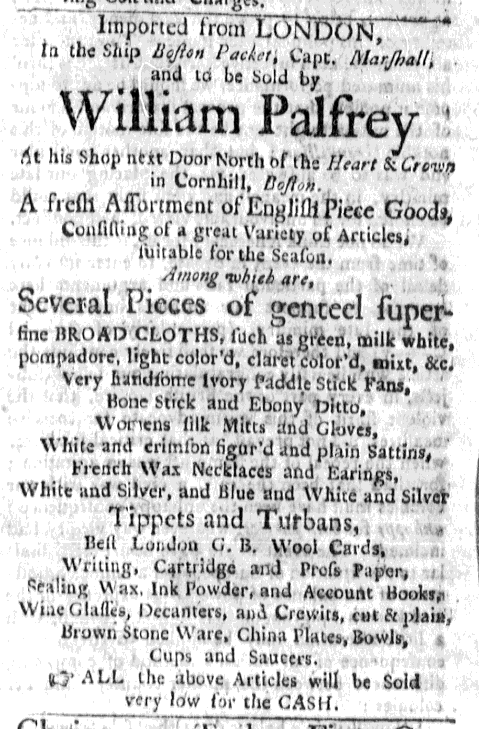
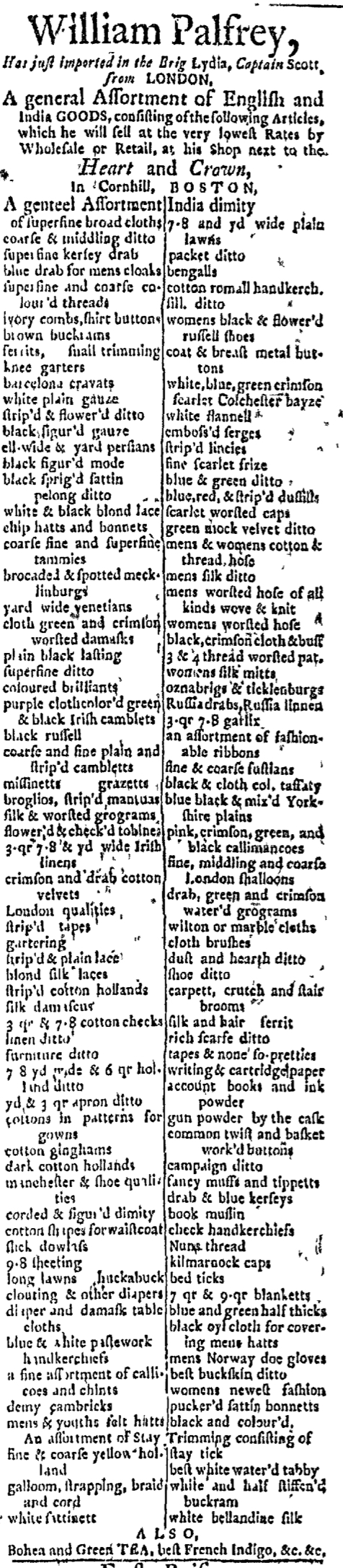
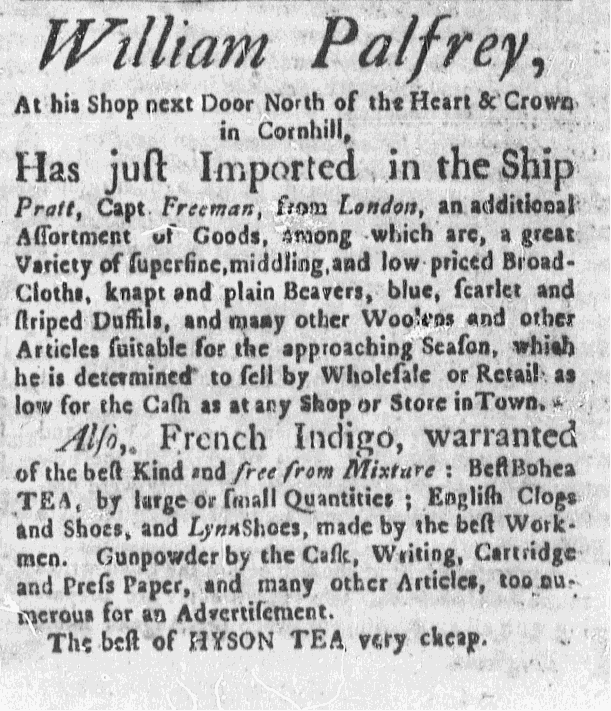
What was advertised in a colonial American newspaper 250 years ago today?
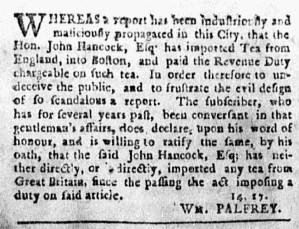
“John Hancock, Esq; has neither directly, or indirectly, imported any tea from Great Britain.”
As news of the Boston Tea Party reached New York and appeared in the December 23, 1773, edition of the New-York Journal, an advertisement in that newspaper took on new significance. Starting on December 9 and continuing for four weeks, William Palfrey inserted an advertisement that addressed a “report [that] has been industriously and maliciously propagated in this City, that the Hon. John Hancock, Esq. has imported Tea from England, into Boston, and paid the Revenue Duty chargeable on such tea.” Such rumors had the potential to tarnish the reputation of one of the merchants who had been most vocal in opposition to the provisions of the Tea Act, decrying Parliament’s attempts to meddle in affairs that he believed rightly belonged to colonial legislatures.
Palfrey, one Hancock’s clerks, took to the public prints to “undeceive the public, and to frustrate the evil design of so scandalous a report.” He noted that he had “been conversant in that gentleman’s affairs” for “several years past” and, as a result, could vouch for Hancock. In late 1773, many readers of the New-York Journal may not have been as familiar with the merchant as residents of Boston, though Hancock regularly appeared in articles reprinted from newspapers published in Massachusetts. Five months before Palfrey’s advertisement appeared, the New-York Journal printed one of Governor Thomas Hutchinson’s letters from June 1768 that described the seizure of the Liberty, “a sloop belonging to Mr. Hancock, a wealthy merchant, of great influence over the populace,” for “a very notorious breach of the acts of trade.” (The July 8, 1773, edition of the New-York Journal carried the entire letter and other private correspondence by the governor.) Contrary to abiding by Parliament’s attempts to regulate colonial commerce and tax imported goods, Hancock had a history of smuggling tea and other items to avoid paying duties. According to Palfrey, neither Hancock’s public position nor his private actions had changed. The clerk declared “upon his word of honour” (and expressed his willingness to “ratify the dame, by his oath”) that Hancock had “neither directly, or indirectly, imported any tea from Great Britain, since the passing the act imposing a duty on said article” and most certainly had not paid import duties on tea. As Jordan E. Taylor has recently demonstrated in Misinformation Nation: Foreign News and the Politics of Truth in Revolutionary America (2022), Patriots and Loyalists vied to establish narratives that fit their politics and their purposes, whether in newspapers, other printed materials, letters, or conversation. That contest over the truth extended to advertisements, including Palfrey’s notice in the New-York Journal.