December 3

What was advertised in a colonial American newspaper 250 years ago today?
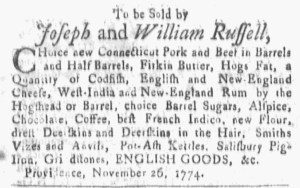
Providence Gazette (December 3, 1774).

“ENGLISH GOODS, &c. Providence, November 26, 1774.”

Joseph Russell and William Russell, two of the most prosperous merchants in Providence on the eve of the American Revolution, regularly advertised a variety of wares in the Providence Gazette.  On December 3, 1774, they ran an advertisement for several commodities, including “Connecticut Pork and Beef in Barrels and Half Barrels, … a Quantity of Codfish, … West-India and New-England Rum by the Hogshead or Barrell, … Chocolate, Coffee, … and “drest Deerskins and Deerskins in the Hair.”  They concluded their notice with “ENGLISH GOODS,” indicating that they stocked and sold merchandise imported from Britain.

This advertisement appeared two days after the Continental Association, a nonimportation agreement adopted by the First Continental Congress, went into effect.  However, that was not the first time that it ran in the Providence Gazette.  A date appended to the end of the advertisement established that the Russells composed it on November 26, matching the date of the first issue of the newspaper that carried it.  Advertisements usually ran for a minimum of three weeks, though advertisers could arrange for notices to appear for much longer.  In this instance, the Russells opted for four weeks, commencing just days before the Continental Association went into effect and continuing when that pact was supposed to constrain buying and selling imported goods.  In the December 3 edition of the Providence Gazette, their advertisement appeared one column over from a notice promoting the Extracts from the Votes and Proceedings of the American Continental Congress, a pamphlet that included “the Association” along with “a List of Grievances” and “occasional Resolves.”  By including the date, the Russells may have sought to offer prospective customers some leeway in purchasing “ENGLISH GOODS” that had been received before the nonimportation agreement went into effect.  They made it easier for readers to feel comfortable with that decision than Richard Mathewson did.  His advertisement, which also ran before the Continental Association went into effect and continued into December, proclaimed that he sold a “large and general Assortment of GOODS” that were “Just imported from London.”  That notice did not include a date, making it less apparent when he received the goods.  Readers could reasonably conclude that Mathewson had ordered that merchandise before learning of the Continental Association, but that required more work on their part than the Russells did when they included a date in their advertisement.

April 16

What was advertised in a colonial American newspaper 250 years ago today?

Providence Gazette (April 16, 1774).

“New-England Rum and Melasses, Claret and Lisbon Wine.”

Joseph Russell and William Russell regularly advertised in the Providence Gazette in the 1760s and 1770s.  In the spring of 1774, the merchants inserted a notice that listed a variety of commodities, including “Jamaica and Barbados Rum, New-England Rum and Melasses, Claret and Lisbon Wine, Coffee, Sugar, Indico, Alspice, large Rock Salt, [and] choice Connecticut Beef and Pork, in Barrels and Half Barrels.”  They did not happen to include tea among their inventory, at least not among the items they enumerated in their newspaper advertisement, even though they frequently stocked it in the past.  Just over a year earlier, they led one of their advertisements with “Excellent Bohea Team, which for Smell and Flavor exceeds almost any ever imported, by the Chest, Hundred, or dozen Pounds.”  Perhaps the crisis around tea – the Boston Tea Party and the efforts of the Sons of Liberty to turn away ships carrying tea in other port cities – convinced them not to advertise that commodity.  As they often did, the Russells concluded with a promise of various “English and Hard-Ware Goods.”

Compared to many of the advertisements they ran in the 1760s, their notices became more restrained in the 1770s.  Their advertisement for the spring of 1774 filled the standard “square,” roughly equivalent in length to most other paid notices in the Providence Gazette.  In contrast, their advertisement in the March 19, 1768, edition listed dozens of items.  The Russells demonstrated that “their assortment is very large” and “customers will have the advantage of a fine choice” with an advertisement that extended more than a column.  On previous occasions, they ran full-page advertisements, including in the November 22, 1766, and November 7, 1767, editions of the Providence Gazette.  Many of their advertisements from the 1760s tended to look like the one for “HILL’s ready Money Variety Store” that appeared in the spring of 1774.  Why did the Russells opt for less elaborate advertisements when facing such competition?  Perhaps they felt secure in their reputation, deciding that shorter notices made customers sufficiently aware of their merchandise.  In 1772, the prominent merchants built “the second brick edifice and the first three-story structure in Providence,” making them and their business even more visible to residents of the growing port.  As their wealth increased and their status reached new heights, the Russells had other means of attracting attention to their enterprise beyond newspaper advertisements, yet they still considered streamlined notices valuable investments in advancing their entrepreneurial activities.

March 13

What was advertised in a colonial American newspaper 250 years ago today?

Providence Gazette (March 13, 1773).

“EXcellent Bohea Tea, which for Smell and Flavour exceeds almost any ever imported.”

Joseph Russell and William Russell ranked among the most prominent merchants in Providence in the early 1770s.  Their mercantile success allowed them to construct an impressive Georgian house in 1772, a landmark still standing in the city and the contents on display in museums.  The size of the house testified to the Russells’ wealth, while the style, including “an original principal entrance taken from the English architectural pattern book Builder’s Compleat Assistant (1750) by Battey Langley,” communicated their genteel tastes.  The massive house enhanced their visibility within the cityscape of the growing town, while their frequent advertisements in the Providence Gazette enhanced their visibility among readers of the public prints in town and beyond.  On occasion, they published full-page advertisements that accounted for one-quarter of the space in a standard four-page newspaper of the period.

Most of their advertisements were not that elaborate, yet the Russells still attempted to entice prospective customers with promises of some of the luxuries that they enjoyed.  Consider a notice from the March 13, 1773, edition of the Providence Gazette.  The merchants listed a variety of items available at the Sign of the Golden Eagle, a store so well known that the Russells did not consider necessary to name it in every advertisement.  Their inventory included “a few Quarter Casks of best Lisbon Wine,” coffee, chocolate, and imported “English and Hard Ware Goods.”  They did not provide additional details about those items, but they did open their advertisement by promoting “EXcellent Bohea Tea, which for Smell and Flavour exceeds almost any ever imported.”  The Russells did more than encourage prospective customers to imagine purchasing the tea; they encouraged them to imagine consuming the tea, to take into account the sensual pleasures of the smell and the taste.  The merchants presented an opportunity for consumers to treat themselves to a small luxury, one that was not reserved solely for the better sorts, hoping that would help to sell their tea.

April 4

What was advertised in a colonial American newspaper 250 years ago today?

Providence Gazette (April 4, 1772).

“They have just opened a large and fine assortment of Spring and Summer Goods.”

Joseph Russell and William Russell were among the most prolific advertisers in the Providence Gazette in the late 1760s and early 1770s.  Two of the city’s most prominent merchants, the Russells generated significant advertising revenue for the printers of the Providence Gazette.  They sometimes ran multiple advertisements at once, especially when they received new shipments of imported goods via vessels arriving in port.  Even when the Russells were relatively quiet, they inserted a new advertisement approximately once a month or every six weeks.  In doing so, they maintained their visibility in the public prints much more consistently than their competitors.  That likely contributed to their prominence, both in the Providence and in other towns where the Providence Gazette circulated.

As part of their ongoing advertising campaign, the Russells inserted a new advertisement in the April 4, 1772, edition of the Providence Gazette.  It did not include much by way of prologue, sporting a headline that read, “To be Sold by JOSEPH & Wm. RUSSELL,” before listing a variety of goods in two columns.  The Russells apparently marketed items they previously had on hand or else they would have resorted to a convention adopted by many merchants and shopkeepers in their advertisements.  That standard format proclaimed that the advertisers had “just imported” certain goods and named the vessels and captains that transported them across the Atlantic.  Prospective customers could compare that information to the shipping news to determine how recently the merchandise made it to shops and stores.

Lacking such an introduction, the Russells’ advertisement suggested to readers that they had not just received the “Cream coloured plates and mugs,” “Brass kettles,” and “Looking glasses of all sizes.”  The advertisement concluded with a note that the merchants “have just opened a large and fine assortment of Spring and Summer Goods” for those who wished to peruse them, but savvy consumers realized that they would choose from among items imported during a previous season.  If the Russells had new goods recently delivered from England, they would have incorporated that information into their new advertisement.

February 15

What was advertised in a colonial American newspaper 250 years ago today?

Providence Gazette (February 15, 1772).

“Choice Bohea Tea, which for Smell and Flavour exceeds almost any ever imported.”

Joseph Russell and William Russell were among the most prominent merchants in Providence in the era of the American Revolution.  The brothers were so successful that in 1772 they built what is now the “earliest extant and most impressive of the cubical, three-story houses that symbolized wealth and social standing in Providence for several generation beginning at the eve of the Revolution,” according to the Providence Preservation Society’s Guide to Providence Architecture.  The building stands at 118 North Main Street (formerly King Street), though its original interiors were removed and installed in several museums a century ago.  In addition, the building “was raised to insert a storefront” in the middle of the nineteenth century, resulting in the original entrance, “taken from the English architectural pattern book Builder’s Compleat Assistant (1750) by Battey Langley,” appearing to adorn the second floor rather than opening onto the street.

The Russells frequently advertised in the Providence Gazette in the 1760s and 1770s.  Perhaps their marketing efforts contributed, at least in part, to their mercantile success.  As they embarked on building their new house in 1772, the brothers advertised a variety of commodities on February 15.  They focused primarily on grocery items in that notice, though in others they promoted a vast array of textile, housewares, hardware, and other goods imported from England.  Among the groceries they offered to consumers, the Russells listed “Nutmegs, Cinnamon, Mace, and Cloves” as well as “Pepper by the Bag” and “Chocolate by the Box.”  They concluded their advertisement with “Choice Bohea Tea.”  Most advertisers did not offer much commentary about that popular commodity, but in this instance the Russells elaborated on what made their tea “Choice” for consumers.  They proclaimed that the “Smell and Flavour exceeds almost any ever imported.”  In conjuring such associations with their tea at the conclusion of their advertisement, the Russells may have incited greater interest in all of the groceries they sold.  Sales of “Choice Bohea Tea” and so many other goods helped finance the house they built in 1772.  The Russells almost certainly enjoyed “Choice Bohea Tea” in the parlor of their new home, partaking in popular social rituals with family and guests.

August 24

What was advertised in a colonial American newspaper 250 years ago today?

Providence Gazette (August 24, 1771).

“Just imported by Joseph and William Russell.”

In the early 1770s, each edition of the Providence Gazette concluded with a colophon in which John Carter, the printer, solicited paid notices.  “ADVERTISEMENTS of a moderate Length (accompanied with the Pay),” the colophon advised, “are inserted in this Paper three Weeks for Four Shillings.”  That fee covered setting type the first time an advertisement ran and the space it occupied in three consecutive issues.  Advertisers could also pay additional fees for their notices to make additional appearances.

Joseph Russell and William Russell, two of the city’s most prominent merchants, did not need the invitation in the colophon to prompt them to submit advertisements to Carter’s printing office.  They regularly placed notices promoting a variety of commodities and consumer goods.  Indeed, they advertised so frequently that sometimes they published new advertisements before older ones finished their runs.  That was the case in the August 24, 1771 edition of the Providence Gazette.  That issue featured two advertisements placed by the Russells, a new one on the third page and another that already appeared multiple times on the fourth page.  That made them the only purveyors of goods with more than one advertisement in that issue, not the first time the merchants found themselves in that position.

Did advertising work?  The Russells believed that it did.  Otherwise, they would not have paid to publish advertisement after advertisement in the Providence Gazette.  They also seem to have made some effort to draw attention to their advertisements by varying the formats rather than assuming that prospective customers would read them just because they appeared in the public prints.  Deploying a particularly unusual format, their names, which served as a headline of sorts, appeared halfway through the advertisement on the third page of the August 24 edition.  That distinguished their advertisement from others in the same issue.  In their advertisements on the fourth page, the merchants divided their inventory into two columns instead of a single paragraph of dense text, making it easier for readers to peruse the contents.  The Russells likely thought (or learned from experience) that advertising worked when designed with some creativity and variation.

August 3

What was advertised in a colonial American newspaper 250 years ago today?

Providence Gazette (August 3, 1771).

“Just imported … by Joseph and William Russell.”

Joseph Russell and William Russell, two of Providence’s most prominent merchants, made shrewd use of the public prints to keep their names … and their merchandise … before the eyes of prospective customers.  Some merchants and shopkeepers advertised only when they received new shipments of goods, running their notices for three or four weeks.  The Russells, on the other hand, continuously updated their marketing efforts, inserting new advertisements in the Providence Gazette when they discontinued others.

For four weeks in the summer of 1771, they ran an advertisement for “A VERY large and neat Assortment of English Goods, Ironmongery, Brasiery, Cutlery, Haberdashery, [and] Stationary” that they “Imported from London, in the Ship Providence, and in the Snow Tristram.”  Two weeks after that notice ran for the final time, they inserted a new advertisement, a much lengthier one that listed a variety of textiles, housewares, and other goods in two columns.  The Russells stated that these items were “Just imported from London, in the last ships.”  Savvy readers probably assumed that the Russells did not advertise merchandise that actually just arrived (or else they would have specified which vessels delivered their inventory) but instead goods received many weeks earlier via the Providence and Tristram.

That purveyors of goods sometimes hedged a bit in their advertisements was not any more of a surprise in the eighteenth century than today.  The Russells did not advance any outright misrepresentations as they attempted to garner new attention for their inventory by publishing an advertisement that differed so significantly from the shorter one that previously appeared in the Providence Gazette.  Had they continued inserting the earlier advertisement, they risked readers skipping over content that looked too familiar.  The new notice, lengthier with a different format, allowed them to highlight particular items even as they promoted all of their merchandise more generally.  The Russells invested in repetition, enhancing the visibility and reputation of their business by keeping it in the public prints.

July 20

What was advertised in a colonial American newspaper 250 years ago today?

Providence Gazette (July 20, 1771).

“A VERY large and neat Assortment of English Goods.”

Joseph Russell and William Russell, two of the city’s most prominent merchants, regularly advertised in the Providence Gazette in the early 1770s.  They placed their notices for short periods, sometimes running more than one at a time.  Consider their marketing efforts during the summer of 1771.  On June 29, they inserted an advertisement to inform prospective customers that they now stocked “A VERY large and neat Assortment of English Goods, Ironmongery, Brasiery, Cutlery, Haberdashery, Stationary,” and other goods imported from London.  That advertisement ran for four consecutive weeks before being discontinued on July 27.  Two weeks after first placing that notice, the Russells placed another advertisement, that one for “THIRTY Barrels of choice Connecticut Pork” as well as corn and textiles.  It also ran for four weeks, appearing in the July 13 and 20 editions of the Providence Gazette with the other advertisement.  On July 27, the Russells published just one advertisement, but on August 3, the last issue for the advertisement about pork, they ran a new advertisement for imported goods.  It also appeared for four weeks.

When it came to advertising, the Russells made deliberate choices.  According to the rates that John Carter, the printer of the Providence Gazette, inserted in the colophon, “ADVERTISEMENTS of a moderate Length (accompanied with the Pay) are inserted in this Paper three Weeks for Four Shillings.”  The Russells did not opt to have their notices run for the minimum amount of time before removing them.  Instead, they added an additional week to allow for greater exposure, but then retired their advertisements and devised new notices.  Doing so allowed them to keep their enterprise visible to prospective customers without risking readers dismissing advertisements that became too familiar.  Did advertising in eighteenth-century newspapers work?  The Russells seemed to believe that advertising was indeed effective, at least when properly managed, or else they would not have placed so many notices in the Providence Gazette and incurred the expenses of doing so.

May 18

What was advertised in a colonial American newspaper 250 years ago today?

Providence Gazette (May 18, 1771).

“Just imported in the Snow Tristram, Capt. Shand.”

The arrival of the ship Providence in Providence on May 1, 1771, had a significant impact on the contents of the next several issues of the Providence Gazette.  Captain Phineas Gilbert carried a variety of letters and newspapers that contained information not previously available in the colony.  John Carter, the printer of the Providence Gazette, selected excerpts to publish for his readers.  The Providence also transported consumer goods that soon found their way into local shops.  Several merchants advertised that their inventory now included merchandise “imported in the Ship Providence.”  No matter where they looked in the Providence Gazette, readers encountered content connected to the Providence.

In the time that advertisements for goods shipped via the Providence continued to run in the newspaper, other vessels arrived with more news and their own cargoes.  Immediately below the masthead in the May 18 edition of the Providence Gazette, Carter noted that he reprinted news he received “By the Snow Tristram, Captain SHAND, arrived here from London.”  A cluster of new advertisements made reference to the same vessel.  Amos Throop proclaimed that he sold “Fresh DRUGS and MEDICINES. Just imported in the Tristram, Captain Shand, from London,” echoing Carter’s attribution to his source for the news.  Joseph Russell and William Russell similarly announced that they stocked a “LARGE and compleat Assortment of English and Hard Ware GOODS” that crossed the Atlantic on the Tristram.  On another page of the same issue, an advertisement the Russells initially placed two weeks earlier once again promoted “a large Assortment of GOODS, suitable for the Season” that arrived via the Providence.  The partnership of “Nicholas, Joseph & Moses Brown, In Company,” also ran two advertisements, one for goods transported on the Tristram and the other for goods transported on the Providence.

Those advertisements meant greater revenues for the printer, but they also suggested more choices for prospective customers who, then as now, often equated newer with better.  That so many advertisements for consumer goods mentioned which ships carried those goods may seem quaint to modern readers, but that detail provided important context for eighteenth-century consumers who were less likely to pick over items that lingered on shelves for months than to browse new items that recently arrived.

May 4

What was advertised in a colonial American newspaper 250 years ago today?

Providence Gazette (May 4, 1771).

“They have just arrived from London, in the Ship Providence, Captain Gilbert, a large Assortment of GOODS.”

The arrival of ships in port meant not only new goods in stores and shops but also new advertisements in colonial newspapers.  Such was the case in Providence in the spring of 1771.  The Providence delivered goods to merchants and shopkeepers.  In turn, they placed advertisements in the Providence Gazette.  Joseph Russell and William Russell published a notice to “INFORM their Customers, that they have just arrived from London, in the Ship Providence, Captain Gilbert, a large Assortment of GOODS, suitable for the Season, which are now opened and ready for Sale.”  John Brown placed a similar advertisement for a “compleat Assortment of European and India GOODS.”  He also reported that he imported his wares “from LONDON … In the Ship Providence, Phineas Gilbert, Master.”  Brown and the Russells placed their advertisements very shortly after the arrival of the Providence, hoping to convince customers that new merchandise meant more desirable merchandise.  The Providence had been in port for only three days, according to news accounts elsewhere in the May 4 edition of the Providence Gazette.

In addition to “European and India GOODS,” Captain Gilbert also delivered news, some of it concerning events in England and elsewhere in Europe and some of it concerning other vessels that made transatlantic voyages.  For instance, Gilbert reported that the Providence “met the Snow Tristram, Capt. Shard, of this Port, in the River as he came down” shortly after departing London on February 6.  Families with seamen working aboard the Tristram and merchants with business interests connected to the vessel must have been relieved to learn that it arrived safely in the Thames and continued toward London.  Furthermore, “Capt. Shand was to leave London the 10th of March, and may daily be expected” in Providence.  Gilbert also reported on three other ships the Providence encountered during its transatlantic journey, noting “all well on board each Vessel.”  More extensive news items also arrived via the Providence.  The printer, John Carter, reserved the front page for news from London “By the Ship Thomas, Capt. Davis, arrived at Boston” previously printed in newspapers in that city, but Gilbert and the Providence almost certainly carried other news “From a late London Paper” that Carter inserted in the Providence Gazette.

The arrival of the Providence in Providence on May 1, 1771, generated various kinds of content for the next edition of the Providence Gazette.  Among the advertisements, merchants hawked consumer goods delivered on the ship.  The printer selected items from London newspapers carried by the captain to reprint for local readers.  The news also included updates about the progress of several vessels crossing the Atlantic, providing welcome updates for both families and merchants.