
What was advertised in a revolutionary American newspaper 250 years ago today?
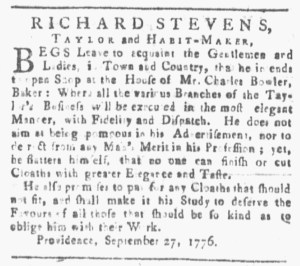
“He flatters himself, that no one can finish or cut Cloaths with greater Elegance and Taste.”
When Richard Stevens, a “TAYLOR and HABIT-MAKER,” prepared to open a shop in the fall of 1776, he ran an advertisement in the Providence Gazette to launch his business. Stevens announced that “all the various Branches of the Taylor’s Business will be executed in the most elegant Manner, with Fidelity and Dispatch,” deploying some of the most common appeals made by tailors and other artisans. He emphasized skill, fashion, and customer satisfaction.
Then Stevens departed from the usual script that most tailors followed in their advertisements, declaring that he “does not aim at being pompous in his Advertisement, nor to detract from any Man’s Merit in his Profession; yet, he flatters himself, that no one can finish or cut Cloaths with greater Elegance and Taste.” What started as a statement of humility and an acknowledgment of the fine work done by his competitors turned into a bold claim about his own abilities as a tailor. Stevens practically challenged prospective customers to see for themselves whether he exaggerated his claim. Perhaps he was a bit pompous, despite his claims to the contrary, but maybe clients could overlook (or even embrace) such pride if the tailor delivered on the “Elegance and Taste” that he so confidently declared. In case that was not enough to entice readers to hire him, Stevens “also promises to pay for any Cloaths that should not fit.” He offered a guarantee, giving prospective customers yet another reason to hire his services. Other tailors promoted their skill, but rarely did they go as far as stating that they would refuse payment if their clients did not believe that their garments fit.
Following his innovative appeals, Stevens returned to standard language that appeared in so many advertisements for tailors and others who hawked goods and services. He concluded by pledging that he “shall make it his Study to deserve the Favours of all those that should be so kind as to oblige him with their Work.” Although he concluded with familiar language that could have appeared in other advertisements, Stevens distinguished himself from other tailors elsewhere in his notice, trumpeting the superior “Elegance and Taste” of clothing that he cut and finished and offering a guarantee that his clients would be satisfied or not pay for his work.
