September 9

What was advertised in a colonial American newspaper 250 years ago today?

Sep 9 - 9:9:1766 South-Carolina Gazette and Country Journal
South-Carolina Gazette and Country Journal (September 9, 1766).

“To carry on Business on her own proper Account, as sole Dealer and seperate Trader.”

Anne Raymor published an advertisement with an unusual twist. Throughout the colonies, newspaper readers would have been very familiar with advertisements for runaway wives, a genre in which aggrieved husbands announced that their wives had absconded or “eloped” from them and warning merchants, shopkeepers, and other not to extend any credit to them. In such instances, men exercised financial mastery over women, curtailing their ability to participate in the marketplace as consumers.

According to today’s advertisement, Anne Raymor wished to be more than a consumer. She wanted to “carry on Business on her own proper Account, as sole Dealer and seperate Trader, exclusive and free from any Concern with her Husband.” In this instance, it was the wife who sought to sever financial connections with the husband. This was a particularly transgressive course considering the political and economic rights of women under the laws of coverture in eighteenth-century America.

Upon marriage, a woman became a feme covert, her legal identity subsumed by her husband, the head of the family and household. She could not own property in her own name, sign contracts, control her own earnings, or sue others in court. All of these actions would have been important and necessary, then as now, for women who operated businesses, whether shopkeepers, milliners, seamstresses, or tavernkeepers. An unmarried woman, a feme sole, did not labor under such restrictions.

Raymor did not provide any details about her dispute with her husband, but she sought some means to function as a feme sole and pursue her business interests independently of her husband’s oversight or interference. Obtaining credit “from some of her Friends” provided an avenue to do so, at least according to the “Advice of Council at Law” that she had consulted.

This advertisement demonstrates that women found themselves in a precarious position when it came to being entrepreneurs in eighteenth-century America. Making a living was also difficult for men, but it was even more imperative for most women to rely on others, especially networks of friends, when they operated on their own in the marketplace. Anne Raymor found herself in the position of using the limited space in her advertisement to delineate her relationship with her husband rather than extolling the qualities of her merchandise.
September 6

What was advertised in a colonial American newspaper 250 years ago today?

Sep 6 - 9:6:1766 Connecticut Gazette
Connecticut Gazette (September 6, 1766).

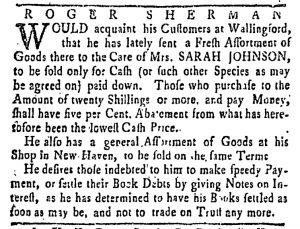
“ROGER SHERMAN … has lately sent a Fresh Assortment of Goods there to the Care of Mrs. SARAH JOHNSON.”

Relative to the number of women who worked as shopkeepers or otherwise operated businesses of various sorts in eighteenth-century America, very few women placed advertisements to promote their endeavors and attract customers. As a matter of principle, I do not wish to further obscure women’s participation in the marketplace as producers and retailers on the supply side of the equation; all too often they are depicted merely as consumers on the demand side. Accordingly, I select advertisements placed by women as frequently as practical.

Today’s advertisement caught my attention because it promotes a business run by a woman, yet it was not placed by the woman herself. Sarah Johnson sold “a Fresh Assortment of Goods” in Wallingford, a town about a dozen miles outside of New Haven. Roger Sherman, however, placed an advertisement in the Connecticut Gazette to “acquaint his Customers at Wallingford” that Johnson sold those goods and provided discounts for customers who bought in volume. He also wanted potential customers in New Haven to know that he sold a similar “Assortment of Goods” on the same terms.

This advertisement raises questions about the arrangements Johnson and Sherman made. It appears that Johnson oversaw the day-to-day operations of the shop in Wallingford, including the necessary accounting and negotiating (as indicated when Sherman allowed for payment in “such other Species as may be agreed on” instead of cash). Yet she seems to have been an employee of some sort rather than a partner. What kind of stake did she have in the enterprise? Did she own any of the inventory she stocked? Did she earn commissions on the goods she sold? How much risk had she assumed compared to Sherman? How much autonomy did she exercise in selecting goods and setting prices? Did she participate in the decisions to offer discounts or to call in debts? Note that Sherman referred to customers Johnson served in Wallingford as “his Customers,” suggesting how he envisioned his relationship to both Johnson and their (his?) clients.

This advertisement acknowledges Sarah Johnson’s presence in the operation of a shop in Wallingford, Connecticut, but it does not fully elaborate on her position relative to Roger Sherman beyond suggesting that even though she participated in the marketplace she did so as a subordinate to Sherman. The advertisement, intended for public consumption, maintained the gender hierarchy of the period, regardless of whatever practices Johnson and Sherman devised outside the public eye.