Megan Watts is a sophomore at Assumption College, where she is a History major and intends to pursue a minor in Women’s Studies. She has enjoyed participating in various educational programs offered at the Fairfield Museum and History Center in Fairfield, Connecticut. She plans to become an historian, believing that understanding the past leads to a better future for the world. She was a guest curator for the Adverts 250 Project during the week of October 23 to 29, 2016, as well as curator of the Slavery Adverts 250 Project during the week of November 27 to December 3, 2016, and March 26 to April 1, 2017.
The Slavery Adverts 250 Project chronicles the role of newspaper advertising in perpetuating slavery in the era of the American Revolution. The project seeks to reveal the ubiquity of slavery in eighteenth-century life from New England to Georgia by republishing advertisements about enslaved people – for sale as individuals or in groups, wanted to purchase or for hire for short periods, runaways who liberated themselves, and those who were subsequently captured and confined in jails and workhouses – in daily digests on this site as well as in real time via the @SlaveAdverts250 Twitter feed, utilizing twenty-first-century media to stand in for the print media of the eighteenth century.
The project aims to provide modern audiences with a sense of just how often colonizers encountered these advertisements in their daily lives. Enslaved men, women, and children appeared in print somewhere in the colonies almost every single day. Those advertisements served as a constant backdrop for social, cultural, economic, and political life in colonial and revolutionary America. Colonizers who did not purport to own enslaved people were still confronted with slavery as well as invited to maintain the system by purchasing enslaved men, women, and children or assisting in the capture of so-called “runaways” who sought to free themselves from bondage. The frequency of these newspaper advertisements suggests just how embedded slavery was in colonial and revolutionary American culture in everyday interactions beyond the printed page.
These advertisements also testify to the experiences of enslaved men, women, and children, though readers must consider that those experiences have been remediated through descriptions offered by enslavers rather than enslaved people themselves. Often unnamed in the advertisements, enslaved men, women, and children were not invisible or unimportant in early America.
These advertisements appeared in colonial American newspapers 250 years ago today.
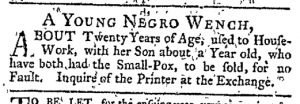
New-York Gazette: Or, the Weekly Post-Boy (April 2, 1767).
**********
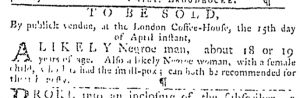
New-York Journal (April 2, 1767).
**********
Supplement to the New-York Journal (April 2, 1767).
**********
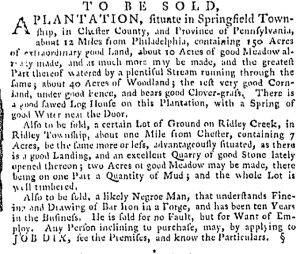
Pennsylvania Gazette (April 2, 1767).
**********
Pennsylvania Gazette (April 2, 1767).
**********
Pennsylvania Gazette (April 2, 1767).
**********
Pennsylvania Gazette (April 2, 1767).
**********
Supplement to the Pennsylvania Gazette (April 2, 1767).
**********
Supplement to the Pennsylvania Gazette (April 2, 1767).
**********
Supplement to the Pennsylvania Gazette (April 2, 1767).
What was advertised in a colonial American newspaper 250 years ago today?
Georgia Gazette (April 1, 1767).
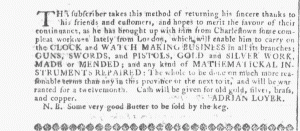
“The CLOCK and WATCH MAKING BUSINESS in all its branches.”
Adrian Loyer announced that he “carr[ied] on the CLOCK and WATCH MAKING BUSINESS in all its branches.” However, watchmaking was not as common as making clocks in colonial America, despite some colonists from England with the necessary skills and tools. Many colonists with watchmaking skills usually repaired watches, rather than creating them. Many of the watches used in colonial America were imported from England instead.
Clockmaking was much more common during the eighteenth century. Clocks were typically made of brass for the dial and wood for the case, including oak, walnut, and mahogany. Some clocks were made with expensive satinwood for inlays. Tall-case clocks made during the eighteenth century were typically expensive; their owners were usually wealthy. As a result, tall-case clocks were usually handed down through generations.
Individual clockmakers typically did not produce more than an average of four to five clocks per year. This was most likely due to the expensiveness of the materials required to produce clocks. Large clocks with tall cases required more materials and more time to produce. Despite these drawbacks, some clockmakers still managed to make a decent living.
**********
ADDITIONAL COMMENTARY: Carl Robert Keyes
Adrian Loyer seemed to be expanding the business he operated in Savannah, thanks to the assistance of “some compleat workmen lately from London” that he recruited on a recent trip to Charleston in neighboring South Carolina. As Evan indicates, Loyer was set “to carry on the CLOCK and WATCH MAKING BUSINESS in all its branches” at his shop, but he offered a variety of other services as well. He and his assistants also repaired mathematical instruments and performed metalwork on weapons and other items.
Residents of Savannah were apparently familiar with Loyer’s work and his reputation: he opened his advertisement by acknowledging “his friends and customers.” Former and potential customers, however, did not know much about Loyer’s new assistants and their work beyond the brief description that appeared in the advertisement. Accordingly, Loyer offered assurances to anyone who visited his shop. He pledged that any work contracted and completed in his shop “will be warranted for a twelvemonth.” In other words, Loyer offered a guarantee that lasted for a year.
Loyer did not provide further details about how his guarantee worked. Was it a money back guarantee? Or did he not charge to repair items that failed within the specified period? Or did he offer customers a choice? Edward Spauldin, who “carries on the Business of cleaning and repairing CLOCKS AND WATCHES” in Providence, explained how his guarantee worked in an advertisement published the previous summer. “If any of his Work fails,” Spauldin stated, “he will repair the same gratis.”
Loyer seemed quite conscious that potential patrons might choose his competitors in Savannah or even send their work to workshops in Charleston. That being the case, it seems most likely that he followed Spauldin’s example and made repairs for free. Doing so gave him the opportunity to satisfy customers rather than relinquish them to other clockmakers and smiths. Whatever the mechanisms of the guarantee, Loyer underscored that he took responsibility for any work that left his shop, whether undertaken by himself or by any of the “compleat workmen” he now employed.
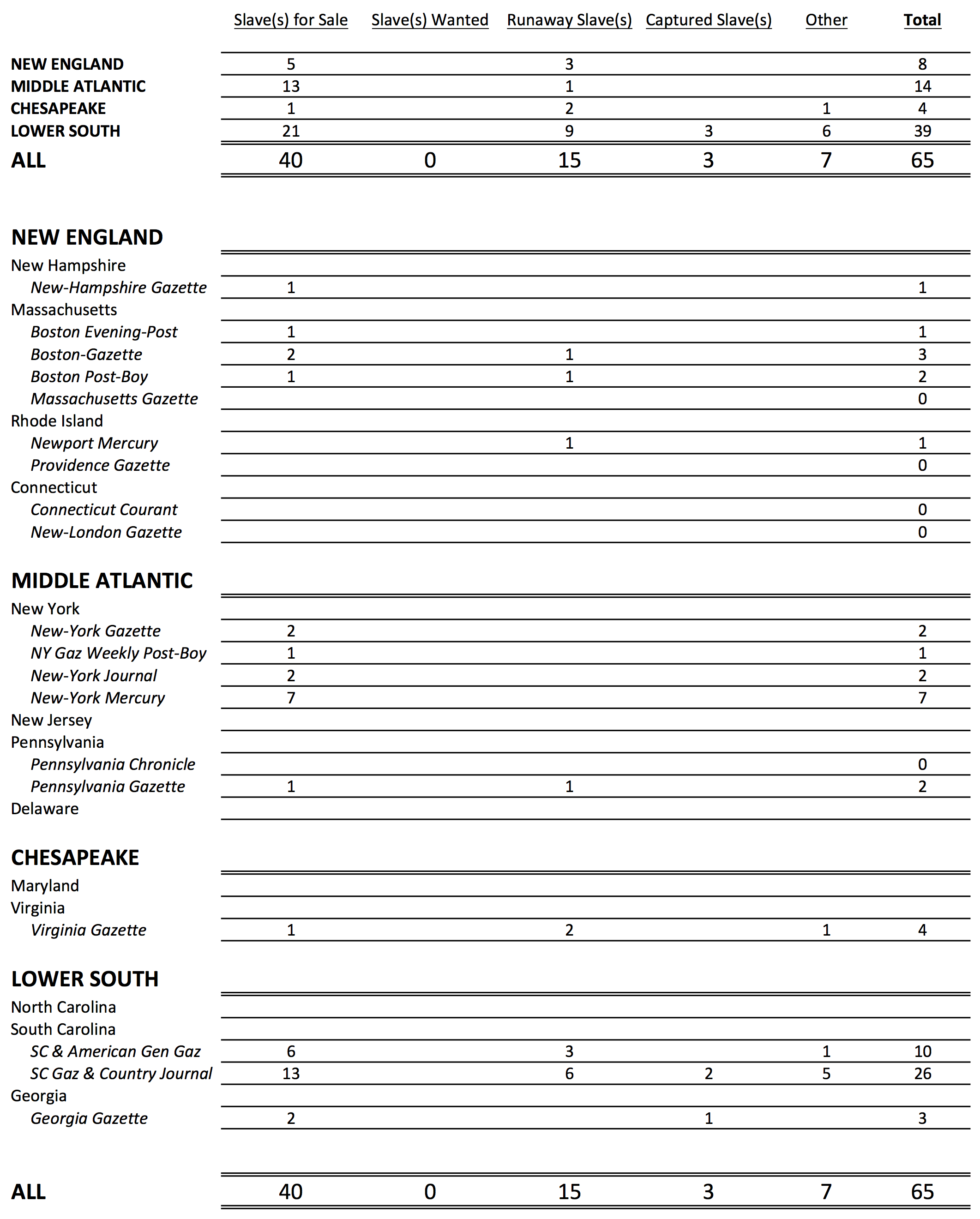
These tables indicate how many advertisements for slaves appeared in colonial American newspapers during the week of March 26 – April 1, 1767. The data has been compiled based on research conducted by Megan Watts.
Note: These tables are as comprehensive as currently digitized sources permit, but they may not be an exhaustive account. They includes all newspapers that have been digitized and made available via Accessible Archives, Colonial Williamsburg’s Digital Library, and Readex’s America’s Historical Newspapers. There are several reasons some newspapers may not have been consulted:
Issues that are no longer extant;
Issues that are extant but have not yet been digitized (including the Pennsylvania Journal); and
Newspapers published in a language other than English (including the Wochentliche Philadelphische Staatsbote).
**********
Slavery Advertisements Published March 26 – April 1, 1767: By Date
**********
Slavery Advertisements Published March 26 – April 1, 1767: By Region
The Slavery Adverts 250 Project chronicles the role of newspaper advertising in perpetuating slavery in the era of the American Revolution. The project seeks to reveal the ubiquity of slavery in eighteenth-century life from New England to Georgia by republishing advertisements about enslaved people – for sale as individuals or in groups, wanted to purchase or for hire for short periods, runaways who liberated themselves, and those who were subsequently captured and confined in jails and workhouses – in daily digests on this site as well as in real time via the @SlaveAdverts250 Twitter feed, utilizing twenty-first-century media to stand in for the print media of the eighteenth century.
The project aims to provide modern audiences with a sense of just how often colonizers encountered these advertisements in their daily lives. Enslaved men, women, and children appeared in print somewhere in the colonies almost every single day. Those advertisements served as a constant backdrop for social, cultural, economic, and political life in colonial and revolutionary America. Colonizers who did not purport to own enslaved people were still confronted with slavery as well as invited to maintain the system by purchasing enslaved men, women, and children or assisting in the capture of so-called “runaways” who sought to free themselves from bondage. The frequency of these newspaper advertisements suggests just how embedded slavery was in colonial and revolutionary American culture in everyday interactions beyond the printed page.
These advertisements also testify to the experiences of enslaved men, women, and children, though readers must consider that those experiences have been remediated through descriptions offered by enslavers rather than enslaved people themselves. Often unnamed in the advertisements, enslaved men, women, and children were not invisible or unimportant in early America.
These advertisements appeared in colonial American newspapers 250 years ago today.