April 7

GUEST CURATOR: Megan Watts

What was advertised in a colonial American newspaper 250 years ago today?

Apr 7 - 4:7:1767 South-Carolina Gazette and Country Journal
South-Carolina Gazette and Country Journal (April 7, 1767).

“A Large and neat assortment of GOODS.”

I chose this advertisement because it demonstrates something common in advertisements for consumer goods in eighteenth-century newspapers, a general store offering a wide array of products. Reeves, Wise and Poole stated that they possessed “A Large and neat assortment of GOODS” at their shop. Throughout my research I have encountered many advertisements placed by shopkeepers. They varied in length and detail, but almost always communicated that they offered a wide array of goods. An advertisement placed by Ancrum and Company is another example of such an advertisement below. These merchants either chose to keep their advertisements short or made them short out of necessity (perhaps because space was expensive). Some advertisements, on the other hand, went on for a quarter of a column. Regardless of the length, the content was the same: an effort to get consumers. Newspaper advertisements were an important way to keep a constant flow of customers and revenue in colonial stores.
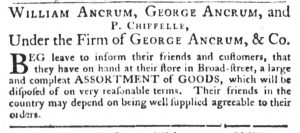
Apr 7 - 4:7:1767 Ancrum South Carolina Gazette and Country Journal Page 4
South-Carolina Gazette and Country Journal (April 7, 1767).

However, newspapers also relied on advertisements for their profits and longevity. Virtually all newspapers in colonial America included advertisements as a way to make money. This practice was widespread. In fact, the first weekly newspaper, the Boston News-Letter (1704) had an advertisement for advertisements, stating that for the price of “Twelve Pence to Five Shilling and Not to exceed” interested parties could buy space to market goods and services or place other sorts of notices. Not only did advertisements provide printers with consistent sources of income for every advertisement, but a newspaper that contained a good variety of news and advertisements could attract new paying subscribers. Advertising was a key part of newspaper printing. As Jack Lynch states, “The newspaper business and the advertising business got under way together.”

**********

ADDITIONAL COMMENTARY:  Carl Robert Keyes

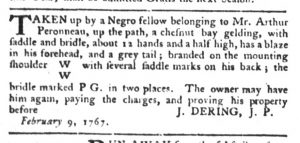
The same issue of the South-Carolina Gazette and Country Journal that carried advertisements by Reeves, Wise, and Poole and George Ancrum and Company also carried twelve advertisements concerning slaves. Six offered slaves for sale. Three cautioned against runaways. One described nine captured runaways “BROUGHT TO THE WORK-HOUSE.” Another listed a variety of consumer goods and a horse confiscated from two runaway slaves, seeking the rightful owner to claim their possessions. The final advertisement described a horse “TAKEN up by a Negro fellow belonging to Mr. Arthur Peronneau.” As far as the South-Carolina Gazette and Country Journal was concerned, this was a relatively small number of advertisements and total column space given over to slavery. That newspaper regularly issued a two-page advertising supplement in order to publish even greater numbers of notices concerning slaves, as well as other sort of advertisements, including those for “A Large and neat assortment of GOODS” that Megan examined today.
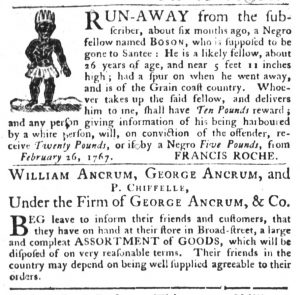
Apr 7 - 4:7:1767 Ancrum and Slave South-Carolina Gazette and Country Journal Page 4
George Ancrum and Company’s advertisement for consumer goods appeared immediately below an advertisement about a runaway slave in the South-Carolina Gazette and Country Journal (April 7, 1767).

Megan makes an important point about the role advertisements played in underwriting the publication of newspapers and, by extension, the dissemination of information in eighteenth-century America. Advertisements place by merchants, like those featured today, as well as similar notices from shopkeepers, artisans, and others who provided consumer goods and services comprised a significant portion of newspaper advertising, yet “subscribers” (in the eighteenth-century sense of “contributors”) submitted a variety of other kinds of announcements. David Waldstreicher has long argued that those other kinds of advertisements included a significant number of advertisements for runaways, both slaves and indentured servants, as well as other notices that facilitated the slave trade and maintained slavery as an institution in early America.

Megan asserts two industries, advertising and newspaper publishing, were inextricably linked almost as soon as the colonists began publishing their first weekly newspaper. In doing so, she acknowledges an important aspect of eighteenth-century print culture. As the Adverts 250 Project has evolved and the companion Slavery Adverts 250 Project developed, one of my aims has been to demonstrate to students the simultaneous significance of advertisements for consumer goods and services and advertisements for slaves. In an era before classifications organized their layout on the page, these two types of advertisements mixed together indiscriminately as they sustained and expanded newspaper publication in the eighteenth century.

Slavery Advertisements Published April 7, 1767

GUEST CURATOR:  Ceara Morse

The Slavery Adverts 250 Project chronicles the role of newspaper advertising in perpetuating slavery in the era of the American Revolution. The project seeks to reveal the ubiquity of slavery in eighteenth-century life from New England to Georgia by republishing advertisements about enslaved people – for sale as individuals or in groups, wanted to purchase or for hire for short periods, runaways who liberated themselves, and those who were subsequently captured and confined in jails and workhouses – in daily digests on this site as well as in real time via the @SlaveAdverts250 Twitter feed, utilizing twenty-first-century media to stand in for the print media of the eighteenth century.
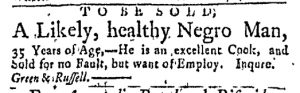
The project aims to provide modern audiences with a sense of just how often colonizers encountered these advertisements in their daily lives. Enslaved men, women, and children appeared in print somewhere in the colonies almost every single day. Those advertisements served as a constant backdrop for social, cultural, economic, and political life in colonial and revolutionary America. Colonizers who did not purport to own enslaved people were still confronted with slavery as well as invited to maintain the system by purchasing enslaved men, women, and children or assisting in the capture of so-called “runaways” who sought to free themselves from bondage. The frequency of these newspaper advertisements suggests just how embedded slavery was in colonial and revolutionary American culture in everyday interactions beyond the printed page.

These advertisements also testify to the experiences of enslaved men, women, and children, though readers must consider that those experiences have been remediated through descriptions offered by enslavers rather than enslaved people themselves. Often unnamed in the advertisements, enslaved men, women, and children were not invisible or unimportant in early America.

These advertisements appeared in colonial American newspapers 250 years ago today.

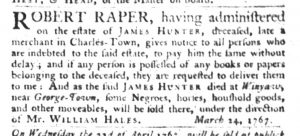
Apr 7 - South Carolina Gazette and Country Journal Slavery 1
South-Carolina Gazette and Country Journal (April 7, 1767).

**********

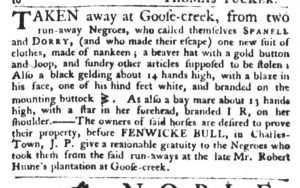
Apr 7 - South Carolina Gazette and Country Journal Slavery 2
South-Carolina Gazette and Country Journal (April 7, 1767).

**********

Apr 7 - South Carolina Gazette and Country Journal Slavery 3
South-Carolina Gazette and Country Journal (April 7, 1767).

**********

Apr 7 - South Carolina Gazette and Country Journal Slavery 4
South-Carolina Gazette and Country Journal (April 7, 1767).

**********

Apr 7 - South Carolina Gazette and Country Journal Slavery 5
South-Carolina Gazette and Country Journal (April 7, 1767).

**********

Apr 7 - South Carolina Gazette and Country Journal Slavery 6
South-Carolina Gazette and Country Journal (April 7, 1767).

**********

Apr 7 - South Carolina Gazette and Country Journal Slavery 7
South-Carolina Gazette and Country Journal (April 7, 1767).

**********

Apr 7 - South Carolina Gazette and Country Journal Slavery 8
South-Carolina Gazette and Country Journal (April 7, 1767).

**********

Apr 7 - South Carolina Gazette and Country Journal Slavery 9
South-Carolina Gazette and Country Journal (April 7, 1767).

**********

Apr 7 - South Carolina Gazette and Country Journal Slavery 10
South-Carolina Gazette and Country Journal (April 7, 1767).

**********

Apr 7 - South Carolina Gazette and Country Journal Slavery 11
South-Carolina Gazette and Country Journal (April 7, 1767).

**********

Apr 7 - South Carolina Gazette and Country Journal Slavery 12
South-Carolina Gazette and Country Journal (April 7, 1767).

April 6

GUEST CURATOR: Megan Watts

What was advertised in a colonial American newspaper 250 years ago today?

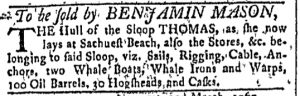
Apr 6 - 4:6:1767 Newport Mercury
Newport Mercury (April 6, 1767).

To be sold by BENJAMIN MASON, THE Hull of the Sloop THOMAS, … Whale Boats, Whale Irons and Warps.”

I chose this advertisement because it focused on items used by mariners, which were unique from the varied offerings of general stores and other sellers. The advertisement mentions the sale of a “Sloop,” a type of boat, along with many other marine supplies (sails, rigging, anchors). This type of advertisement definitely fits in the newspaper that printed it, the Newport Mercury, published in Newport, Rhode Island. The benefits of colonizing New England included the abundance of ports and access to marine passageways. The geography of New England inspired the establishment of many maritime-based businesses and activities. However, what surprised me was the mention of “Whale Boats” and “Whale Irons.”

As a New Englander I was aware of the booming whaling business of the 1800s. I have even visited the Whaling Museum on Nantucket. But what surprised me was that there was an advertisement regarding the whale trade in Rhode Island in the 1700s. I did some research to learn more about the long history of whaling in New England. Whaling has been a business in the region since the 1600s, dating back to Long Island in 1644 to be exact. Some of the products from whaling throughout the years included whale oil and materials used in candle making. The whaling business was common even before the 1800s!

In addition, I also learned that it was likely this whole advertisement was about whale hunting vessels and equipment. I learned that a sloop was a type of vessel commonly used for whale hunting. According to the New Bedford Whaling Museum, “[W]halers began to outfit single-masted sailing vessels called sloops to pursue the animals into deeper water.” Any sailor who picked up this newspaper would have at once recognized the common tools used in whaling, which was an important element for both a coastal colony and a diverse economy.

**********

ADDITIONAL COMMENTARY: Carl Robert Keyes

Megan reaches a sound conclusion that everything in this advertisement – from the vessel to the equipment to the supplies – would have been used to outfit an eighteenth-century whaling expedition. Not only would sailors have recognized these tools of the trade, they would have noticed that Benjamin Mason spoke their language, especially when he included “Whale Irons and Warps” in the list of equipment for sale.

Thomas Lytle notes that the tool most people know as the harpoon was commonly called an iron by the officers and sailors who served aboard whaling vessels. Lytle dispels a popular misconception about harpoons. In most circumstances harpoons were not used to kill whales. A different tool, known as a lance, was used for that job. Lytle explains that the harpoon “was meant only to fasten to the whale and act as a hook to fasten the whale to the whaleboat.” That then gave the whale hunters an opportunity to kill the whale before it could escape. Lytle asserts that the harpoon “was the single item that determined the success or failure of a whaling voyage” and the entire industry. In addition to the essential “Whale Irons,” Mason also offered “Warps,” better known to most people as nets, for sale. Any buyer would have been well equipped to sponsor a whaling expedition.

Rhode Island’s leaders wanted to encourage that industry in the eighteenth century, long before the golden age of whaling that has captured the popular imagination. In his History of the American Whale Fishery, Alexander Starbuck explains that “the Rhode Island assembly passed an act for the encouragement of the whale and cod fisheries” in 1731. That act authorized “a bounty of five shillings for every barrel of whale oil, one penny a pound for bone, and five shilling a quintal for codfish, caught by Rhode Island vessels and brought into this colony.”[1] Within two years, vessels from Newport successfully collected the bounties offered for whales.

**********

[1] Alexander Starbuck, History of the American Whale Industry from Its Earliest Inception to the Year 1876 (Waltham, MA: Published by the Author, 1878), 35.

Slavery Advertisements Published April 6, 1767

GUEST CURATOR:  Ceara Morse

The Slavery Adverts 250 Project chronicles the role of newspaper advertising in perpetuating slavery in the era of the American Revolution. The project seeks to reveal the ubiquity of slavery in eighteenth-century life from New England to Georgia by republishing advertisements about enslaved people – for sale as individuals or in groups, wanted to purchase or for hire for short periods, runaways who liberated themselves, and those who were subsequently captured and confined in jails and workhouses – in daily digests on this site as well as in real time via the @SlaveAdverts250 Twitter feed, utilizing twenty-first-century media to stand in for the print media of the eighteenth century.

The project aims to provide modern audiences with a sense of just how often colonizers encountered these advertisements in their daily lives. Enslaved men, women, and children appeared in print somewhere in the colonies almost every single day. Those advertisements served as a constant backdrop for social, cultural, economic, and political life in colonial and revolutionary America. Colonizers who did not purport to own enslaved people were still confronted with slavery as well as invited to maintain the system by purchasing enslaved men, women, and children or assisting in the capture of so-called “runaways” who sought to free themselves from bondage. The frequency of these newspaper advertisements suggests just how embedded slavery was in colonial and revolutionary American culture in everyday interactions beyond the printed page.

These advertisements also testify to the experiences of enslaved men, women, and children, though readers must consider that those experiences have been remediated through descriptions offered by enslavers rather than enslaved people themselves. Often unnamed in the advertisements, enslaved men, women, and children were not invisible or unimportant in early America.

These advertisements appeared in colonial American newspapers 250 years ago today.

Apr 6 - Boston Evening-Post Slavery 1
Boston Evening-Post (April 6, 1767).

**********

Apr 6 - Boston Evening-Post Slavery 2
Boston Evening-Post (April 6, 1767).

**********

Apr 6 - Boston Post-Boy Slavery 1
Boston Post-Boy (April 6, 1767).

**********

Apr 6 - Boston-Gazette Slavery 1
Boston-Gazette (April 6, 1767).

**********

Apr 6 - Boston-Gazette Slavery 2
Boston-Gazette (April 6, 1767).

**********

Apr 6 - Boston-Gazette Slavery 3
Boston-Gazette (April 6, 1767).

**********

Apr 6 - Boston-Gazette Supplement Slavery 1
Supplement to the Boston-Gazette (April 6, 1767).

**********

Apr 6 - New-York Gazette Slavery 1
New-York Gazette (April 6, 1767).

**********

Apr 6 - New-York Gazette Slavery 2
New-York Gazette (April 6, 1767).

**********

Apr 6 - New-York Gazette Slavery 3
New-York Gazette (April 6, 1767).

**********

Apr 6 - New-York Mercury Slavery 1
New-York Mercury (April 6, 1767).

**********

Apr 6 - New-York Mercury Slavery 2
New-York Mercury (April 6, 1767).

**********

Apr 6 - New-York Mercury Slavery 3
New-York Mercury (April 6, 1767).

**********

Apr 6 - New-York Mercury Slavery 4
New-York Mercury (April 6, 1767).

April 5

GUEST CURATOR: Megan Watts

What was advertised in a colonial American newspaper 250 years ago this week?

Apr 5 - 4:4:1767 Providence Gazette
Providence Gazette (April 5, 1767).

“A FRESH and NEW Assortment of English and India Goods.”

I chose this advertisement because it specifically mentioned English products. One thing that has surprised me over the course of my research into consumer culture is how much Americans tried to emulate British society in the middle decades of the eighteenth century. This is interesting because in the 1760s and 1770s colonists had continent-wide movements to reject both British importations and government.
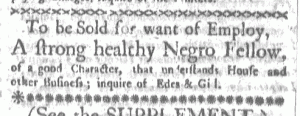
To understand the original interest in British goods, even so close to the American Revolution, what the products represented has to be understood. In 1767 many colonists viewed England, especially London, as very genteel and sophisticated. This idea generated a sizable demand for imported goods. The motivation for owning these goods, however useful they might have been, was not purely functional. Many colonists had a mindset like this: the more English items owned, the more refined (and wealthy) a person was. This assumption went both ways. If a colonist owned an English item, it not only boosted that person’s understanding of their personal socioeconomic status, but also affected their peers’ judgment. In addition to the material possessions, even the use of such these products came under scrutiny of fellow colonists. As the public historians at Colonial Williamsburg explain, “Those who owned the ‘right stuff’ without knowing how to use it properly gave themselves away as imposters.” The social rituals and protocols associated with many goods were complicated, and no one wanted to seem like an uncouth pretender. Overall, if colonists possessed a fashionable product, especially if it was an object associated with genteel society, they could express their real (or perceived) higher status, for just a small fee to a seller like Thompson and Arnold.

**********

ADDITIONAL COMMENTARY: Carl Robert Keyes

Price. Choice. Fashion. These were some of the most common appeals to consumers that appeared in eighteenth-century newspaper advertisements. As Megan notes, Thompson and Arnold implicitly advanced an appeal to fashion when they announced that they sold imported English goods. In addition, they made more explicit and extensive appeals to price and choice in their advertisement published in the Providence Gazette on April 4, 1767. Many advertisers merely made passing or brief mentions of the prices they charged for vast assortments of imported goods, but Thompson and Arnold made variations on these standard appeals in order to attract potential customers’ attention.

For instance, the shopkeepers did not resort to stating that they stocked an “assortment of goods.” Instead, they informed readers that their inventory included “Goods suitable for Town and Country, Winter and Summer.” In fact, they had such a broad array of merchandise that “to enumerate the Articles would take up too much Room for a News-Paper.” (Despite that protest, Thompson and Arnold previously published list-style advertisements that named dozens of imported goods they sold, and in recent months the Providence Gazette had repeatedly printed full-page advertisements for a variety of local shopkeepers, including Thompson and Arnold.) The partners boldly declared that they carried “as great a Variety of Article as can be found in any one Store in New-England.” Most advertisers promoted an assortment of goods as a means of allowing consumers to make choices that corresponded to their own tastes, choices that allowed them to make statements, as Megan notes, about their character, status, and familiarity with the rituals of gentility. Thompson and Arnold offered a different explanation for why it was significant that they carried such a vast variety of goods: “their Assortment is so large they hope to save their Customers the Trouble of going through the Town to supply themselves with the Necessaries they may want.” In presenting customers with so many goods that they “would take up too much Room” to list them in their advertisement, Thompson and Arnold underscored that they sold convenience in addition to choice, an innovative variation on one of the most common appeals in eighteenth-century advertisements.


April 4

GUEST CURATOR: Megan Watts

What was advertised in a colonial American newspaper 250 years ago today?

Apr 4 - 4:4:1767 Providence Gazette
Providence Gazette (April 4, 1767).

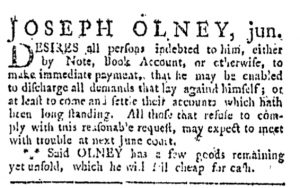
“Said OLNEY has a few goods remaining yet unsold, which he will sell cheap for cash.”

I chose this advertisement because it piqued my interest. Despite the short nature of the consumer portion it reminded me of something important. Throughout navigating newspapers and collecting advertisements I have seen plenty of advertisements that talked about selling for cash or making deals with good credit. But one thing I never really thought about was the actual currency of colonial America. What was this cash? Was there a uniform currency accepted throughout all the colonies? Was money mostly coins or paper?

I did some research into it. Currency, as it happens, had a great variety in eighteenth-century America. There was no one type of universal payment; instead, there was an astounding diversity. Ron Michener discusses this confusing system of currency in the colonies. “The monetary arrangements in use in America before the Revolution were extremely varied. Each colony had its own conventions, tender laws, and coin ratings, and each issued its own paper money.” The customs regarding payment were specific to each colony. For example, in 1750 Massachusetts prohibited the use of paper money. Anything other than “specie,” gold or silver coinage, was utterly valueless there.

Also, colonists could not travel from New Jersey to Rhode Island, for instance, and expect to buy something using printed currency. They had to engage in some type of exchange prior to payment. In addition, throughout the colonies, foreign currency continued to be accepted as legal payment: “Colonists assigned local currency values to foreign specie coins circulating there in … pounds, shillings and pence.” These coins could include British or Spanish money. This caused a lot of irregularity in transactions because, depending on location, the amount stated could be measured using one type of specie or currency, and the buyer could use another type of payment. For example, a seller could ask for five South Carolina dollars for an item, and the buyer could then pay in Spanish specie. There must have been a lot of confusion and mathematical calculations happening in that era!

Over the course of my exploration I realized that there were many different types of money exchanged for goods and which coins or bills were accepted really depended on the location and year, The use of cash in America is not as simple as I originally thought; it has a long and complicated history.

**********

ADDITIONAL COMMENTARY: Carl Robert Keyes

Extensive networks of credit facilitated the consumer revolution of the eighteenth century. Even as merchants and shopkeepers attempted to incite greater demand (as Joseph Olney, Jr., did when he announced he had “a few goods remaining yet unsold), their advertisements testified to generous credit they extended to customers who obtained the “baubles of Britain” from them. Merchants and shopkeepers were middlemen and –women, often caught in expanding transatlantic webs of credit themselves. Note that Olney justified his decision to call in the debts owed to him by explaining that doing so was a necessity so that he, in turn, would be “enabled to discharge all demands that lay against himself.” Just as his customers owed him money, Olney was indebted to those who supplied him with the merchandise he sold.
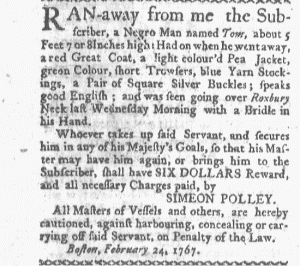
Like many others who placed similar notices in the 1760s, Olney seized an opportunity to generate more revenue by following his request for payment with a brief promotion of his current inventory. In almost every example, the advertisers suggested that they were no longer in the business of extending credit to customers. There was no sense in exacerbating the problem, especially considering that earlier in the advertisement Olney threatened legal action against anyone who “refuse[d] to comply with this reasonable request” for payment. Because Olney wanted to spare himself the hassle of making “trouble at next June court,” he indicated that he would sell his remaining goods “for cash.” He made no mention of any form of credit, whether “by Note, Book Account, or otherwise.”

Olney’s advertisement was much less striking than many others that included extensive lists of merchandise or made elaborate appeals to potential customers. It served a necessary purpose, however, as he went about operating his business, just as similar advertisements did for his counterparts and competitors throughout the colonies.

Slavery Advertisements Published April 4, 1767

GUEST CURATOR:  Ceara Morse

The Slavery Adverts 250 Project chronicles the role of newspaper advertising in perpetuating slavery in the era of the American Revolution. The project seeks to reveal the ubiquity of slavery in eighteenth-century life from New England to Georgia by republishing advertisements about enslaved people – for sale as individuals or in groups, wanted to purchase or for hire for short periods, runaways who liberated themselves, and those who were subsequently captured and confined in jails and workhouses – in daily digests on this site as well as in real time via the @SlaveAdverts250 Twitter feed, utilizing twenty-first-century media to stand in for the print media of the eighteenth century.

The project aims to provide modern audiences with a sense of just how often colonizers encountered these advertisements in their daily lives. Enslaved men, women, and children appeared in print somewhere in the colonies almost every single day. Those advertisements served as a constant backdrop for social, cultural, economic, and political life in colonial and revolutionary America. Colonizers who did not purport to own enslaved people were still confronted with slavery as well as invited to maintain the system by purchasing enslaved men, women, and children or assisting in the capture of so-called “runaways” who sought to free themselves from bondage. The frequency of these newspaper advertisements suggests just how embedded slavery was in colonial and revolutionary American culture in everyday interactions beyond the printed page.

These advertisements also testify to the experiences of enslaved men, women, and children, though readers must consider that those experiences have been remediated through descriptions offered by enslavers rather than enslaved people themselves. Often unnamed in the advertisements, enslaved men, women, and children were not invisible or unimportant in early America.

These advertisements appeared in colonial American newspapers 250 years ago today.

Apr 4 - Providence Gazette Slavery 1
Providence Gazette (April 4, 1767).

April 3

GUEST CURATOR: Megan Watts

What was advertised in a colonial American newspaper 250 years ago today?

Apr 3 - 4:3:1767 New-Hampshire Gazette
New-Hampshire Gazette (April 3, 1767).

“West India RUM by the Hogshead or Barrel, … Good Molasses.”

I chose this advertisement because I recognized an important product, “West India Rum.” The economy of the British North American colonies greatly depended on a transatlantic system of export and import. This included several items from around the globe, like fabrics, tea, and rum.

Rum was especially integral to the colonies’ economy, in part because alcohol was favored for consumption. One estimate claims that for every adult male approximately 20 gallons of rum were consumed per year.[1] The high rate of consumption led to demand for more rum. One way to have a surplus was to distill molasses and create more rum. This created a booming industry in the colonies. According to John J. McCusker, “The distilling of rum from molasses created a substantial colonial industry, employing local capital, management skills, and labor. Steadily in demand, rum and molasses represented for the colonial economy almost a currency.”[2] Not only was rum a commodity traded around the world, distilling it was also an opportunity to establish businesses within the colonies and contribute to the local economy.

*******

ADDITIONAL COMMENTARY: Carl Robert Keyes

Unlike modern advertisements that often prominently feature prices as a means of enticing potential customers (and manipulating their perceptions, such as $99.99 rather than $100), eighteenth-century advertisements rarely listed prices for the goods they marketed. Some merchants and shopkeepers deviated from that rule, especially those who sold some of the most popular commodities that retailers and end-use consumers tended to purchase in volume.

For instance, in the same issue of the New-Hampshire Gazette as today’s advertisement placed by Noah Parker, three of his competitors did include prices for some, but not all, of the commodities they listed. Henry Appleton noted prices for “Loaf Sugar” and “BEST London BOHEA TEA, by the Hundred, Dozen, or single Pound,” but did not reveal how much he charged for chocolate, rice, or “All sorts of West India Goods.” Edward Sherburne also the “Best of BOHEA TEA,” barely undercutting Appleton’s price: £4 15s Old Tenor per pound instead of £4 16s OT per pound. Like Parker, George Turner provided prices for only some of his goods (rum, sugar, coffee, and “COTTON-WOOL”).

Richard Champney perhaps came closest to modern marketing methods with his version of “limited time only” prices for coffee, which he sold at “22s. Old Tenor per pound.” However, he did not “promise to sell at that Price long, as the late remarkable Frost in the West Indies, may have the same effect on Coffee, as on Limes; therefore probably that Article may be scarce and dear.” Champney used temporarily low prices and the specter of scarcity to drive customers to his shop.

That four advertisers listed prices in a single issue of the New-Hampshire Gazette was remarkable and extraordinary. It was not uncommon for entire issues to be devoid of specific pricing in advertisements. Most merchants and shopkeepers adopted the approach taken by Noah Parker, relying on the goods themselves to attract customers but not specifying prices in the advertisements. Many made general appeals to price, promising “low costs” or “reasonable rates.” Parker did not go even that far. Instead he invited “those who desire to know the Price to call and see the Articles.” In so doing he echoed an argument sometimes made by other advertisers: specifying a particular price was meaningless in the absence of examining the quality of the merchandise.

**********

[1] John J. McCusker, “The Rum Trade and the Balance of Payments of the Thirteen Continental Colonies, 1650-1775,” Journal of Economic History 30, no. 1 (March 1970): 247.

[2] McCusker, “Rum Trade,” 247.


Slavery Advertisements Published April 3, 1767

GUEST CURATOR:  Ceara Morse

The Slavery Adverts 250 Project chronicles the role of newspaper advertising in perpetuating slavery in the era of the American Revolution. The project seeks to reveal the ubiquity of slavery in eighteenth-century life from New England to Georgia by republishing advertisements about enslaved people – for sale as individuals or in groups, wanted to purchase or for hire for short periods, runaways who liberated themselves, and those who were subsequently captured and confined in jails and workhouses – in daily digests on this site as well as in real time via the @SlaveAdverts250 Twitter feed, utilizing twenty-first-century media to stand in for the print media of the eighteenth century.

The project aims to provide modern audiences with a sense of just how often colonizers encountered these advertisements in their daily lives. Enslaved men, women, and children appeared in print somewhere in the colonies almost every single day. Those advertisements served as a constant backdrop for social, cultural, economic, and political life in colonial and revolutionary America. Colonizers who did not purport to own enslaved people were still confronted with slavery as well as invited to maintain the system by purchasing enslaved men, women, and children or assisting in the capture of so-called “runaways” who sought to free themselves from bondage. The frequency of these newspaper advertisements suggests just how embedded slavery was in colonial and revolutionary American culture in everyday interactions beyond the printed page.

These advertisements also testify to the experiences of enslaved men, women, and children, though readers must consider that those experiences have been remediated through descriptions offered by enslavers rather than enslaved people themselves. Often unnamed in the advertisements, enslaved men, women, and children were not invisible or unimportant in early America.

These advertisements appeared in colonial American newspapers 250 years ago today.

Apr 3 - New-Hampshire Gazette Slavery 1
New-Hampshire Gazette (April 3, 1767).

**********

Apr 3 - New-Hampshire Gazette Slavery 2
New-Hampshire Gazette (April 3, 1767).

**********

Apr 3 - South-Carolina and American General Gazette Slavery 1
South-Carolina and American General Gazette (April 3, 1767).

**********

Apr 3 - South-Carolina and American General Gazette Slavery 2
South-Carolina and American General Gazette (April 3, 1767).

**********

Apr 3 - South-Carolina and American General Gazette Slavery 3
South-Carolina and American General Gazette (April 3, 1767).

**********

Apr 3 - South-Carolina and American General Gazette Slavery 4
South-Carolina and American General Gazette (April 3, 1767).

**********

Apr 3 - South-Carolina and American General Gazette Slavery 5
South-Carolina and American General Gazette (April 3, 1767).

**********

Apr 3 - South-Carolina and American General Gazette Slavery 6
South-Carolina and American General Gazette (April 3, 1767).

April 2

GUEST CURATOR: Megan Watts

Who was the subject of an advertisement in a colonial American newspaper 250 years ago today?

Apr 2 - 4:2:1767 New York Gazette Weekly Post-Boy
New-York Gazette: Or, the Weekly Post-Boy (April 2, 1767).

“TO BE SOLD, A Smart likely active Negro Girl.”

I chose this advertisement because it revolves around a controversial and pivotal part of early American society: slavery. In 1767, slavery was a part of life for British North American colonists everywhere. There were large workforces of slaves used to support Southern plantation agriculture. In addition, in other regions slaves were used on smaller scale farms and in domestic service. For the modern reader, the very contemplation of such practices is appalling and repulsive. However, we cannot look at American history without recognizing the integral role slavery played in society and the economy. Slavery also shaped American politics and government.
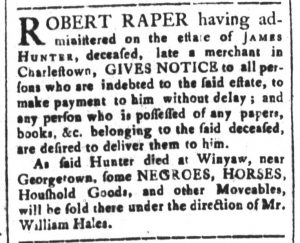
For instance, the founders focused on slavery during the Constitutional Convention in the summer of 1787, just twenty years after this advertisement was published. Over the course of the Constitutional Convention the delegates discussed multiple issues, including slave importation and whether proportional representation should include slaves. These were important issues that garnered differing opinions during the debates. The Northern states pushed for no representation of slaves to reduce Southern power, while Southerners fought to include slaves in their population.[1] Eventually, the delegates decided to count three out of five slaves in matters of representation; this was known as the Three-Fifths Compromise.[2] The debates about slavery characterized the Constitutional Convention and created intense tension. While the practice of slavery was abysmal, there was no doubt that it shaped the American Constitution and the government it established.

**********

ADDITIONAL COMMENTARY: Carl Robert Keyes

An anonymous slaveholder offered a “Smart likely active Negro Girl” for sale “for no Fault but Want of Employ.” In other words, the enslaved young woman evinced no shortcomings that prompted the sale. Instead, her owner simply did not have enough work to keep her busy and thus had no further use for her. Such explanations commonly appeared in advertisements offering single slaves for sale – both adults and youths – in New England and the Middle Atlantic colonies in the 1760s. This was a significant regional variation that distinguished many advertisements selling slaves in the northern colonies from their counterparts in the Chesapeake and Lower South.

“But Want of Employ” advertisements underscore the commodification of enslaved men, women, and children in eighteenth-century America. Slaveholders faced a choice when they determined that they no longer needed slaves’ labor: sell the slaves or set them free. The decision to sell them signals that slaveholders thought of their human property as any other commodity, an investment to be recouped as much as possible upon exceeding usefulness. A “Girl, about 14 Years of Age” could be traded as easily as textiles or furniture or any other goods that filled the advertising pages in colonial newspapers.

This advertisement and many more like it appeared in newspapers during the imperial crisis, the decade of tensions between colonists and Parliament that ultimately resulted in a war for independence. Colonists contemplated the meaning of liberty in their own lives even as they sold slaves “for no Fault but Want of Employ.” This advertisement makes clear that the promises of liberty were not evenly applied to all residents of the colonies during the transition from protest and resistance to severing political ties with Great Britain. This has been a central theme in my Revolutionary America course: many different kinds of experiences rather than a unified narrative.

As my students continue to curate the Slavery Adverts 250 Project they assess and verify this argument as they examine original sources. In many ways, a single advertisement for a “Smart likely active Negro Girl” to be “sold for no Fault but Want of Employ” is much more convincing than abstract statements that broadly aggregate the experiences of enslaved men, women, and children in the Revolutionary era.

**********

[1] Richard Beeman, Plain Honest Men: The Making of the American Constitution (New York: Random House, 2009), 204-215.

[2] Beeman, Plain Honest Men, 204-215.